
We Hate Strollers, But Here’s Why We Love Our Stroller for Disney World Travel.

You might think that a review of the best stroller for Walt Disney World, Disneyland, airports, cities, and other travel from self-professed stroller haters is the equivalent of a vegetarian reviewing Yachtsman Steakhouse. And maybe you’re right.
On the other hand, who better to scrutinize prams than parents who would prefer not to be using them in the first place? Who thus might be more sensitive to their faults and failures, rather than those predisposed to loving strollers? Perhaps we have higher standards or, at the very least, different criteria for judging strollers than the average family? Maybe it carries even more weight that we ended up loving one particular stroller?!
Our primary use-case for strollers is while at the Disney Parks and when traveling domestically or internationally. Even when traveling, we’ve taken several trips without a stroller at all. When Baby Bricker (Megatron) was smaller, we traveled extensively in Japan and took only the baby carrier for several weeks. (See our Guide to Baby Wearing for Walt Disney World & Travel for the ‘why’ of that along with extensive recommendations.)
The problem with this approach came as Megatron got older, bigger and heavier. We had been logging 20,000+ steps per day with her in the carrier as an ~8 month old. That became more impractical once she turned 1 year old, was larger, and wanted more independence.
At the same time, she also did not (and still does not) have the stamina to walk 20,000+ steps per day. This makes the stroller a valuable tool or necessary evil. While there are definite drawbacks as compared to babywearing, it’s a false choice for us at this point. The stroller is better than the actual alternative, which is shorter days. Since our babywearing days are effectively over, we now use the stroller extensively to supplement walking.

The point is that our priorities skew strongly towards the stroller that’s best-suited for travel and not everyday use at home. Because outside of days at Disneyland, we aren’t really using the stroller at home. It largely collects dust when we’re not traveling.
If you’re trying to find the ideal all-in-one stroller option for daily use around your neighborhood or wherever, this post probably is not for you. There are likely better (and cheaper) options that’ll better serve you. Just a friendly ‘fair warning’ before we get going and you realize this is useless to you because you’re nothing like us, have different needs, etc.
These also our firsthand experiences with strollers as opposed to ‘scientific’ lab testing. They’re also not comprehensive. While we did a lot of research and in-store trials to narrow our choices, we didn’t buy a dozen strollers and put them all through the paces.

The biggest takeaway is that there’s no one-size-fits-all “perfect” stroller. It’s all about striking the right balance of size, weight, durability, strength, quality and cost. You cannot have it all, the laws of physics and pricing probably prohibit that.
With that in mind, here were our priorities for our travel stroller:
- compact size (carry-on friendly)
- child comfort and safety
- lightest, space age materials
- ease of use and maneuverability
- car seat compatibility
Here are things we did not care about:
- storage space
- all-terrain durability
- bells & whistles

Based on a mixture of these parameters and our first-hand stroller testing, there was literally only one option that worked for us: Stokke YOYO3 Stroller. (This product was previously made by Babyzen, a French company; that business was bought by Stokke, a Norwegian children’s products company. Same thing, new name.)
One thing to note is that the Stokke YOYO3 Stroller is currently on sale up to 36% off! All colors are at least $100 off, with some up to $180 off. This includes both the classic black/taupe color combo and ‘Air France’ blue. Most styles are $160 off as of October 16, 2026.
I’m not sure whether this is an early Black Friday deal or extended Prime Day sale, but it’s the cheapest these have been the last year. Prices are lower than they were last year during November and December. This is still pricey by stroller standards, but if you travel a lot, I promise that it’s worth every penny–and then some.

We ended up paying $350 for the Stokke YOYO3 Stroller, scoring a rare deal on the device on a previous Black Friday. The full MSRP was $450 when we bought it (it’s now up to $499), and we would’ve paid that price if push came to shove. The Fall 2026 prices are less than we paid, despite three more years of inflation, etc.
With something like a stroller that you’ll use extensively for years, it’s worth paying premium prices for a premium product. The per use basis of a cheap stroller vs. a nice one isn’t that significant, so we’d rather pay more for a quality product that we’ll use extensively.
There’s a big difference between being frugal and being cheap. When something offers commensurate quality or value, we are completely willing to pay more. Quite often, being cheap costs you more money over time than just spending the money on the high-quality option.
Anyway, let’s run through the pros & cons of the Stokke YOYO3 Stroller…

Aside from the high price, the other drawbacks of the Stokke YOYO3 Stroller are easier to address. One of the biggest criticisms of it is the lack of storage space in the under-the-seat compartment. It hasn’t been a problem for us, and I would suggest that the target audience for the Stokke doesn’t need a ton of storage in the first place. If you do, this stroller might not be for you.
We didn’t purchase a stroller to use as a sherpa for a bunch of junk we’d carry around with us while traveling. We try to travel as light as possible, which is part of why we bought this stroller in the first place! All we want is the ability to throw a lightweight bag down there and maybe souvenirs we purchase in the parks or while out and about.
With its 22 pounds of carrying capacity and decently-sized pouch, the YOYO3 stroller serves our needs and then some. There’s also a zippered pouch in the back of the cover. This is quite deep, and we’ve managed to throw a number of things in there. Just keep the weight low, or you risk the stroller tipping over when there’s no baby on board (ask us how we know).

It’s a similar story with bells and whistles.
Some strollers advertise their wealth of features and other attachments that make life easier for parent or child. Again, we were uninterested in all of this. The more stuff you add to a stroller, the more weight and size it adds. It’s impossible to have it all, and again, our priority was compactness.
There are a bunch of other first-party attachments, including a newborn carrier. The main one of these we’ve purchased is the rain cover since we use the stroller a lot in rainy environments. It works really well and is compact when not in use. Sarah also bought a cupholder that gets attached from time to time, but never has gone on a flight with us.

Over the years, I’ve locked eyes with tired parents trying to navigate their double-wide stroller through post-fireworks crowds in Magic Kingdom, get on a jam-packed Disney bus with a Cadillac-sized stroller, or simply navigate uncrowded gift shops or restaurants with their strollers.
A couple of specific memories from the first two examples are literally etched in my memory, and informed our preferences. I’m completely serious about that, and am probably overly sensitive to the number of parental meltdowns we’ve witnessed over the years at Walt Disney World. I never wanted that to be me.
Accordingly, we wanted a stroller that could easily be broken down in crowds in the parks so one of us could carry Megatron while the other held the lightweight stroller. Same story with getting on a packed Walt Disney World bus, etc. We wanted something that we could break down one-handed in under 5 seconds, and that could go anywhere we could. We didn’t want the stroller acting as an anchor, inhibiting our movements. And for the most part, it doesn’t.

Finally, we saw complaints about the YOYO’s inability to handle rough and rugged terrain. The wheels are smaller and the suspension more limited than some more robust strollers, resulting in a ride that isn’t as smooth and more difficult handling in scenarios that aren’t simple sidewalks and streets.
This actually was initially a concern for us, as we often travel to older cities with cobblestone (or at least uneven) streets, and like to go off-road onto trails and other areas. But the more we thought about this, the more we realized it was unlikely we’d be using a stroller in these scenarios in the first place.
That has turned out to be true for us. We’ve spent a lot of time at the beach, hiking, exploring historic cities, and so forth. In all of those scenarios, we reached first for the carrier–and now the sling or nothing at all. The practical reality is that there are limiting qualities inherent to all strollers.

The biggest selling point of the Stokke YOYO3 Stroller, as suggested above, are its compact size and low weight.
Weighing in at 13.6 pounds, it’s not the lightest stroller we tested. There were some that were around 10 to 11 pounds. However, it didn’t feel noticeably heavier than any of those. More importantly, it folds down to 20.5 × 17.3 × 7.1 inches. This is incredibly compact, and the size-weight combo along with the attached strap makes it easy to throw over your shoulder and carry.
The biggest selling point for us in this regard is that the YOYO³ fits cabin dimensions for most airlines, meaning you can put it in the overhead bin when flying as opposed to checking it. After hearing horror stories of strollers destroyed by airlines as checked luggage, this was key for us.

The YOYO³ being compatible with our car seat was also very important.
This is probably a niche use case, but we’ve flown multiple long flights with Megatron. Actually, we’ve flown exclusively long flights with her–we’ve yet to log one under 4 hours, traveling from Los Angeles to Orlando (several times), Indianapolis (a few times), Osaka and Tokyo (four times). Our longest trip yet has been to Hong Kong, which is 15 hours 20 minutes (not that we were counting or anything).
That’s just too long for us to have her on our laps, so we get her a seat and take her car seat. And rather than lugging that thing around by hand through the airport and wherever else, we’ve found that it’s much easier to attach it to the stroller and push it. I can’t imagine that this is that important to the average parent, but it’s something that mattered to us a lot–and limited our options, as a result.

Speaking of which, here are the top alternative travel strollers we considered and almost bought based on our testing and research:
Although our approach wasn’t scientific or exhaustive, that’s the entire list. If there’s another stroller deserving of consideration, we somehow did not encounter it.

We came very close to getting the Bugaboo Butterfly, but ultimately, the YOYO won out.
The difference-maker for us ended up being knowing more people with the YOYO and hearing anecdotal reports of airline crew denying the Bugaboo at the gate–whereas it sounded like the YOYO is a much more ‘known quantity.’
Since purchasing our Stokke stroller, we’ve actually had the chance to use the Bugaboo Butterfly 2 quite extensively. We’ve even traveled with it. Overall, there’s a lot of overlap between the two, with many of the same strengths. The Bugaboo Butterfly notches slight wins on durability and handling in more challenging conditions.
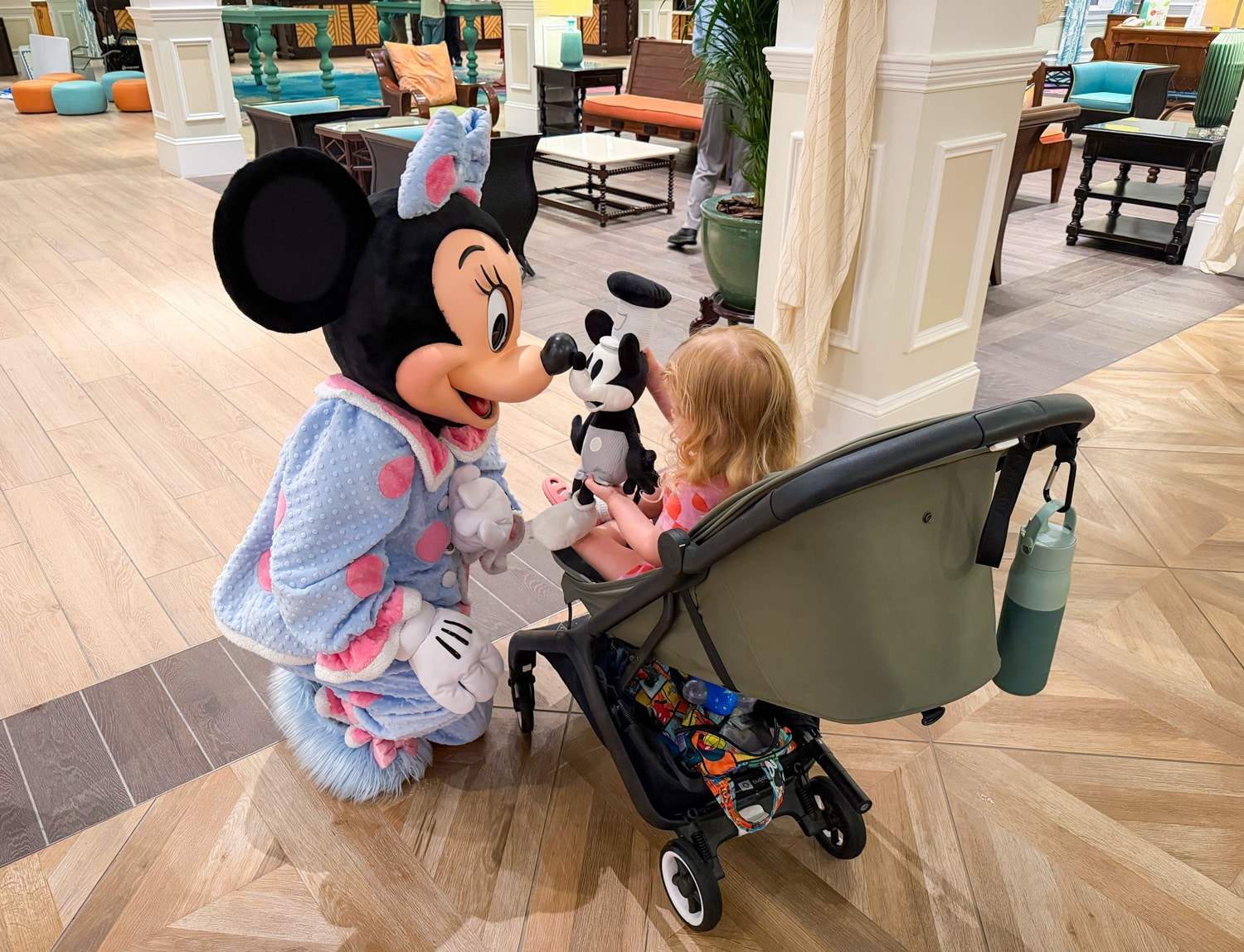
The trade-off is that the Bugaboo Butterfly doesn’t fold down to be nearly as compact at the Stokke. It’s also heavier.
There’s supposedly only a ~3 pound weight difference (13 vs. 16 pounds), but I swear that the Bugaboo feels like it’s nearly twice the weight. The Bugaboo Butterfly is also clunkier and more unpleasant to carry, especially in crowded or tight situations. This might sound like a minor quibble, but it’s a big deal in a travel stroller.
On that basis, we would not recommend the Bugaboo Butterfly for travel. It’s better viewed as a compromise option bridging the gap between all-purpose and travel strollers. (The Bugaboo does fit in overhead bins, but it’s tight. There’s plenty of space to spare with the Stokke.)

The final strength of the Stokke YOYO3 Stroller is that it’s a really smooth ride and has exceptional handling on flat ground.
The ultra lightweight chassis, coupled with the Hytrel elastomer technology in the 4-wheel full suspension and patented “Soft drive” system makes it a dream to maneuver. Don’t ask me what any of those terms mean, I’m not a Stroller Scientist.) I assumed these were going to be pointless marketing buzzwords–and I guess they kinda are since I’m regurgitating them–but they’re also true.
What I found was that the YOYO handles beautifully when you’re using it in optimal conditions–like through the airport, on a regular ole sidewalk or within a theme park (well, except the portions that have “themed” pavement). On smooth ground, the YOYO is unrivaled. It can make tight turns and weave in and out of crowds effortlessly. If I were racing through the airport, Home Alone style, this is the stroller I’d want to use.
We’ve actually used it to weave through crowds a lot–and love it. You become one with the stroller, and the boundary between parent and pram vanishes. You become one with the stroller, not noticing or being hindered by the device you’re pushing. It becomes effortless.

That may sound a little crazy, and sure, it probably is. But in a nutshell, that is precisely what we wanted in a stroller. Not a “Children’s Cadillac” with the kitchen sink of features and all the bells and whistles, but a device that would get out of our way. To the greatest extent possible, we wanted a stroller that we wouldn’t notice we were lugging around, and the Stokke YOYO3 Stroller is exactly that.
It’s lightweight, compact, and perfect for traveling. It certainly doesn’t serve every purpose and isn’t for everyone–if we were primarily concerned with an option to carry around in the back of our car and use in all-purpose scenarios from there, it’s not what we would’ve bought.
For most people, I suspect the Stokke YOYO3 Stroller is better suited to serve as a secondary stroller in certain situations. That’s an awfully expensive backup, though. For us, as people who would prefer not to use a stroller–and seldom do save for traveling–the Stokke YOYO3 Stroller is the perfect single-stroller solution.

One huge selling point for us is that a stroller is basically a free locker. We’ve “joked” to one another that we wish we thought of this hack before we had a baby. If it weren’t for the awkwardness of taking a baby-less stroller through security, we would recommend it to non-parents.
Seriously, the stroller-as-a-free-locker is a game-changer. It’s even better than a paid locker, as you can put it where you want it and move it around. But the purpose of this post is not to extol the virtues of strollers at Walt Disney World.
The biggest reason to supplement strollers with carriers or slings is because, as noted above, carriers can go anywhere that you can. Whereas you have to park strollers outside most attractions, you can bring your baby into queues and on many rides while being worn in a carrier or supported by a sling.

This alone is huge. Holding a squirming baby or toddler while waiting 45 minutes for Peter Pan’s Flight is not a pleasant experience. It’s also not easy, as your arms will likely get tired. Now repeat that process over and over again for every attraction with long lines. By contrast, a baby in a carrier can stay in that, often even on the ride itself.
I know some parents fear leaving their stroller behind due to theft or having it relocated. We do not. We just drop an Air Tag in that bad boy and park it with all of our belongings (minus my camera bag) for hours on end. While stroller theft does happen, that’s true of anything. We still park our car and leave our home unattended.
Just be careful not to accidentally leave your stroller behind after leaving the park at the end of the night…not that we speak from experience or anything. Oops.

Ultimately, the Stokke YOYO3 Stroller is not for everyone, as is probably obvious from the forgoing. If you’ll primarily be using a stroller around your hometown, and primary consideration is loading and unloading it from the back of your SUV, there are undoubtedly better and probably cheaper options.
The Stokke YOYO3 Stroller is unrivaled as the perfect travel stroller. It’s also great for “city life” more generally, as the Stokke is just so much more convenient for folding to quickly carry down stairs, board crowded trains, etc. I’ve never felt like the Stokke has inhibited us in urban environments, whereas I have with the Bugaboo–and that’s something a lab test can’t tell you. Take that, science!
Suffice to say, the Stokke YOYO3’s many strengths are conducive to cities and travel, whereas its weaknesses are less likely to be noticed by parents in those precise scenarios. The biggest downside is the cost and, quite honestly, we don’t view it as that bad given the quality and how many miles we’ve already logged with the Stokke.
It’s certainly a better value proposition than the ‘designer’ strollers, which look fancy but are functionally lacking. This is doubly true with the current Black Friday deal, which takes 20% off the price of the Stokke YOYO3 Stroller and makes it more reasonable.
Planning a Walt Disney World trip? Learn about hotels on our Walt Disney World Hotels Reviews page. For where to eat, read our Walt Disney World Restaurant Reviews. To save money on tickets or determine which type to buy, read our Tips for Saving Money on Walt Disney World Tickets post. Our What to Pack for Disney Trips post takes a unique look at clever items to take. For what to do and when to do it, our Walt Disney World Ride Guides will help. For comprehensive advice, the best place to start is our Walt Disney World Trip Planning Guide for everything you need to know!
YOUR THOUGHTS
Do you have a favorite stroller for travel or everyday use? Have you used the Stokke YOYO3, Bugaboo Butterfly, or anything else discussed here? Think it’s worth it to pay more for higher-quality stroller given how many miles and hours you’ll log with it? Do you agree or disagree with our assessment? Any questions we can help you answer? Hearing your feedback—even when you disagree with us—is both interesting to us and helpful to other readers, so please share your thoughts below in the comments!






Would love a similar, in-depth and thoughtful review of strollers that can hold two children, because sometimes when it’s one parent with two children, that’s what you need.
We used a tandem double stroller that could convert as they grew. I don’t remember the brand but it matched with the car seats to attach onto the stroller. It also converted the back seat to a sit-and-stand for when they outgrew the back seat. I found the tandem double stroller easier to navigate through the crowds though with the length it could at times be a little difficult in the tight store layouts. It was still easier to move through the store and lines than the side by side, imo.