
Disney World Has a New #1 Interactive Dark Ride. Here’s How to Score Over 999,999.
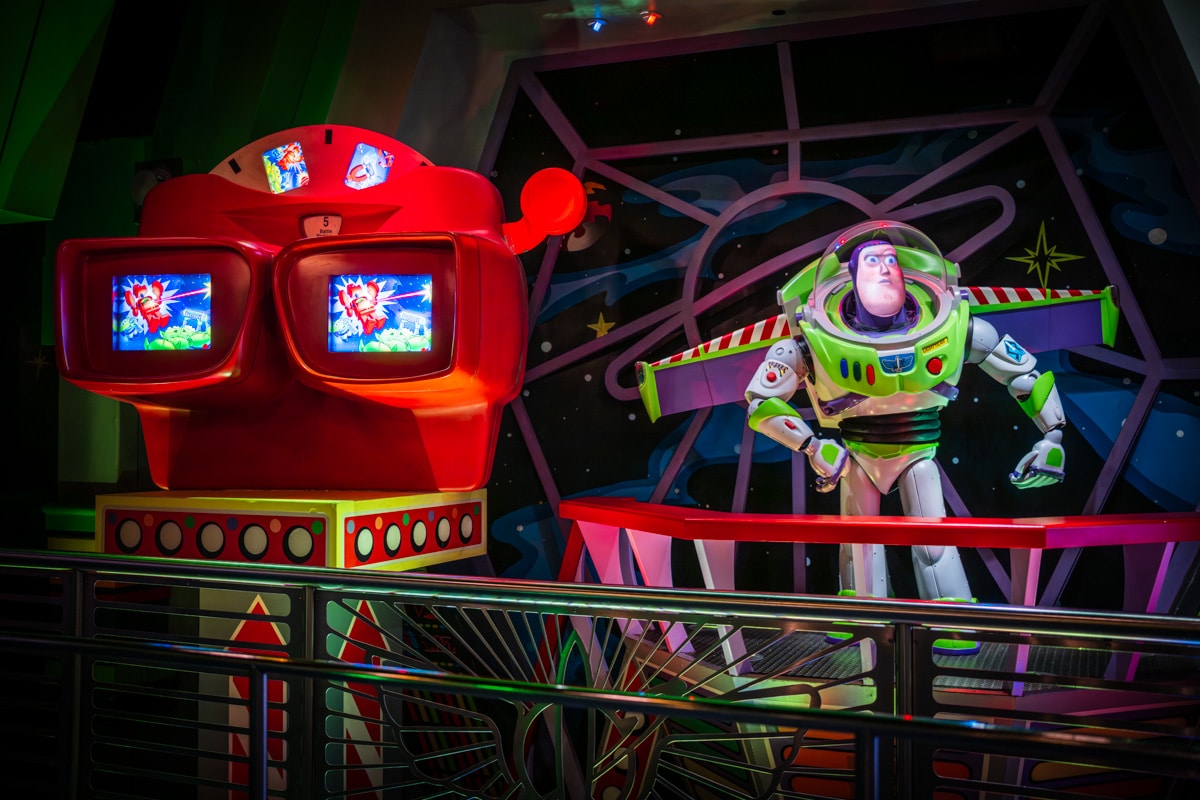
One of my unpopular Walt Disney World opinions has long been that Buzz Lightyear’s Space Ranger Spin is a better attraction than Toy Story Mania. Not that it had the stronger gameplay, because it definitely did not. But that it was the superior overall experience. With the recent recharge, the argument could now be made that it’s both.
It’s worth contextualizing this, because arguing that Buzz Lightyear’s Space Ranger Spin beats Toy Story Mania in any capacity is a controversial take. However, my general perspective is that even interactive rides are at their best when the gameplay is more approachable and there’s a worthwhile dark ride to fall back on for guests who just want to passively experience the attraction.
The old Buzz Lightyear’s Space Ranger Spin was only okay as an interactive shooter ride, and definitely a generation (or a few) behind Toy Story Mania. Its strength was that it also featured physical show scenes to make it engaging for guests who want to enjoy the attraction passively or actively. Staging, props, effects and Audio Animatronics added a lot, even if it was still hardly the pinnacle of dark rides.
By contrast, Toy Story Mania has a bigger barrier to entry, and there’s no enjoying it passively period since it’s all screens. So if you have toddlers or grandparents in your family (and we sometimes have both!) who aren’t really into the gameplay, there’s limited appeal.
On the other hand, if the gameplay in Toy Story Mania is compelling to downright addictive for everyone in your party, the newer attraction is so far superior that there was really no comparison. Hence the claim of Buzz Lightyear’s Space Ranger Spin beating Toy Story Mania being controversial or unpopular!
Despite not being as popular as Toy Story Mania, Buzz Lightyear’s Space Ranger Spin has been a reliable crowd-pleaser at Magic Kingdom that’s maintained modest mid-tier attraction popularity. It’s also been, for the better part of a decade, a ride that Disneyland fans politely pointed to when making the case that Florida’s version was the lesser product.
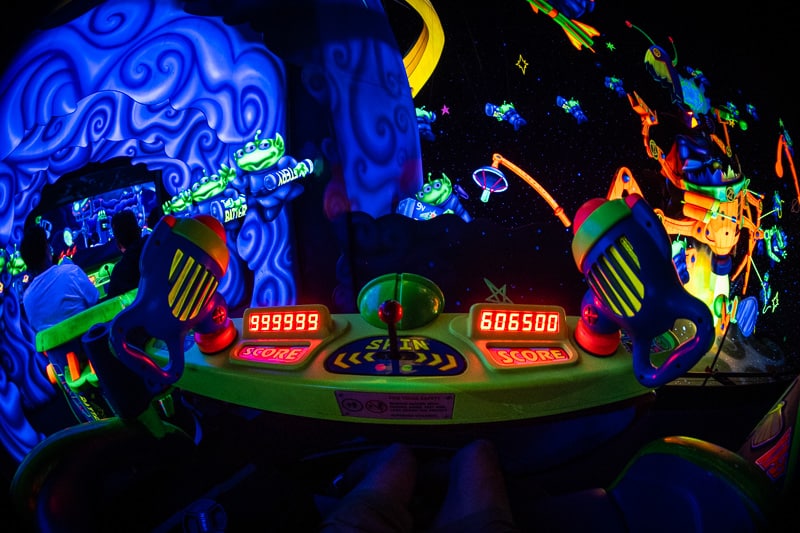
The original mount on the joystick blaster was imprecise, assuming it worked at all. The gameplay wasn’t particularly engaging or deep. Maxing out the blasters at 999,999 was both too easy for veterans and too confusing for newcomers. And the attraction wasn’t able to fall back on the core dark ride, as the show scenes were showing their age.
The ‘recharged’ Buzz Lightyear’s Space Ranger Spin that reopened ahead of summer fixes almost all of that. In so doing, the Walt Disney World attraction has leapfrogged its Disneyland counterpart, and become the definitive version of the ‘Buzz Blaster’ attraction anywhere in the world.
Space Ranger Spin is also better than Shanghai Disneyland’s Buzz Lightyear Planet Rescue and Hong Kong’s Ant-Man and The Wasp: Nano Battle, both of which had previously set the high-water mark for this style of ride. We assume this will be short-lived, and the $200 million Wreck-It Ralph shooter at Tokyo Disneyland will claim the top spot. If OLC spends that much on the reimagining and it’s not the best, something will have gone wrong.
It’s also now less controversial of a claim that Buzz Lightyear’s Space Ranger Spin is the better overall attraction than Toy Story Mania once you take the complete package into account; not only gameplay, but also refreshed show scenes and lack of screens. Let’s dig into what’s changed and improved, before we share strategy for achieving a high score…
What’s Changed
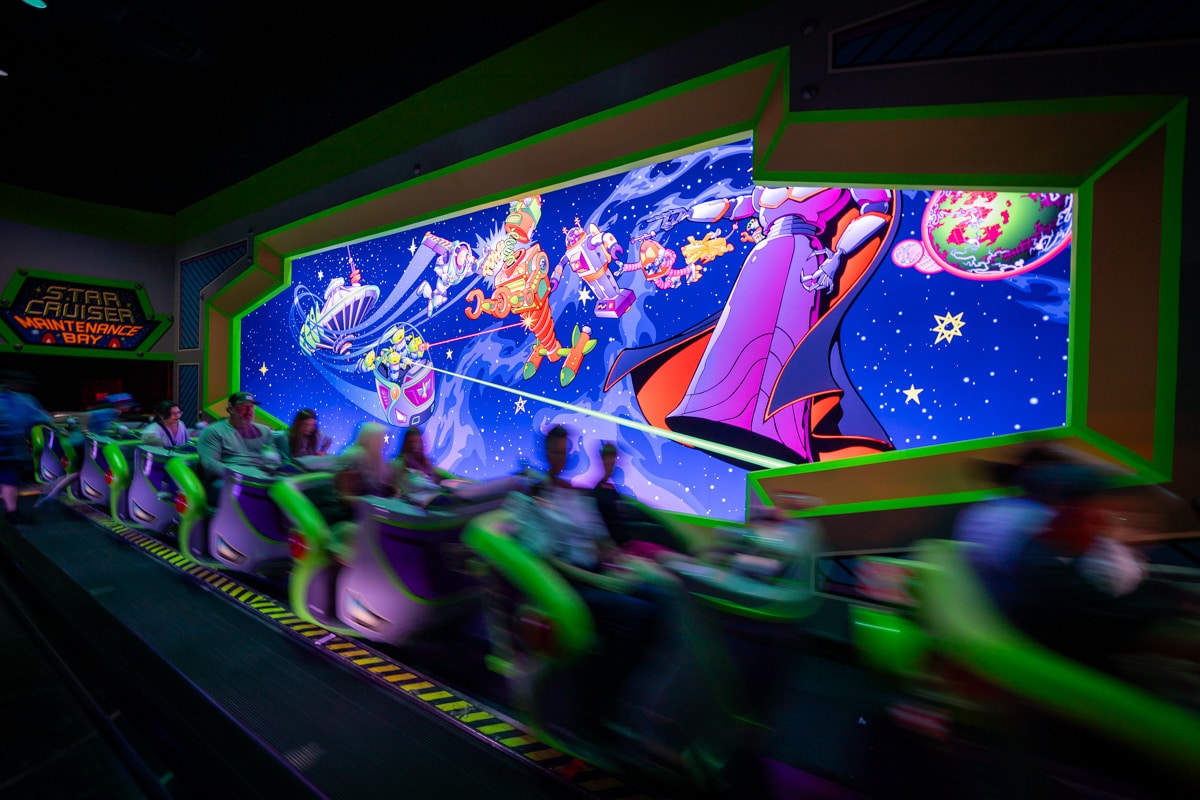
The bones of the attraction and core experience are the same. You’re still boarding Star Cruisers, defeating the Evil Emperor Zurg, spinning through the rugged landscape of Planet Z and Gamma Quadrant, and blasting Z targets to defeat nefarious creatures. The track layout and the fundamental concept haven’t changed.
What’s changed is that the attraction no longer feels like a prototype late-1990s interactive attraction, and has been modernized to feel fresh. Other than the cleaner queue, the new handheld blasters are the most immediately noticeable improvement.
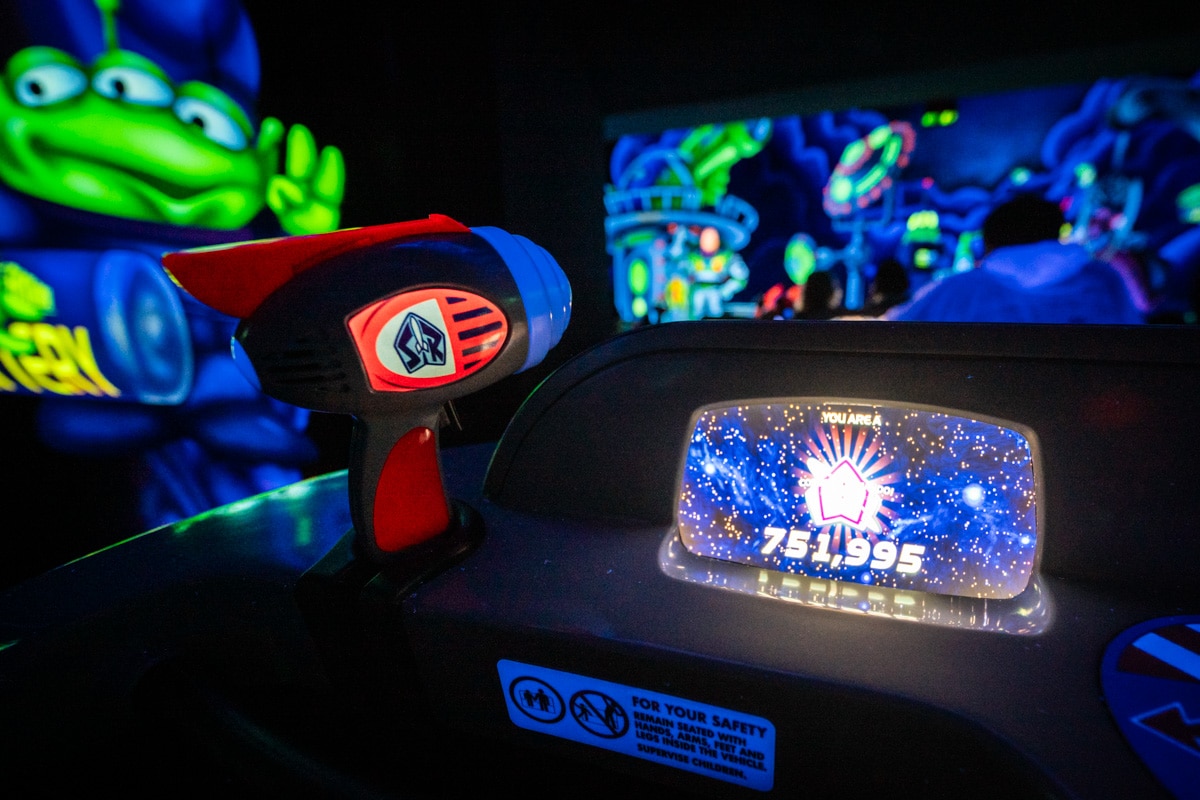
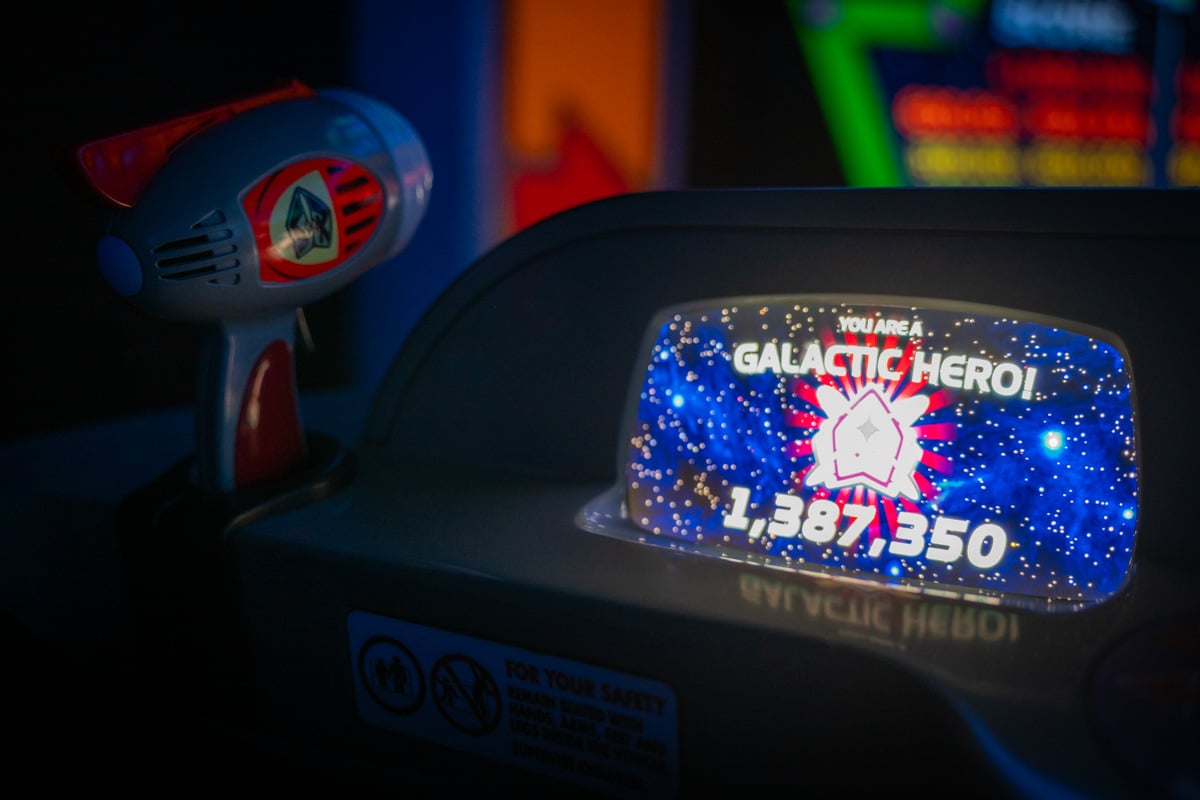
The new blasters are handheld, with an always-on laser, vibration effects when you hit a target, and distinct sound effects that confirm your shots. Each Star Cruiser has two blasters in different colors, mirrored on the target itself when you land a hit, so you have a better idea of whether you’re aiming accurately or are way off-planet.
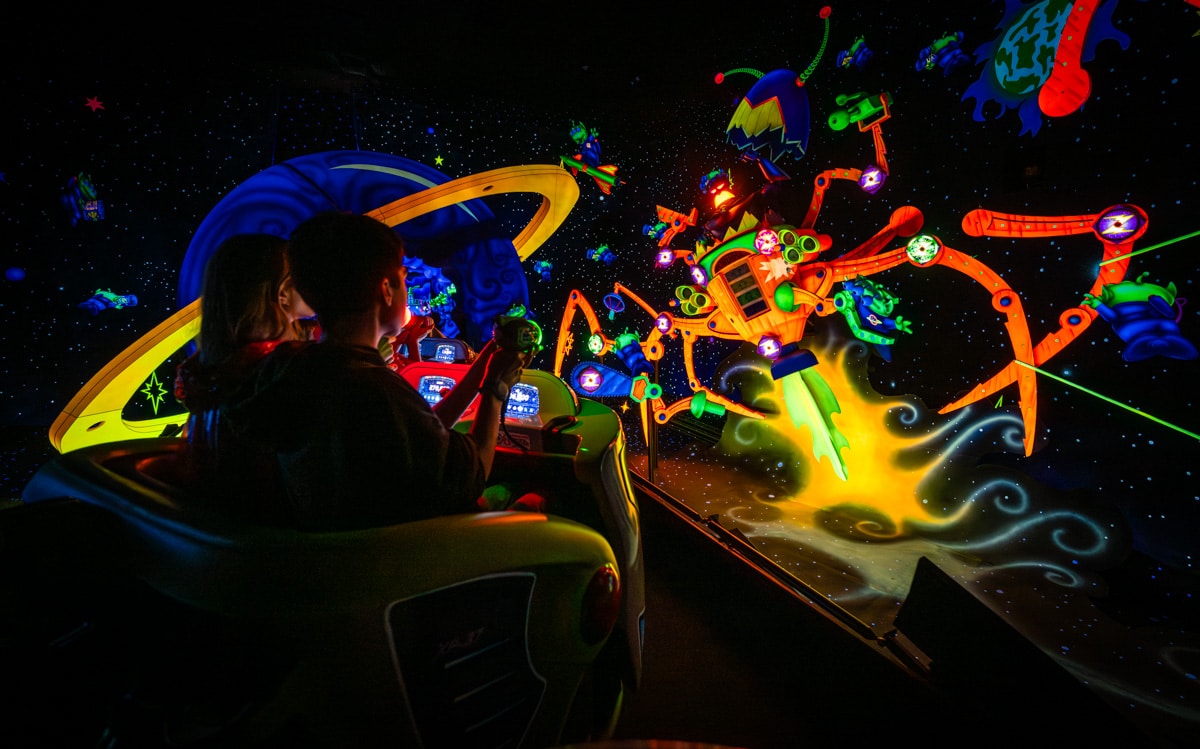
This might seem like a minor quality-of-life upgrade, but it changes the gameplay. Shooting felt stilted and somewhere between frustrating and unsatisfying before. Now, it is much more engaging.
For young riders and non-gamers who previously had no idea if they were hitting anything, this is a great enhancement. For competitive riders who want to chase high scores, it opens up a much more dynamic and satisfying gameplay loop.
The new ride vehicles include real-time scoring monitors that update with each hit, as opposed to the old school counters. This likewise makes the experience feel fresh, although it’s not as much of a game-changer as the new blasters.
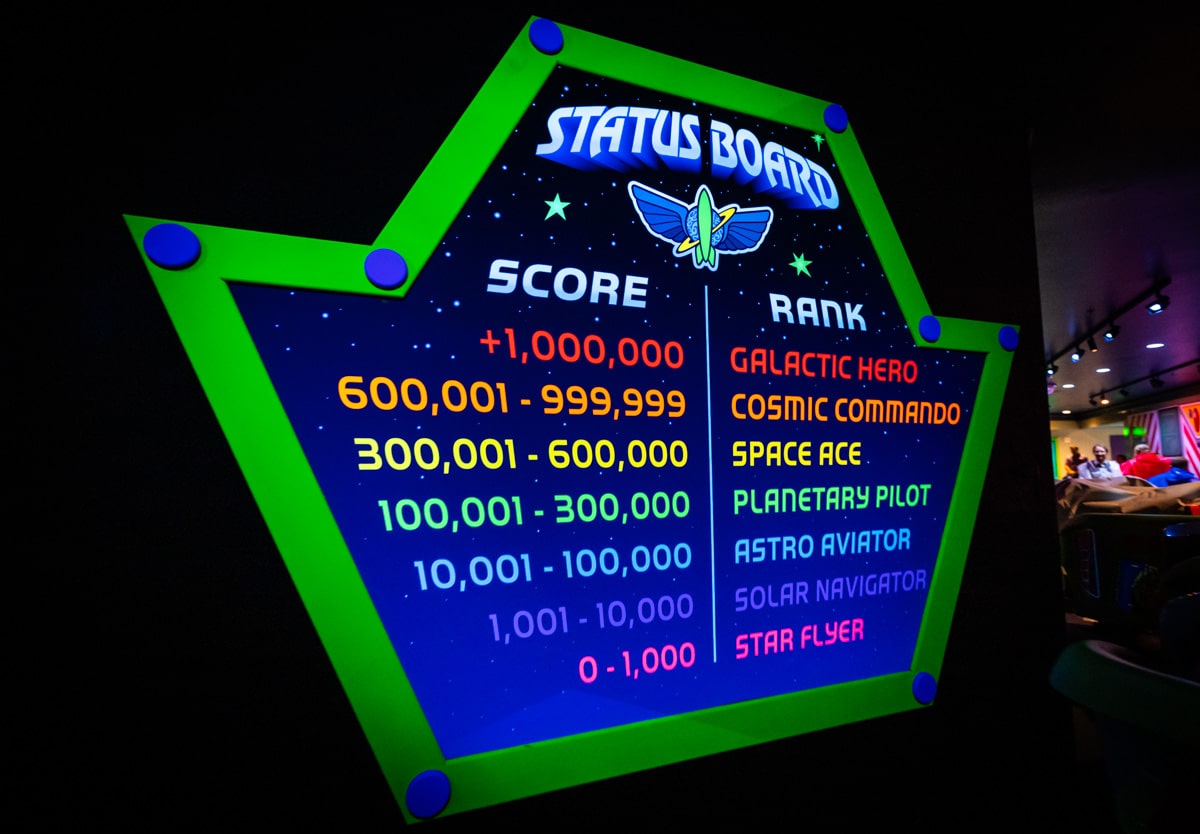
More critically is that scoring is now uncapped. After learning where all of the high score targets were in the old ride, the real challenge for me before was maxing out both blasters.
Whether I accomplished that had less to do with my precision aiming and more with whether or not the blasters and targets were working that day. Now, there is no maxing out the score, and I’ve found myself addicted to doing better.
The interactive targets are the final piece of the puzzle when it comes to gameplay improvements, and arguably the biggest change for guests chasing high scores. The old static Z targets have been replaced with interactive ones that light up when hit…and more! We’ll circle back to this in the strategy guide.
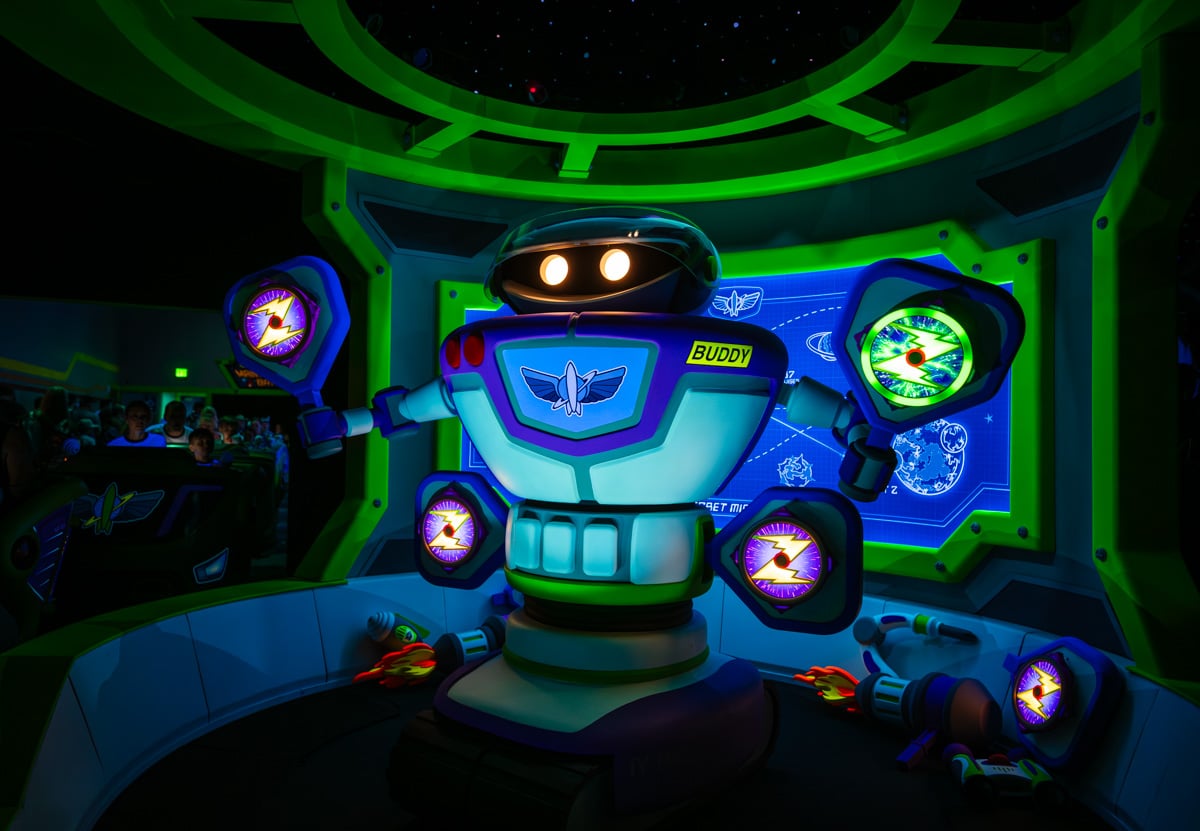
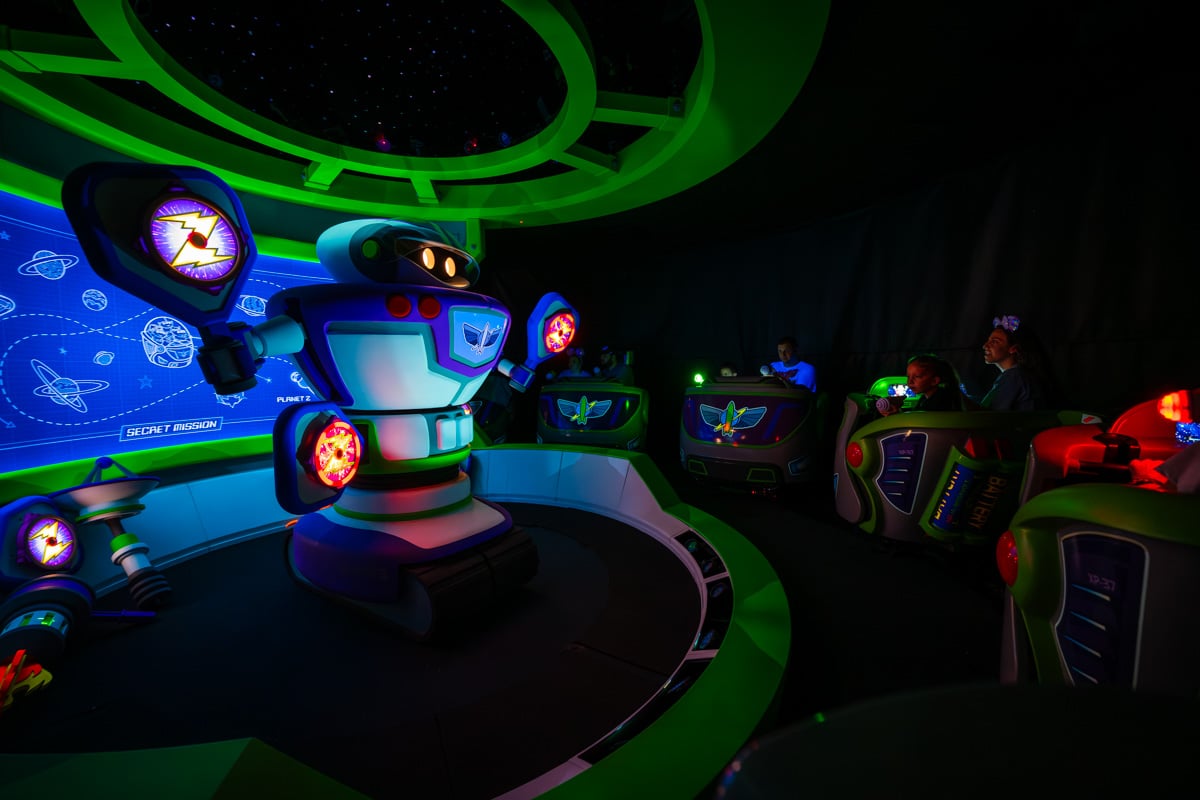
Buddy, the all-new Audio Animatronics character who greets guests at the start of the ride, is a nice addition. This support-bot is a theme park original, and her scene doubles as an introductory gameplay tutorial, giving guests a chance to orient themselves with the new blasters and interactive targets before the real mission begins.
The area Buddy occupies was previously dead space, so this is low-hanging fruit as improvements go, but it is an improvement. Perhaps it was unrealistic expectations from the pre-opening marketing cycle, but I expected more out of this character.
Buddy doesn’t have much personality to speak of, and I highly doubt anyone is going to exit the attraction saying Buddy is one of their new favorite original theme park characters. The throne in Tomorrowland is still safely secured by Sonny Eclipse (RIP Skippy).
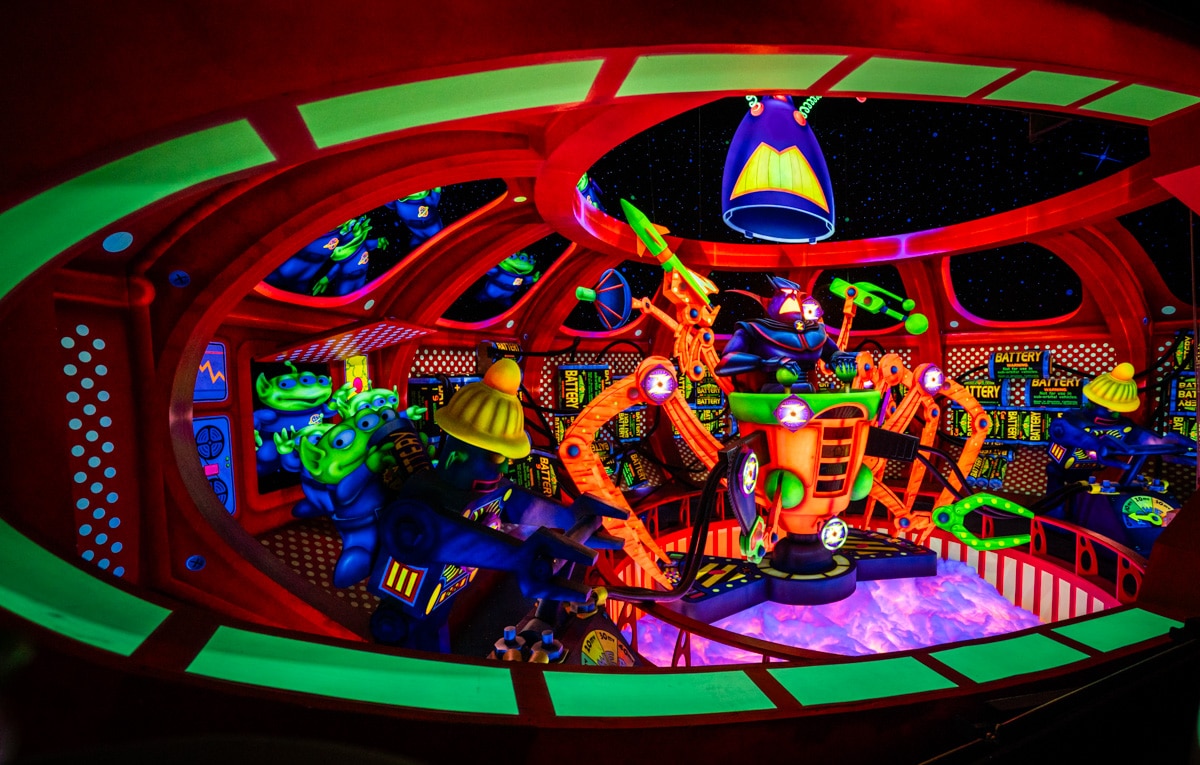
Throughout the rest of the ride, Buzz Lightyear’s Space Ranger Spin remains colorful and cute. As I look at my photos of the giant floating eyeball, slim sandworm and other kitschy creatures that have no discernible connection to the Toy Story Universe, it’s hard for me to set aside my nostalgia. At the same time, a dash of weirdness is the ‘secret sauce’ of these old school dark rides.
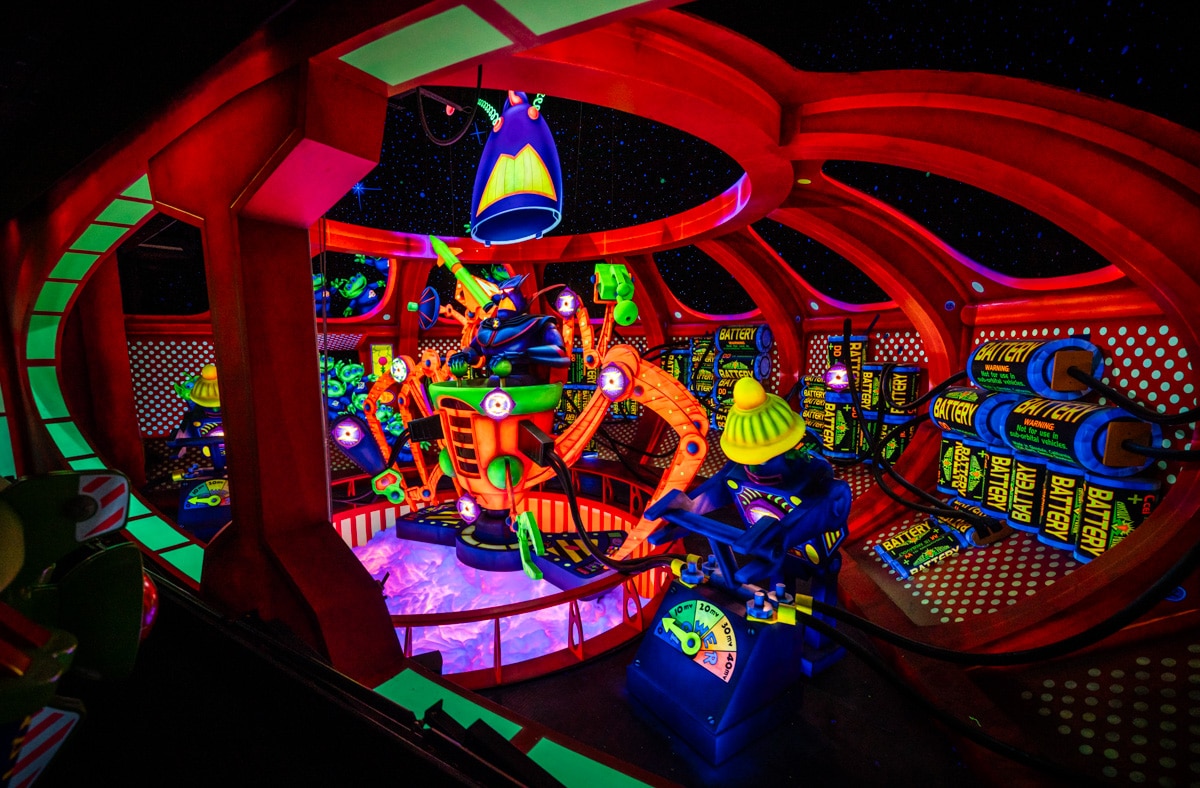
Space Ranger Spin is still not the pinnacle of dark ride staging, but there are enhanced scenes. One notable example is the Escape Hatch transition, which features new dimensional set pieces. The Zurg wind tunnel before the climactic battle sequence in the grand finale, previously felt straight out of the 1990s (because it was), and that’s been totally redone.
Other enhancements are more minor, the kind of TLC you’d expect out of a routine refurbishment as opposed to a fully-fledged reimagining. That’s why we like the ‘recharge’ term (beyond it being on-theme); the gameplay feels like a ground-up remake, whereas what the underlying dark ride received was more like a refresh. Reimagining oversells it, but refurbishment undersells it.
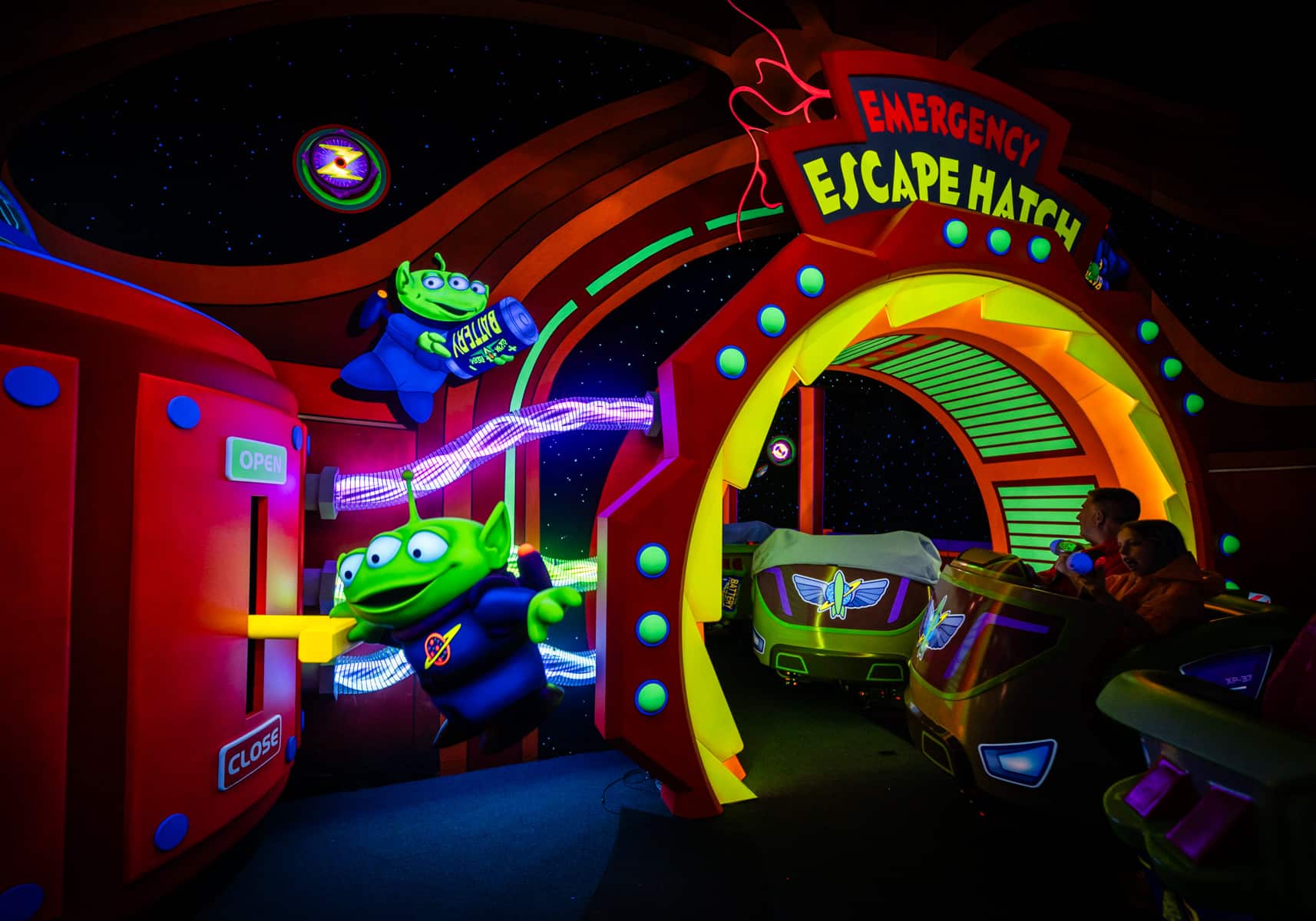
Personally, I love the approach that Imagineering took with Space Ranger Spin. When they last ‘updated’ a Buzz Blaster attraction, the end result was Ant-Man and The Wasp: Nano Battle. That essentially left the track and layout unchanged, while gutting the show scenes and replacing them with screens.
It’s a fun, frenzied attraction, but lacking the charm and dimensionality of Space Ranger Spin. You could not simply sit back and watch the ride, unless you’re really into video footage of an industrial datacenter, or whatever the setting is.
Space Ranger Spin’s show scenes are physical, showcasing a veritable circus of the oddest creatures in the Gamma Quadrant. Yes, they’re weird and sometimes cheesy, but that’s the nature of the beast.
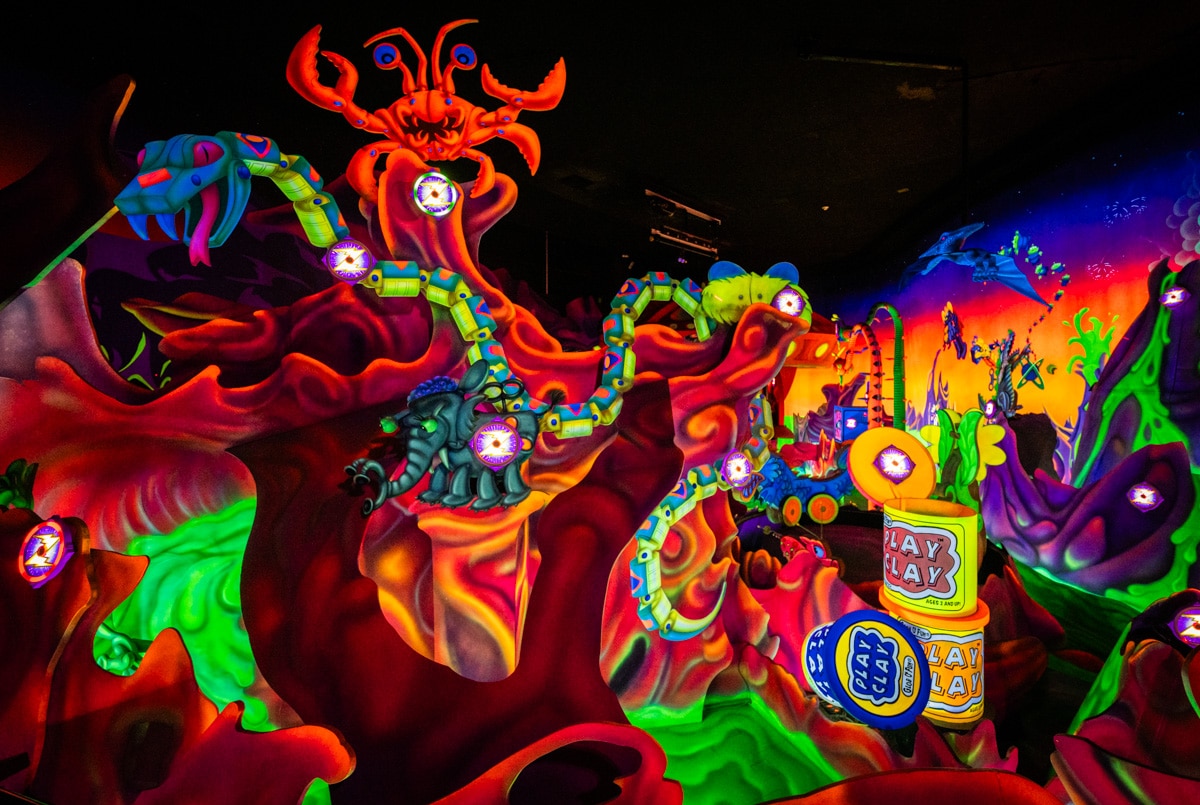
And no more odd than listening to an alien lounge lizard sing about Yew Nork and his low wages. The bottom line is that the attraction works as a passive experience with memorable visuals along the way.
More importantly, the new blasters, interactive targets, and scoring system make it engaging for competitive riders in a way the old version simply wasn’t. And it works better for guests of all ages and skill levels.
It’s approachable for casual guests, who will have an easier time hitting targets and understanding their score, while serious players now have an actual challenge.
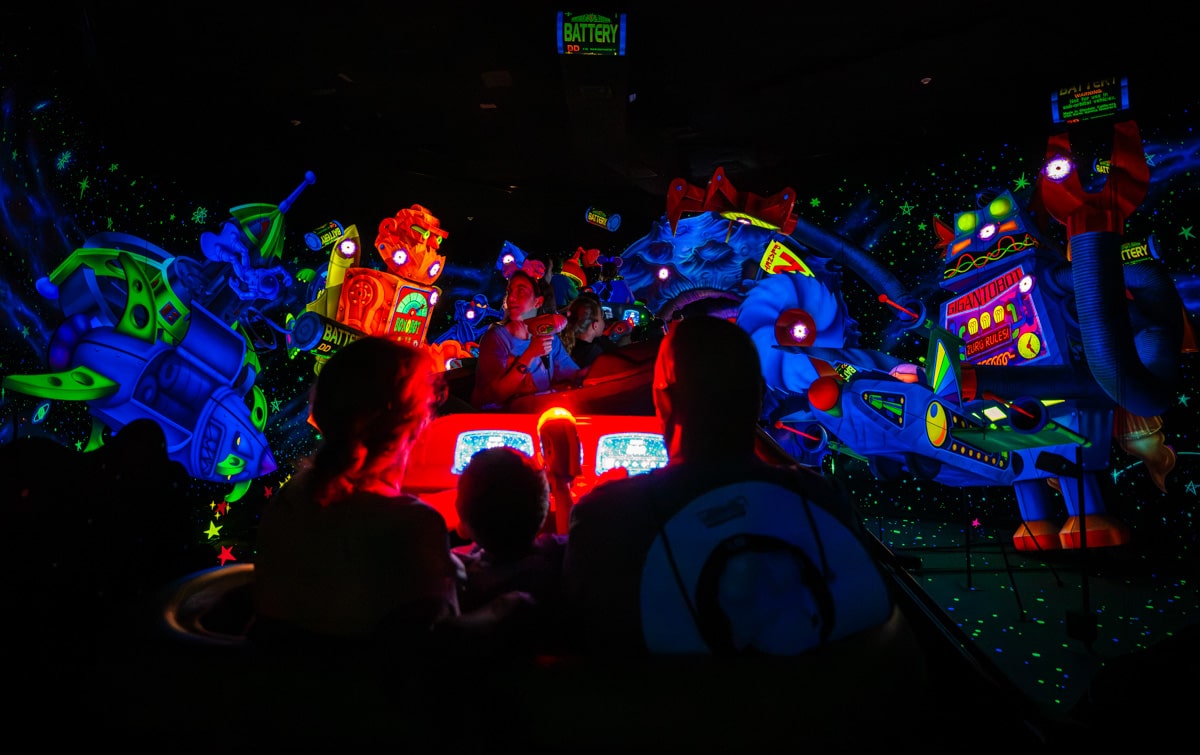
The feedback loop of the new blasters is satisfying. Hitting a target and feeling the vibration in the blaster while seeing your score tick up in real time on the ride vehicle monitor is fun.
Scanning the scenes for the ‘activated’ targets is serious business, and once you understand what ‘unlocking’ these gameplay modes does for your total score, you get addicted, wanting to ride again and again.
I speak from experience here. On a recent night in Magic Kingdom, heavy rain cleared out the park for the last hour or so of the evening. I could’ve done almost anything in the park as a walk-on (Space Mountain had a posted 10 minute wait), and yet, I kept looping Buzz Lightyear’s Space Ranger Spin. With each ride, I told myself, “just one more try.”
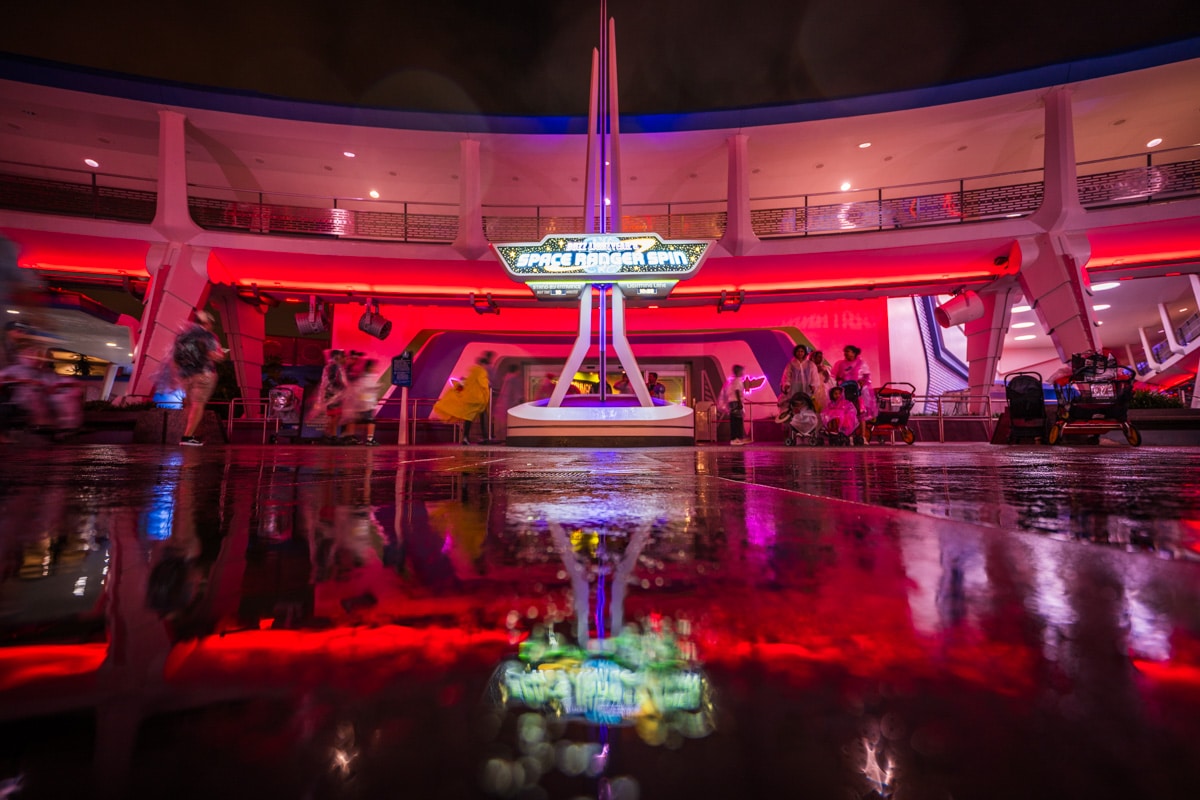
That’s something I’ve never done with Buzz Lightyear’s Space Ranger Spin before. The gameplay was previously fairly flat, fun enough for a single ride through but clearly a generation before the modern gamified attractions that rolled out starting with Toy Story Mania.
The screen-based nature of that attraction still allows for unlocking deeper gameplay, but Space Ranger Spin perfectly threads the needle, having both depth of show scenes and competitive blasting, all while being approachable to first-timers. It’s a massive win.
Now let’s turn to tips for breaking the 999,999 barrier…
Buzz Blastin’ Basics for Beginners (Strategy Guide)
Buddy’s Tutorial: This is a warm-up round, giving you the chance to get your bearings with the new blasters, see your color, and feel the feedback once you’ve hit the center of the target. No need to go nuts here blastin’, better to just get oriented with the new blasters and targets before getting out to the actual gameplay.
Distance: Farther away targets are now worth more than closer ones. This rewards guests who embrace the challenge of aiming at targets across the room rather than just blasting whatever’s closest. The high-value shots are usually the ones that are more challenging to hit, which is precisely the point.
The caveat I’ll add here is that this can be more challenging in practice not just due to distance, but also because it’s what many other riders are also doing. The new colors are great for keeping track of your blaster, but there are still a dozen or so riders in each scene at the same time, and it’s possible to lose track of which is yours, especially when aiming for the same distant target as a few other guests in other ride vehicles. Thankfully, the always-on laser makes it easy to “find” again if you get lost.
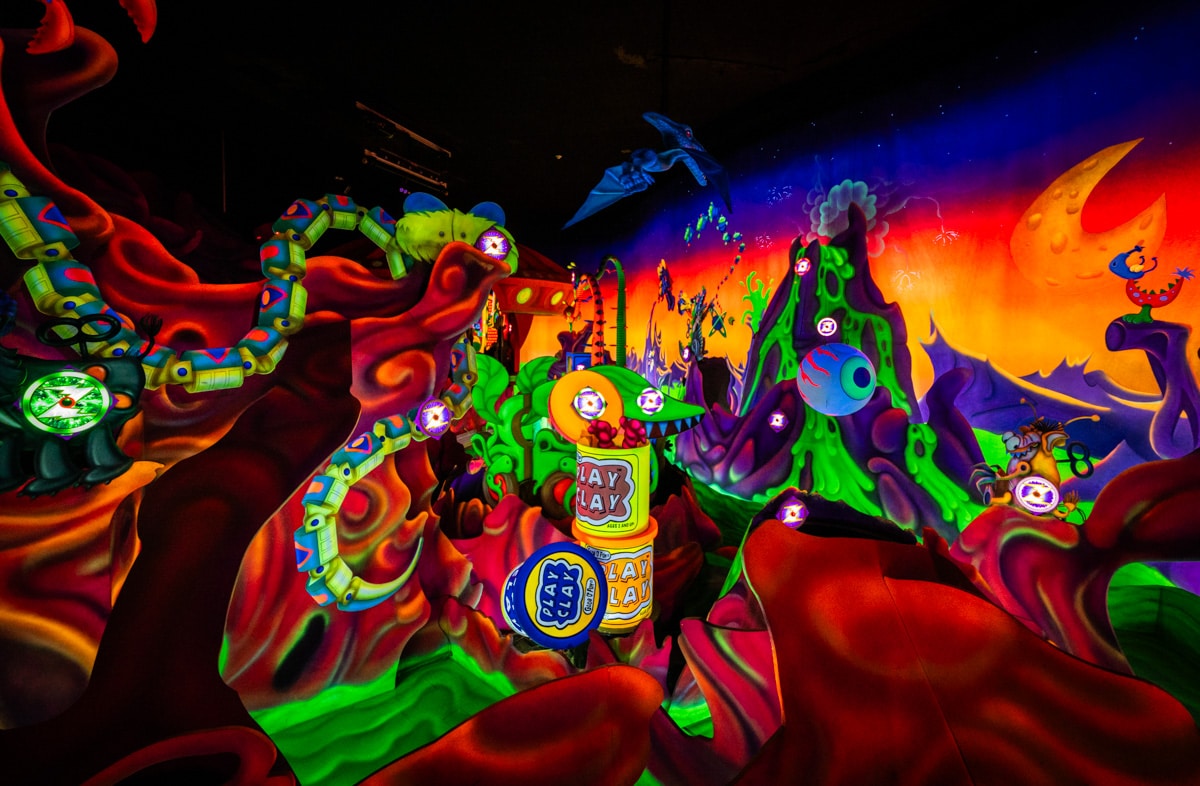
Variety: The end-of-mission scoring includes a bonus based on the number of distinct targets you’ve hit throughout the ride. This rewards a style that scans the scenery, eliminating threats (I assume the creatures are threatening?). So spread your shots around, as opposed to spamming the same high-value target once you’ve locked-in.
As an old school Galactic Hero, this is new approach took me a while to get used to, as the target spamming approach is what worked best on the old version of the Magic Kingdom attraction, as well as the slightly more modernized Disneyland version. But scanning the scenery ultimately works best for the sake of target variety, and spotting when the limited-time bonuses activate.
Secret Targets: The classic high-value secret targets from the original attraction are still present, and a few new ones have been added. Their individual point values have been reduced considerably in the recharged ride, but if you want to take a trip down memory lane and aim for the secret targets, that’s a viable approach to set a respectable floor under your score.
I’m told there are two new 100,000 targets and I’m hoping to find those soon and update this guide accordingly with photos or at least a description of their locations. Stay tuned.
Watch for the White Ring: Certain targets will randomly illuminate with a white outer ring, which means they’re worth double their normal value when hit. These do not disappear immediately once hit, so my approach is actually to spam them with repeated shots for as long as they’re white.
Hunt for the Random Rainbow Ring: The rarest and most valuable target in the new system is indicated by a rainbow ring. Only one exists in the entire attraction at a time in random locations, and if it isn’t hit within a few seconds it vanishes and reappears elsewhere.
Once hit, this activates a bonus gameplay mode on the target with the rainbow ring, and every target in its immediate vicinity. What follows is a major limited-time bonus mode, and all targets in the area are worth significantly more points for a brief period. This bonus window is starting to wind down when the outer ring begins to count down by extinguishing counterclockwise. That’s a nice touch, adding to the stress or sense of urgency to keep blastin’ until the bitter end.
The rainbow ring is my white whale. It is what unlocked an obsession in me with Buzz Lightyear’s Space Ranger Spin and compelled me to ride again and again. Once you’ve ‘captured’ a high score once thanks to the rainbow ring mode, you become addicted to chasing it again and again. The problem is that it only appears in one location at a time in the entire ride.
There have been several full ride-throughs during which I didn’t spot a single rainbow ring. Other times, I only spotted it at the last minute, narrowly missing activation. (Unfortunately, I don’t have photos–but it looks a little too similar to the red targets for my eye to easily and quickly distinguish the two.)
In my view, the best path to a high score is scanning each scene for rainbow rings, knocking out white rings and distant targets in the process. I quickly abandoned the legacy secret targets and any distant target with several other guests aiming at it.
Basically, it’s rainbow ring or bust for unlocking a high score, so you want to keep your eyes peeled for when that mode is activated. Every time I’ve scored over a million at this point, it’s been thanks to the rainbow ring mode. And I’ve never broken the 999,999 barrier without unlocking the rainbow mode.
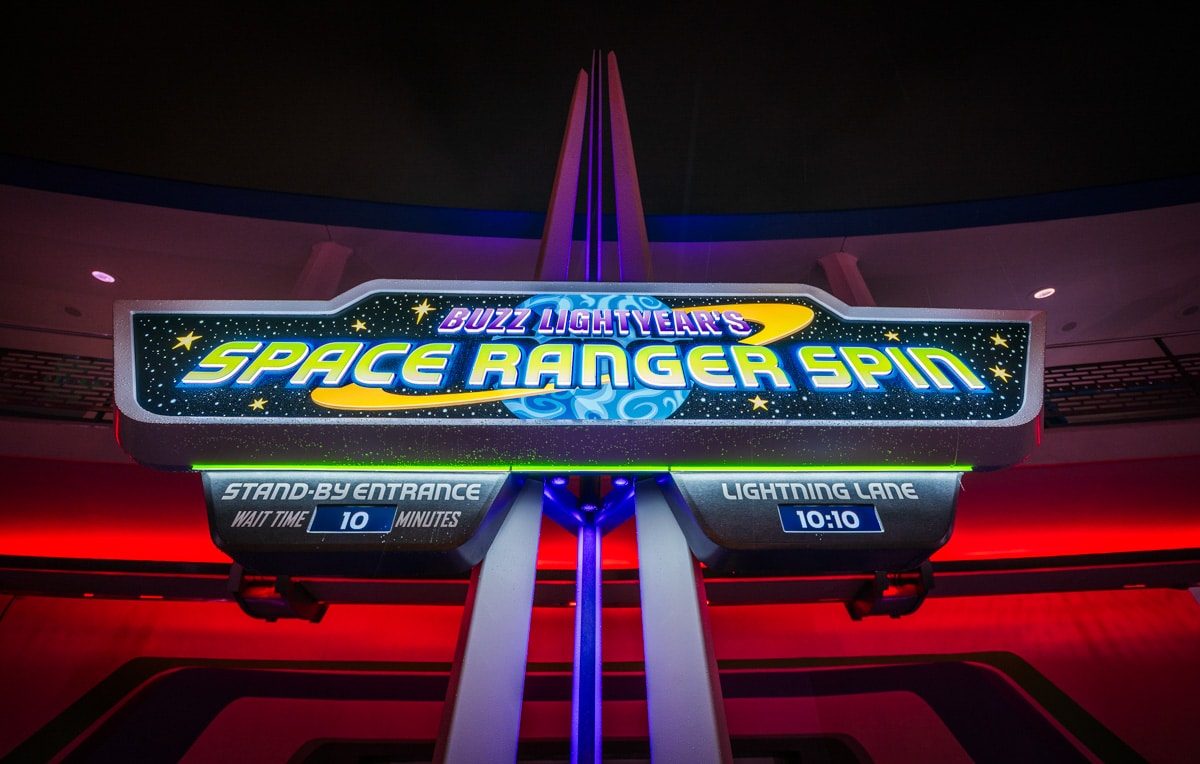
Recharged Ride Verdict
Buzz Lightyear’s Space Ranger Spin has always been an enjoyable ride, but never a true must-do. Even as someone who might’ve overrated the previous incarnation, I would’ve categorized it as midday filler to round out your day.
The new version is different. Not only is it the #1 interactive dark ride at Walt Disney World on balance, but it’s an addictive attraction. The new blasters make shooting intuitive and satisfying for riders of all ages, the reactive targets add gameplay depth, and the bonus modes give competitive guests something to chase.
The dark ride elements are substantially the same, but with sufficient plussing to make the ride feel fresh. The remade gameplay loop is the difference-maker, adding repeatability and making the attraction a more fun experience for guests of all skill levels.

Once the dust settles and it’s time to re-do our Rankings of All 80+ Attractions at Walt Disney World, I’m expecting Buzz Lightyear’s Space Ranger Spin to land somewhere between #25 and #30, a spot or two ahead of Toy Story Mania (currently #29, but likely moving down with the redone rides reopening).
If you’re visiting Magic Kingdom and enjoy simple-but-addictive gaming, consider budgeting time for a re-ride or two…dozen. What was previously a one and done kind of attraction is now endlessly replayable. I can’t wait for my next chance to do Extended Evening Hours or Early Entry ‘for fun,’ as looping Buzz Lightyear’s Space Ranger Spin to improve my high score will be my top priority. In the end, that’s the highest endorsement I can give the recharged ride!
Planning a Walt Disney World trip? Learn about hotels on our Walt Disney World Hotels Reviews page. For where to eat, read our Walt Disney World Restaurant Reviews. To save money on tickets or determine which type to buy, read our Tips for Saving Money on Walt Disney World Tickets post. Our What to Pack for Disney Trips post takes a unique look at clever items to take. For what to do and when to do it, our Walt Disney World Ride Guides will help. For comprehensive advice, the best place to start is our Walt Disney World Trip Planning Guide for everything you need to know!
Your Thoughts
Have you ridden the recharged Buzz Lightyear’s Space Ranger Spin? What’s your high score? Which strategy worked best for you? Do you agree that this is now the best interactive blaster ride at Walt Disney World, or think Toy Story Mania is still #1? Do you agree or disagree with our assessment? Hearing your feedback — even when you disagree with us — is both interesting to us and helpful to other readers, so please share your thoughts below in the comments!


This ride is awful, both before and after “upgrades”.
My family and I have always preferred this over Toy Story Mania. Nice that they fixed it up. Not sure how I feel about the always on feature of the laser. Rest sounds great!
It’s only a targeting laser to help with your aim. Still have to pull the trigger to “blast” the target. Definitely makes it easier for the little ones to make some hits.
One of the 100,000 targets is the eye of the green plant monster going through the volcano.
I, too, like this more than TSMM. I don’t seem to have the technique right on TSMM and my forearm aches after playing that! This looks like a nice update and I like the gameplay improvements encouraging you not just to spam the high-value targets.
How is it different to the shanghai version?
Does one of the two riders still have to control the star cruisers or will it automatically swivel?
One of my biggest issues with the Shanghai version was that everything seemed so much darker/less vibrant in the show scenes, and I was concerned this was due to the nature of the new target system. Your photos seem to suggest this version avoids that problem? Looking forward to trying it!
Same brightness level as before, but more vibrant and cleaner. The show scenes look fantastic!
This sounds great! The second-to-last time we rode it my gun didn’t work and I had to sit there the whole ride watching my husband rack up points 🙁 So I’m really looking forward to the new version.
This sounds great! The second-to-last time we rode it my gun didn’t work and I had to sit there the whole ride watching my husband rack up points 🙁 So I’m really looking forward to the new version.
Speaking of high scores, I hear Tom’s cholesterol is over 999,999.
As a Galactic Hero, I’ve done the pledge and have the button to prove it, I look forward to this new challenge to keep our galaxy safe from Emperor Zurg and his minions.
I fall into the category of people who preferred the old Buzz ride to Toy Story Mania because I like the real 3D sets and find 3D glasses annoying. Can’t wait to ride the new version!