
Changes & DAS Denials at Disney World
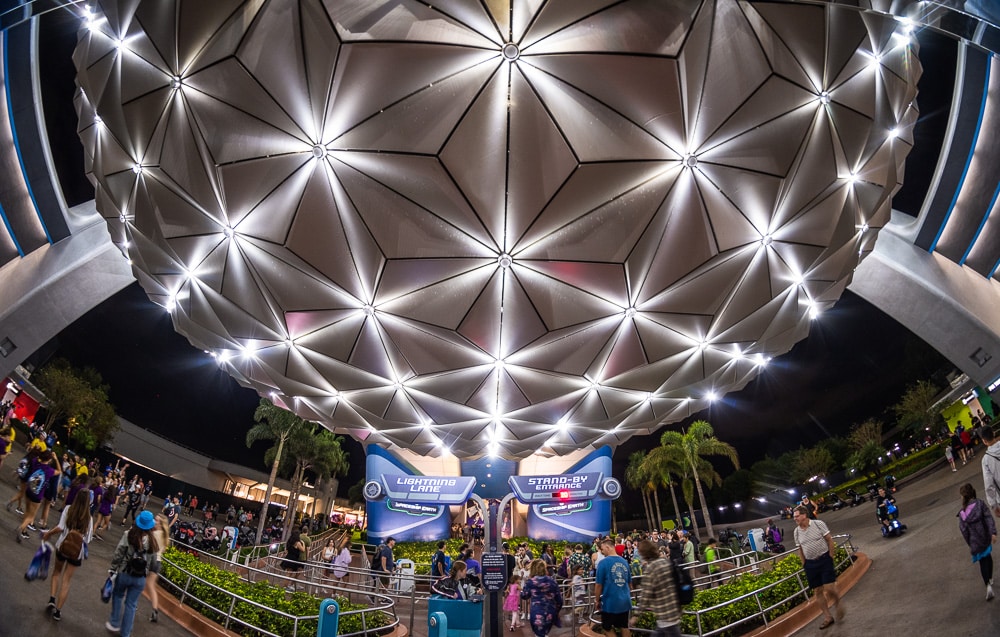
The relaunch of Disability Access Service at Walt Disney World started rolling out last week, bringing with it a more stringent process to qualify for DAS. As a result, there have been widespread reports of guests who previously had the pass being denied and advised to use alternative accommodations, some of which are new (or revised and being advertised more prominently).
We’ve been following this saga closely, receiving reports from readers and reading accounts of other guests applying for accommodations after the overhaul of the Disability Access Service at Walt Disney World. Obviously, it’s a highly sensitive subject that is very, very personal since it is, quite literally, make or break for some guests trying to experience Walt Disney World. (Something we hope you’ll keep in mind before leaving a crass comment.)
If this is the first you’re hearing of the changes and are wondering why Disney is once again redoing DAS at Walt Disney World and Disneyland, it’s due in large part to abuse, misuse, and proliferation of the program’s use. That article covers a lot of ground about the specifics of the new-look Disability Access Service, plus our commentary about winners & losers, as well as collateral damage and more.
According to Walt Disney World, “DAS is intended to accommodate a small percentage of guests who, due to a developmental disability like autism or similar, are unable to wait in a conventional queue for an extended period of time.” This line (or a variation thereof) can be found repeatedly throughout Walt Disney World’s new DAS resources. From that, it is clear that they’re trying to recalibrate expectations about the intended recipients of DAS.
Walt Disney World has publicly stated that DAS usage has tripled since 2019. Independent of that and prior to it, we received credible reports that the majority of Lightning Lane usage is actually not Genie+ guests, but rather, DAS. Just to put that into perspective for people who might be inclined to believe that DAS is still a low number in the grand scheme of things or relative to Lightning Lanes as a whole. It’s not.
Of course, it’s fair to point out that Disney has exacerbated abuse and misuse by eliminating free FastPass+ and replacing it with paid Lightning Lanes. This new system and each subsequent price increase thereof created a perverse incentive for cheating the system. At the same time, it also expanded the audience for social media “hacks” about how to skip the lines for free. This, in turn, created its own vicious cycle. As this DAS abuse content proliferated, it became normalized by virtue of its ubiquity.
This isn’t to excuse anyone for cheating or lying. Everyone is accountable for their own actions, and what’s wrong is wrong. We’re only suggesting that Disney’s hands are far from clean in this whole mess, and where things are today is largely the predictable result of Disney monetizing line-skipping. But I digress.
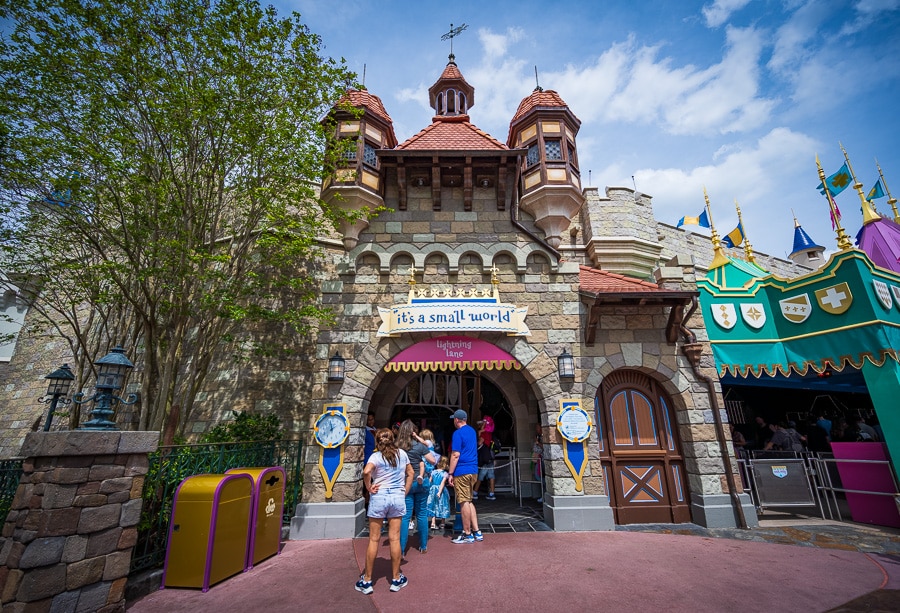
Turning to the changes, the first thing we have is the first official details about the Attraction Queue Re-Entry process. Many guests applying for DAS who don’t qualify have been directed to use this as an alternative. The official Walt Disney World website has been updated with the details on how Attraction Queue Re-Entry will work:
There may be times when a Guest must briefly step out of the standby line and then rejoin their party in the line. Every location has a defined process to support this option based on a person’s disability while the rest of the party remains in line.
How to Use Queue Re-entry
Speak to a Cast member at the location for directions on how to re-enter the queue.
- A Cast Member will provide details about how to exit the queue and how to navigate back to your party.
- While the Guest who must leave the line is briefly away, the rest of the party will remain in line.
- The Guest reunites with their party to ride the attraction.
Note: Guests must meet boarding requirements to ride.
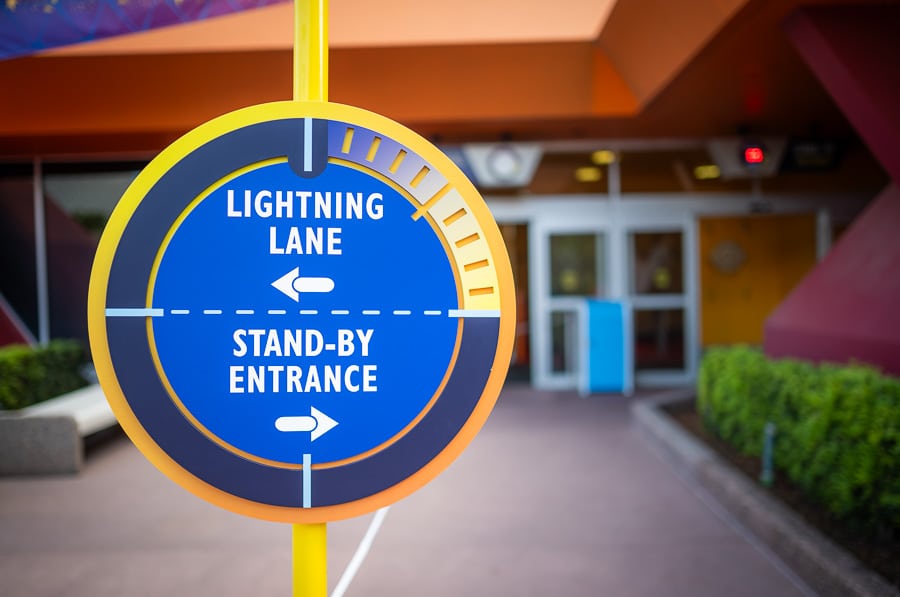
The Attraction Queue Re-Entry feature was one that was anxiously awaited by many Walt Disney World fans, us included. In our DAS at Walt Disney World FAQ, we wrote this about the new offering: “It’s unclear whether this will be a digital system, a physical flip card or something of that sort, involve better Cast Member training and guest communications or what.
It’s possible that Walt Disney World hasn’t even fully figured out the mechanics of how the ‘return to queue’ process will work, or aren’t ready to discuss it for whatever reason. This was the first I had even heard of this being in the pipeline, whereas a DAS overhaul has been in development for a while. I’d be surprised if it’s digital or is anything all that elaborate, but could be wrong.”
Honestly, it seems like Walt Disney World still hasn’t fully figured out what the Attraction Queue Re-Entry feature will be. I’m not sure it should even be called a feature or whether capitalizing it as a term or proper name is even appropriate. It’s my understanding that Disney actually does have a defined process for this and Cast Members have the ability, at least in theory, to implement it at queue entrances and Lightning Lane returns, but I haven’t heard any stories of it working as intended. As it’s presently being conveyed to guests and utilized, Attraction Queue Re-Entry and Return-to-Queue (which I’m told are two separate things) strike me as half-baked.
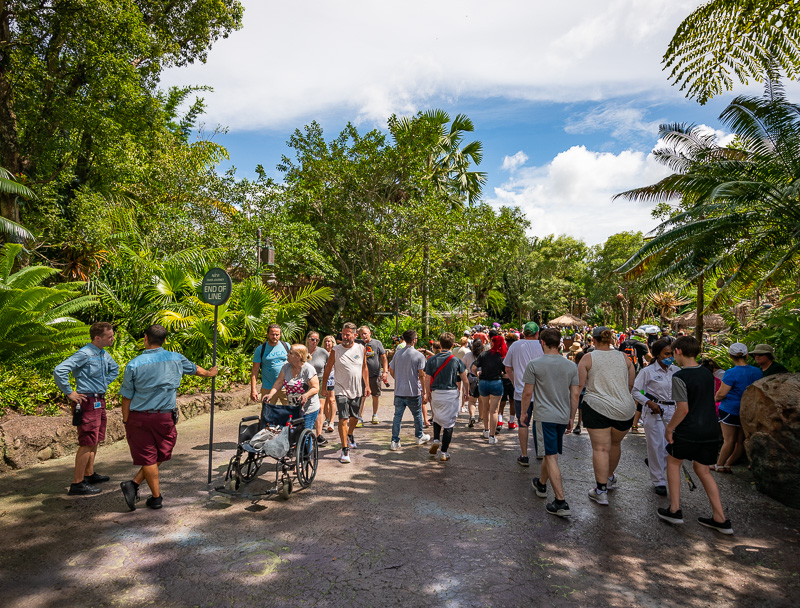
Although a lot of guests are being directed to this return-to-queue option, it doesn’t sound any different in practice than how leaving lines and rejoining them as always worked. From everything I’ve read, it’s still a ‘fend for yourself’ type deal. The defined process part of the equation, to the extent it’s even being implemented, is not being clearly communicated to guests…which is perhaps the biggest part of the problem.
Granted, I’m coming at this from the outside looking in. I can also understand Disney’s basis for being vague about certain policies, as too much specificity could open the door on abuse of those as influencers, social media groups, and other bad actors hashed out how to exploit them. In a matter of months, we’d be right back in the same spot as DAS was with abuse.
However, I’d also assume that a big issue with leaving lines and rejoining them is a matter of ‘guest glares’ (for lack of a better term). Those with invisible disabilities needing to exit and re-enter the queue are at the mercy of other guests being amenable to people passing them–going in the “wrong” direction to leave and then “cutting” them to rejoin the queue.
There’s no perfect solution, only compromises. Nevertheless, it seems like the Attraction Queue Re-Entry process needs to be a clearly-communicated, transparent, and (ideally) visible. As simplistic as it might sound, think of something like a hall pass from your grade school days. I’m not saying that Disney needs to hand out keys tied to obnoxiously oversized rulers…but what’s happening with this alternative accommodation thus far clearly isn’t working.
“Attraction Queue Re-Entry” needs to be something that is consistent across the board, average guests know exists, and they can see being used so they don’t think others are trying to cheat the system or cut in front of them. Look, I’m on record repeatedly saying that we all should err on the side of courtesy and not judge others–that disabled guests would trade places with you in a second and stand in long lines if it meant not being disabled. And I stand by that.
But the thing is, the overwhelming majority are not reading this blog, and the people that most need to read admonishments like that aren’t doing so. In other words, I’m also a realist. If the “Attraction Queue Re-Entry” feature/process/whatever is not done in such a way that other guests know about it and how it works, it’s going to lead to more disdain towards the disabled. One of the big goals of this overhaul, in my opinion, should be to reduce that–not exacerbate it.
With all of that said, it’s still early. I’ve heard some things suggesting that the return-to-queue process could work well as an alternative to issuing DAS. But in practice, what I’ve read from firsthand accounts of guests is that the Attraction Queue Re-Entry feature is being used as a basis for denying DAS and then the process itself in the parks is unclear and has not gone smoothly.
All of this brings us to the reports of DAS denials, which have been fairly widespread in the last week.
Then I’ve read a lot of other reports of denials that, in all honesty, strike me as ordinary given the announcement and other policies and protocol that Walt Disney World has in place. This is fairly unsurprising, as the process for evaluating DAS requests in the past was not very rigorous–it was more or less a rubber stamping once certain words were said.
This was by design, especially in-park where Guest Relations Cast Members were given the unenviable task of evaluating DAS requests. It was better for them to err on the side of asking too little and issuing DAS too often, both as a matter of law and the Four Keys. (They are not medical or legal professionals, so a liberal approval process was the savvy move for Disney to avoid run afoul of public health and administrative law.)
As a result, DAS was issued to legitimately disabled guests in many scenarios where other accommodations were available. These guests were not abusers (we dubbed them “unwitting misusers” in our previous post about DAS) as their requests were genuine, and they were simply following established procedure. If reevaluated once the new policies take effect, many of them would not receive DAS. That was to be expected, with the anticipated outcome being fewer issuances of DAS.
So some of the stories we’ve read are fairly routine. Denials we’d expect flowing from Walt Disney World’s own stated policies. They make sense given that. That’s all I’m going to say about some such denials, following my own advice about being judgmental towards the disabled. Even if Walt Disney World is technically just tightening up its own process, I’m sure that’s of little solace to those disabled guests who “unwittingly misused” DAS and for whom, as a practical matter, it made the parks so much easier to experience. No sense rubbing salt in the wound.

With that said, we’ve also read reports that are heartbreaking.
I don’t purport to be an expert on this, but some of the guests who have been denied strike me as exactly who the system was designed to accommodate. True, “if not them, then who?” scenarios.
Some of these have been heartbreaking–parents with upcoming trips who are scrambling to figure out how to navigate the parks, or if they even can, given their kids’ conditions. Others who bought into Disney Vacation Club specifically because Walt Disney World was the one vacation destination they could do as a family and feel “normal” for a brief time. Reports that humanize the changes, and put a fine point on the “collateral damage” of a system that absolutely needed overhauling.
One problem with the internet is that it’s impossible to assess not only the veracity of the anecdotes, but proportionality. I have no reason to doubt some of the sad stories I read, but I have no clue what percentage of guests are encountering issues. (To be clear, no one should have negative experiences with Walt Disney World–exemplary guest service is kinda of the whole point. But it does happen from time to time, and there’s no sense in pretending otherwise, even if the overwhelming majority of experiences are great.)
While it shouldn’t be happening to anyone, it does make a difference if 82% of ostensibly valid DAS applicants are being denied, versus 2.8%. And if you were simply reading horror stories on social media, you’d be inclined to assume the number is closer to the former as opposed to the latter. I’m not suggesting either number is accurate–my suspicion is that it’s a double-digits number somewhere between the two. Just that it’s worth remembering that there’s more of an incentive and tendency to voice frustrations and complaints than there is to share ordinary or uneventful experiences.
With that in mind and wanting to hear more firsthand reports, we asked members of our Facebook group: Does anyone have firsthand accounts they’d be willing to share of being approved or denied?”
The first bit of good news is that we received 250+ replies. The bad news is that many of these weren’t answering the question at all, but went on random rants about about DAS, abuse, Disney’s greed (the usual suspects–paid FastPass makes an understandable and obvious appearance…plus cameos by the end of Disney’s Magical Express and free MagicBands), or how Universal does things better. The second bit of good news is that the majority of responses shared that their family members or friends were approved.
In fact, most of the replies were so unremarkable that I almost didn’t write this article. From what I could ascertain, the general trend seemed to be that the process was more thorough than before and required more specific explanations of how guests couldn’t wait in a queue, along with why alternative accommodations wouldn’t work.
Several had praise for Cast Members, with one reader saying they were “wonderfully kind, empathetic and helpful.” Others praised the process, calling it “simple” once it was clear to Cast Members that they couldn’t wait in a traditional standby line. Another offered this explanation: “The registration process was very similar to what we did 2 years ago for our Disney vacation. The cast member was courteous and we didn’t have to wait on hold very long (only 10 minutes or so), which was a welcome change to the extremely long wait times on hold for previous trips. We were approved per Disney guidelines.”
Another reported being “approved but advised to utilize the return to line or rider swap if possible before using the DAS.” From what I gathered on social media, this type of ‘conditional approval’ seems to be happening from time to time. Elsewhere, I read reports of solo travelers being approved for DAS as a party of one only, but required to use the “Attraction Queue Re-Entry” feature/process/whatever if visiting with others.
With that said, there were a few readers who did report denials. One with epilepsy who always previously had DAS reported being denied. One shared that her husband was advised that he would have been advised based on one of his health conditions, if that were his only basis for the request (which was not the case previously), but was approved pursuant to the guidelines based on another diagnosis.
Another with GRIN2A-related disorders who had DAS in the past was denied, sharing the following: “I actually teared up on the call not over the outright denial but over what the other ‘accommodations’ are. The CM could not tell me how anything would work, other than that I would have to likely share his disability over and over to cast members at each ride and they might possibly be able to help, again not known. I do not want to talk in front of my child about his disability every time he wants to ride something, that’s not fair to him. We are out of state APs and Disney has always been wonderful about inclusion. We likely will not be able to renew. And yes I did attempt to contact Disability Services for feedback or simply to try to understand the situation better, but I received a standard reply.”

Honestly, I’m not sure what to make of all this. I posed the question on Facebook because of the horror stories I had read, wanting to get responses from what I presume to be a more representative group. I also assumed that actively soliciting feedback would yield more balanced results. Finally, I figured that waiting until several days had passed after the new DAS system launched meant that things would be going smoother than rollout day. All of that might be correct–or it might be incorrect. Admittedly, this was still a really small sample size in the grand scheme of things.
Nevertheless, my take is that the worst outcomes are receiving a disproportionate amount of attention, while the routine approvals are less discussed. That’s perfectly understandable–those being approved don’t have as much reason to post unsolicited feedback online, especially given that it could function as a playbook for scammers. Conversely, there’s (also understandably) a lot of fear among those who depend on DAS. So denials getting the bulk of the attention makes perfect sense.
I don’t want this to be perceived as flippant, suggesting that everything is going swimmingly with the new-look DAS process or downplaying the denials. Even if the early reports are unrepresentative, they’re still concerning. It’s probably of little solace to those who believe they were denied erroneously or felt interrogated by the Inspire health professionals to learn that they were anomalies. (I’m not even saying they are anomalies–it’s impossible to know what the denial rate is now versus pre-changes!) Even as someone who thought a DAS overhaul was necessary to curb abuse, I want to see it accomplished as fairly, consistently and compassionately as possible.
The final note I’ll end this on pertains those who feel they were given an abrupt and unfair denial after a cursory conversation with a Cast Member. I’ve encountered more than a few fans who had this type of exchange early on with the new DAS process, and are reticent to contact Walt Disney World again because they don’t want to be perceived as trying to game the system and have their file flagged, etc. I do think that’s a fair concern, and one I would also have. However, some of those interviews struck me as incomplete and uncharacteristic of Disney.
While I cannot speak to an official “best practice,” I do know that if I were in the shoes of those individuals, I would contact Disney again and be transparent about how the process played out previously. Explain how it was not as thorough as expected, bases for the accommodations request, and provide all pertinent details that can help. Obviously, be polite but explain how the previous interaction left a bad taste in your mouth, so you wanted to reach out again to see if it had gone accordingly to Walt Disney World’s established protocol. You very well may still end up with a denial, but at least you’ll know it was by the books and not just getting unlucky with a specific health professional wanting to get through their caseload as quickly as possible.
Planning a Walt Disney World trip? Learn about hotels on our Walt Disney World Hotels Reviews page. For where to eat, read our Walt Disney World Restaurant Reviews. To save money on tickets or determine which type to buy, read our Tips for Saving Money on Walt Disney World Tickets post. Our What to Pack for Disney Trips post takes a unique look at clever items to take. For what to do and when to do it, our Walt Disney World Ride Guides will help. For comprehensive advice, the best place to start is our Walt Disney World Trip Planning Guide for everything you need to know!
YOUR THOUGHTS
Anyone have firsthand accounts they’d be willing to share of being approved or denied? (Please be light on details if you were approved. I don’t want to inadvertently turn this into a potential playbook for abusers on what ‘magic words’ to say.) Any firsthand experiences being advised to use the Attraction Queue Re-Entry or Return-to-Queue features? Anyone actually use these options yet? Please try to stay on topic–we’ve noticed some of these DAS comments sections get heated and personal. Discuss the policy itself, not others’ use (or lack thereof) of it.






We are 2 disabled grandmas taking granddaughter to Florida for her first and probably only trip with us. We are from UK and when younger visited many times and enjoyed ourselves even though we are both physically disabled and one using a wheelchair through necessity.
Having just read all the above we have sadly made the decision not to travel and have taken the hit on one ticket and changed the name on another to a family member. Our granddaughter is devastated. The extra cost of paying on top of entry tickets to actually get on the rides was scandalous enough but now no actual help in any circumstances being available to physically disabled customers is just downright disgusting. I had contacted Disney direct but have heard nothing other than the original acknowledgement. I hope someone with cash to spare takes legal action. This kind of treatment would not be tolerated in many other countries in this world we live in today. Shame on you Disney!
Hi Tom,
I am noting a positive experience. My sis has gotten DAS previously and she just navigated the revamped process. She said it was similar to before and very courteous. She was approved for DAS for our next trip. She is legally neurologically disabled. Thanks for allowing me to voice a positive.
I was approved for DAS due to gastrointestinal issues because of medication I take. Standing in the heat, makes it worse as does being near large crowds of people which brings on anxiety and can make it worse. I didn’t feel like the conversation was intrusive. I gave them enough information to determine that going back in line was not a solution. But I can see where Disney definitely has to do something to make this process better. I don’t hear about this happening at Universal. What do they do?
universal require you to have a pass externally approved by a third party (which usually requires diagnostic paperwork from a medical professional)
For Universal, one applies through a web site, and submits medical documentation detailing the nature of the disability and what accommodations are recommended or needed. Once approved there, the applicant, on arrival at a Universal park goes to Guest Services – where they might face waiting in a long line. Guest Services then decides what accommodation will be granted, and the applicant is given a card. There are different levels of accommodation, ranging from being able to get a return time at the ride, then going through the Express Pass lane to being offered a “exit and return to line” pass, to being outright denied. All of which can change each day, depending on the whim of the Guest Services team member.
We go to Disneyland and DisneyWorld very frequently, in particular DisneyWorld. Since 2020, the people entering the LL who then have the audacity to turn to each other and laugh and say something to the effect of, “It worked again!” have been more than apparent. Even prior to Genie+ and after FastPass was eliminated, DAS continued to exist, and the numbers of people barreling through what became the LL cues was anything but low. I disagree that Disney honestly has any real fault in this scenario, as FastPass was never technically owed to us as guests and was simply a great perk. But again, not owed. Disney exists to make money, and for us as guests to say Disney has some degree of fault in people abusing the DAS system isn’t accurate. Lying to get what one wants is always wrong, period, particularly so when lying about any form of disability. People weren’t put in that situation when Disney removed FastPass; they simply opted to game the system to get the results they wanted. That fault falls squarely on the shoulders of those people who chose to do it and who likely had no intention of ever stopping. They learned all too well of the numerous things they could say to get their free version of a “FastPass” that also included preset ride times. How very convenient for those abusing the system. I hope those who planned on abusing it this very weekend have found themselves standing in long lines with everyone else, as they should. Undoubtedly they are furiously researching what to say during future attempts to pull it all off again. And because of them, the system is now more difficult for those who do truly need it. But Disney should not be expected to continue enabling those who have played this game for the past 4 years. All those who were hopping into the LL laughing and making snide comments celebrating their “success” in tricking CM’s into approving DAS can thank themselves for helping make things very apparent to Disney. Do they not think that cameras capturing these such moments and CM’s themselves observing it in the moment wouldn’t catch up to them? In the words of Shakespeare, “what a tangled web we weave…”.
This is clearly what it is. An attempt for Disney to monetize the DAS requirements.
Disney has become total trash where the almighty dollar is now priority #1. Customer service, which used to be the gold standard, is now in the toilet. I have an issue that I need DAS to visit, and no I can’t leave the line by myself and return later, nor am I leaving my children to stand in line by themselves.
We have a trip planned in September, we even have free Park Hoppers, but if they deny my DAS request, we will never visit Disney again.
As someone who has had a family member utilize this in the past, the return to line seems like they took something that worked ok and messed it again. My brother has ushers syndrome and is blind in the lower 3rd of his vision. He sees dine the rest of his vision but is also highly sensitive to light change from light to dark and vice verse. A past visit several years ago we would go to the entrance and get a return pass for the time it would have taken us to wait in line. It avoided the dark and difficult to maneuver line for my brother to navigate thru. Sounds like now he wouldn’t be eligible for this unless someone in the party waited in line. I guess I don’t see what the purpose of having the someone wait in line at all. Maybe I’m mis-understanding the rules. He hasn’t been back since the change and would probably be discouraged to go back as now he wouldn’t be able to spend a large time with the family if he’s waiting outside the ride and part of our group is in line. He has said he doesn’t want to cut in line, just the lines don’t work for him. There has to be a better way for him and others in his situation to not cause issues with the genie + lines. Also he personally does not have an issue showing proof to Disney of his medical condition in order to get DAS in the future or something else but stated he wasn’t sure if Disney was even allowed to ask for it, which could be part of the problem. His family is going with ours the end of 2024, so he’ll go thru the process and see how difficult this is going to be. If it is, Disney will have lost his family of 5 from coming back again after this year.
When Genie+ was new and guests satisfaction numbers were low, Disney made a point of reminding guests that they could expect a certain number of lightning lanes each day (something like 3 or 4?). This was in response to many folks’ belief that they’d be able to get 6-8 useful ones. Maybe the same communication could be applied to DAS users. Complicated problems rarely have one solution – maybe this could be added to the mix & keep the lightning lanes shorter.
As a single mom, I cannot leave my 1 child in line to exit to handle my other child and hope i reconnect with him. This is a really ill thought out policy and definitely affect future trips. Since you can only get approved 60 days out so I won’t know ahead of time., I am less likely to make the trip. And while we used DAS I also bought genie and lightening lane to ensure the smoothest day possible.
There is no utopia. With some real-world issues, you can realize that, shrug your shoulders, say ‘There’s no magical elves either, so what?’ and get on with whatever compromise is possible. With others, you end up really, really wishing that there WAS a utopia that could answer all needs. Disability access is in the latter category— but sadly, utopia still does not exist and “the best compromise we can manage” is still all that is possible.
The only thing we can all do is show courtesy and compassion all around: to those with disabilities, to the front line cast members, to the people in the Disney boardroom, even to those guests letting their glares show (in the midst of a long queue on a hot, busy day feelings of irritation will happen— and even someone determined not to show them may just have a poor poker face). No one is to blame for utopia’s absence. None of us LIKE its absence but all we can do is muddle along the best we can, and realize everyone else is doing the same.
Well said.
Thank you Tom, your article was very good as always. I was diagnosed with autism in 2012 and I have multiple physical/mental disabilities from birth. I was approved for DAS in 2023 and it was very helpful. I would have no problem providing a doctor note or any medical documentation. I’m concerned that if I were to try to apply for DAS again I would not be approved because my disability’s are not “severe” enough. I also feel sorry for a family if they are going to Disney. From what I understand, the soonest you can apply for DAS is 30 days before your trip. I would want to talk with a cast member or one of the health alliance experts before I spent any money to get an idea if I would be approved to get a better idea if it’s even worth spending the money.
As someone who used DAS in the past (Type One Diabetic) and who’s other family would currently qualify, there are really concerning issues with the system. I travel with my husband and toddler and so for me to use the Return to Line pass to treat my illness I would need to leave them in line alone, which is incredibly dangerous. When I’m low or high to a point of needing to sit and leave a line I’m not generally capable of taking care of myself fully and require assistance to do tasks at times (opening juice etc). This requirement is could be very dangerous for many, and would not work for those travelling alone with a child. I am also really troubled by the hard cap on who can be on a pass. My dad frequently travels with my siblings family, mostly to help with their child with ASD. He would not be able to be on their pass so would be left out of everything. Grandparents and other adults play a huge role in helping families with members with ASD to make really big trips more manageable, and so providing hard limits if you can’t join really limits many families ability to manage outings especially if they have multiple children. It also makes me incredibly sad that my family member with ASD would not be able to participate in riding rides with their other family members on larger trips due to the pass use restrictions, which can be really othering for them. There are some serious kinks that need to be worked out.
I can see how the system might have been abused with parties of 20+ but cap at 4 is a little ridiculous, especially since a family of four and a set of grandparents can fit in single rooms at multiple locations on property.
I can say I have two kids with ASD and we will just have to deal, because there is no way that DAS is going to work for us. Other people will just have to deal with my son escaping through lines. ♀️
I do not know your situation and am not referring to you specifically. But, as someone with Type 1 diabetes in members of my immediate family, I don’t think DAS is needed for a person with Type 1 diabetes without comorbidities. We do have to get out of line a few times a trip which sucks but is not comparable to a person who can’t wait in line. There have been bad days where we didn’t do much at all, but DAS would not have helped in those situations. The combination of LL and ride experience times would have been too long for us to safely do things. What if we have a low blood sugar when leaving the dock at Pirates or Jungle Cruise? We have never used DAS and would have felt bad about making LL lines longer for people who truly need it.
As someone who has qualified for the DAS in the past due to two “invisible” disabilities, I would not use the pass when the line was 20 to 30 minutes or less. I can definitely make it that long. We also try to go at less crowded times, and less crowded seasons.
I am in a wheelchair now, but only temporarily. Cast members, for the most part, have been really great about that with my son pushing me around.
We shall see once I’m out of the wheelchair, but still unable to stand in line for extended period of time, if under the new rules I now qualify.
That will also determine if I purchase another annual pass in the future.
That’s life!
Tom, I just came across your website due to your recent Galactic Starcruiser article. I love your in-depth writing and ability to offer even-handed commentary on Disney parks. However, the ability to read your articles on a mobile browser is horrific. The placement, size, and number of ads on mobile is insane, and I had as many as four ads running between banner, video, mid-article, and overlay with every scroll. It also creates a huge battery drain on my device. The desktop experience is probably not so bad, and I understand that you need to make a living from ads. However, please consider an advertising redesign to lessen the intrusiveness. Keep up the great work!
I think it depends on what kind of mobile you’re using. I have no trouble whatsoever on my mobile.
I agree with the previous reply – it might be worth it to try different browsers on your phone (beyond what is preloaded). I find this useful for other sites too that may be quirky (for example, my water company site doesn’t work on Firefox or Chrome, but does on Safari!). Just a thought!
P.S. I’m reading using the DuckDuckGo browser on my iPhone and don’t see the ads you’re describing!
When we went with a person who was in a scooter and could not walk or stand for long, we did not ask about DAS (because, as far as I know, it is not for people with mobility disabilities). However, we discovered that Disney was not well set up for people who use, essentially, an electric wheelchair, In many cases the line was not wide enough, especially at the turns. It was quite awkward to discover this mid-queue. In many cases, cast members intercepted us before we entered the queue and had us enter through an alternative route – sometimes the fast pass lane, sometimes in the out lane! It seems to me that having good signage would have helped with that, but doing something similar for people who leave and return would also help.
A scooter costs $65 a day plus a $20 deposit. This is a money grab by eliminating the DAS for those of us with mobility issues.
Give those $65 back in credit on the bill for each day a scooter is needed.
We have utilized DAS several times at both Disney World and DisneyLand for my daughter. She is hearing impaired and it took a lot of explaining every time we call in to qualify to have her approved. I am wondering if anyone else with this type of disability has been approved under the new guidelines? When we have been unable to avoid waiting in line for something she really wants to do or the lightning lane is also very crowded, it has resulted in tears from too much sound. Can you request a return to line immediately upon entering the line?
I can tell you even under the old system hearing accommodations are supposed to be their hearing assistive devices (they do closed caption OR headphones), ASL at certain times, and earplugs. They will give you earplugs at guest services. DAS was not meant for having trouble with the amount of sound in lines, which we were told directly and honestly seemed appropriate, as there is still loud sound in the LL or during rides and shows.
I am not trying to be rude, so please don’t take it that way, but I am genuinely curious how noise can affect a deaf child from waiting in line? I don’t have any deaf friends or family members so this is not something I can understand.
She is not deaf, she is hearing impaired and wears a hearing aid and cochlear implant. Her devices work by taking the closest loudest sound and magnifying it to a volume she can hear. They do not adjust like regular ears to “tune out” unwanted noise. Ear plugs are not helpful as her ears are already plugged with devices and removing them renders her unable to hear anything. It’s a catch 22 that being able to avoid long durations of being trapped with hundreds of your closest friends talking all around you helped us avoid the eventual overwhelm/frustration.
This is actually for Amy – But it’s not unusual for people who have hearing differences to have sensory difficulties associated with them. You basically end up with the same sensory difficulty a person with autism has, but not the diagnosis with it that causes sympathy. I live with an individual who is single sided deaf. This means he can not locate sound, and those microsecond differences in when a sound hits each ear means words blur and he loses the ability distinguish communication from noise. This often makes it easier to be completely deaf that to be hearing while in a crowded space. As for people who are hard of hearing in both ears, I’ve heard comments that aids can become more trouble than help in overly loud places.
It’s stressful, but the line itself isn’t the issue, it’s the ability to control the amount of noise.
Thanks. I had no idea!!
I’m a teacher reading this. Has she tried noise cancelling head phones that would fit overtop? Not for DAS purposes, just for life.
We have tried those, in several situations. They make it difficult to carry on a conversation… like many others have said, I would wait in any line so she wouldn’t have this challenge!
Out of curiosity, do she/you/your family know and use ASL? If not, I know it isn’t a quick solution to this problem, but could help in the future and in other world situations.
hearing impaired? that’s not a reason to have DAS that’s why they are cracking down. Being partially deaf is no reason to be able to not wait in lines and I’ve worked with deaf people.
Thank you for digging into this subject a little further. As an out of State guest, we visit WDW once every 3 to 5 yrs. I didn’t even realize DAS exisited…..perhaps because our party does not have the need coupled with our infrequent visits. I appreciated your comments regarding Disney having a significant hand in the increasing misuse of DAS by some. Coming from someone who has very little knowledge of what constitutes a legitimate DAS situation, I would think maybe the DAS approval process could be handled by providing Disney the diagnosis documentation (Dr letter) ahead of the visit. Disney could then evaluate and approve/deny based on facts rather than being at the mercy of what sounds like an ambiguous conversation with whatever CM answers the phone for the interview. The DAS designation could be good for a yr or so and a DAS icon added to the My Disney app to show cast members at ride entries. Maybe this is not viable due to HIPAA restrictions.
HIPAA is only if the doctor gives information without patient consent, so it doesn’t apply to a person volunteering their information.
Something I believe is unique to Disney is there are hordes of doctors out there willing to write people fake letters to get a pass. It’s been going on for years with people’s doctors offering this to them even while Disney has refused to accept doctor’s notes. If they swapped to a doctor’s note system you get a two fold problem- one being that not everyone with the same diagnosis has the same needs. You are going to have notes because someone has X diagnosis but no need or people with a normally “not bad enough” diagnosis who has a need but a doctor who doesn’t agree, two would be the new market for fake doctor’s notes, which you know would become a valuable thing people could buy online. It would be a pop up industry over night.
Not only is demanding detailed diagnosis and medical documentation a gross intrusion of privacy (HIPAA only pertains to healthcare personnel handling patient info) but many people do not have conditions that require medical management. My own is one of those – there is nothing any doctor can do for me that I am willing to accept. My diagnosis is nothing more than a code on my record, and nothing more is done about it by my doctor other than a mention during my yearly PE. I handle it on my own by avoiding certain situations – we leave before the fireworks, for instance, or having support to help me manage, and one of those was DAS. I am sure I will be turned down now if I apply.
So no, that is not a solution.
The Americans with Disabilities Act prohibits companies from requiring medical documentation for accommodations since many people have lifelong conditions that don’t require ongoing care (because there isn’t anything a doctor can do). Requiring people to always have updated medical documentation would be a costly burden to people, especially those without health insurance. Disney cannot legally ask for medical documents or even a diagnosis.
Do you know why the person with epilepsy was refused? That blows my mind and it’s exactly my issue. I have seizures as a result of cumulative stress, tiredness, heat and flashing lights (which can include natural light such as between leaves). I don’t necessarily know when I’m about to have one, so my life is a balancing act of trying to not put myself in situations likely to produce one. Standing in a hot, closely confined queue for hours on end is going to very much contribute to my having seizures. I already take multiple in-park and out-of-park breaks to try and keep as stress free as possible. I try and avoid certain things in the parks.
And now potentially I won’t even get DAS?
It’s really disheartening. Particularly if autism is going to be used as a catch-all (I can appreciate many with autism can’t queue; there are also people who can).
Not a cheap solution, but I really wish Disney would implement something akin to the “queue” at Universal’s Jimmy Fallon ride. You get a color and wait in a room. You can’t ride other rides, but you can sit. In air conditioning. Your kid can play a game or use the bathroom. There is plenty of room for wheelchairs. Sometimes there’s entertainment. (I don’t need the entertainment – I just need to be off my feet, with a bathroom readily available for my kiddo and a little breathing room.)
In a prefect world, they’d add a quieter space for folks with sensory challenges to wait.
In any event, you wait, they call your color, you briefly queue up, and you’re on the ride. Accommodating to (almost) all, and everyone waits the same.
I like the idea of returning to line at Disney, but execution seems like a nightmare – no way is my anxious neurodivergent kiddo going to want to leave the line without me. And if we don’t leave someone in line, doesn’t sound like we can rejoin. And rejoining sounds like a shame-filled nightmare… seriously, implement the Jimmy Fallon queue.
Tom- offering true thanks doe you frank writing. You preserve the intention of the program and those who truly need it with your tone of empathy and honesty. Preserving dignity is difficult for those with disabilities and can be exhausting always advocating for those in need. I hope that DAS ends up being granted for those who truly need it but I am apprehensive. I am mad ad Disney for letting it get abused so easily and offering a cost-based service that is not equal as an alternative , mad at the internet and humans for trying to “hack” everything at the expense of those who need it and human nature for those who have to character and knowingly lied. We applied for our trip at the beginning of June and were granted. The wait time for video chat went from an hour or more in the past few years to minutes this time, which speaks volumes. Two family members/friends I know who used to get DAS for “anxiety” (and yes I am using quotes because the anxiety is situational and that situation is, they don’t wanna wait a long line because it’s inconvenient) stated that they will not apply anymore. I was sure to share with them that it’s unfortunate that they are an example of why this program was revamped, and there are others now that could certainly benefit but will not get to use the program anymore because of the stringent rules.
we are a family that bought into DVC because this is a minimum annual vacation that we can all go on and that is enlarge part because of DAS. if for some reason, our son does not qualify for DAS in the future, I don’t know what that would do to our vacations and our investment in DVC.