
Bob Iger Looks Bad in Disney ‘War of Succession’ Book

The House of Mouse: Bob Iger and The War of Succession at Disney is the first unauthorized book about the battle between Bob Iger and Chapek, and it offers a “rigorous reassessment” of the former CEO, according to a preview of the title by the New York Times. After reading that, it’s very easy to see why the company did not want this book to be released.
The book is written by veteran Wall Street Journal reporter Robbie Whelan, who covered the Walt Disney Company before moving on to the scandal-free Nvidia. (I’m sure the new beat will be quiet and won’t keep him busy.) Whelan spent nearly four years on the book, and received help from Ike Perlmutter, former Marvel chairman and major Disney shareholder who was ousted by Iger.
The House of Mouse: Bob Iger and The War of Succession at Disney is slated to be released on December 1, 2026 and can be preordered now. (That and others in this post are Amazon affiliate links; your purchase helps support the site.) The 528-page title comes out on the same Tuesday that Bob Iger will attend his final Disney board meeting.
This is not the first Battle of the Bobs book to be released in the waning days of 2026. A couple of months ago, Bob Chapek’s memoir, Behind the Castle Walls: My Thirty Years at the Happiest Place on Earth, was released and sold at least a few dozen copies.
If you’ve just joined Bob vs. Bob already in progress, here’s a quick recap. After being named CEO in early 2020, Disney Fired CEO Bob Chapek and Rehired Bob Iger as CEO back in November 2022. There were a lot of subsequent developments in the Battle of the Bobs that trickled out over the course of the last four years, but the Disney drama had been colored by Bob Iger bias.
There have been many articles in the mainstream media that have been published about this corporate drama since 2022. The whole saga has been equal parts Succession and Game of Thrones…or a sequel to DisneyWar. I’ve been awaiting such a sequel for the last few years, and Whelan’s book should be the first of those unbiased accounts.
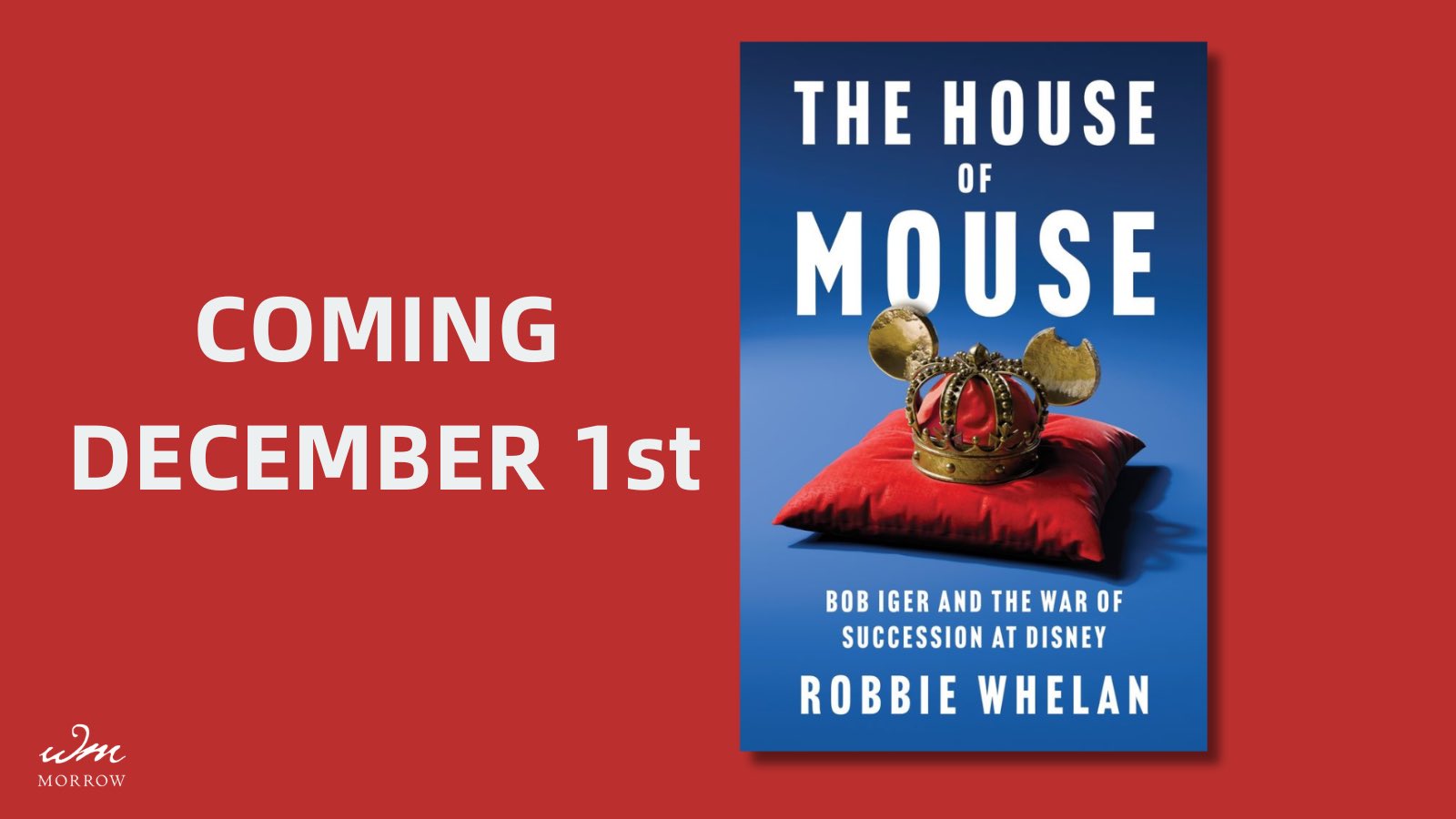
According to the NYT preview of the title, The House of Mouse depicts Bob Iger as “insecure, vindictive and preoccupied with money.”
The book highlights private emails obtained by the author via Perlmutter, some of which were Iger moaning about money. “I am frustrated about compensation!” Iger wrote in the email. “I had a nasty and distasteful negotiation to extend my contract this last time.” These messages were sent in 2014, after Disney’s board extended his contract to 2018. Iger was paid $46.5 million in 2014, up 35.5% from the previous fiscal year.
Despite this, the book is not a hit piece aimed at vilifying Iger. It also lays out his transformation of the Walt Disney Company after taking the helm as CEO through shrewd acquisitions of Pixar, Marvel, and Lucasfilm during his first tour as CEO from 2005 to 2020. It credits Iger with rare dual talents of pragmatic business instincts and a genuine feel for the creative process.

As for the negative, much of what the NYT reports about The House of Mouse feels familiar, echoing the surely unbiased account of Bob Chapek’s recent memoir. In case you’re not one of the few dozen people who read it, his book accused Iger of a relentless sabotage campaign, claiming that Iger played “an intentional and preconceived role in abruptly ending” Chapek’s career, disparaging and rendering him unhirable.
Chapek made a bunch of other bold allegations along the way. One of those that is debunked by The House of Mouse is the motivation for Iger stepping down in February 2020. Whelan found no hidden scandal behind Iger’s surprise announcement, which prompted wild speculation of illness. The author’s reporting largely backs Disney’s explanation: Iger had grown weary of aspects of his job, particularly Wall Street scrutiny.
Speaking of Chapek, he emerges badly from The House of Mouse. Per the NYT, Chapek had a knack for finding new ways to make money for Disney, especially at the theme parks, which is not breaking news to anyone reading this. Whelan also paints Chapek as calculating, paranoid and tone-deaf. At a 2022 Marvel movie premiere, Whelan recounts that Chapek gestured toward fans dressed as superheroes and asked, “Did you get a look at the freaks?”
This quote is revealing and disappointing…but is anyone honestly surprised? By the end of Chapek’s tenure, he had gone from openly adversarial towards fans to flat-out hostile. He made no efforts to hide his dislike for us, and his poorly-veiled public-facing image was one of many reasons we wrote that Bob Chapek has proven that he did not and still does not “get” what made Disney…Disney.

The House of Mouse also discloses information about Iger’s personal life and youth that the former Disney CEO has long sought to keep private. The author told the NYT he was proud of “decoding the psychology” behind Iger’s career, tracing his ambition and insecurities to his childhood.
Reading this passage in the New York Times article was unsettling. As someone who didn’t go to journalism school, I’m not quite sure how this should be handled. My gut instinct is that the stories about his childhood should be off-limits; Iger sought to keep this private and it’s very clearly a sensitive subject. Perhaps the full book does a better job of establishing a nexus between this and Iger’s corporate career, but I’m struggling to see one.
Leaving me even more unsettled was what followed, contrasting Iger’s public support of the #MeToo movement with his personal conduct. Although this is also a very private matter, this strikes me as fair game; there’s a more obvious connection to Iger’s leadership, profession, and public persona.
I’m not going to recount the sordid details as they don’t seem appropriate for DTB, but suffice to say, I have lost all respect and admiration for Bob Iger as a person. His professional accomplishments are what they are, but I can’t say I want to hear leadership lessons from him again.

As you might recall, Disney and Iger ‘disputed’ the contents of The House of Mouse: Bob Iger and the Fight for the Soul of Disney. It was previously reported that Iger and Disney hired pitbull attorney Charles Harder to push back on the upcoming title. It’s now really easy to see why they didn’t want this book released!
Harder reportedly sent multiple letters to publisher HarperCollins, seeking information about its contents. They contended that Whelan has covered Iger and Disney negatively in the past, and slams the author as being biased and committing a “hit job” on Iger and Disney. They previously demanded time to review and fact check the book before it’s released.
Whelan confirmed all of this in an interview with the NYT. Iger’s lawyer sent letters to the publisher raising concerns about a potentially “false and defamatory” account. Disney also declined to cooperate, according to the author. “Their instinct was to bully me,” Whelan said.
He also confirmed that neither Disney nor Iger cooperated with The House of Mouse, or sat for interviews with Whelan. The company did provide a statement to the NYT, which read like a stock line from the press release boasting about Iger being named a Disney Legend. The House of Mouse contends it’s an “unvarnished” portrait of one of the most famous CEOs of the past 50 years, including his departure from and return to Disney.

It’ll be interesting to see just how much further the book goes in recasting Bob Iger in a negative light. My guess is that it’ll reveal a complicated and conflicted professional trying to do the right thing for the Walt Disney Company, albeit sometimes for the wrong reasons and via underhanded means. As a person, it already appears to be a much more damning indictment of Iger.
By and large, we’d expect the main outcome of The House of the Mouse to be making Iger look worse. His professional and personal positives are already well-known; Iger and Disney have carefully-crafted his reputation, and things like the acquisitions are largely a matter of public record. The new material will likely skew negative, and we expect ample anecdotes that place Iger in unfavorable light, as a ruthless and cutthroat corporate executive.
Even as someone who was happy to have had Bob Iger return and replace Chapek, I fully believe Iger had at least some of those characteristics. Given the era during which he originally rose to power, how tightly he maintained his grip on the company and how meticulously he manicured his image, along with what unfolded from 2020 to 2022, it seems likely that the biggest revelations about Bob Iger will worsen perceptions of him.

After the last few months, I’m honestly now less curious as to how it handles Bob Chapek. The NYT piece suggests that Chapek comes out of this looking worse than Iger, but that presumably presupposes you’re coming to this with a blank slate.
As we’ve covered elsewhere, Bob Chapek’s media appearances and interviews to promote his own book were an unmitigated disaster. He wrote this book to tell his side of the story in order to rehabilitate his image, reframe his legacy at Disney, and make himself hireable again. He accomplished exactly zero of that.
He defended the wrong decisions, doubled-down on his penchant for price increases and cost-cutting, and continued to express his open disdain for Disney fans. Behind the Castle Walls reinforces Chapek’s own past admissions that he has low EQ or emotional intelligence, and is oddly proud of it.
Chapek’s book is shockingly candid, contains countless interesting anecdotes, and gives insight into his thinking. It’s a really fascinating read, and clearly was not polished by a PR team or editors trying to massage the messaging. There have already been a few occasions when I’ve wondered “why would you publish these words?!”
Behind the Castle Walls reads like a quasi DisneyWar spin-off, but written by one of the main characters who didn’t quite comprehend how to paint himself as a sympathetic figure, even as he tries to blame Bob Iger for his failures. While The House of Mouse may be more akin to an indirect DisneyWar sequel, I’m still not sure how it can make Chapek look any worse than what we already know.

Ultimately, I’m looking forward to reading The House of Mouse: Bob Iger and the War of Succession at Disney. The palace intrigue that unfolded behind the scenes at the Walt Disney Company during this tumultuous time is fascinating, the closest I get to soap operas. From the sound of it, this book should underscore that there are no heroes here. Neither Bob Iger nor Bob Chapek are totally blameless for what transpired, and the Walt Disney Company is probably better off with both gone.
The good news is that it seems like the Walt Disney Company has finally closed the book on this era of its history, and the extended DisneyWar era is finally in the rearview mirror. It feels like the company is finally back on track, and headed in the right direction (especially Parks & Resorts). My most sincere hope is that the palace intrigue is over, and the D’Amaro era is so dull that we never see any “unauthorized” titles about it.
Need Disney trip planning tips and comprehensive advice? Make sure to read Disney Parks Vacation Planning Guides, where you can find comprehensive guides to Walt Disney World, Disneyland, and beyond! For Disney updates, discount information, free downloads of our eBooks and wallpapers, and much more, sign up for our FREE email newsletter!
YOUR THOUGHTS
Will you be buying The House of Mouse: Bob Iger and the War of Succession at Disney? Do you feel more sympathetic to Chapek now than you did in 2022? Have a less favorable opinion of Bob Iger? Or do you still view both men about the same? Anything to add about Disney’s Battle of the Bobs? Hearing your perspective–even when you disagree with us–is both interesting to us and helpful to other readers, so please share your thoughts below in the comments!






I’m not planning to read this, but it doesn’t make me like Chapek more or change my opinions o Iger much. I have perhaps grown cynical, but a large part of me wonders if it is possible to be someone with a huge amount of wealth and/or power and still be a decent human being. Watching stories like this from Disney, Nvidia, much of our government, and what we know of the Epstein files that once you reach a certain level your moral compass turns off. Or perhaps not having the compass is what it takes to get to those levels.
“Or perhaps not having the compass is what it takes to get to those levels.”
I think this is certainly true to an extent (and has the causality in the correct direction), but it isn’t necessarily true. Good people can advance to prestigious positions, and there’s a right way to do so. Maybe it’s just easier to turn off the moral compass and be ruthless.