
Imagineering’s New Human to Skeleton Transforming Audio Animatronic Debuts in Pirates of the Caribbean
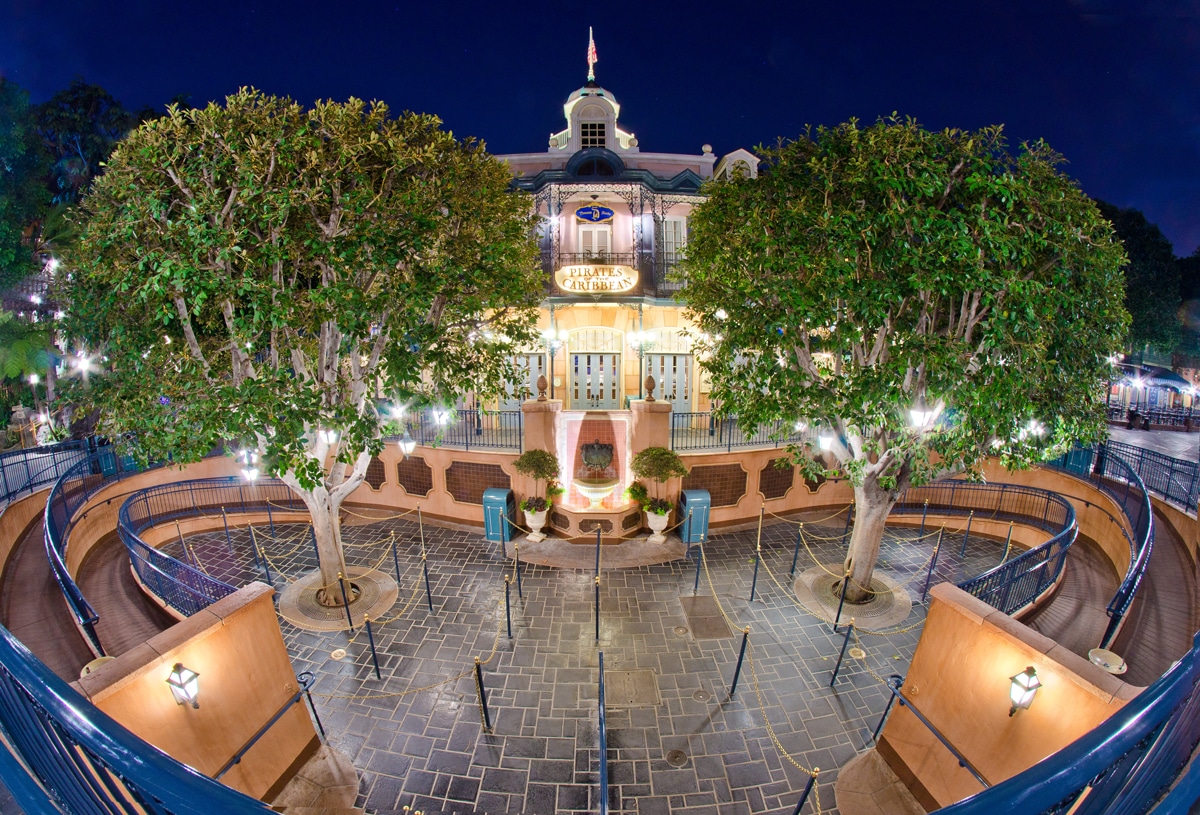
Walt Disney Imagineering has invented a brand-new Audio-Animatronics figure that transforms right in front of guests! The AA debuts today in Pirates of the Caribbean at Disneyland when the ride reopens from a lengthy refurbishment. Here’s the latest, including photos & video, plus my firsthand experience seeing this tech in-person during a recent tour of Imagineering’s offices in Glendale, California.
When the Pirates of the Caribbean attraction in New Orleans Square at Disneyland reopens to guests today after a lengthy closure that began back in early May, it should look and feel fresh. The extent of the changes made to the iconic attraction during its downtime are unclear, but Disneyland filed multiple construction permits for Pirates of the Caribbean, which cover a wide range of possibilities.
Among other behind the scenes work encompassed by the aforementioned permits, it’s our understanding that Disneyland maintenance teams and Walt Disney Imagineering worked on general upkeep, repairing rockwork, and enhancing show lighting, along with animation of the Audio-Animatronics figures. We now know that one such “animation” updates is some new magic introduced to one of the attraction’s classic scenes: the treasure-filled grotto.
For the first time, guests floating past this iconic scene in Pirates of the Caribbean at Disneyland will witness a pirate sitting atop a pile of cursed gold transform from a flesh-and-blood buccaneer to a skeleton right before their eyes.
Developed by Walt Disney Imagineering Research & Development, this transformation is made possible by the installation of innovative next generation Audio-Animatronics technology, combining real-time front projection with a mechanical head to create a highly detailed and expressive figure.
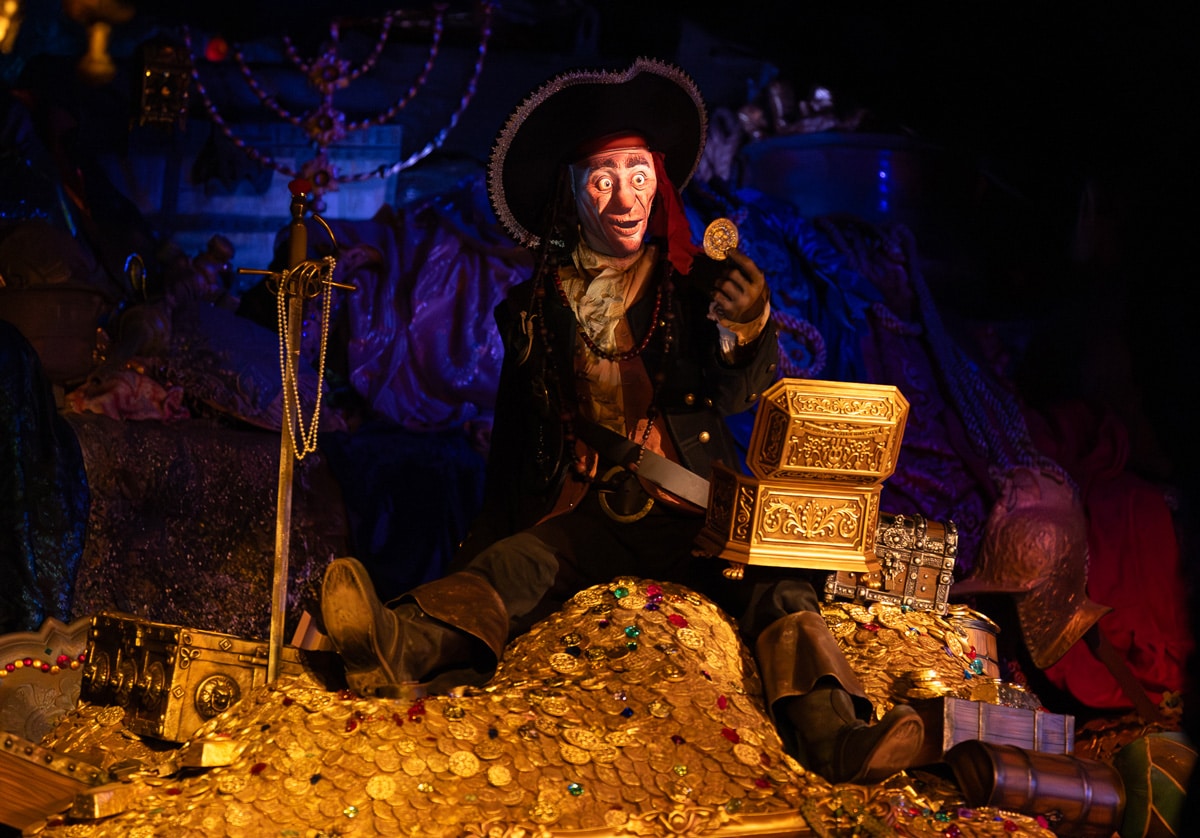
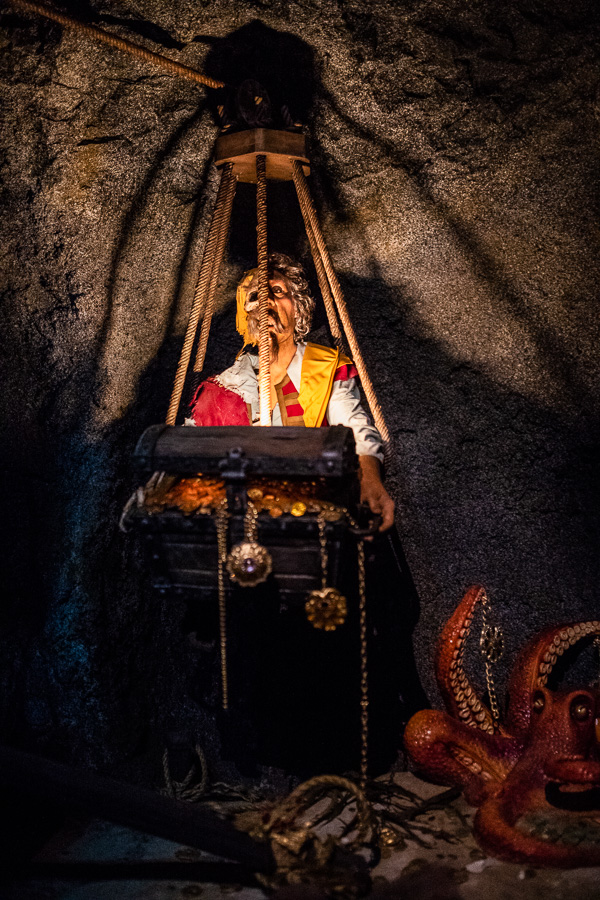
Here’s the human version of the transforming pirate:
…and the skeleton:
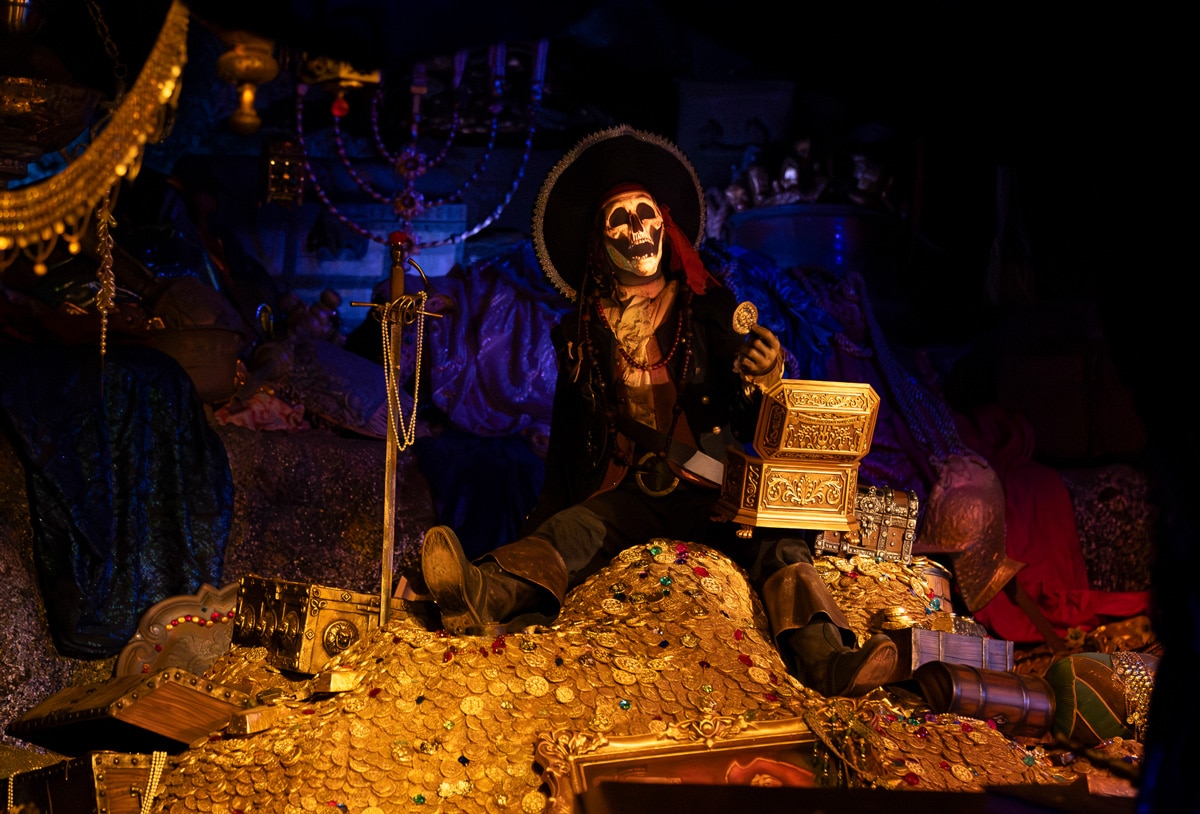
According to Disneyland, this next-generation Audio-Animatronics technology allows Imagineers to expand their storytelling repertoire and enable a whole new level of immersion for guests visiting.
The story of the pirate is that he picks up a cursed gold coin, freezing in time. He then drops the coin, releasing him from the curse. But the temptation is too powerful; he cannot resist the cursed coin, causing him to pick it up again and again, making the same mistake for eternity and locking himself in an endless loop. As with the other pirates in this cautionary tale, his insatiable greed is his doom.
Here’s the Audio Animatronics in action, with an explanation of the technology by Walt Disney Imagineering:
A new piece in TechRadar shares more about the mechanics (or lack thereof) of the new transforming pirate Audio Animatronics figure. Unlike traditional Audio-Animatronics that rely on complex mechanical systems for facial movement, this AA begins with a 3D-printed shell and no visible mechanical articulation in the face.
The pirate’s expression is driven almost entirely by a high-fidelity front-projected image mapped directly onto the character, which dramatically expands what Imagineers can create with physical characters. Think of a person crying, laughing, grinning with emotion, and ultimately being more human.
During calibration, a blue and white mesh grid is projected across the entire figure, mapping the projection system to every contour of the physical surface, from the brim of the hat down to the beads around the neck. Once that mapping is locked, the projected character snaps into place with precision.
With the installation of this new technology at Pirates of the Caribbean, this next-gen Audio-Animatronic platform has various sensors that complete calibration daily, as well as the necessary compute and projection tech, and redundancies for all of these. There are also cooling and filtration systems for the various components to keep running day in and day out.

Leslie Evans, Executive R&D Imagineer at Walt Disney Imagineering Research & Development told TechRadar that WDI chose Pirates of the Caribbean to showcase this new tech because the team was “looking for a figure where creatively we could do a great transformation,” and decided “this pirate transformation would be a great, great first place to do it.”
Evans explained that the new technology enables transformations that previously were “really challenging or in some cases impossible,” and will enable characters to blush, cry, or demonstrate other human emotions. Imagineering built and evaluated versions of the tech with individual facial features, including the nose, projecting onto them and asking whether the complexity added anything from a creative standpoint. If not, it was cut.
Evans explained that the real-time rendering is powered by Unreal Engine-based systems, animation tools, and incredible CG assets. However, she also added that Imagineering does not build technology for technology’s sake. The goal here is suspension of disbelief, and making people believe it’s real. “Everything is about telling a great story to our guests,” she said.
Just a reminder: This is the same front-facing projection mapping technology Disney first showcased last year. The pirate is simply the first real-world application of it we’re seeing in the parks.pic.twitter.com/aLLpD1X5AE https://t.co/NtnfC9lMst
— Scott Gustin (@ScottGustin) June 26, 2026
Our Commentary
I previewed this technology in person at Walt Disney Imagineering in Glendale as part of a wider-ranging tour of what’s being developed. When I saw it, this technology wasn’t tied to any specific character or attraction; it was more like a proof of concept for the platform itself.
The underlying technology was incredibly impressive as a demo. There’s a lot of potential for this as a blank slate technology that could be leveraged for more life-like humans. (Similar to the video above–it was also showcased in “We Call It Imagineering.”)
The version I saw was a real person, and it looked much better than this transforming pirate. If Disney ever acquires the rights to Die Hard, they could use this tech to create a dead ringer for John McClane because, from a few feet away, it looked like Bruce Willis was standing there in front of me.

One thing that was stressed during that tour was the aforementioned redundancies and responsiveness of the platform, all of which ensure that it’s reliable for in-park use. (A fair concern given what we’ve seen lately from Tiana’s Bayou Adventure and previous not-quite-ready for primetime implementations.)
My expectation was that it would be utilized to accurately convey Robert Downey Jr’s likeness in the upcoming Stark Flight Lab in Avengers Campus. Just to be clear, Disney and Imagineering were totally silent as to the intended in-park implementation(s), but that remains my assumption.
When it comes to that specific use case, there is tremendous potential for this technology. Even for all of the advancements in Audio Animatronics technology, Imagineering still hasn’t been able to get faces of real people quite right, a reality that became abundantly clear last year with the debut of Walt Disney – A Magical Life, which garnered, ahem, mixed reviews from fans.

Although the Walt Disney Audio Animatronics figure is impressive, it misses the mark just enough for fans to foil complete suspension of disbelief. Walt is well-known, and we’re all extremely familiar with his face. It’s a similar story with Tony Stark and other people from the Marvel Cinematic Universe. (Another possible use case is Harrison Ford in Indiana Jones Adventure, but I’d expect the rich history of off-model depictions of that character to continue.)
As with so many pieces of hot technology, the use of this will all come down to where and how it’s implemented. Imagineering can hire all of the world’s top wizards, but if they’re putting their wizardry in the wrong places, fans rightfully won’t be happy with the results!
Avengers Campus, featuring RDJ and other actors whose likenesses are well-known, is pretty much the optimal setting from my perspective. I still feel like that’s the actual intended end game for this technology, and Pirates of the Caribbean is an opportunity for a bit of real world testing before that expansion.
My assumption is that Stark Flight Lab will otherwise be a pretty straightforward ride, so adding a wow-inducing Audio Animatronics of RDJ would elevate the overall attraction. Sort of like how the best only good part of Avengers Assemble: Flight Force is the Iron Man AA.
NEW: Disney shared a first look at Walt Disney Imagineering’s next-generation Audio-Animatronics technology debuting today on Pirates of the Caribbean at Disneyland. The pirate figure transforms from a human into a skeleton. pic.twitter.com/uW1WfxmL8k
— Scott Gustin (@ScottGustin) June 26, 2026
Honestly, I’m a lot less jazzed on this type of technology for other use cases. I’m very pleased that Imagineering has otherwise moved away from projected faces, as the modern generation of AAs for Frozen, Beauty and the Beast, and other animated characters looks better with articulated faces.
Pirates of the Caribbean features humans, sure, but they’re depicted as Marc Davis-style caricatures. Cartoonified versions of buccaneers, which is precisely why the attraction works so well in the first place even as it showcases all sorts of nefarious behavior.
I haven’t seen this Pirates of the Caribbean Audio Animatronics in person yet, so I hesitate to comment beyond that about the specific implementation here. One thing I’ll note is that this type of technology often looks worse in photos and videos than it does on an actual ride. Hopefully this presents better in person with actual show lighting and the dynamic range of the human eye.
At minimum, I question how this transforming pirate fits within the narrative structure of Pirates of the Caribbean at Disneyland, which depicts the aftermath of their actions and frames what’s to come as a cautionary tale. In this sense, it reminds me of the Hatbox Ghost at Magic Kingdom, which was added as plopped down early in the ride without regard for the flow of the story. This doesn’t seem quite as egregious since it’s also a cautionary tale, but it’s still not an organic integration.

Beyond that, I’m of two minds about Imagineering tinkering with Pirates of the Caribbean (and Haunted Mansion, the other ride that gets this type of treatment). On the one hand, they’ve developed a lot of really cool technology that’s been implemented on the various versions of this attraction.
Pirates of the Caribbean: Battle for the Sunken Treasure at Shanghai Disneyland is among the most revolutionary attractions ever developed. It’s one of the best and most innovative attractions ever created; a mind-blowing experience with several wow-moments.
Ten years later, most of the tech from that still has not “trickled down” to the legacy versions of the attraction. (Although if we’re lucky, the ride system will finally be brought stateside to the Avatar boat ride in Disney California Adventure.)

There have been other enhancements to Pirates of the Caribbean that I’ve liked. The best example of this is the transforming Barbossa at Disneyland Paris (above and below), which is really cool and comparatively low tech, but nevertheless very impressive.
If the movie additions are going to remain in the iconic attraction, that’s the type of thing I wouldn’t mind seeing added at Walt Disney World and Disneyland (assuming there’s space, and I’m not sure that’s the case).
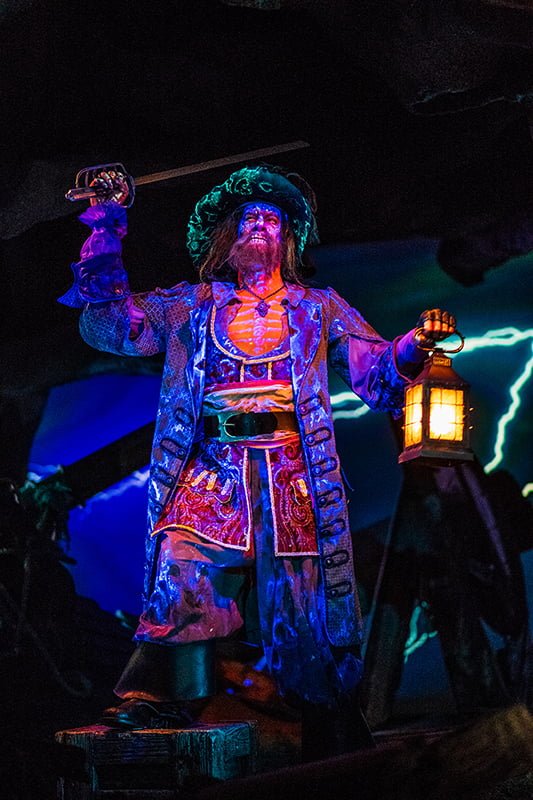
Imagineering has also done a lot of little things over the years with Pirates of the Caribbean that have resulted in less fanfare.
During one of the last big refurbishments at Disneyland, they added a somewhat similar (albeit lower tech) dead to life effect with a caged pirate and an octopus nearby (pictured below), restored dialogue and other effects, while removing some of the IP integrations. Those changes were unanimous hits with Disneyland fans.
Years ago at Walt Disney World, there was a brief test of mermaids in the attraction around the time one of the films was released. That one was more controversial, but I actually liked it.
On the other hand, we’ve been skeptical of Imagineering sometimes being obsessed with emerging technology and letting the tail unnecessarily wag the dog in some circumstances. There have been scenarios where it felt like fancy tech was leveraged gratuitously, and drew attention to itself as opposed to furthering the story and fading away.
That’s been the case more broadly, but it also feels like Pirates of the Caribbean and Haunted Mansion receive disproportionate attention from Imagineering. And arguably when they don’t really need it, as both are flawless, 10/10 attractions. Meanwhile, there are a dozen-plus attractions in Disneyland that actually could use some TLC and modernizations, such as the recently-reopened Buzz Lightyear’s Astro Blasters. Even if this AA looks better in person, I still question whether that budget could’ve been better spent elsewhere.
I feel like Disney often takes a “don’t fix what isn’t broken” perspective with things that ‘perform’ well, like Mickey’s Not So Scary Halloween Party or Oogie Boogie Bash, even when fans are begging for those events to be refreshed. At the same time, Imagineering doesn’t follow that mantra with perfect legacy attractions.
I get it. Imagineers are some of the most diehard Disney fans, and it’s probably dream come true and tremendous honor to iterate on the classic attractions that they grew up on. Pirates of the Caribbean and Haunted Mansion are why many of them became Imagineers in the first place! It’s only natural to want to work on those iconic rides, adding something that fellow fans will appreciate.
At the same time, with great power comes great responsibility. Pirates of the Caribbean and Haunted Mansion are classics that stand the test of time, and are themselves timeless…for a reason. It is exceedingly difficult to integrate modern technology with these decades-old attractions and have it all come together seamlessly. There have been as many, if not more, misses than hits with changes to these classics over the years.
To their credit, they captured lightning in a bottle with Hatbox Ghost at Disneyland (not Magic Kingdom). That’s one instance of the above that really works, and despite being more modern than the rest of the ride, the technology largely fades away. This transforming pirate looks like it’s trying to pull from the same playbook. I really hope it works better in person and is an actual enhancement, as opposed to looking like another instance of the technology tail wagging the dog and being incongruous to the attraction.
Planning a Southern California vacation? For park admission deals, read Tips for Saving Money on Disneyland Tickets. Learn about on-site and off-site hotels in our Anaheim Hotel Reviews & Rankings. For where to eat, check out our Disneyland Restaurant Reviews. For unique ideas of things that’ll improve your trip, check out What to Pack for Disney. For comprehensive advice, consult our Disneyland Vacation Planning Guide. Finally, for guides beyond Disney, check out our Southern California Itineraries for day trips to Los Angeles, Laguna Beach, and tons of other places!
Your Thoughts
What do you think of the new transforming Audio-Animatronics figure in Pirates of the Caribbean at Disneyland? Do you agree or disagree with our assessments? Any questions we can help you answer? Hearing your feedback–even when you disagree with us–is both interesting to us and helpful to other readers, so please share your thoughts below in the comments!

It sounds like they already went back and swapped out the new figure’s projection head for a physical skull. That was fast…
B-mode. Sigh.
Sure hope it looks better in person because on that video it looks like a cheap Halloween decoration. I also wonder about that placement, but I haven’t seen it yet, so maybe cautious optimism for now. Besides, what I don’t get why they seem to think we’re all going to be super excited about them fiddling around with popular classic rides and (like Tom said) fixing what ain’t broken. Maybe they should try that new tech on improving the “Walt” animatronic, cuz he needs some help.
I like the tech and concept. Will be interesting to see how well it is implemented.
Tiana’s Bayou Adventure does have issues. When we rode this ride a couple year’s ago, Tiana’s character at the end of the ride was “Dead” — she looked like a zombie or something out of “Thriller” with her head askew. It was rather disconcerting.
Since it was “reimagined” that entire ride is a waste of space. Poor narrative continuity and mediocre animations. The only good thing left about it is the final drop. Rode it once. That was enough.
Saw it tonight in person. It’s a neat effect…and I don’t mind the placement…but like so many things Imagineers do these days, it’s looped on too short of a cycle.
There should be several seconds of pause when the skeleton freezes…it would then lean more into the idea of being mysterious, and something you have to patiently keep an eye out for to catch it. As in: “did you just see that…I think that thing was moving?”….
As it stands right now, it loops about every 5 seconds, and that just feels way to repetitive and forced. As our boat floated by I think we saw the trick four or five times.
Regardless of the quality of the figure, the caverns are not the place to pull focus with flashy tech and sound effects. While the pirate skeleton is staged as the center of this particular scene, the stillness allows guests to explore the details of the surroundings and discover all those details that makes the DL Pirates so wonderfully textured. Now, guest attention is “forced” to the movement and sound of the new figure and not to the richness of the environment.
The DL Pirates is such a masterpiece because the Blue Bayou and caverns gradually pull guests into the dreamy otherworldly realm of the attraction. It’s unfortunate that the current Imagineers want to break that carefully-crafted spell to show off what they can do with a projection face.
That’s disappointing, it’s like current imagineers don’t understand subtle story telling or creating atmosphere…at all. Why don’t they go fix “Walt” with the shiny new tech?
I’m reserving judgement on the animatronic itself…but I’m actually impressed that they managed to keep it under wraps until the ride reopened. This seems like the kind of thing they usually can’t resist hyping up months in advance…
My guess is they were avoiding advance pushback from fans.
Or fix Figment, or fix the insufferably boring and disjointed Tiana’s Unnecessary Adventure.
I hope this looks better in person because for me, the video ain’t it. It’s *almost* convincing from the right angle, but that actually makes it worse in an uncanny valley sort of way. Something seems off to me in a way where I’m trying to figure out why it looks wrong rather than suspending disbelief. It’s also a weird choice when Disney just spent money to remove projected faces from a different boat ride that remains popular with guests.
I could see this being used in Avengers Campus; it seems very similar to what they’ve done over at Epic for Harry Potter, and I agree those do a good job of mimicking well-known faces. I could also see it being used on the Coco attraction, specifically for the secondary skeleton AAs I imagine we’ll see in the Land of the Dead. A way to give background figures more life while the majority of the budget goes into Miguel and Hector.
“I could also see it being used on the Coco attraction, specifically for the secondary skeleton AAs I imagine we’ll see in the Land of the Dead. A way to give background figures more life while the majority of the budget goes into Miguel and Hector.”
Great call–I didn’t even think of this, but that would absolutely make sense while also explaining this specific implementation.
I assume this looks better in person. How much better is the big question, and whether it’s enough to justify its own existence. The actual human versions look incredible; similar to those at Epic Universe in Potter and Monsters.
It will be scene from 20 feet away not super close up 4k camera footage with all the lights on. It looks awesome in real time.
Kinda reminds me of the Hatbox Ghost
” I question how this transforming pirate fits within the narrative structure of Pirates of the Caribbean at Disneyland, which depicts the aftermath of their actions and frames what’s to come as a cautionary tale. In this sense, it reminds me of the Hatbox Ghost at Magic Kingdom, which was added as plopped down early in the ride without regard for the flow of the story.”
I completely get the criticism of the Hatbox Ghost at MK. There shouldn’t be materialized ghosts before the Madam Leota room. But this one seems plausibly coherent to the Pirates story. I agree that you go back in time when enter the big ship room. But the story is not committed to how far into the future the skeleton caves toward the beginning of the ride are. Before the Pirates movie, we could assume that takes place long after the siege of the town. But it could be right after the siege as the pirates start going through their plunder and they are turned to skeletons by the cursed treasure. It still fits the cautionary tale of the violence and crime that caused the pirates’ downfall.
Yeah, that’s why I didn’t push too hard on the narrative element. Imagineering also offers an explanation in the video (which I’ve written out right before it) that is, as you put it, plausibly coherent. I don’t think it’s perfect, but it’s definitely not egregious like Hatbox Ghost.
Ultimately, I think they just wanted somewhere to test this tech in the wild before Avengers Campus (or wherever it’s actually going), and this scene in PotC checked enough of the right boxes. (And I also wonder if there’s been guest feedback that the opening act of PotC is “too slow” and this is a fix for that. I wouldn’t agree with that, but I also wouldn’t be surprised by it.)
This tech looks absolutely incredible.
Hit the nail on the head with the MK Hatty comparison – breaks the lore. Makes me sad…
Will they be able to use this tech in Florida or is it too humid?
Not sure, but I also can’t think of many use cases that aren’t climate-controlled in the first place.
I don’t think PotC is actually the intended implementation of this tech–just a convenient test at Disneyland.
Is this similar technology to the Victoria Frankenstein AA in Epic? If so, color me excited. I couldn’t stop staring at her face during the Monsters Unchained preshow, half-convinced it was a real person. That ride is stellar in general, but that specific animatronic is truly impressive to me.
I can’t speak to the underlying technology, but having seen both, they are very similar from a guest-facing perspective.
That’s why (IMO) this works best for actual humans. With the right show lighting, it can be very convincing.
I think it’s a fascinating new technology, and very impressive. But I also think it’s a bit “overkill” for POTC at Disneyland. Did the scene as it exists really NEED an enhancement? Also, I can’t help but think this is another thing that might “break” often and isn’t really needed here.
If the Imagineers want to play with POTC, I feel like the MK version is a better playground. Though the new DL pirate shown here looks cool, the MK version is so much lackluster to me (one hill, shorter duration, more boring show scenes) and could use more “wow” versus the DL version already had a more impact as it is.
My best guess is that Disneyland’s PotC being chosen came down to its proximity to Glendale where R&D is located and that attraction going down for a lengthy refurbishment giving them time to tinker and someone at WDI having an interesting idea for an implementation there.
I agree that MK’s PotC could benefit more from something like this (and it’d make more sense story-wise there), but I don’t think “plussing PotC” was the actual starting point here.
I truly do not believe this is the Endgame for this tech.
If you pause the video at the 8 second mark, the pirate looks like Keith Richards from the POTC movies.
I wonder if that’s intentional.
Pirates of the Caribbean & the Haunted Mansion are like the original Star Wars trilogy. They’re beloved and practically perfect, but creatives insist on going back and making changes to them. These changes range from harmless enhancements to hideous eyesores.
This falls into the latter camp for me, much like the Hatbox Ghost does in MK. I think the new tech is jarring juxtaposed with the 60s figures. However, more importantly, I think it is at odds with the attraction’s story and the tone of the existing scene.
I agree. It’s like they don’t know when to leave great things alone. But also never fix the ones that desperately need help. Sounds like they’re still unclear on subtlety and building atmosphere.
This is interesting, particularly as they have just moved away form projected faces in the Frozen ride. I’m curious if this looks like those did, or the intervening years have improved the technology. I don’t mint the projections that were the FEA (nd 7DMT), but I prefer the new ones.
Based on what I saw, this looks a lot better than the rear projected faces from a decade-plus ago. At the same time, I don’t think it looks better than the new Frozen (and other) AAs for animated characters.
Pirates of the Caribbean is sort of an in-between case. Obviously, they’re humans…but they’re not striving to accurately convey any particular person’s likeness and are caricatures of real pirates.