
2026 Crowd Calendars for Tokyo Disneyland & DisneySea
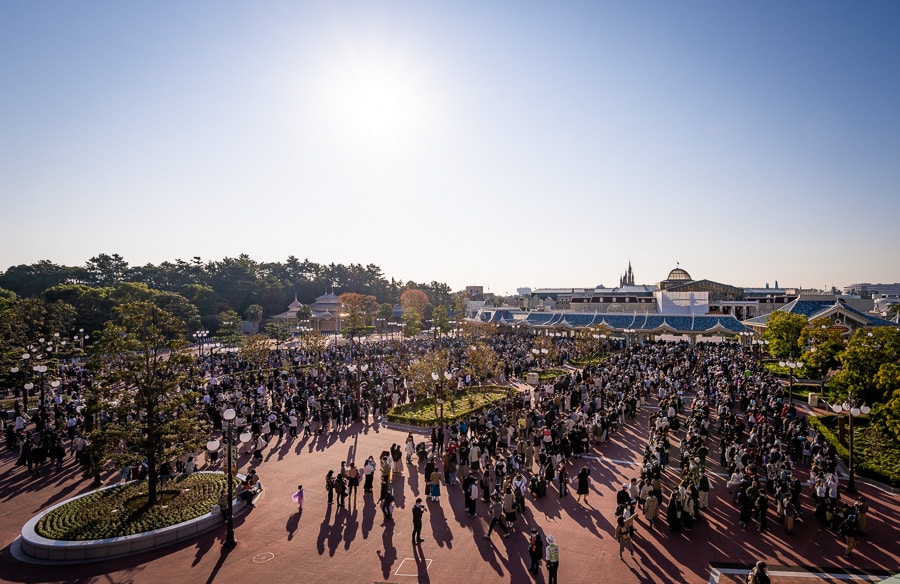
This explains how to use the most accurate 2026 crowd calendars for Tokyo Disneyland and DisneySea. Using daily attendance forecasts is important for choosing least busy days in the parks to avoid the worst wait times, congested viewing areas for parades, long lines just to enter the parks, and more.
Tokyo Disney Resort is notorious for having the busiest theme parks in the world, and it’s especially bad at Tokyo DisneySea. The good news is that our scathing post explaining Why Disney’s #1 Park is Getting 1-Star Reviews is no longer completely valid. The bad news is that too much of that still remains accurate and you absolutely need to arrive early, purchase Premier Access, use savvy strategy, and stay late in order to beat the crowds. And that’s just on a normal day.
The crowds at Tokyo Disney Resort cannot be overstated. Wait times at Tokyo DisneySea are high over 200 days of the year. It’s no longer as absurd as it was when Fantasy Springs was using a de facto virtual queue, but it’s still bad. There are 8 attractions that average wait times of 100 minutes or more. Five of those have averages above 2 hours. These are averages–peak waits of 240 minutes for multiple headliners is not uncommon!
If you’re still in the preliminary stages of thinking about a trip to Japan, start by reading our When to Visit Tokyo Disneyland post, which breaks down the best seasons. Tokyo Disneyland & DisneySea crowd calendars are more useful for narrowing your dates within a broad range than choosing the (qualitatively) best time to visit.
Before getting to that, we need to offer the important caveat that Tokyo Disney Resort still is not back to normal. The parks are still limiting attendance, with ticket sales capped below their prior levels. This is due largely to closed restaurants, retail, and temporarily unavailable entertainment. All of this still has not returned in the past ~5 years following the closure of the parks.
While individually minor, these absences significantly impact park capacity in aggregate. The end result is crowded shops and very long lines for dining options, especially at peak times. So even though park capacity is reduced and attendance is limited–which sounds good on its face–the end result is that ‘feels like’ crowds are worse than before.
In short, an attendance level of 30,000 right now is not equivalent to 30,000 in 2019. From a congestion and crowds perspective, 30,000 today is more like 40,000–perhaps more–in 2019.

This also impacts how theme park tickets are sold for Tokyo Disneyland and DisneySea. The biggest change is that only single-day tickets are currently available, which includes a variety of late-arrival passports and (sometimes) Park Hopper tickets. All of these are date-based, with pricing that varies based upon projected demand. And Park Hopper tickets are so expensive that they have a negligible impact on crowd dynamics, even when available.
Multi-day tickets are not being sold, nor are Annual Passes. This is also important to take into account, as the lack of Annual Passes and all multi-day tickets has disrupted the normal attendance dynamic (e.g. weekdays significantly slower than weekends) at Tokyo Disney Resort.
The patterns are not nearly as consistent or predictable for 2026 at Tokyo Disneyland and DisneySea as they were in 2019 or earlier. And because prices are date-based, value-seeking locals with flexible schedules often target the less expensive dates.
The result is that significantly more expensive weekends can, from time to time, end up being less busy than adjacent weekends. That would’ve never happened back when Annual Passes were available. Those peak priced dates would’ve been insanely busy, not comparable to adjacent weekdays.

The other caveat we need to add is that Fantasy Springs is now open at Tokyo DisneySea. That blockbuster new $2 billion expansion themed to Peter Pan, Tangled and Frozen is the eighth themed port of call at Tokyo DisneySea, and has had a huge impact on attendance patterns and crowds.
More to the point, it’s had an inconsistent and somewhat unpredictable impact on attendance trends. The first ~6 months the new port was open, Oriental Land Company (OLC), the owner and operator of Tokyo Disney Resort, reports that Japanese guests largely avoided it for fear of larger crowds…making it less crowded than it was during the holiday season. Attendance was actually down that summer as compared to the prior year!
The expectation is that crowds will continue to trend up in 2026, but that’s not certain. Summer was once again down last year (not year-over-year, but as compared to the baseline), which is a bigger-picture trend that theme parks are experiencing.
OLC previously revised its attendance projections down by 1 million guests, which is a huge change and reflects reduced expectations for Fantasy Springs. Going forward, the new land will undoubtedly be popular, but actual attendance growth is far more modest.
Not even OLC knows for sure, and they have access to future bookings and ticket sales! Thus far, attendance in the 2026 fiscal year has been largely flat–up only 0.4% year-over-year according to the most recent quarterly report.

There’s still pent-up demand, especially among international tourists who were shut out of Japan. These foreign travelers are now entering in record numbers. Japan has set all-time records for arrivals throughout the last two years, smashing the record previously set in 2019.
Every single month was up at least 30% year-over-year, and it’s expected that 2026 will be another record-setter for international travel. The weak yen is certainly a contributing factor there, and there’s no end in sight to that.
Whereas the U.S. parks have almost entirely recovered and gotten back to normal at this point, the same cannot be said for Tokyo Disney Resort. Staffing shortages colliding with operational inefficiencies and cutbacks plus pent-up demand are still disrupting crowd patterns. The “feels like” crowds are far worse now than they were in pre-COVID.
Point being, you should not expect crowd calendars to be quite as accurate as in the past. Moreover, even the lower attendance levels identified on the Tokyo Disneyland and DisneySea crowd calendars will feel worse than they did in pre-closure years. Keep this in mind, and don’t overly on the crowd calendar below. It’s not going to be 100% accurate–more like 75% or so.

With all of that out of the way, we recommend consulting AOKSoft’s Tokyo Disney Crowd Calendar, which has attendance projections for both Tokyo Disneyland and Tokyo DisneySea.
Note that this Tokyo Disneyland crowd calendar is not something we’ve created. While we are Tokyo Disney Resort regulars who had Annual Passes for years, but it’s still outside the scope of our knowledge to create crowd calendars for these parks.
With that said, we’ve spent enough time in Tokyo Disneyland and DisneySea over the years to be able to surmise that this crowd calendar is largely accurate. It’s not immediately intuitive (even when translated), so here’s a rundown of how to use it…

Ever since we first published our Tokyo Disneyland Planning Guide, we’ve been recommending the AOKSoft Tokyo Disneyland Crowd Calendar.
Originally, it was one of two crowd calendars we recommended–and we actually listed the AOKSoft one second because it was more difficult to understand. We’ve also received a ton of questions from readers who had difficulty using the AOKSoft crowd calendar, which is only in Japanese.
For starters, you’re going to want a browser that translates webpages. Once you’ve pulled up the AOKSoft Tokyo Disneyland Crowd Calendar in that, it’s much easier to use. Thanks to the Google Translate assist, you should see a page with a graphic that looks like this:

With Google Translate, this is pretty easy. The first thing to know are that the calendar defaults to Tokyo Disneyland, but you can toggle that to Tokyo DisneySea with the blue button at the very top (spoiler: crowd numbers track between TDL to TDS; the latter is just proportionately lower most days). The buttons to the left and right of the current month navigate you to the previous (left) or next (right) month.
“Day” is Monday and “Soil” is Sunday (the names of the weekdays are a definite Google Translate fail!), but that should be obvious if you compare the blue dates on this calendar to your calendar. Next, the number in the square is the crowd projection, which represents anticipated attendance (more on this below). Finally, at the very bottom, you can toggle the weather to show how it impacts crowds. As with the TDL/TDS toggle buttons, it’s usually a proportionate change.
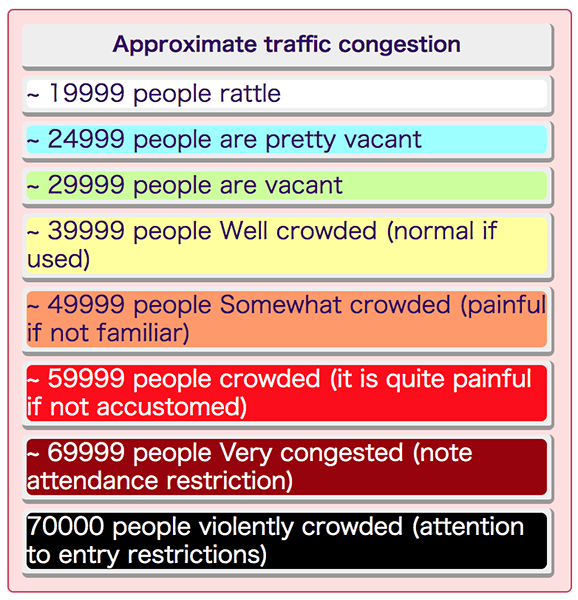
Above is the legend for those crowd numbers, as amusingly translated by Google. Obviously, the lower the number the better. Contrary to what the translation suggests, there is no rattle on light attendance days, nor is there violence on high attendance days. For your first visit to Tokyo Disney Resort, we recommend starting with two days that are yellow or lighter.
On orange days, the biggest difference you’ll notice is lines at restaurants and people claiming spots for parades and entertainment earlier. There are a couple of easy solutions to this: eat lunch by 11:30 a.m. (noon and after is when things really get bad) and schedule your entertainment around days that are yellow or lighter.
When it comes to attraction wait times, you will notice very little difference between yellow and orange days, especially if you arrive at rope drop and utilize strong touring plans. Our 1-Day Tokyo Disneyland Itinerary and our 1-Day Tokyo DisneySea Itinerary can help with that.

Another thing I really appreciate about this crowd calendar is its information density. This can be overwhelming the first time you look at it, as there’s a lot going on, but the good thing is that at its core, all you truly need are those numbers on each date in squares and the knowledge that lighter is better.
However, after you play around with dates for a bit, your comfort level should quickly grow, and you can start playing around with other features and looking at other info that’s provided. One key resources is the right sidebar (above) which lists everything from special events to refurbishment dates to national holidays in Japan that impact crowds.
This can be invaluable information, and save you from juggling multiple browser windows as you plan your travel dates.

Earlier in the post, we mentioned that the AOKSoft Tokyo Disneyland Crowd Calendar used to be our secondary recommendation. Our favorite crowd calendar was by TDRNavi, which you still might find referenced on older pages on this site.
Now, their old crowd calendar page redirects to a “Disney Countermeasure Congestion Guide.”) That Tokyo Disneyland crowd calendar was more intuitive and easier to read, and equally accurate.
I’m not sure why TDRNavi stopped publishing it, but I have a guess: reliability. Around 7 years ago, we found that both crowd calendars were right on the money. I mean, I obviously can’t speak to the precise attendance numbers being forecast, but the relative crowd levels from day to day were always accurate.
In the time since, we’ve seen a gradual erosion of accuracy on the AOKSoft Tokyo Disneyland Crowd Calendar. Even though we aren’t skilled enough to create our crowd calendar, we visit during all different times of the year for several-day stretches, and have first-hand experiences with different crowds.
There have been several times when we’d plan visits around their “Pretty Vacant” (blue) dates, and found a couple of days that were on par with their “Somewhat Painful” (orange) dates.
It’s impossible to attribute this to any one variable. There are a number of possible explanations, from Tokyo Disney Resort marketing off-season dates more heavily to undeniable demographic shifts that have occurred as Japan has seen a surge in overseas tourism.

Whatever the explanation, we should reiterate that the AOKSoft Tokyo Disneyland Crowd Calendar is still pretty reliable and should definitely be consulted.
We’d say it was about 95% accurate up until 2018, 75% accurate pre-Fantasy Springs, and probably 70% accurate today. That’s still pretty good.
Suffice to say, none of this is to knock the Tokyo Disney Resort crowd calendar. As we’ve seen with the U.S. parks, it’s simply more difficult to predict crowds now with so many complex variables at play.
If you do want other Tokyo Disney Resort crowd calendars, there are now a few pretty good options:
Of these, Kidokoma is far and away my favorite. It’s the only one of the bunch that’s Japanese and seems to be based on more than just past wait times data. Don’t get me wrong–past data is valuable and the single best predictor of future crowds. But there’s more to it than that, and I don’t see either of the English TDR crowd calendars adjusting for shifting holidays, pricing, or anything else.
I also really appreciate that the Kidokoma Tokyo Disney Resort crowd calendars publish their accuracy, which is great for transparency. They claim a 90% accuracy rate, which is pretty impressive. I haven’t used Kidokoma long enough to vouch for this (it’s a new to me TDR crowd calendar), but I’ll definitely be monitoring it going forward. If this crowd calendar does well, it might become a top recommendation alongside AOKSoft!

Finally, a note on those infamous crowds at Tokyo Disneyland. Thanks to social media, images have circulated of huge lines to enter the park, heavy crowds waiting for entertainment, and long wait times for popcorn. There’s no denying that Tokyo Disney Resort can have some of the worst crowds in the world.
What is not accurate is the suggestion or belief that this is an everyday occurrence. Well…except at Tokyo DisneySea in the aftermath of Fantasy Springs opening. Our hope is that the fanfare around Fantasy Springs dies down and Tokyo Disney Resort changes its current (terrible) entry policies.
That would go a long way in fixing this issue. Otherwise, guests do arrive to enter the parks early every morning, causing huge pre-park opening lines to form that are photographed from the monorail and circulated on social media for shock value. Punctuality is a cultural thing, and it’s absolutely true that people line up early to enter the parks in Japan. Every. Single. Day.

There’s also a sharp divide between weekend and weekday crowds. Japan’s parks are less tourist destinations and draw more of a local audience, which means people visit when their normal lives allow for it, e.g. weekends. Add that to the fact that these two parks are a short train ride away from one of the most populous cities on earth.
It thus should be zero surprise that AOKSoft Tokyo Disneyland Crowd Calendar shows attendance numbers that are often higher on Saturdays than Fridays. Anyone who has visited Tokyo Disney Resort on a weekend and a weekday can probably attest to their weekday experience being noticeably less crowded and more pleasant.
Again, this dynamic is not as pronounced right now as it once was, but we expect that to change over the course of 2026. It might take until 2026 or 2027 before things are entirely back to normal at Tokyo Disney Resort. We wouldn’t be the least bit surprised if multi-day tickets don’t return until mid-2026 and Annual Passes aren’t back until 2027. That’s a very plausible scenario, and one that means an ongoing disruption of “normal” crowd trends.

In addition to Tokyoites, people from other major cities in Japan take the train for a weekend getaway to Tokyo Disney Resort, which is why hotel rates are often double the cost for Friday and Saturday nights than any other day of the week. (This is why we almost always book hotels arriving Sunday and checking out Friday morning.) As we’ve stressed elsewhere, avoid the weekends at Tokyo Disney Resort unless you have no other choice.
Ultimately, the AOKSoft Tokyo Disneyland Crowd Calendar is an invaluable planning resource, but you shouldn’t feel beholden to it. Choosing a season that works best for you, has the most appealing entertainment, and has more favorable weather might be more important to you than +/- 10,000 people in the park. Plus, at the end of the day, avoiding weekends and visiting exclusively on weekdays will have the largest impact on the crowds you experience. Nevertheless, all else being equal, it never hurts to choose a week that’s projected to be less-crowded!
Planning a trip to Tokyo Disney Resort? For comprehensive advice, the best place to start is our Tokyo Disneyland & DisneySea Trip Planning Guide! For more specifics, our TDR Hotel Rankings & Reviews page covers accommodations. Our Restaurant Reviews detail where to dine & snack. To save money on tickets or determine which type to buy, read our Tips for Saving Money post. Our What to Pack for Disney post takes a unique look at clever items to take. Venturing elsewhere in Japan? Consult our Ultimate Guide to Kyoto, Japan and City Guide to Tokyo, Japan.
Your Thoughts
Have you used the AOKSoft Tokyo Disneyland Crowd Calendar to plan your travel dates in Japan? Did you find it relatively accurate? Do you agree or disagree with our take on Tokyo Disney Resort crowd levels? Any questions? Hearing your feedback–even when you disagree with us–is both interesting to us and helpful to other readers, so please share your thoughts below in the comments!


As I’m considering to visit TDR (and HKDL) in November next year, I’m checking https://en.disneyreal.asumirai.info/crowd/disneysea-past-calendar.html for the crowds this month. Unfortunately, the crowds are very high, even higher than those previous year, and I cannot explain why… So not sure if I should visit TDR in November next year…
It’s a bit disconcerting (reliability-wise) that neither AOKSoft nor Kidokoma calendars show any uptick in TDS crowds on April 15, 2026, the start of the Jubilee. Hard to imagine it won’t be suddenly more crowded when that starts.
They probably aren’t “finalized” until closer to those dates arrive as there’s a lot of data that isn’t available right now. Perhaps I should add that caveat in the post.
With that said, we’ve gone at the start of anniversaries in the past, and once you get past the first few days, it’s often not that noticeable. Especially if prices are lower before and higher after.
OK. I guess for now I’ll tentatively look at the middle of May instead. Better weather, plenty of time (I hope) for the Jubilee thrill to wear off, and Sinbad will be re-opened. And this Tom guy on the Internet says it’s the best time…
the crowd calender is down 🙁
Hi Tom, the AOKSoft crowd calendar is down and has been for weeks. Do you have any alternatives you can recommend?
Thanks for all the info! We’ll be in Tokyo the first two weeks of March and Sunday is the least crowded. Is that the norm? I was thinking of going on weekday, instead of a weekend day, but if Sunday is the least crowded, I’m all for it!
Great information Tom. We are actually splitting our Disneyland trip next month. With a Thurs and Friday, Kyoto on the weekend and back to TDL for Tues-Wed-Thurs. This crowd calendar shows lots of rattling and white. So hopefully the Disney gods will be on our side in the summer heat!
Hi Tom! Thank you so much for the wealth of information you’ve provided! I’m going to Tokyo Disneyland and Disney Sea for the first time with my family in October of this year. Looking at the crowd calendar you recommended, it looks like the entire month is projected to have super low crowds (even on weekends) unless I’m missing something? The little box with the color indicating crowd levels is white with a little dash inside for pretty much every day of the month which is very surprising to me considering every you’ve said about weekends and Halloween being busy. Am I missing something, or can I actually expect blissfully low crowds when we go?
Hi Crystal, when the box indicating crowd levels is white with a line through it, that means it hasn’t had a value assigned to it yet. Essentially they haven’t done the crowd estimate for those dates yet.
I am also going in October this year and am watching the crowd calendar keenly for when it puts the information for more dates up!
Oh okay, that makes sense, thank you! I guess I’ll keep checking and keeping my fingers crossed
Following up on Niki’s post re: deciphering the AOK crowd calendar (I noticed the same thing right away, too!)
“Day” is Sunday and “Soil” is Saturday. And to fill in the rest: moon = Monday, fire = Tuesday, water = Wednesday, wood = Thursday, mone(y) = Friday.
Sincerely,
– a native Japanese speaker, first time poster, and long time fan of your site 🙂
Just a quick correction from a Japanese speaker! Monday is moon day and Saturday is soil day. Thank you for all of your hard work! I read your blogs for Disney world and Disneyland too!!!
This post is spot on! We have been regular Tokyo Disneyland and Disney Sea goers since 2012.
Hi!
First, thanks for all this great information, it is incredibly helpful. I’m a regular at Disney World, and am now planning my first trip to Tokyo Disney Resort. As well, for the first time in a long time, taking young kids with us.
I went through the 1 day Itineraries, but know they are pre-COVID. Any chance you might be tweaking them soon for those of us going in the next few months?
Thanks again!
I keep hearing March is a bad time to visit but the calendar (both 2022/2023) says it’s not too bad. Has spring break not been accounted for yet?