
Disney World Explains Attraction Queue Re-Entry Rules

Disney expanded step-by-step rules & tips for guests with disabilities to access rides in the Walt Disney World and Disneyland theme parks as an alternative to DAS. This covers details of these lesser-known policies, which clarify how to use the Disability Access Service substitutes in the event of DAS denial, supplementation, etc.
As quick background, Disney overhauled DAS at Walt Disney World and Disneyland back in May 2024. According to the company, the changes were due in large part to abuse, misuse, and proliferation of the program’s use–with issuances of DAS tripling from 2019 to the time of the reforms. For more about the specifics of the overhauled DAS, see Disability Access Service (DAS) Changes at Walt Disney World FAQ.
Although there have been no major policy changes since then, it’s been a veritable roller coaster of rule rollbacks, tweaks, and other more minor–but often meaningful–updates. Some of this has likely been in response to a class action lawsuit filed last year. There’s also a proxy proposal seeking an “Independent Review and Report on Accessibility and Disability Inclusion Practices” that will be voted on during the Walt Disney Company’s 2026 Annual Meeting of Shareholders on March 18, 2026.
It’s worth noting that these are not major substantive rule changes to Attraction Queue Re-Entry nor is this a new feature, just an under-discussed and under-utilized one. In actuality, this has been policy since the DAS overhaul. This is more about transparency, and clearly conveying how this feature works.
Some of this was previously published, but there was also a lot of confusion around this feature and how to use it as a DAS alternative or supplement. (Thanks to Hastin for bringing these Attraction Queue Re-Entry changes to my attention–I would’ve missed them otherwise.)
Here’s the updated/expanded verbiage that now appears on both Walt Disney World and Disneyland’s pages for Accessing Attraction Queues:

Attraction Queue Re-Entry or Meet-Up
Guests with specific needs that may arise while waiting in an attraction queue may exit the queue while the rest of their party waits in the queue. The Guest may then re-enter the queue prior to boarding the ride. A Guest may also wait outside the queue and meet up with their party before boarding the ride if needed based on the nature or condition of the queue at a particular attraction and the Guest’s specific needs. Every attraction has a defined process to support these options.
How to Use Attraction Queue Re-Entry or Meet-Up:
To leave and Re-Enter a queue…
- 1) At the entrance of the attraction, talk with a Cast Member to learn about exit options should you need to leave the queue.
- HELPFUL HINT: If you already know how to exit the queue, then you don’t need to speak with a Cast Member prior – just join the queue.
- 2) In the event your specific need requires you to leave the queue, simply exit while the remainder of your party stays in the queue.
- HELPFUL HINT: If you need someone to help you – they can leave with you while the remainder of your party waits in the queue.
- HELPFUL HINT: If you are traveling alone or with party members who can’t be left alone in the queue, please contact Accessibility Services prior to your visit.
- 3) When you are ready to return, go to the front of the attraction and let a Cast Member know that you are using the Attraction Queue Re-Entry accommodation and need to regroup with your party in the queue.
- HELPFUL HINT: You don’t need to discuss your reason for needing to leave the queue.
- 4) The Cast Member will help you meet your group to ride together.

To Meet Up with your party that has been waiting in the queue…
- 1) At the entrance of the attraction, the members of your party joining the queue should ask a Cast Member at what point they should let you know it’s time to join them.
- HELPFUL HINT: Other members of your party must join the queue, and you should make sure your party can call or text you to meet up.
- 2) When your party lets you know that it’s time for you to join them, go to the front of the attraction and tell the Cast Member you are using the Attraction Queue Meet-Up accommodation and need to meet up with your party in the queue.
- HELPFUL HINT: You don’t need to discuss your reason for waiting outside the queue with the Cast Member at the attraction.
- 3) The Cast Member will help you meet your group to ride together.
Again, the Attraction Queue Re-Entry procedure has existed since the DAS relaunch; its existence as an alternative hasn’t been highlighted, nor has the process been fully articulated. This changes that, expanding and clarifying the ‘how’ of Attraction Queue Re-Entry or Meet-Up with the above steps and ‘helpful hints’ added.
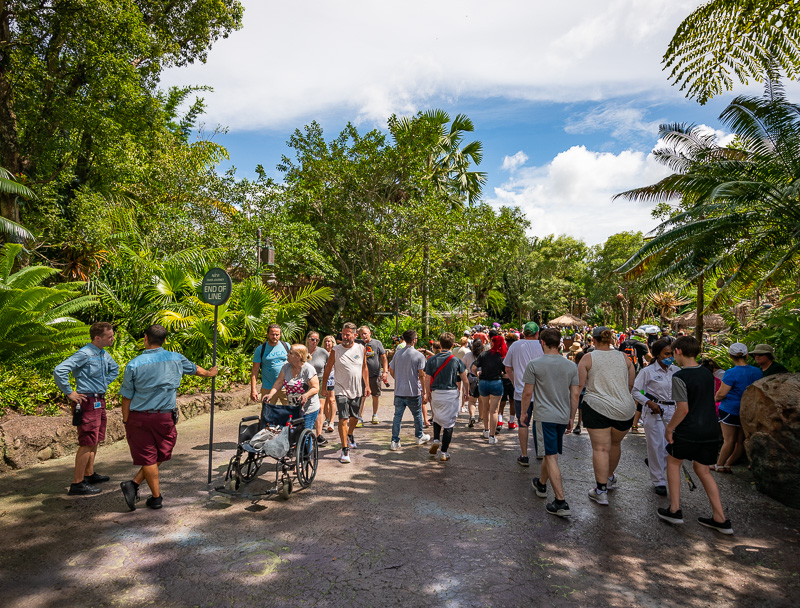
Our Commentary
The Attraction Queue Re-Entry or Meet-Up feature was one that was anxiously awaited by many Walt Disney World fans prior to the launch of the overhauled DAS. Details were minimal at first, but Disney has slowly offered more and more about the mechanics of using Attraction Queue Re-Entry.
In the last year-plus, we’ve heard a lot of stories about Attraction Queue Re-Entry or Meet-Up from readers who have used it. While I’d still assess these as being very much a mixed bag, the trajectory is clearly heading in the right direction. It seems like there are fewer horror stories and more success stories.
In fact, several readers have indicated that Attraction Queue Re-Entry or Meet-Up has served their needs perfectly. Again, this isn’t to say it’s a perfect system. There are still horror stories, and it’s not my intention to gloss over those and paint a picture of rainbow and sunshine perfection for everyone.

As longtime readers might know, my dad previously qualified for DAS under the pre-closure policies. He almost certainly would not qualify for the overhauled DAS, which is fine, because a functioning Attraction Queue Meet-Up is the actual, optimal solution for him. (We haven’t used it, as he hasn’t been to the parks since the DAS changes, so no firsthand experience to share here.)
The key components of a “functioning” system or “optimal solution” are Cast Member assistance and communications at the attraction entrance. That’s what actually makes this an actual system or protocol, and not just a DIY solution. Informally, it has always been possible to leave lines and rejoin them by awkwardly saying “excuse me…” while trying to squeeze past people in the standby line.
The big issue with leaving lines and rejoining them is a matter of ‘guest glares’ (for lack of a better term). It doesn’t take a disability to realize how judgmental other guests can be. If guests are perfectly comfortable being vocally rude to pregnant women or a solo parent with small children–two visible and obvious circumstances for needing to exit and reenter a queue–I can only imagine how much worse it gets for guests with invisible disabilities.
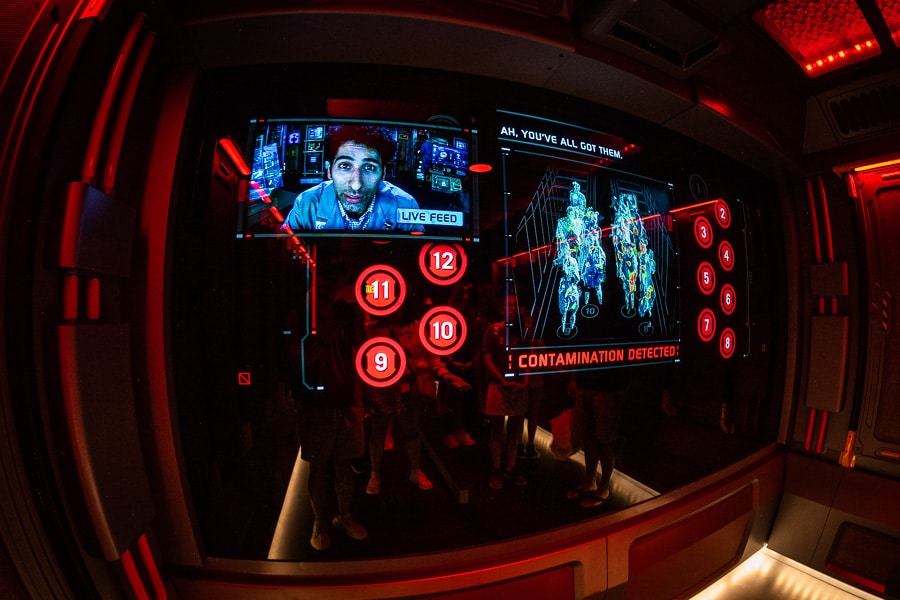
Attraction Queue Re-Entry or Meet-Up would work best if one of the options for Cast Member help is an actual escort to rejoin the rest of the part. Or if the procedure is something more substantial than the aforementioned weaving back through the standby line while saying “excuse me…” on loop.
Otherwise, guests with disabilities needing to exit and re-enter the queue are at the mercy of other guests being amenable to people passing them–going in the “wrong” direction to leave and then “cutting” them to rejoin the queue.
It’s not hard to imagine this leading to hurt feelings, disabled guests feeling small or humiliated, or even actual confrontations. I would dread someone saying something rude to my dad, because he’s at that filterless ‘zero forks given‘ point of his life. Whatever they say is not going to hurt his feelings, but his response will hurt theirs. Probably not something that should be caught on camera and spread on social media.

For the Attraction Queue Re-Entry feature to be a serviceable alternative to DAS, the process needs to be a clearly-communicated, transparent, and ideally visible to other guests.
If it’s not feasible for a Cast Member escort, something as simple as a hall pass from the grade school days could be offered. I’m not saying that Disney needs to hand out keys tied to obnoxiously oversized rulers, but something visible might be best.
Disney has already used a similar system in the past–the red FLIK cards with lanyards for tracking actual ride wait times. Something like that might work. The goal with this would be conveying to average guests that those using Attraction Queue Re-Entry or Meet-Up aren’t trying to cheat the system or cut in front of them.

We all should err on the side of courtesy and not judge others–that disabled guests would trade places with you in a second and stand in long lines if it meant not being disabled. You don’t know what someone’s circumstances are, whether they have an invisible disability, etc., so it’s best to just mind your own business.
There’s just no upside to being rude; it’s not going to change anything, and is stressful for all involved, yourself included. It’s better to have a live and let live attitude, rather than sweating stuff that’s pretty inconsequential in the grand scheme of things. Kind of like my attitude towards the Cosmic Rewind pre-show; the stress and discomfort isn’t worth shaving 1-2 minutes off your wait time.
It’s a bit shocking just how comfortable people have become with being nasty. One of the greater thinkers of our time, Mike Tyson, put it eloquently: “Social media made y’all way too comfortable with disrespecting people and not getting punched in the face for it.” That’s really underscored when guests are nasty to one another at a place like the Disney parks. I’m probably preaching to the choir, though.

Ultimately, if the Attraction Queue Re-Entry or Meet-Up feature is not done in such a way that other guests know about it and how it works, it’s going to lead to more disdain towards the disabled among other guests. More importantly, it also wasn’t going to be utilized by those who could use it (but were denied DAS or have opted against applying after hearing horror stories) if what’s published is vague or confusing.
The bottom line is that clarifying how these DAS alternatives or supplements work via a step-by-step policy on the official websites is a step in the right direction. Here’s hoping the on-the-ground implementation of Attraction Queue Re-Entry or Meet-Up makes the system intuitive and easy to use for those who need it.
Planning a Walt Disney World trip? Learn about hotels on our Walt Disney World Hotels Reviews page. For where to eat, read our Walt Disney World Restaurant Reviews. To save money on tickets or determine which type to buy, read our Tips for Saving Money on Walt Disney World Tickets post. Our What to Pack for Disney Trips post takes a unique look at clever items to take. For what to do and when to do it, our Walt Disney World Ride Guides will help. For comprehensive advice, the best place to start is our Walt Disney World Trip Planning Guide for everything you need to know!
YOUR THOUGHTS
Any firsthand experiences using the Attraction Queue Re-Entry or Meet-Up protocol? Was your experience positive or negative? Were these features easy to use? Was the implementation consistent with what’s on the website? Agree or disagree with our assessment of the changes or policy as a whole? Please try to stay on topic–we’ve noticed some of these DAS comments sections get heated and personal. Discuss the policy itself, not others’ use (or lack thereof) of it.


Thanks Tom.
I very much enjoy your articles, especially your family tales. They’re reminiscent of our early days in WDW and bring back many memories and a few laughs. I just try to separate the “fun” articles and experiences from the instructive ones. We’ve learned a lot from your observations even though I don’t agree with all of your conclusions.
Question: Have you ever considered amalgamating your family timeline blogs into a book of sorts? There are plenty of Disney “How To’s” out there, but if you went back to when you and your lovley bride first started out exploring Disney together, emphasizing the personal aspect and going up up to the present day, I think it’d be unique and I’d happily purchase a copy. You certainly have enough material and it’s really been fun and interesting to have followed you two, then three, over the years. I’m sure others would also find this so. You could self publish. My brother in law was a roadie for a rather famous heavy metal rock band back when. A few years ago he self published a memoir, even eventually did a photo-illustrated hard cover. He’s not a polished writer of your skill by any means, he didn’t make a million bucks, but he had fun and sold a few thousand copies to boot!
Our Best!
Here’s an idea. Introduce free passes that allow you to jump the queues, maybe a maximum of three with only one of them for a top tier ride. Thereafter you can get one free pass at a time
Disney used to do that; now they charge for it (Lightning Lane passes.)
Im sorry but if you “cant be” on a line- why the heck are you at Disney World? Disney is essentially a line for everything you do there.
Its like going to a meat convention and u r mad there is no broccoli lol
I will repeat Mike Tyson here but you are too comfortable so I rather not. By the way, people should be allowed to have fun independently of their needs.
So handicapped people should not be allowed to have fun? That’s BS and not funny.
I had the experience of different CM reacting differently to our asking for a return time due to my husband needing an accommodation for invisible disability. Some did not have an issue, others asked “how many” in the party, and yet others said they were making a one time exception and that other rides might not do it. The inconsistency and difference in the CM attitudes is stark. No one with a disability, especially one others cannot see, wants to discuss this with a stranger. It’s very hard to do and should not be a thing. So I pray that at some point things will be more streamlined and if a DAS call CM says to let the CM at the ride know we cannot be separated and they argue with us, that can actually trigger the disabled person. It’s shaming and degrading. I don’t know what else to say.
Report those CM’s. They should get retraining. I fully understand that CMs have difficult jobs, but if these guidelines are known by non-CMs, then the CMs should be aware of them too.
I’ve heard sentiment like this from a lot of readers, unfortunately. It was especially bad at the beginning, when clearly Disney created new policies without communicating anything to frontline CMs.
Since then, it seems like things have gotten better with specific policies/procedures at each attraction, training and communications, but it still isn’t perfect. My hope (as mentioned below in another comment) is that these policies being better explained to guests *also* means there’s more happening internally to make things smooth and consistent.
Excellent write-up – thank you for the background and personal insights.
Bill
Two things:
1. Your information is interesting but what you’ve said could have been communicated with far less verbiage. You don’t actually get into the “meat” of your article until about a third of the way in and even then you wander. Please consider being more concise.
2. What you’ve described has existed for as long as I can remember coming to Disney, and that is since before dirt was invented. My first trip was in 1971 shortly after MK opened. We stayed at Shades of Green which, as I remember, was the only “On Campus” resort fully open at the time. At the time it reminded me lots of a plain-vanilla motel.
In any case, what you’ve described in so many words, is the codification of an extant process and therefore, a non-solution, to the DAS “situation”.
Hope this finds you and the family well.
Best
Jack
Jack
1. Thanks for the feedback; you’re right. I’ve gone back and edited further, shaving off ~400 words, most of which were before the ‘meat of the article.’ There’s still a bit too much rambling in the commentary, but nothing I can fix without extensive time reworking the article. And I figure that’s better spent elsewhere, especially since the main point has already been made.
2. If you’re talking about informally meeting up with people in line, of course that’s possible with any queue. It is the process and protocol that was created for the DAS overhaul, but never really communicated or put into writing in step-by-step form. It’s supposed to be more “official” now with assistance from CMs. As noted in the article, we’ve heard from readers saying this system worked great for them, others who reported less than stellar results, and more still who had no idea this was an option.
Disneyland Paris simply requests documentation of the disability and then you get an access pass. Why isn’t that OK? The rules in the US sound horrific. I actually could not visit if I had to wait on my own outside the line for most of the day. I also think there is a profound misunderstanding of what invisible disability looks like. I can wait in a line. However, for every line, I need to then take abour an hour to not be in a crowd or else I WILL have a bad meltdown and take several hours to reset. I So not using an access pass leads to getting on maybe 2 rides a day. I used to buy the fast passes, but they are now prohibitively expensive. As with almost all disability accommodations, reforming the experience for everyone would solve this problem. “Fast pass” used to be free and available for all via a ticket, but there was profit to be had and so that disappeared. I honestly don’t know how they can justify the cost of park visits at all nowadays. For anyone.
I have asked this also before; in the USA, it is illegal to ask for evidence or ID because of their Disability Act. I will not be visiting the USA any time soon, but the uncertainty of getting your disability approved or otherwise by someone who is not a doctor would put me off visiting Disney World.
We expected to go the IBCCES route when the DAS overhaul was first rumored, which would’ve added a bit more friction via third party documentation, but pending litigation over that likely swayed the decision. (More on that here: https://www.disneytouristblog.com/universal-orlando-stops-requiring-controversial-disability-access-card/)
@ Alouette – I don’t believe thats true. As long as the documentation isn’t used as a way to exclude people from access, like they can’t require a doctor’s note in order to gain admission, but everything I’ve seen says that they can ask for medical documentation. Disney just seems to choose not to do that
@TomBricker please take into account that some of us are “meat” eaters and enjoy your writing style and come here specifically for that. Maybe for some who are looking for a less loquacious response they can enter your article into AI for a summary or something, but I am here for the long format and don’t think I am alone.
Maybe there will be an incident one day with someone being denied DAS passing out or having an other type or major issue in line and then the policy will change.
You generally need a major problem to start change
from what I can tell there already has been but Disney Corp care not one bit. they have always thrown the baby out with the bath water when it comes to correcting things.
I’ve developed a disability in my leg–I still walk, but usually wear a sleeve around my knee, which isn’t obvious in winter months when I wear full-length jeans over it. I’ve come to realize this DAS I’ve been hearing about is more for “autistic or similar” people who have psychological issues with waiting in line. I don’t want to cheat my way out of waiting in line–I’m just hoping for a way I can easily avoid stairs in line. Like I ended up not paying Dinosaur a farewell visit because I remembered stairs that at a not-long-ago period in my life would’ve been easy to handle. If there’s elevators around in these lines, they sure don’t make them clear. Does anyone know what to do in such situations?
Its been forever since I’ve been on Dinosaur, but since its a clone of Indy at Disneyland, I feel safe to say there are elevators. As you get close to the load station, right before the stairs, you’d see them. I think you could probably just ask the cast member at unload to use the elevator.
Dino had elevators as I found out when I was confined to a wheelchair due to a leg injury.
As others have said, yes, there are elevators at DINOSAUR. Being the newest of the 4, Animal Kingdom is an accessible park.
As a general matter, your circumstances are pretty much a perfect fit for accommodations at the attraction entrance. Just tell a Cast Member you can’t handle stairs, and they’ll offer an accommodation, as necessary.
so they say to have your party join the queue and you can meet them later when it’s time. What if your party is two? Is a couple supposed to spend the bulk of the trip waiting for rides by themselves?
Totally random timing but here’s my park experience today: My second year here alone after previously having DAS. I also carry an IBCCES card, neurocognitive disability. I only travel alone or with one other person who needs to stay with me. Last year I was told my accommodation was to ask at the attraction entrance for a return time (instead of doing it from anywhere in the park with the app). I wrote out a card saying exactly that, and it worked for a posted return time at every park and attraction. I thought it was a reasonable accommodation for me to have to walk to an attraction first as my disability is not physical but neurological. While it was certainly less convenient, it made sense that I wouldn’t have immediate access to the things a DAS approved or LLMP person can do remotely. They had to draw the line somewhere, things were out of hand. It’s extremely easy to get your personal doctor to write a note about any desired issues, this alone would not do much to decrease the misuse and over usage. Some doctors profit from doing these letters for an out of pocket price. Also–some people with disabilities don’t have access to regular medical car.
Today at Epcot, I used the same note card from last year and had three inconsistent experiences. The first time I was granted the posted 120 min return time. Later in the afternoon at the same ride I was told I had to attempt the standby queue and then exit for a return time if needed, even if medically it was just five minutes. Wanting to make a safe but good faith effort, I set a timer to hit my fifteen min goal and when I left the line I was given the posted 60min return time. Most attractions do have an easy way to leave the queue or an exit door every so often.
On a different attraction a few hours later I got confronted about why I couldnt stay in the queue specifially, I didnt gave a good answer trying to keep my disability diagnosis private without getting defensive, but he stated I wasn’t eligible for anything at all even when I told him that’s what the CM and doctor said on my call. I felt uncomfortable, but asked for a supervisor and the original guy left and begrudgingly came back and gave me a return time.
Seeking clarification on the way out I spoke with a manager at Epcot Guest Services who gave me the protocol for guests that are granted a return to queue accommodation on their DAS call (and who cannot be left alone). I (or we)# need to try to attempt standby (even if briefly) and then step out for a location return time. This isn’t ideal for some of the examples here, but I still feel this is a reasonable accommodation for me personally, and at least I know what to expect now. I am hoping this feedback translates across parks.
I would recommend doing the DAS chat, which is the accessibility services team mentioned in the Hint Section, and then following up with guest services when you enter the park. I think they make a note on your chart what the accommodations are even if you don’t get DAS. They pulled something up from their end on my account.
interesting. Yeah this is what we did last year, after I was denied DAS. Sometimes I was asked why I couldn’t wait, other times I was not. While I was nervous each time approaching the CM at the queue, it worked every ride. It is just the two of us so I really appreciated getting a return especially since I know I have to leave the line, and we don’t want to wait separately all day.
I hope we are given the same kind consideration for this year’s trip.
Just wanted to say thanks for taking the time to type out your experience!
Disney has been a bit overly opaque about the alternatives to DAS (IMO), leading many guests to feel like it’s essentially DAS or bust. But in reality, there are other accommodations that were created with the rollout of DAS that can be the optimal solution for specific circumstances. The problems are two-fold: 1) that guests don’t realize these exist in the first place because Disney hasn’t done a great job of communicating them; 2) that the lack of comms is also internal, and the application of the policies is inconsistent.
With the step-by-step process now published for Attraction Queue Re-Entry and Meet-Up, my hope is that this is also being better communicated internally, and applied on-the-ground at the attractions. Writing out the steps is obviously a little thing in the grand scheme, but given how spotty this has all been, it’s still a step in the right direction.
Again, thanks for sharing–I hope your experience helps someone else!
Unfortunately, I’ve seen reports from CMs where they have been told to not issue return times and that managers track how many they give out.
Personally, I don’t think its reasonable to ask you to stand in line in order to gain the accommodation for your disability. It comes across like they want to test if you really are disabled at every ride and make it as difficult as possible to actually get the accommodation.
I still think Six Flags did it the best back in the early days of FlashPass. It wasn’t free, though Disney should offer a free version, but you could pay more money to wait less time. The basic pass was a 70% wait and the middle pass was a 30% wait and the premium pass was a 10% wait with an option to re-ride immediately. Disney should offer those three choices as a paid option and a 100% wait for free. The basic concept is you choose what rides you want to ride, and what order you want to ride them in. Your first ride is assigned a return time based on the current Standby Wait Time, modified by your tier of pass. As soon as you enter the ride, your next ride is selected and you are assigned a return time with the now current Standby Wait Time. You can pick any ride as many times as you want even back to back. It simply takes your place in the Standby Line, based on how much money you paid. There would be a limited number of passes available for each tier and you can do anything else in the park while you wait. The only option that might cause a problem is the re-ride option. It would probably cause too many issues with wait times.
the original way the das was set up in the early 2000 to 2014 was great for my sons needs. we went 1 to 2 times a yr but all this new stuff has made us skip Walt Disney. we will go to universal because of the way they help us. I wouldn’t mind producing a Dr letter for my sons needs but they wouldn’t take that at we back when we wanted to go back. I was actually told by an agent on the phone to get a fast pass to park his wheel hair where he wouldn’t see me do it. (can’t take him to ride to get one because he would want it right then,he doesn’t understand come back)seriously! he is like a 2 year old and to be left alone.
Reality check, folks: If the waiit time in line is an hour or more, even adults without kids aand who aren’t pregnant may need to pee. Perhaps cast members can issue “Bathroom.Break” cards?
It’s one thing for a single group member with anxiety disorder on the autism spectrum to.join a group. It’s another entirely when one person holds the place and five , six, eight more jojn just before reaching the goal. THAT shouldn’t be allowed. It distorts the wait times for everyone else. And that isn’t playing fair.
i have to wonder how this will affect me. I am.just old and can’t stand for an hour or walk 10 miles a day. I will be using an ECV to get around and am counting on sitting on it in line. I ass7med it can get parked with the strollers while on the ride. Anybody know if I am correct in my assumptions?
depends upon the ride. on pirates I could not use my evc as I had to use one of the rides wheelchairs.
My husband and I use ECVs at the parks. We were able to keep them throughout the entire wait in line. Obviously, some lines were difficult to maneuver due to the narrow width. But, still manageable.
Once we got close to the ride itself, a TM will ask for the key to your ECV. You ride your ride, & your scooter will be waiting for you when you get off the ride. IMO it was perfect.
Unlike other parks, you have to leave your scooter at the beginning, & when you exit the ride, you’re forced to take that long walk, through hills and the store and then all the way back to the start of the entrance to retrieve your ECV.
At 79 yes old, and arthritis in both knees, you can only imagine how frustrating & painful that is.
Disney, in this case, does it right!
I don’t think that this really alleviates the real issues with these options.
The first is that there is still significant ambiguity on how this works ride to ride, which people on the DAS call cannot clarify either.
The lack of CMs to actually assist in leaving or re-entering the lines means that parts of this clarification aren’t able to be implemented; a CM isn’t going to be able to leave the front of the line to actually assist you, they will radio to merge and let them know you are coming potentially sending you down the lightning lane or maybe not because it’s different on every ride and depending on the CMs you get.
And there isn’t an answer to how solo guests, guests with children who can’t be left alone or guests that aren’t safe to be alone while having a medical issue will be accommodated. This is a question I’ve asked on DAS calls in the past and there wasn’t ever an answer, so I don’t have hope when the clarification asks those guests to contact accessibility services.
And since you won’t (or can’t) be asked why you are asking for this accomodation, it seems clearly open for just as much abuse as Disney claimed was happening with DAS.
This also doesn’t alleviate any issues with super long queues on Rise or Guardians etc or the need to request accomodations at every occasion rather than just once.
The solution is something Disney seems to refuse to want to do, which is just ask for a diagnosis and a note from a doctor in order to qualify for DAS.
Isn’t this just going to be abused more that just giving a person the DAS ?
yes it will. human nature.
Absolutely. You can bet cash money on it!!!
My husband and I use it some last summer. He qualified under the previous DAS rules, but did not this time. Our first night in MK, after pretty well avoiding long line issues all day, ended up in a Peter Pan line that looked like it was moving…until we entered the indoor part of the queue and then it stalled. There was not a CM in sight, and we had a group behind us forcing us forward and a group ahead of us refusing to move. It was awful! We made it through, barely, but it definitely had us on edge for the remainder of the night.
The next day, we took time and stopped at Guest Relations and let them know about our experience. They let us know about the Queue Re-entry option, and it definitely improved the trip. However, the lack of CMs that are actually IN the line for some of the more popular rides is an issue with this. As you stated, you’re in a position where you have to rely on other guests to let you get back out- something we could not do without incident in the Peter Pan line. It’s also something we have repeatedly given feedback to Disney about (online, in person, at the queue itself with the ride CMs). In order to utilize the re-entry, you have to first get out of the line. If your reason for needing this accommodation includes an issue with confrontation, it’s something you need to be aware of because exiting a line in order to re-enter later without one is not always possible.
I think making guests aware of the options and how to use them is helpful. Raising awareness in guests who don’t need them but may see others using them is also helpful. However, the one area I feel that Disney could *really* improve this is to have more CM posted within the queue. This particularly important in long, cavernous queues like Ride of the Resistance, Flight of Passage, Toy Story Mania, Runaway Railway, or Pirates of the Caribbean. It’s also important on rides like Peter Pan where the line goes inside/through an interactive portion where people can get hung up and the line stops moving. This one change could make a world of difference for people who need this accommodation.
I love your post! You said it perfectly regarding confrontation issues. If a person is already anxious and had to be confronted, they end up in fight or flight, and it can really ruin the experience and people in line are VERY confrontational.
Exactly! It makes a difficult situation worse. If this is the expectation, then Disney needs to put more CMs IN the queue to help monitor. From a pure safety standpoint, this is probably a good idea. However, for this accommodation it’s pretty much a necessity for it to work!
Clearly “The problem is that the overwhelming majority of guests are not reading this blog”
But you’re doing a great job, and it’s probably just a matter of time!
I’m glad they are writing it this clearly. So many people have been afraid to try (or even cancel trips) because they don’t believe what the person on the call told them to do.
Will this remove people in wheelchairs from riding in the queues? In December, we saw person after person after person ramming into the queue railings with their wheelchair. Thank God they were metal otherwise people would have been hurt.