
Disney World is Worried About Its High Prices.

Disney World is pricing out the middle class. This has become an increasingly “popular” topic among fans. Every few months there’s a big piece in the mainstream media that gains a lot of traction and draws new attention to issues of price increases, nickel & diming, and unpopular decisions made by leadership.
Usually, these articles are supported by quotes from disgruntled fans. They paint a picture of the company suggesting its about to hit its breaking point, and fans in revolt. The thing is, you could use fan anger to “prove” anything. Disney diehards are a passionate bunch, and I could crowdsource an article about the closure of the Fossil Fun Games in Chester & Hester’s Dino-Rama being Walt Disney World’s worst decision ever.
This isn’t to diminish complaints about rising prices. It’s just to say that quotes from random fans aren’t really as conclusive as to consensus as some outside the community might believe them to be. Disney reaching its breaking point has been a much-discussed topic for at least the last decade. However, an excellent new report in the Wall Street Journal actually brings something new (and worthwhile) to the table: internal discussions from Disney about pricing problems and quotes from the company.
Before we get to that, let’s talk about the numbers supporting the assertion that Disney is pricing out the middle class. There’s a lot of financial analysis in the article, which is interesting, but not altogether dissimilar from our own How Much Does It Cost to Go On a Walt Disney World Vacation in 2025?
As with our assessment, the WSJ breaks down different tiers of trips. We have four tiers, mirroring Walt Disney World’s own Value, Moderate, and Deluxe Resort hierarchy–along with the addition of a frugal class for guests staying off-site and trying to do Disney as inexpensively as possible.
By contrast, WSJ has five tiers. That’s not the biggest difference, though. Instead of just taking the cost for each tier of trip at face value, they’re overlaying that with the five U.S. income tiers, and government BLS statistics on average annual travel spending. We question this approach to some extent.
While there is an undeniable nexus between income and travel spending, it’s not definitive.
It’s a fool’s errand to conduct an analysis of Disney pricing out the middle class–or any of the quintiles of consumers–based solely on spending and income data. There are over 125 million households in the United States, and Disney only needs to capture a small percentage of them–we’re talking single digits–each year. And that’s assuming no one visits from overseas, which is obviously inaccurate.
Averages are important but not outcome determine for Disney. What various tiers of average American households “can,” “should,” or “do” spend per year on travel is only part of the equation. Because all it takes is the outliers to skew things completely. Nevermind credit card debt, saving up for expensive vacations, multi-generation trips funded by grandparents, or even the international “whales” (non-derogatory) who make up an increasingly large slice of the tourism pie (not just for Walt Disney World, but for pretty much everywhere).

We’ve previously rebutted the notion that Walt Disney World is now catering only to the wealthy–or even the top 20% of American households, as WSJ suggests. To the contrary, the parks are still reliant on the middle class, and that demographic being willing and able to spend the ever-increasing amount that a Walt Disney World vacation costs.
To be sure, there are wealthy Disney guests. It’s probably fair to say that the top 20% is overrepresented at Walt Disney World as compared to most vacation destinations. However, there are not enough of them to fill the parks and resorts on a daily basis. Bluntly, Disney is dead without the middle class.
The majority of Disney guests–probably the overwhelming majority–are still the middle class, splurging or going into debt. The upper class cannot sustain the parks and resorts. If you visited Walt Disney World today and could Thanos-snap away everyone who wasn’t part of the top 20%, the parks would suddenly look like ghost towns.

To be very clear: we are not saying that this makes the nonstop price increases any better. Nor does it make Walt Disney World’s current approach a savvy long-term business strategy (it makes it worse!). We’ve been sounding the alarms about Disney eroding goodwill for years, and have serious concerns about the company cultivating new generations of fans.
There’s nevertheless a fundamental difference in pricing out the middle class versus attempting to extract more money from them. Disney is squeezing the middle class, not attempting to exclude them. The rich are not booking motel-style rooms with exterior hallways at the Value or Moderate Resorts, let alone the many nearby off-site budget hotels that Disney relies upon to fill the parks. Rite of passage vacations among the affluent are certainly a thing, but not nearly enough to sustain Walt Disney World.
The bottom line is that Walt Disney World is a middle class vacation destination. We’ve made this argument before, often when there’s new data to “prove” that Walt Disney World is dangerously unaffordable. The reality is that the data is important, but it’s only one half of the puzzle. If prices alone were conclusive, Disney would’ve been in serious trouble over a decade ago. And yet, that obviously wasn’t the case.
In reality, the current trajectory doesn’t change until the middle class says “enough is enough.” When that happens is more complicated than simply looking at income and spending. It also concerns guest satisfaction, intent to revisit, and perceptions of value for money. There’s the objective side to this that does matter, but the emotional component is equally critical.
Walt Disney World could increase prices ’til the cows come home, but if they’re also increasing the perceived value at a commensurate clip, many of these conversations about pricing people out wouldn’t be happening. Middle class Americans would save and splurge, viewing their trips to Walt Disney World as “worth it” even if they came with financial strain.
The reason these conversations are happening more and more is because the price increases have been accompanied by cost-cutting, nickel & diming, and other net-negatives that change the calculus for middle class Americans. Not just them, either. No one likes to be ripped off, so that 20% quintile that can safely afford Disney may opt against it, further underscoring the importance of the non-financial factors at play. This is starting to happen and the tide is turning, as evidenced by a year-plus of lower crowds.
According to the WSJ, these conversations are also happening inside the company–not just outside it among fans and critics. This is precisely why all of this matters–because it’s not just the normal financial analysis, but because the WSJ is showing that Disney is starting to lose the middle class on the equally important emotional level.
This brings us to the truly interesting tidbits from the WSJ, which reports that “some inside Disney worry that the company has become addicted to price hikes and has reached the limits of what middle-class Americans can afford.” People with Disney familiar with pricing say that “internal discussions over whether Disney parks may be losing their grip on the hearts and wallets of families with young kids have become more frequent.”
And then there’s this: “Starting in late 2023, the company’s own internal surveys of Walt Disney World and Disneyland guests found that the number of them planning return trips had ticked sharply down.”
This doesn’t come as any surprise to us. If you search this site for “intent to revisit or recommend” or “intent to return” or “guest satisfaction”, you’ll see we’ve been discussing these dropping metrics for a while. It’s our understanding that guest satisfaction took its first big hit with the rollout of Genie+ (late 2021), but improved in 2022-2023.
It’s one thing for us to hear this and another entirely for the Wall Street Journal to be able to credibly source and report it. Although the WSJ doesn’t say as much, our understanding–which we discussed at the time–was that leadership on the ground at Walt Disney World was very concerned with this and wanted to make changes, but then CEO Bob Chapek refused. (That’s precisely how leaks like this start in the first place–concerned employees sounding alarms but being overridden by senior management.)
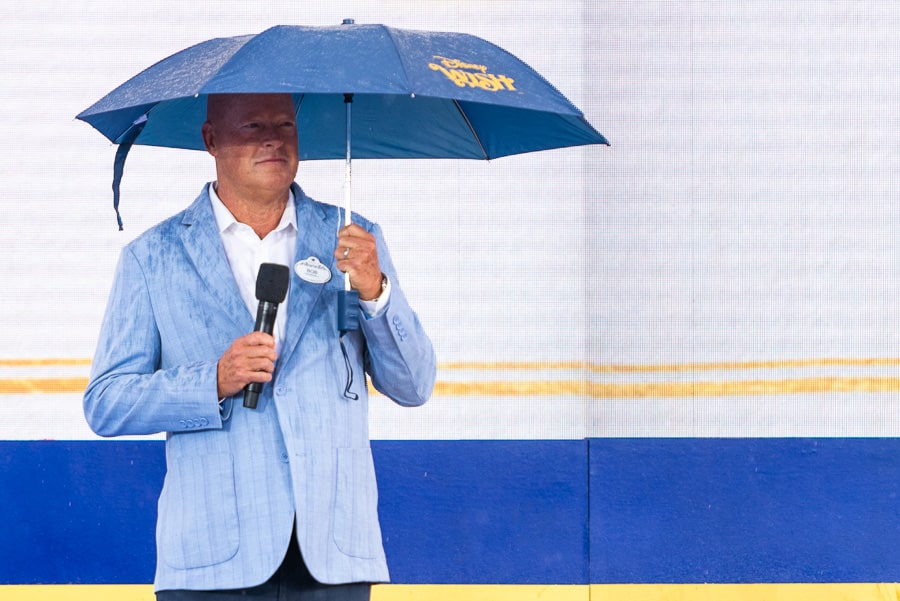
Most fans probably don’t need a reminder of the dark days of the Chapek era, but most of this was set in motion by him. He cut once free-perks, reduced park entertainment and offerings, and set in motion two years of the most precipitous price increases we’ve ever seen at Walt Disney World and Disneyland. Suffice to say, there’s a reason fans hate Chapek.
Upon his return, Bob Iger made it clear that he had been “alarmed” by price increases at Walt Disney World and Disneyland, and was concerned that Chapek was “killing the soul” of Disney. This was widely reported at the time–it’s nothing new.
Shortly after returning, Iger called a meeting with Parks Chairman Josh D’Amaro and asked him to come up with a list of things the company could do to win back the goodwill of fans. According to people familiar with the meeting, D’Amaro offered up discounted parking, more days during the off season with lower-priced tickets, and freezing the regular rounds of price hikes.
Iger chose to bring back free overnight parking at Walt Disney World Resort hotels and ticket promotions, but regular price hikes continued, the WSJ reported. This isn’t entirely accurate.
I don’t know why I even bother since perception is reality and prices spiked massively from 2019 to early 2023–and fans are still reeling from that. But Walt Disney World did not raise ticket prices between December 2022 and last year. That was unprecedented.
At the same time, hotel rack rates barely budged last year (below the rate of inflation, on average). For 2025, there were just as many rack rate decreases as there were increases. Due to greater discounting, the effective rates at resorts largely decreased from 2021-2022 to 2023-2024 (and in 2025, so far).
Ticket prices are up, and fairly significantly for many dates, in 2025. Restaurant and merchandise prices have continued to increase, unabated, since 2022. Same goes for upcharges and add-ons, including the line-skipping service (that once was free). So it’s not like overall prices have held steady.
To be clear, none of this is a defense of Disney–just striving for accuracy. We have also argued that while Iger got off to a strong start in improving guest satisfaction, that progress has stalled and more needs to be done (see Walt Disney World Could Fix the Guest Experience by Improving These Things and Big ‘Little Things’ Disney World Needs to Bring Back).
The bottom line is that prices have gone up sharply since 2019, and even though increases have decelerated dramatically since 2022, it’s no wonder fans are disgruntled. The cumulative impact of the cost-cuts coupled with price increases is still staggering, and much more needs to be done to address it.

WSJ also reports that about a year after Iger’s return, Disney began to have “serious concerns” about the rising cost of visiting the parks, according to former employees involved in the discussions. The results of surveys asking whether Walt Disney World and Disneyland guests intended to return soon showed a drop. This aligns with what we’ve been told, and also extends to the likelihood to recommend metrics (which is equally important).
The issue was reportedly raised with Iger, according to WSJ citing people familiar with the matter, but parks were still booming. The Experiences division, which is primarily Parks & Resorts, had become the company’s primary profit engine in 2022, replacing the declining cable TV business. Experiences represented 70% of Disney’s overall operating income in the 2023 fiscal year, up from 41% in 2019 and 34.5% in 2018.
The Experience unit’s income of $3.1 billion for the final three months of 2024 was flat year-over-year. Attendance declined 2%, and operating income fell 5% year-over-year. As we explained following last week’s earnings call, the results probably would’ve been more positive but for Hurricanes Helene and Milton, both of which had a long tail of cancellations. Nevertheless, this came at the same time that the international parks were up a staggering 28%, fueled not by the smoke and mirrors of cost-cuts and higher guest spending, but by opening new lands and attractions.
Pricing has been a concern for investors and analysts, and was even one of the catalysts for the proxy fights of the last couple years. For the company’s part, CFO Hugh Johnston indicated during the December earnings call that Disney needs to be “smart about pricing,” especially at the lower end of the market where consumers are “feeling stress.” (This is similar sentiment to what fast food chains and retailers have reported during their recent earnings calls.)
Johnston indicated that Disney has tried to hold prices steady for lower-priced offerings at the parks and that most of the price increases were concentrated among premium packages or during high-demand dates. He added that the company wants to “tap in to those families and build the habit of coming to Disneyland or Disney World, not one time, but multiple times.”
“The number-one thing we hear from the millions of guests who visit our parks each year is how much a Disney vacation means to them, and we intentionally offer a wide variety of ticket, hotel and dining options to welcome as many families as possible, whatever their budget,” said Josh D’Amaro in a written statement to WSJ. “We also know that in inflationary times it’s especially important to give families ways to save on their visits.”

One random tidbit from the WSJ article that I found interesting was this: “Five years ago, the skip-the-line feature FastPass was free. Now visitors choose from three different tiers of Lightning Lane passes for the privilege—the most expensive reaching $449 a person a day.”
I’ve mentioned this repeatedly, but one of my recurring fears as a longtime fan is been that Disney is inflicting long-term brand damage for short-term financial gain. This line in the article is a perfect example of that. That $449 cost is eye-popping, and will catch the attention of the general public.
Without added context, they might (understandably!) assume that line-skipping at Disney costs hundreds of dollars, not that it starts at under $20. Insignificant as it might seem, lines like those might turn people off from even considering a Disney trip. They won’t learn the full range of Lightning Lane prices, because they’ll say “I’m out” before it even comes to that.
Obviously, this WSJ article as a whole is damaging to Disney. But so are specific sentences like that, or every single article about the failed Star Wars Galactic Starcruiser. Same goes for the $100,000+ private jet Disney Parks worldwide “adventure” and the Storyliving by Disney communities.
Those have received outsized negative attention for niche offerings–same with Lightning Lane Premier Pass–and I really wonder whether the limited financial gain is worth the brand damage inflicted. It’s not something that shows up on a balance sheet, so of course they look like positives (except Starcruiser, which very obviously was not). But a balance sheet can’t measure long-term ramifications or indirect consequences. I feel like this is a microcosm for this “Disney is pricing out the middle class” conversation, as a whole.
The WSJ report also points to a couple of surveys that indicate an overwhelming majority of Americans feel theme parks, cruises, and other expensive vacations are financially out of reach.
Many are reporting trading down from these to nature-driven experiences, such as state parks or beaches. Visitor data from the National Park Service bears this out, as does the growing discrepancy between Orlando International Airport’s traffic volume and Central Florida theme park (all of them) attendance.
Disney called one of the polls “flawed and misleading” and unfairly cast Disney in a negative light, according to the WSJ. The company’s response strikes me as oddly defensive, but I’m admittedly not as interested in this type of survey. Over the last decade-plus, I’ve received countless ‘story pitches’ about surveys like this for Walt Disney World, Disneyland, and myriad other destinations. (In fact, you can find recent articles similar to this one about tourism in Las Vegas or New York City.)

It’s been true for a while that the majority of Americans feel Disney vacations are financially out of reach.
The percentages have undoubtedly increased, but the results themselves are nothing new. Those of us who can afford to visit are extremely fortunate. As with the income vs. costs data, what matters more is behavior.
Are enough people voting with their wallets, or are they complaining about prices in surveys but continuing to visit and having positive experiences? It’s undeniable that the financial burden is steep; but is the emotional value still worth it? That’s what makes the intent to revisit/recommend and guest satisfaction metrics the biggest key to all of this.

I’d go a step further and say the “intent to recommend” is a very underrated variable in this. We have heard from more and more fans that, even though they’re still going to Walt Disney World for emotional or sentimental reasons, they’ve stopped recommending it to friends.
It used to be the case that current Disney fans were excellent, unpaid brand ambassadors for the company–introducing Walt Disney World to others, making new fans in the process. What we’ve heard is that–due to higher prices, greater complexity of visiting, less value for money, and more–fewer readers of this site are recommending Disney Parks to others. This is really significant, and under-discussed. People trust the word of one person in their own social circles more than that of one-thousand social media influencers.
This is also why it’s worse for Disney to lose fans on an emotional level. If costs were all that mattered, the damage would be easy to undo. Disney could turn its big pricing dial down, or pull that giant discount lever and entice people to return in greater numbers. But when you lose fans emotionally, the likelihood of that damage being undone is far lower.

Ultimately, this WSJ piece is not going to be “breaking news” to anyone reading this. It covers some well-trodden ground, and similar sentiment to what we’ve been hearing and expressing (see our article, Is Disney Eroding Fan Goodwill?, from 2018 and its nearly 400 reader comments) for years–long before the Chapek regime.
One difference here is that we’re starting to see cracks emerge in Disney’s financial results, with growth at Walt Disney World and Disneyland being primarily driven by price increases as attendance “softens” and demand moderates. Another is that the WSJ spoke to people inside the company, with the leaks suggesting that there are significant worries within about pricing (and probably a fierce internal debate if this is bubbling over with people going to the press).
Finally, there’s the practical reality that Disney has a couple of years ahead of it with no new attractions opening, and at a time when it’s biggest competitor is opening a brand-new theme park down the street. My sincere hope is that important people inside the Walt Disney Company recognize the gravity of all this and the long-term ramifications and intend to do something about it. I was optimistic about that in early 2023, and although I’m still optimistic about the long term investments in new attractions and lands, there needs to be a greater sense of urgency about improving the guest experience and satisfaction in the near-term. Otherwise, there won’t be as many fans or as big of a pool of guests from which to draw once all those fancy things open.
Planning a Walt Disney World trip? Learn about hotels on our Walt Disney World Hotels Reviews page. For where to eat, read our Walt Disney World Restaurant Reviews. To save money on tickets or determine which type to buy, read our Tips for Saving Money on Walt Disney World Tickets post. Our What to Pack for Disney Trips post takes a unique look at clever items to take. For what to do and when to do it, our Walt Disney World Ride Guides will help. For comprehensive advice, the best place to start is our Walt Disney World Trip Planning Guide for everything you need to know!
YOUR THOUGHTS
What would you like to see done to improve the guest experience and satisfaction at Walt Disney World? Think that runaway price increases are the big concern, or is the value proposition an equally or more significant matter? Thoughts on the WSJ article? Do you agree or disagree with our assessment? Any questions we can help you answer? Hearing your feedback–even when you disagree with us–is both interesting to us and helpful to other readers, so please share your thoughts below in the comments!




This comment is about Disneyland, not Disneyworld, but the same ideas apply. I grew up in Los Angeles and my family would go to Disney two or three times a year. My daughters are now 13, and they’ve been to Disneyland twice… in their lives. We’re not poor — we travel regularly overseas and in the States — but we just don’t have the budget for regular visits to Disney. My sister just visited for Thanksgiving and wanted to take us all to Disneyland as an early Christmas gift. I was thinking “My god, for five people, that could be at least one and a half, maybe TWO tickets to Europe,” but it was important to her, so we went on the Sunday of Thanksgiving weekend, a Tier 4 day.
We all hated it.
The crowds were wall to wall in the morning. We had purchased Lightning Passes, but I once I figured out how they worked and that our first slot would be at 2:50 in the afternoon (we’d arrived at the park opening), I felt like we’d been scammed. And when we arrived for our window, the ride (Indiana Jones) was temporarily closed. Meanwhile, the inflated prices of absolutely everything (though I will say the food at Disney beats that of most similar attractions) and the constant pressure to buy, buy, BUY! put me in a bad mood. The realization that most of my fellow parkgoers had already bought, bought, bought! and seemed less financially able to do so than my family put me in an even worse mood. The high prices only made the experience seem more cheap and plastic. Disney is gouging its most diehard fans, forcing them into debt for something they’re told is an essential part of childhood. For us? We can afford it, but not so easily that I wouldn’t rather spend a little more and go to Pompeii, watch Kilauea erupt or go eat real Cajun food for a lot less in New Orleans. In the end, even my daughters couldn’t wait to leave, which made me sorta sad. But the world is full of more authentic magic that costs less to access.
My husband grew up in central Florida and Disney World was a huge part of his childhood. I never experienced Disney parks until I was an adult and I remember having a blast when he brought me for the first time in 2010. It was interesting to see how the experience changed somewhat on later visits, but it was usually still quite enjoyable and I completely understand that nothing stays the same. We ended up moving to Orlando in early 2022 and got annual passes as Florida residents, which was something I thought would be fun at first. Unfortunately, at this point it frequently feels more like a dreaded chore when he wants me to go to one of the parks with him. While we are lucky and usually able to afford splurging on things when we want, I’ve found that even paying for supposedly “premium” experiences can often still lead to disappointment. I’m not surprised at rising discontent among consumers as it seems more challenging to find moments of magic at the parks. Instead, when I visit, I more often feel like a walking target in a corporate cash grab. If my husband didn’t have such a strong sentimental attachment to the parks from his childhood, I would be totally fine with canceling our passes.
We always stay at the Grand Floridian when we travel to WDW, so it was a surprise on our last trip when we saw that “Fast Pass” was gone and “Lightening Lanes” were in it’s place, at a cost. I don’t care were you’re staying, adding another $20 to an already expensive park ticket is a kick in the pants to all the people that go to WDW. That was one of the perks I could justify when we stayed at GF, we get Fast Passes FOR FREE to ride the popular rides. It’s now just “how much can we drain everyone of their cash”. It’s sad. Why don’t the high level executives at WDW take a pay cut or don’t take their million dollar bonus so people who enjoy going to WDW don’t have to get a 2nd mortgage to go. We’re heading there in November 2025, but we’re going to Universal Orlando first. I have to say, we’re staying at the Hard Rock Hotel and they give us Unlimited Express Passes. WDW needs to start watching what other parks are doing in the area to keep up with them.
It’s really sad when you look back and see how the big leaders and those who make decisions are not interested in the service that the company provides. I have gone to Disney once a year since 2021, and every year I see how the experience is getting worse. Even the restrooms are constantly messy, the soap is more water than soap, the food at the restaurants is really bad, and even the cast members seem tired. Don’t even get me started on DAS and their new policies, but ultimately, it’s our decision where we spend our money. There are other parks, and there is a tremendous opportunity for Universal right now. My perception is to visit other parks and enjoy the other Disney parks around the world. They are half the price and offer much better customer service and experiences.
This article is written about me! We are Disney diehards and have young children that we have been bringing to the parks since they were babies. Then we jumped into Disney cruise line. With all the cost increases, we couldn’t justify the value anymore to go quite as often. For the first time last year, we didn’t have a Disney vacation. And our big trip this year is visiting the 5 Utah national parks (which we’re SO EXCITED) about. We’ll still visit Disney because we love it there. But for the value, we find more return for our money on actual travel to destinations around the world – especially with Disney Cruise Line. We are willing to pay higher prices for the premium product it offers. But! When I look at the cost of a week on the Treasure? I could take my kids abroad to a really amazing new destination, or a heck of an extended adventure in the U.S. I just can’t justify it anymore. I think this may be an every 3-4 year trip instead. I feel other families are the same. So getting that extra few dollars from us on each vacation has actually cost them dependable, repeat business. And yes! I have certainly stopped even talking to my friends about Disney. I used to be able to justify the cost by all the inclusions. Now it just feels embarrassing telling people why I think it’s worth the spend.
Disney should have looked at 2025 differently: an influx of Orlando visitors but not primarily heading in Disneys direction.
Guests visiting Orlando won’t have the time or cash to buy Disneys big, multi day, slightly-better-value tickets this year as they will be spending both at Universal to get to Epic…..yep that’s me. However, as I’m in the neighbourhood I’d like to stop by Disney for a day or two if the price is right, but guess what, it isn’t! It’s nuts for a day or two. It’s nuts for 4+, but a more reasonable nuts. I can’t do 4+ days and I can’t do one day for stupid money, so I’m going to skip it, like so many others will. Disney, hear me, bring out a summer special: $99 weekday special offer. You will make way more, sell more food, keep your merchandise flying off the shelves and give those stats a huge boost to brag ‘Epic Who? Disneys busier than ever!’ I will visit. Loads more will visit too if they think ‘that’s an offer we can’t pass up while we are there!’ Accept it, you have little to offer this year, it’s not your year, it will come, but not this year. Make this your value year, the year you just fill those parks again and get people through the door and give them a reason to come back to see the rest another time…..it’s got to be better than waving at the guests walking only through Universals doors…..think about it, please.
We came “that” close to buying Poly DVC last Fall. While the cost per point was much less than we expected (a pleasant surprise!), the realization that we would be hostage to 25+ years of increasing park tickets and meals expenses kicked in. So, we skipped DVC and will rent points instead. We’ll still go to WDW but only when we can afford the luxury.
Your point of the emotional connection was key for me. middle class and definitely need to do a lot more saving to make that same 7-10 day trip happen than I did a few years ago. For that price, I can fly to Europe and experience several countries and cultures. I did a day at Paris Disney and it was such an easier experience than WDW or DL. I made a lot of forever memories for the same price as riding some rides and bad park food. I love Disney, but it was a no brainer for me.
Excellent article as always.
The real problem is not that Disney has priced out the middle class. They have.
Its that they have the arrogance to think that if they want to fix things they can just add perks, lower prices and the people will come running back. Nope. Americans are stubborn. When you burn them they say bye and thats it. For example they have completely alienated the Star wars and Marvel fanbase to the point that no one is watching any new material. So I wouldnt assume that reducing prices will “fix” things. Disney has a big problem.
My first ticket to Disney was $7.30. Even with inflation the cost would be nowhere near what it is today.
I 100% agree with the entire article. I’ve been many times over the years and I had a holiday booked for this year- flights reserved, Disney free dining package reserved, all ready to go, but I’m cancelling it. I have the money, I have the time, I want to go, but I’m not overpaying for an underwhelming experience. I’ll rebook for Universal next year for Epic, but I’ll only go to Disney if they change the price to value ratio. A rising tide does not lift all boats. Disney need to stop charging more and delivering less, there are many other options available for vacations, even for long term Disney fans.
We did exactly this in 2024. We had an eight day trip planned and booked (for our ideal week) – hotel, park tickets (refundable through a 3rd party), ADRs (exactly the restaurants we wanted). We had our strategy all laid out. It would have been another nice Disney trip I’m sure. All that was left to do was go. And then we canceled. The most regretful part are the special (to us) things I know are going away that we won’t have the opportunity to experience again, regardless of what happens in the future.
What did we do instead? We took 2 trips. We went to the Adirondacks off season and felt like we had the entire Park to ourselves. (Fun fact: The Adirondacks is the largest park in the contiguous US.) We stayed in just the sort of cabin Disney emulates with the Fort Wilderness Cabins, overlooking a gorgeous lake. (Fun fact: There are over 3000 lakes in the Adirondacks Park). We ate dinner every night at a hotel originally built in 1850, and we ate breakfast every morning in a different quaint town. Next, we took an Amtrak train in a sleeper compartment across the country and, among other highlights, stayed in a hotel literally in the Union Station train terminal in Denver CO, a very cool experience. We spent less money for both trips combined than we would have for the planned Disney vacation.
I still like what Disney Parks have been, and what they continue to have the potential to be. I’m just not as fascinated by them anymore. I used to marvel at the often stunning, nearly always exceptional, things Disney was able to achieve at the parks, the attention to detail and level of service, at a scale that seems mind boggling. Now it’s more of an “it is what it is” proposition.
The most expensive costs of any experience, which maybe aren’t thought about enough, are the opportunity costs.
The rise in cost is a big issue, but the loss of the complementary and changing of perks is the biggest let down. To use a line from one of Disney’s IP to express this. We feel like Lando when talking to Lord Vader in Empire Strikes Back about the deal he made ” I am altering the deal. Pray, I don’t alter it any further”. The fast pass was a way to help the lower line waits, the dinning plan was to help with stress at restaurants, we had free rides from and to the airport, our items purchased at the parks could be shipped to our hotel rooms, magic hours for everyone staying at the hotels at the parks. Now, we pay money to skip the lines, our dining plans only cover the bare minimum at restaurants, you have to pay to travel to and from the airport to a 3rd party, any item you purchase is held at the front of the park, magic hours have tons of exceptions unless your at a deluxe hotel. It seems everything Eisner did for Customers has been either removed/diminished, or put behind a pay wall. Yes, Disney is becoming unaffordable, but it seems like Disney really doesn’t care about the customers with these changes. I miss Eisner at least he knew how to take care of the customer.
I 100% agree! I went in 2017 for the first time as a parent. I loved it as a guest and seeing it through my children’s eyes. My husband who came to Disney without a whole lot of expectations was a huge Disney fan at the end. Receiving our free magic bands and luggage tags prior to our trip. The convenience of the Disney Magical Express bus being free to take us to and from our hotels. Us seeing our luggage magically appear in our hotel rooms without having to retrieve them from the baggage carousel in MCO, or us seeing our in-park purchases in our room at the end of the day. Having 3rd party strollers or 3rd party groceries delivered/picked up from the hotel for free/minimal fee. Free fast passes and being able to book them in advance. Extra magic hours even though we were in a moderate hotel. The list goes on. He was the biggest fan and told so many people how Disney’s services were so great and made the experience for parents so easy.
We went again in 2023. It was a good trip. We had a lot of fun. But so many of those conveniences and extra touches went away and we could feel it. We left the trip saying it was a nice memory but we couldn’t see us going back to the park anytime soon for what we received. Instead we went to Paris in 2024 for a week (& spent just as much for going to WDW) and this year we’re hoping to go to Japan and see DL there.
Also, America’s tariffs war on Canada is not making me want to spend my Canadian money in the USA right now…!
I think they should figure out how to do a promo for first time guests. I actually still think there’sa lot of magic at Disney overall but yes the price makes you grumpy. If you really said to yourself “how much would I enjoy this if it were free”; I think you’d enjoy it a lot.
I think a few other things that weren’t mentioned is that people are more willing to travel further these days. When I was a kid, going to Florida was the big trip. Now, people are willing to go AI in Mexico or go to Italy or Hawaii. Also cruising is taking up a big part of the market share. Even DCL is taking guests from the parks.
The last thing is that they aren’t capturing the attention of as many toddlers and preschoolers overall. With so much streaming content you really have to compete hard for little kids attention. If Mickey and friends (or princesses) don’t become a “thing” for little kids parents will be less likely to bring them. (That emotional connection). I know families who missed the window of bringing their kids at ages 5-8 bc of covid and now they just won’t go. Kids aren’t interested and they didn’t make that connection younger. That’s a kid who won’t be a nostalgic adult in fifteen-twenty years. Much less likely to bring their own kid. I think pre-school promos are hugely underrated. Not even for current customers but to create new future family customers that repeat from “nostalgia”. Bringing Bluey to the parks can’t come fast enough. They haven’t had as many hard hitting cultural impacts into the preschool and kids scene lately as they did when mine were little (the Frozen era)… parents are going to pay to bring their kids to see their hero Elsa. The way that kids are excited about Spider-Man at Worlds of Marvel dining… that’s what parents are willing to pay for. That’s the magic and it’s not always about money. If there’s no connection , you could go anywhere on vacation. And people are! another thing, kids are so overstimulated and have seen so many things, that a Disney trip doesn’t always hit as hard as it used to. And lastly, families spend so much time and money on sports and sports travel that they don’t take vacations. I know quite a few families that put all extra money into their kids sports, and only travel if it’s related to that. All of these things are contributing to a shifting family vacation dynamic and it’s not JUST about money (although that’s very much part of it.) Another great article Tom!
I’m going to Orlando for a business convention next week. The convention finishes at 12:30PM each day, so there is an opportunity to go to the parks in the afternoon. At $169 a day for Animal Kingdom, that’s over $500 for 3! In the late 90s, Disney still had afternoon passes, but those are long gone. Also, buying tickets that never expire are long gone. So, there is no chance for a discount ticket. Disney does not even try to offer fans a break. In 5 days, we will go to Animal Kingdom once, Sea World once, and Disney Springs, where at least you can get the Disney flavor for free, twice. It’s only a matter of time before Disney Springs will cost $30 to walk through the gates.
In 1985 the average DW ticket price was $21.50 in 2025 the average ticket price is $155.00. This is a 620% increase over 40 years. Meanwhile, the average salary in the US in 1985 was $23,620 and the projected figure for 2025 is $53.490. That is a 126% increase.
Granted this was the first set of numbers that came up in my search. But I don’t think other searches would reduce it by the 500% margin to much.
So, yes Disney is make larger price increases than the average person can afford.