
July 2026 is Disney World’s Least Busy Month Since September 2021.
We’re less than one week into July 2026, but it’s already been the slowest month at Walt Disney World since September 2021. Wait times over the Independence Day holiday weekend were predictably low, despite sold out park reservations for Annual Passholders and resort restrictions to ensure adequate fireworks viewing for Magic Kingdom area overnight hotel guests.
Also predictable were the reactions on social media, expressing surprise about the parks being “dead” or “ghost towns” along with fans offering their own favorite theories as to why this happened. This post covers wait times data and discusses the real reasons for lower crowds during what used to be a popular holiday.
None of this will come as a surprise to regular readers of this blog. This is a point we’ve been stressing for years, most recently in Should You Visit Disney World in Summer? That post offers our verdict on whether visiting this time of year is “worth it,” which basically comes down to weather and longer days versus lower crowds and better deals. There’s more to it than that, but that’s the nutshell version of the salient points.
Summer hasn’t been peak season since 2016. There were a couple of years that were anomalies during the pent-up demand period, which is probably a big reason why some fans are being caught off-guard by the summer slowdown at Walt Disney World in 2026. Because it hasn’t been the case that summer has consistently been slow during the last decade.
Contrary to the conventional wisdom that Memorial Day through Labor Day is the busiest stretch of the year in Florida, summer crowds are no longer unbearable (just the weather). Summer no longer being peak season comes as a surprise to some, but the even bigger shock is that the week of Independence Day is the slowest of the slow summer weeks to visit Walt Disney World.
This long weekend used to have 10/10 crowds and be among the busiest holidays of the year. That is no longer even remotely the case. To the contrary, it has become below-average. It’s typically less busy than either Memorial Day or Labor Day, which are also not popular holidays for travel to Walt Disney World. (All of the ones after Labor Day until the following Memorial Day are, though!)

For those who aren’t well-versed in this topic, the Fourth of July has been a quieter holiday since pent-up demand ended.
Independence Day 2023 was downright dead at Walt Disney World. It was such a hot topic that it drew an explanation from CEO Bob Iger, who attributed the light crowds to an exhaustion of pent-up demand and bad weather. He wasn’t totally wrong, but pricing and aggressive ticket blockouts were the bigger culprit.
Independence Day 2024 crowds were again unexpectedly low, even minus blockouts. Walt Disney World as a whole had an average wait time of 26 minutes on July 4, 2024. That was down as compared to the last two weeks of June, which had average wait times of 35 minutes (second to last week) and 31 minutes (last week).
Fourth of July 2025 crowds were similarly slow. The first week of July had a 26 minute average and crowd level of 1/10. Sunday, July 6th was the slowest day of summer (and the entire year up to that point). This was a sharp contrast to the last week of June, which was tied for the busiest week of summer.
We have consistently predicted that the first week or so of July 2026 would NOT be busy. To the contrary, we have been imploring our readers to target this particular week for their summer vacations for over a year.
We went as far as to add the week around Independence Day to our list of the 10 Best and 10 Worst Weeks to Visit Walt Disney World in 2026 & 2027. We made the case to visit during this specific week of summer last November in a standalone post: Best Week to Do Walt Disney World in Summer 2026 Just Got Better!
This was despite the holiday falling on a Saturday and Walt Disney World doing more to promote the Fourth of July for America’s 250th Anniversary. While acknowledging that the U.S. Semiquincentennial could be a wild card, we’ve pointed to several signals suggesting that it wouldn’t be bad. None of this made a difference, as many fans still questioned whether this year would be different, and disregarded our advice.
Against that backdrop, let’s see how our predictions performed via wait times courtesy of thrill-data.com:
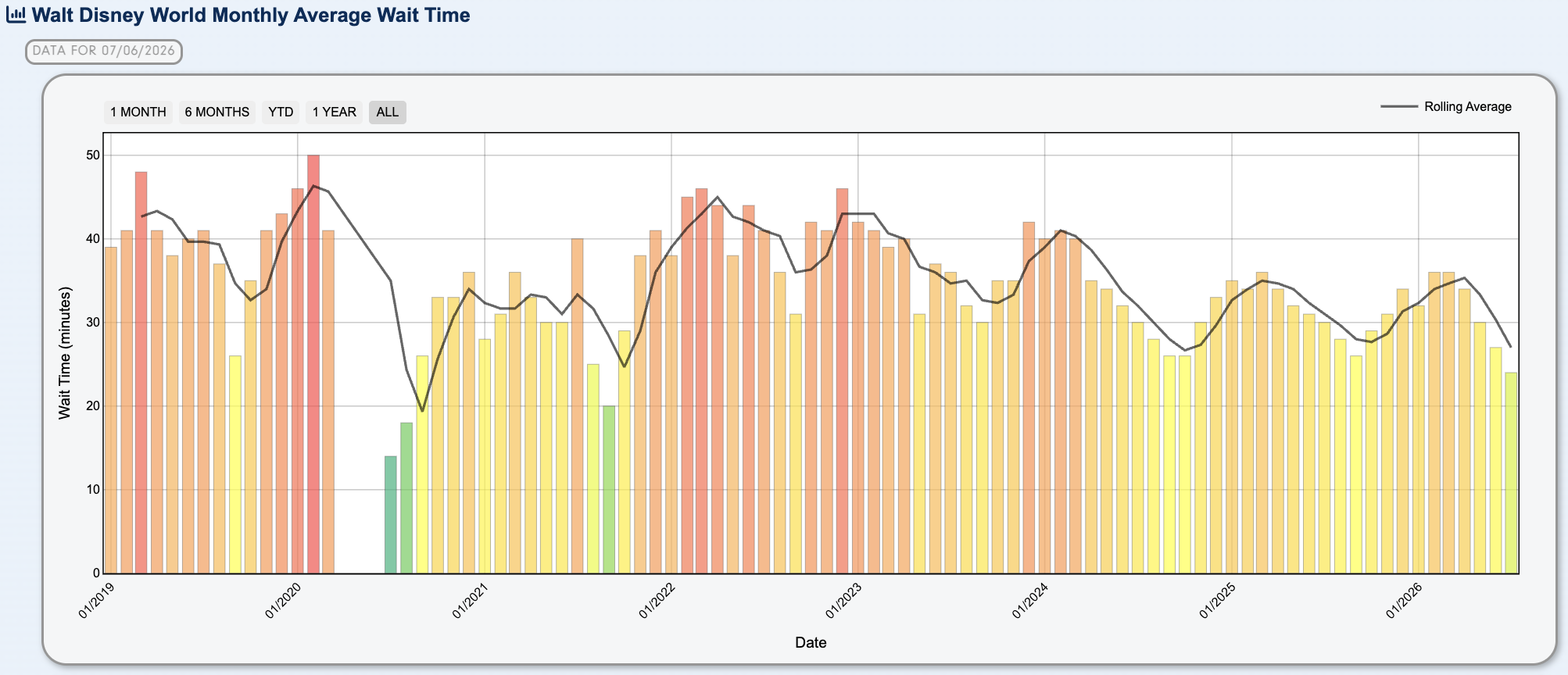
Let’s start with a look at monthly wait time data, which shows every month since the beginning of 2019.
We’re only 6 days into July 2026, so this is obviously a very incomplete picture. Nevertheless, we’re offering this view because the month is already split into two weeks, and because this underscores just how slow July has been thus far.
Currently, the last month to have lower crowd levels than July 2026 was September 2021. That was back during the phased reopening, when the delta variant and reinstated face mask rules caused a surge in cancellations. It is safe to say that July 2026 won’t end up being that slow.
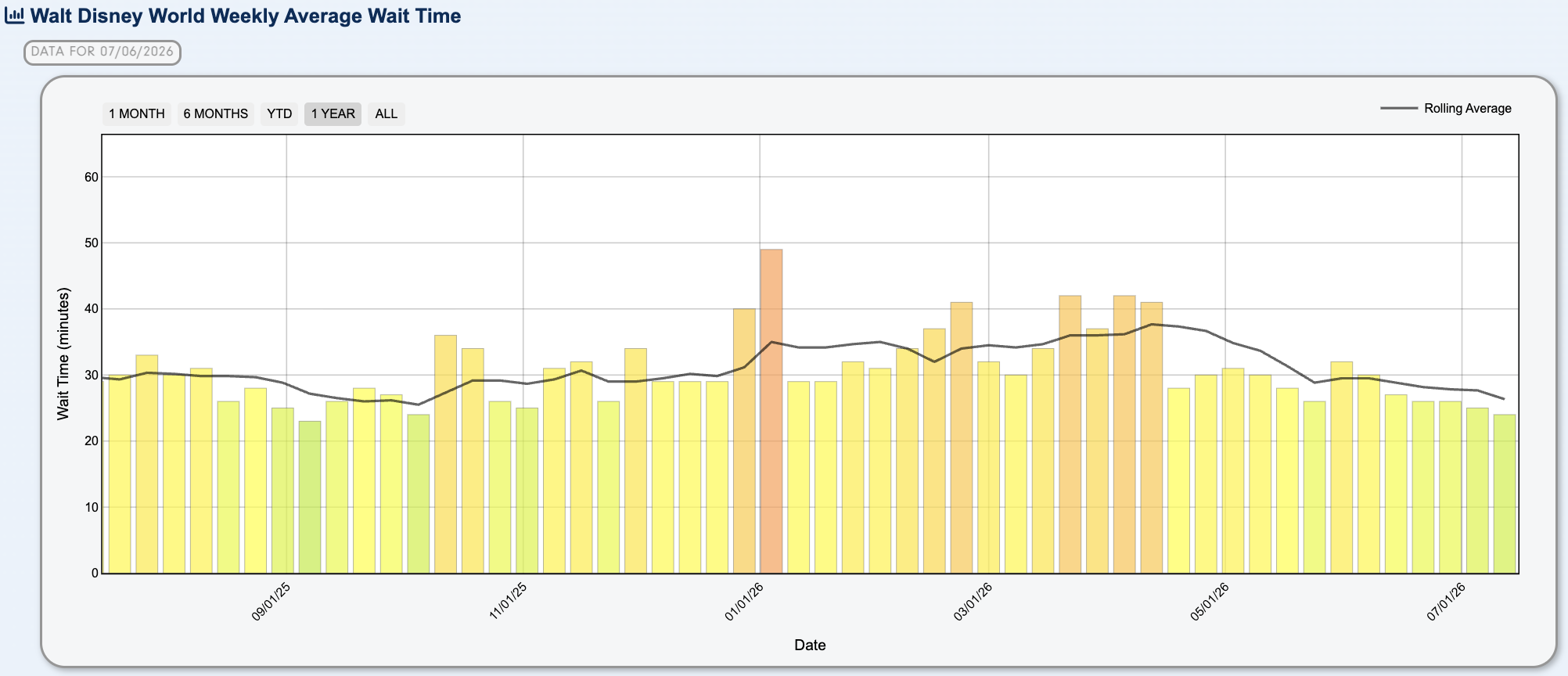
Here’s the weekly view, which shows the summer slowdown in action since around Memorial Day.
There are typically two peaks in summer. The first is at the end of June, and it did not happen this year. The second is usually in the second half of July and into early August. That one is still a couple of weeks away. It’ll be interesting to see whether it actually happens.
Usually, the week of Independence Day is the least-busy of July. That’ll probably be the case again in 2026, but if the second half doesn’t get appreciably busier, it’s entirely possible that July 2026 stays the slowest month since September 2021. Last month only ended up with an average wait time of 27 minutes, and July is usually slower than June.
All July needs is a 26 minute average to tie with 3 other months for the slowest since September 2021. Also notable is that August is usually less busy than July, and September is typically the slowest of all. In which case, it’s possible that crowd levels in September 2026 rival September 2021.
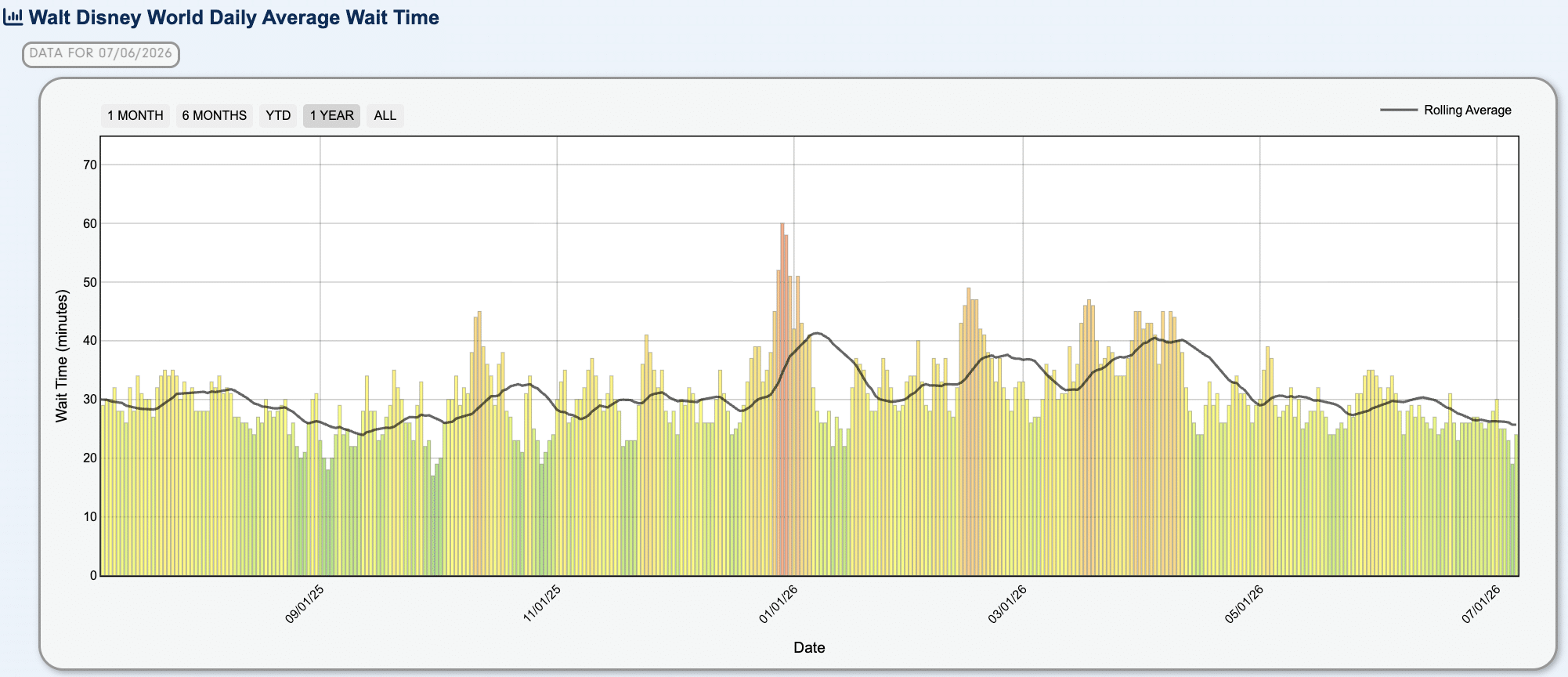
Here’s a look at the daily data for Walt Disney World as a whole.
July 1st was the high water mark, with 3/10 crowd levels and 30 minute average wait times. Every day since has been 1/10, with all of those dates having average wait times of 25 minutes or less. Sunday, July 5, 2026 was the least busy at Walt Disney World not just in all of 2026, but since October 28th of last year. There were a few dates last August and September that were even lighter, but nothing outside of that.
July 5, 2026 had an average wait time of 19 minutes, which is absurdly low. We’re talking headliners with posted wait times of 30-45 minutes, and walk-ons at most other attractions, regardless of posted wait times. (One reader reported doing Avatar Flight of Passage with under 15 minute actual waits throughout the day.)
Not all parks were equally uncrowded on July 4, 2026. Magic Kingdom outperformed slightly; EPCOT did so massively, with a 7/10 crowd level. These two parks being busiest is particularly unsurprising since they’re the only two with special Fourth of July fireworks shows and there’s currently a ticket deal that prevents Park Hopping.
It’s also worth pointing out that crowd levels are statistical, meaning they measure wait times as opposed to park congestion. Usually, wait times are a good proxy for crowds, but not always. Magic Kingdom and EPCOT fireworks viewing areas on Independence Day are a prime example of this exception, as they were undoubtedly very busy. (That’s precisely why Walt Disney World “sold out” of park reservations for APs, despite low wait times.)
Then there’s Animal Kingdom and Hollywood Studios, which were extremely slow by any measure. Both parks had their lowest wait times of 2026 on the Fourth of July, and were even lower than the last few years. Hollywood Studios had an average wait time of 20 minutes, which is extremely low for DHS. That’s lower than any day I’ve visited DHS since the COVID days.
With wait times data out of the way, let’s talk possible theories as to why the Independence Day holiday weekend hasn’t been busy at Walt Disney World…

Economic Anxiety
The economy is something that inevitably comes up in the comments to posts like this, and understandably so. At the same time, any theory that can be contradicted by higher crowds in the last few months or the next few months is off the table.
Meaning that higher prices, fewer perks, and the company’s reputation do not explain the lower summer crowds trend. We figured this was worth a reminder as Walt Disney World just released October through December discounts, which offered abysmal availability. Already, many resorts are sold out, and Disney’s CFO has indicated that bookings for the coming quarters are up year-over-year.
This isn’t to say Walt Disney World doesn’t have a pricing problem. It does as we’ve discussed in countless posts, including Is Walt Disney World Too Expensive for Middle Class Americans? But across-the-board price increases do not explain why summer and Independence Day, in particular, continue to see year-over-year wait times decrease.
None of that really matters here, as there’s key data that tells a fairly conclusive story. The TSA reported that the agency was preparing for the heavy volume over the Fourth of July holiday period. The TSA was expecting to screen nearly 18.7 million travelers at U.S. airport security checkpoints between Tuesday, June 30, and Monday, July 6, 2026. That is up over recent years, albeit only slightly.
For its part, AAA projected that 72.2 million travelers will head 50 miles or more from home over the Independence Day holiday travel period between Saturday, June 27 and Sunday, July 5. This year’s domestic travel forecast surpasses last year’s record of 71.8 million travelers, but the increase is smaller than recent year-over-year gains.
The number of travelers driving and flying to their destinations is relatively flat compared to last year, while travel by other modes, including cruises, is the category seeing the biggest increase. According to AAA, 85% of Americans traveling for Independence Day are expected to drive to their destinations, despite gas prices reaching four-year highs. Last year, the national average for a gallon of regular gasoline was $3.15.
The bottom line is that whatever issues might exist with the U.S. economy, the American consumer is still spending freely and going places for Independence Day. It’s certainly not impacting travel as a whole, although it could affect what consumers are doing once arriving at their destinations. In addition to cruises increasing in popularity, it is also likely that consumers on the lower end of the economic spectrum are “trading down” for lower-cost beach trips, U.S. National Parks, and other outdoor destinations.

Pricing
This is a tricky one. Thanks to aggressive discounts, it’s possible to take a less expensive trip to Walt Disney World during Summer 2026 than any other season. There are fantastic resort room, ticket, and even dining discounts available, and bargain hunters can stack these discounts for their cheapest trip since 2018.
These deals have helped and definitely moved the needle for the last two years, but there’s a big asterisk to this. These promos have also attracted more cost-sensitive consumers…and you know what that demo will do? Comparison shop.
The Independence Day holiday weekend is still the most expensive timeframe of the summer season to visit, and that’s just accounting for tickets and resorts. Almost every aspect of traveling over the holiday weekend is more expensive, since travel prices are largely demand-driven. As compared to the rest of the summer season, this means higher average airfare, rental cars, off-site hotels, and more.
Annual Pass Blockouts
Saving the best theory for last is Annual Passes. This is a multifaceted one. First, both the Pixie Pass and the Pirate Pass–two affordable admission options for locals–are blocked out the bulk of Independence Day weekend. That means even more Floridians than normal wouldn’t have been in the parks.
We’ve long suspected that there’s a disproportionate number of Pixie Dust Annual Passes in circulation, in large part because it was the only AP tier that was sold for over a year. Although that hasn’t been the case for a while, inertia has probably kept the discrepancy going. Floridians got used to paying a lower price, found it worked out just fine for them, and didn’t upgrade when it came time to renew. And the price for both the Pixie Dust and Pirate Passes is certainly right, especially for cost-conscious locals.
Walt Disney World doesn’t release statistical breakdowns of its AP population, so this is only theory. However, it’s also corroborated by crowds. Whenever these passes (especially Pixie Dust) are blocked out beyond their normal weekends, it shows up in wait times data, both in the actual blockout and the lead-up to that.
There are countless other examples like this, with a rush of locals “getting their Disney fix” before a blockout and then lower crowds during it. It also happens every year in January when the blockouts lift, and occurs ahead of Thanksgiving, Christmas, and Spring Break. This explanation is now well-supported by the last four years of data.
Fewer Floridians
My other theory with regard to the local popular is less supported by data, but it’s one that is anecdotally accurate in our circles. It’s that fewer Floridian families and friend groups all have the higher tiers of Annual Passes (or APs at all), and are thus opting for holiday gatherings and activities that everyone can do to avoid exclusion.
Whereas it used to be the case that entire friend groups had higher tier Annual Passes at Walt Disney World or Disneyland and made the parks their default hangout spot, that’s now not the case. Anecdotally, I’d also add that this seems interconnected with weather.
Independence Day gatherings are often all-day affairs (whether at the parks or elsewhere) for locals, with the high heat and humidity making that less desirable–especially when you can drop in for an evening and catch fireworks any ole night later in July. All of this combined makes backyard barbecues, pool days, etc., more appealing to Floridians than the parks.

Ultimately, my strong suspicion is it’s the relative lack of locals that are the ones really moving the needle on lower wait times over Independence Day at Walt Disney World. Meaning that if you took the actual tourist attendance of the holiday weekend and added the average Annual Passholder attendance for this summer, the number would come out looking fairly close to normal Summer 2026 days at Walt Disney World. Maybe even higher than normal.
With a growing Floridian fanbase, the presence or absence of locals can have a big impact on crowds. The most pronounced example of this for years has been when blockouts lift in early January. The lighter Fourth of July is basically just the mirror image of that dynamic.
But again, “normal” by Summer 2026 standards is still a shadow of what things were like before 2016. Even after that, Independence Day continued to be very busy at Walt Disney World for at least a couple of years. It was not a peak season holiday like Easter, Thanksgiving, Christmas, New Year’s Eve, etc., but it also wasn’t moderate–like Memorial Day or Labor Day.
If you’re looking for an actionable takeaway, it’s that this week should once again be the best of Summer 2027. (The previous recommendation in our best & worst weeks list is June 29 to July 4, 2027, but I’ll probably tweak that to start and end later.) At this point, there’s absolutely no reason to expect higher crowds in 2027. If anything, my very early prediction would be lower year-over-year wait times. But that’s premature at this point, and beyond the scope of this post.
Beyond, it’ll be interesting to see whether there’s a bounce-back in crowds after the holiday weekend concludes. Late June ended up not seeing its normal mid-summer spike, which is unusual. Usually, there’s a second spike at the end of July, which we’ve attributed to ‘last hurrah’ summer travelers taking trips before school goes back into session.
After this weekend’s blockouts conclude, I could see a gradual increase in crowd levels through the end of July 2026. It’s safe to say those numbers, whatever they are, will drop in early August. The big question is whether the next few months will drop below September 2021 crowd levels. Those were really low for several reasons that are non-factors in 2026, but the current trajectory would put September 2026 right around that ultra-low level. We’ll keep you posted!
Planning a Walt Disney World trip? Learn about hotels on our Walt Disney World Hotels Reviews page. For where to eat, read our Walt Disney World Restaurant Reviews. To save money on tickets or determine which type to buy, read our Tips for Saving Money on Walt Disney World Tickets post. Our What to Pack for Disney Trips post takes a unique look at clever items to take. For what to do and when to do it, our Walt Disney World Ride Guides will help. For comprehensive advice, the best place to start is our Walt Disney World Trip Planning Guide for everything you need to know!
Your Thoughts
Do you agree or disagree with our assessment as to why Independence Day holiday weekend crowds at Walt Disney World have been below-average? Or, do you disagree entirely, and think it’s been as busier than normal? Any observations about attendance trends during the fall months that follow this summer dip? Hearing your feedback about your experiences is both interesting to us and helpful to other readers, so please share your thoughts or questions below in the comments!


We were at MK on July 3rd from EE to close, Hollywood Studios July 4th EE to Fantasmic /close and July 5th Epcot EE to close. Fireworks were absolutely amazing! Way better than MK. With lightning lane for each day. Felt that crowds were extremely low all 3 days in the parks, and we were able to fully utilize LL and also rode many rides multiple times with minimal standby wait. The weather while hot really wasn’t that bad, was a lot better than anticipated, breezy and only very minimal rain mid-afternoon 4th. I thought that it was going to be a very busy weekend when booked in April, and still thought it would be busy as it got closer judging by available lightning lane selections, dining reservation options, and looked at remaining hotel reservations a few days before arrival and appeared very few rooms were available on property. Very pleasantly surprised, and thankful that it was lower crowd levels. And honestly the worst crowd /longest wait experience we had over 5 days was actually on July 2nd trying to find parking at the Vineland Outlets mid day. I think part of the reason the crowds may have been low people may just prefer to vacation the beach for the 4th, or anywhere on water to cool off/relax. I would definitely recommend 4th of July at Disney World in the future, and look forward to going again.
So strange to this 80s/90s cast member. July 4th used to be as crowded as New Year’s Eve at the Magic Kingdom.
We are here now and it is absolutely dead. I’m loving it! Epcot was a ghost town this morning. We have been taking more breaks in the room to deal with the heat. However, wait times are low, so time really isn’t lost. Also, we purchased after-hours tickets to combat the high temps and do most of our park time after the sun has set.
We are joining some friends for their first trip the week of July 20. I said in August 2019 that I’d never go to WDW again in the summer. But here we are so my daughter can do Disney with her bestie. Lol. Fingers crossed crowds stay low. I personally would take a 11/10 crowd day with temps in the low 70s (I’m looking at you, week between Christmas and New Years), over a 3/10 crowd day and temps in the 100s. . .
I am looking forward to the trip though! I have a solid strategy for trying to stay less hot, and I know the parks much better now than I did in 2019.
I personally love Disney on the 4th. It reliably a great time to go. Slightly different but we were at Disneyland over the 4th this year (4th-6th). And the 4th was light crowds for sure until around 8pm (going from the first Paint the Night into Fireworks was maybe the most congested I’ve ever felt in any Disney park in my life.. what a horrible idea that is). But the 5th was DEAD. We went to Lamplight for brunch and rode a few things, then chilled at the hotel until 6pm.. from 6-10pm we rode Space, Matterhorn, Pirates, Big Thunder, Indiana Jones, ate dinner, then rode Goofys Sky School, Incredicoaster, Radiator Springs racers, and then watched world of color and was in the room again by 11pm. It was INSANE!! LLs were a total waste. It was slightly busy again on Monday, but again we didn’t go to the park til evening (after dinner at Din Tai Fung – yum! – kids didn’t want to go earlier since we did everything easily the day before – I actually took my youngest to knotts for a few hours).. in evening we rode a few things incl Rise (25 min wait) (saw the galaxy edge fireworks version) and watched Fantasmic (walked up 5 min before started). Rides did get pretty bad temporarily, after the first Paint the night ended. Basically after the first Paint the night parade is just a huge hassle no matter what in the park. Very stressful. But anyway. If you do a DL recap then that’s my experience! Also the high was like 78 degrees so sign me up for that again next year, hah. My only complaint about DL is the nighttime entertainment situation, there’s just too much going on w/ 2 paint the nights, 2 fantasmics and fireworks. It just makes the entire park insane at night.
We went to UOR instead of Disney this year (were were Disney over Independence Day weekend in 2025) and it was a similar story there, with both the 4th and 5th being very low crowd level days.
Having now visited several times at this time of year, I was not expecting heavy crowds – and I also think the heavy afternoon thunderstorm on the 4th further cleared some people out? We were at Epic Universe that evening, and BatM was a walk-on from 7-9pm (posted as 30 min, but actually just the time needed to walk the full queue). Even the fireworks crowd waiting around the fountain at 9pm was quite sparse (the fireworks were disappointing – quite basic and lasted for only 6 minutes).
We had a great time in the parks and appreciated the low crowds and wait times (though in Epic they were often offset by ride downtime – looking at you, Nintendo World!) If you can plan to avoid the brutal midday sun and primarily rope drop/tour early mornings and after 4pm, it’s a great time to visit!
We went to MK on 7/1. We spent (wasted) $160 on LL and were only able to book second tier rides that would’ve had 30 min or less wait times. Monsters Inc laugh floor, Tea cups, Philharmagic and Tomorrowland speedway were all that we could reserve. Sold out: Buzz, all the mountains, Seven dwarves, Jungle cruise, PP. Haunted mansion was down or sold out. Big thunder was only 35 min wait but Tiana’s and Tron were at least 75 to 90 mins. HS was 6/29 and Rise was only 30 ish min wait. It wasn’t dead but we were able to get a decent amount done though not slinky and runaway were not able to be done. We did have decent LL choices available though. EPCOT 7/2 with 75 min Guardians and test track waits. AK 7/3 was much better but Kali had 50 min wait. Altogether it felt very much like the 3rd week of June and July from last year. Certainly not 10/10 crowds but it did feel like at least 3-5/10 depending on the day. We still had a great time with our daughter and grandkids. Also, I got to see CoP one last time as I have known it my whole life. I am glad we didn’t reschedule.
If you have to take out a second mortgage to visit WDW, it’s too expensive. Our family used to go all the time, but not anymore. It’s sad the stockholders are so greedy.
We were in MK on July 3rd and Epcot July 4. Epcot was pretty dang busy the entire day IMO. Most of the major rides were over an hour all day with Guardians and TT sometimes getting close to 2 hours. Guardians was 75 minutes even at early entry. MK was a bit weirder on July 3rd. It was pretty dead in the morning but was slammed after about 3pm. Honestly after the fireworks show and the 10 pm parade it was one of the busiest days I remember seeing in MK while we were leaving the park. We never went to HS or AK so I cant comment there.
Yeah, the 7/10 crowds at EPCOT on 7/4 were the highest (by far) of any park over the holiday weekend, and the worst at EPCOT since 6/1!
The extreme lows at DHS and DAK were what dragged down the averages on July 3-4, with every park being very low July 5th. If you didn’t visit those parks, or at all on July 5th, your experience probably would’ve differed.
Same experience here! EPCOT post fireworks on 7/4 was the busiest I have experienced it (never been there holiday time), leaving the park was not easy/fun from Canada (we thought more people would be at MK on the 4th so personal fail on the zig when they zag strategy). I do think the flyover got a decent number of people into the parks earlier on the 4th. We ee rope dropped Guardians and I think they opened it a smidge later than usual which may have explained the early am long posted time mentioned by Jeff. (Much better than our rope drop targets DHS (slinky) and MK (SDMT – sorry we didn’t check Tron for DTB data!) which both had more seriously delayed ee openings… fortunately we bailed early and managed a productive start to both days.) DHS was pretty good 7/3, but fantasmic did fully fill which is my personal barometer for a truly slow day (only one showing). However, the heat did get us and we are in the “never high summer again” camp now that I have checked off the bucket-list item of 4th of July park fireworks.
We are going for the week you have as the “second spike” this year, due to the $150 off moderate hotel deal they had ending that week. If that deal went through August we would’ve waited until then, but we couldn’t pass up Port Orleans for less than $150 a night (less than Pop was on the deal). Hopefully there wont be a huge spike, but we will enjoy our time either way.
My last trip to WDW was April 2025. For the first time since 2006 we do not have another Disney trip on the books, nor do we plan on going any time soon. It’s just so expensive that the cost is no longer worth it. We went to Scotland this past April for far less than what a Disney trip would cost.
We were there all day on the 3rd and 4th and for a few hours on the 5th. We did Animal Kingdom, Epcot and Magic Kingdom. I can confirm that both crowd levels and wait times were extremely low, even compared to last 4th of July. We had lightning lanes but absolutely could have skipped them and walkways were wide open throughout the parks. It was a wonderful and productive couple of days. One major exception to this was naturally the evening of the 4th at MK. We found a spot in the hub about an hour and a half before the fireworks and it was already getting crowded at that point but it devolved into the absolute WORST crowd control I’ve ever seen from Disney, that is to say there WAS no crowd control whatsoever. There were no walkways maintained anywhere and the few cast members present did nothing except try to cram MORE people in. It was dangerous and the only time I’ve ever felt unsafe in a crowd at Disney. Had there been a medical emergency or the like there would have been no way to get anyone in or out. After the fireworks, it took us 20 minutes to get from the middle of the hub to the Tomorrowland bridge and required pushing through people that refused to move. To make matters worse for two hours before the show, they had DJs in the hub, frontierland and Tomorrowland blasting EDM and pop music louder literally louder than the fireworks show. It seemed to make the crowd more tense and continued after the fireworks. We had chosen MK for the 4th to take advantage of the midnight closing but ended up leaving after because the vibe was sufficiently killed by the off theme music throughout the parks and uncontrolled crowds. We did Carousel of Progress one last time before leaving and even that was tainted by thumping bass from outside that could be heard throughout the show.
It was a disappointing end to a nice weekend and I would absolutely not do MK on the night of the 4th again. Epcot fireworks on the 3rd however were very enjoyable and relatively uncrowded.
Agreed. We were at MK on evening of July-3. We grabbed a spot around hub about 20-25 minutes before fireworks. Really wasn’t necessary given no projections. But the crowd was crazy once fireworks ended. And the DJ music was completely unnecessary and did not fit the MK vibe at all. It was just noise to most everyone.
Hey, I will be going to Orlando next week July 13-20. Do you think that crowds will remain somewhat low or will reach potential spikes? I’m planning on going to the parks on the earlier part of those dates.
Maybe if it wasn’t so incredibly expensive to go, maybe more people could actually afford to go.
number one thing is the cost,people would take their children before even in the heat, love Disney but sea world knows how to do it right the value is way better for family’s Disney needs to take some of there notes
the weather and costs. locals don’t want to die in heat at a park if they have a pool at the house. APs have become cost inefficient, if you don’t live within 2 hours.
You want Disney to take notes from Sea World?
Disinterested employees, obscenely overpriced food and parking, etc? No thanks.
Disney is charging way too much of a premium for July 4th as compared to dates around it, even with the 4 park magic ticket. We looked into going for July 4th this year, but flights, tickets, and hotel were all more expensive, and we just couldn’t justify the cost, so we visited extended family with a beach house instead. July 4th is now added to my bucket list of pricy times to go that I want to make a point of doing if we ever get APs for a year. I don’t think it’s coincidence that July 4 crowds dropped after WDW introduced date based pricing and increased prices for the holiday week/weekend.
We were in the parks every day last week from Saturday to Saturday (midday breaks a must). The last weekend of June was good except for Saturday storms. Early entry always “felt” busy at opening but the first couple hours were great every day. Our only disappoint was Wednesday July-1 at Epcot which did not feel empty or the slowest day of the year. MK on Friday July-3 was awesome, 8am opening, rode Buzz then headed to Tron which started shortly after 7:30am, we rode as a walk-on twice. The crowds did come in for the fireworks at night end. But the best was HS on July-4 which actually looked half as full as mid-week. Mid-morning we rode ROTR as a walk-on 3 times in a row (even as Slinky was down). Good week!
We were at EPCOT all day on July 1st. Believe me, it was quiet for a normal EPCOT day. I actually felt sorry for guests who bought LLs, because our standby waits on all the rides were close to the LL waits.
In approximately three hours yesterday morning, we managed to ride Guardians four times. The complete lack of crowds, except if you wanted to ride Slinky Dog in the late afternoon following the delayed start and weather delay, was mind blowing as someone who usually goes late March/early April. If you can stand the heat and don’t mind afternoon storms, early July really is the sweet spot for low crowds.