
Why Now Is a Golden Window to Visit Tokyo Disney for Lower Crowds & Prices

Diehard fans have probably seen the claims that it costs more to take a Walt Disney World vacation than it does to travel halfway around the world to visit Tokyo Disneyland and DisneySea. We’re going to discuss the truth about that, along with why there’s a golden window of opportunity to visit TDR in 2026 and 2027.
First, a bit of background context. Longtime readers know that this isn’t our first or even second post on the subject. Way back in November 2014, we published Money-Saving Tips for Tokyo Disneyland. That contained what was a bold assertion at the time: it was potentially cheaper to visit the Disney Parks in Japan than Walt Disney World. Or at minimum, less expensive than expected.
This was a point we made repeatedly as part of our initial “push” to convince Americans to take the plunge and visit Tokyo Disney Resort. A lot of Disney fans were appreciative, and even today, the reader feedback that I relish most is when people tell us they stepped out of their comfort zone and visited Japan because of our advice and persistent recommendations. At the same time, there was a lot of backlash.
At that time over a decade ago, a lot of fans felt the Asian parks were out of reach. Many who figured they’d never visit Tokyo didn’t enjoy hearing how those parks were better and cheaper. The advice struck many as out of touch or unrealistic, especially coming from a childless couple who didn’t have to deal with the practical realities of traveling abroad with children to destinations aimed primarily at young families. (Criticism that no longer applies.)
Fast forward 12 years. Highly influential influencers and vloggers “discover” Tokyo Disney Resort on a weekly basis. The barriers to traveling internationally have never been lower, even if that flight hasn’t gotten any shorter. (Bring back the Concorde!) It’s gotten more expensive to visit Walt Disney World, whereas prices haven’t increased nearly as much at TDR.
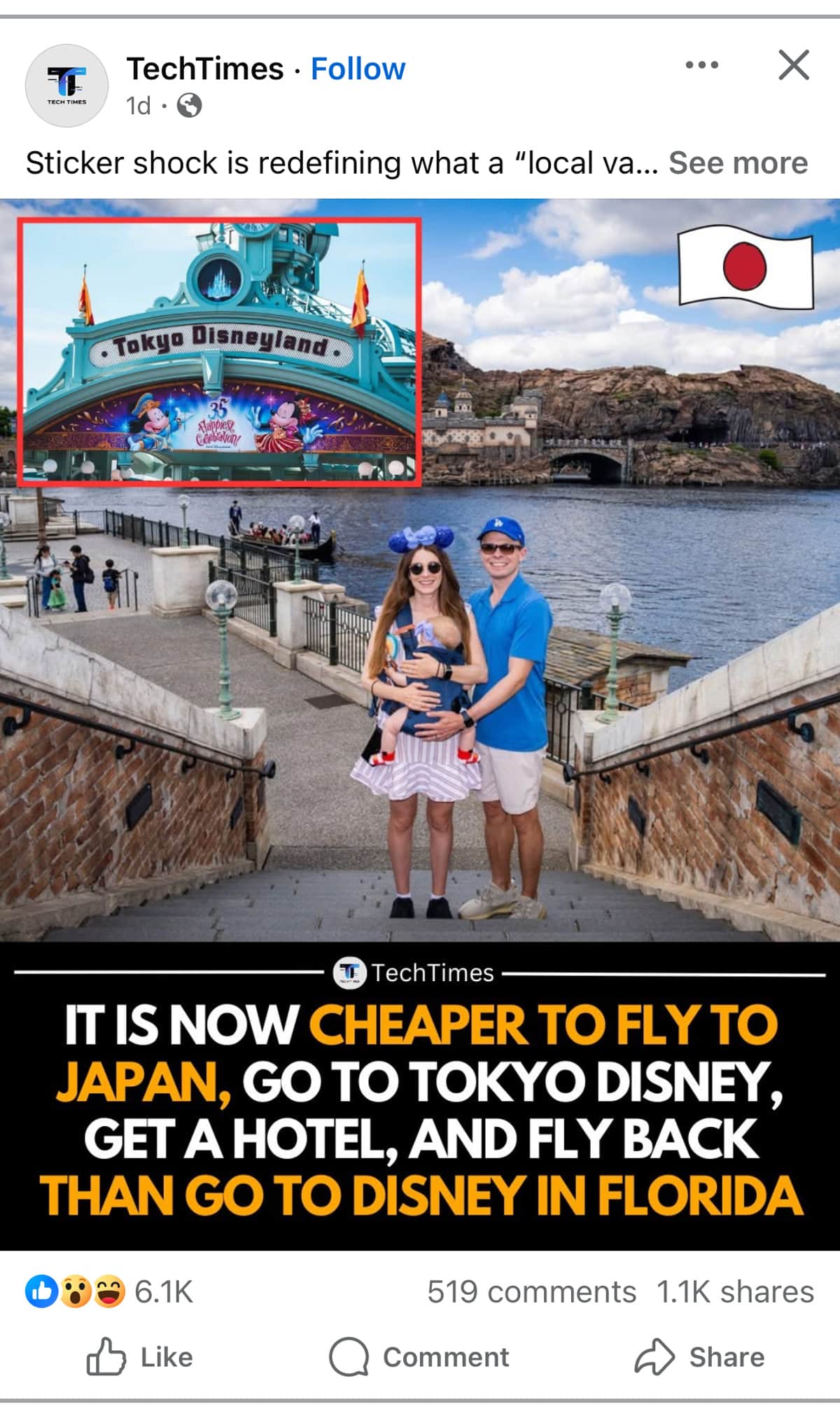
Articles about it being cheaper to travel halfway around the world to Japan instead of cross country to Florida have become ubiquitous and uncontroversial. For us, it’s come completely full-circle. We’re no longer the primary ones posting this advice, but instead are having our photos stolen for advertising others’ articles:
Suffice to say, word has gotten out. Tokyo Disney Resort being potentially cheaper to visit than Walt Disney World now routinely makes the rounds in the mainstream media. It’s such common knowledge among Disney fans that we’ve sought new angles to highlight the international parks, with an increased emphasis on the Disney’s most underrated and easiest park in the world.
Before delving deeper into this comparison, context is necessary. One reason is that median wages and household income are significantly higher in the United States than in Japan. The target demographic for each destination is domestic tourists, not international ones, so local economics drive pricing as each strive to maintain a sufficient pool of “income qualified” guests.
For these and other reasons, it’s somewhat silly to look at Walt Disney World vs. Tokyo Disney Resort in absolute terms as an indictment of pricing structures or the corporations that own each resort. Each exists in very different economies, serving divergent demographics. That matters in an inside baseball sense. It does not if you’re simply an American wanting to plan an inexpensive international trip to the two best Disney parks on the planet.
Here are the new wrinkles to this hot topic, and why the next year or two presents a golden window of opportunity to visit Tokyo Disney Resort…
Yen at 40-Year Lows
The yen has been “historically weak” for several years now. Given that, how does this make the list in an article specifically about why 2026 or 2027 is a golden window of opportunity?
Because the yen is getting even weaker. The yen is currently hovering around 162 per dollar, just shy of last week’s low of 162.84, which was the weakest level since 1986. Experts fear this could get “worse” and trigger Japanese intervention, buying yen to (theoretically) support its currency. Analysts doubt that any such move would deliver lasting support to the yen. There’s also the risk of a hawkish U.S. Federal Reserve, which is a negative for the yen.
To put this into perspective for those who are unfamiliar with traveling to Japan or foreign currency, a good/normal rule of thumb used to be a 100:1 exchange rate. Now, it’s above 160:1. I’m no mathematician, but that’s a massive improvement. It’s also on top of the lower baseline prices in Japan.
The next couple of years should (still!) be a great time to visit Tokyo Disney Resort with the exchange rate good-to-great by historical standards, especially as Japan’s new(ish) Prime Minister Sanae Takaichi has expressed a desire to keep interest rates low.
This is great news for Americans traveling to Japan, but it doesn’t apply to everyone. People who live in Japan and are paid in yen have a different perspective on this topic. This is the biggest reason why comparing prices at the domestic parks to the international ones is apples to oranges.
If the exchange rate were back around 100:1, this would be a completely different conversation. Someday, it might return to those levels. We’ve visited before when it was, and given price increases in all facets of travel since, our visits to Japan would be prohibitively expensive if/when that happens again.

Price Increases at TDR Hotels
Massive price increases are hitting the hotels of Tokyo Disney Resort hotels starting in October 2026, with some room types rising by tens of thousands of yen per night (or hundreds of dollars). Everything from standard rooms to suites is seeing significant jumps, with prices at Toy Story Hotel costing $100 per night more and Tokyo Disneyland Hotel up by $200 or so. It’s a similar story with the Ambassador and Celebration Hotel.
The only thing that’s surprising about these major increases is that they took so long. The hotels at Tokyo Disney Resort have long enjoyed sky-high occupancy rates, hitting 95% and 96% in each of the last two years. That is ridiculously high. The only reason I don’t have a before vs. after comparison for Hotel MiraCosta above is that it is so popular that the hotel instantly sells out most dates. MiraCosta appears to be much higher based on the limited comparisons I could find, for whatever that’s worth.
Tokyo Disney Resort cannot raise prices on tickets too much because they’re dependent largely on the local domestic audience to fill the parks. In the most recent fiscal year, attendance was actually down slightly and young visitors were priced out. Accordingly, OLC has actually mulled a wider range of prices, and decreased rates on the lower end.

The hotels are a totally different dynamic. There is far less capacity to fill, and they can be much more reliant on affluent domestic visitors and international guests who are already benefiting from the incredibly favorable exchange rate. This is something that we’ve seen with chained-brand hotels that use dynamic pricing. Rates are up slightly in dollars versus 2019, which means they are up massively in yen.
Despite this, occupancy remains high because international visitor numbers have increased to such a degree that this approach is sustainable. The same will be true with the hotels at Tokyo Disney Resort. Oriental Land Company (OLC), the owner and operator of TDR, will learn that they can push prices even higher without seeing an appreciable drop in occupancy, so they will.
Accordingly, the obvious advice here is to visit between now and September 2026 if at all possible to beat the upcoming price increases. But even if you can’t, it’s still smart to book an on-site stay ASAP because price increases on hotels will continue until occupancy is impacted. (The positive is that park ticket prices should not go up much, if at all.)

Crowds Will Get Worse.
This one isn’t specific to Tokyo Disney Resort, but is more about Japan as a whole. However, we’d hope that you aren’t traveling halfway around the world and only visiting theme parks. If you’re going to any touristy places (and you probably are, since you’re a tourist if you’re reading this), it’s worth warning you that Japan has been bonkers the last couple of years.
The number of foreign visitors to Japan topped 36.87 million in 2024, setting a new annual record. That surpassed the previous full-year high of 31.88 million set in 2019, according to the Japan National Tourism Organization (JNTO). Every single month of the year recorded at least 30% growth compared with the same month of the previous year.
Last year was even busier, but the rate of growth slowed. Japan reported a record 42.7 million international visitors in 2025, which was a more than 15.8% increase on the previous high, and the first time the country broke the 40 million barrier.
These crowds are not pent-up demand at this point. It’s going to get worse unless the yen gets stronger. In fact, Japan’s goal is attracting 60 million foreign visitors annually by 2030. That’s an increase of ~20 million over 2025’s number, which is both difficult to fathom from a capacity perspective (Kyoto, in particular, is already bursting at the seams during peak dates) and perfectly believable given the YoY increases in the last 3 years.
Crowds Are Down…For Now.
The bad news is that Japan wants more visitors and crowds will worsen over time. The very good news is that 2026 is down! The number of foreign tourists to Japan is expected to drop by 3% in 2026 to 41.4 million, according to an estimate released by JTB, which is Japan’s largest travel agency.
This is already happening. The number of foreign visitors to Japan has been down several months in 2026 thus far by totals of roughly 3 to 5%. The JNTO reported that 3.55 million people visited Japan in May 2026 (the last month for which there’s data), down 3.6% YoY. These have been the first drops since January 2022 during the COVID-19 pandemic.
This is despite visitors to Japan from 19 countries hitting record highs in 2026. South Korea and Taiwan are up 15%. Travelers from the United States are up 7%, and even the Middle East is seeing a rebound after the resumption of flights. So how does this drop make any sense in light of the above?!
Visitors from China plunged 60.4% to some 310,000, the sixth straight monthly drop. Last year, Chinese travelers accounted for about 20% of the total to Japan, which was the single largest source of foreign tourists.
However, the Chinese government urged its citizens to stop visiting Japan last fall following remarks by the Japanese Prime Minister about Taiwan. Chinese airlines reduced or suspended flights to Japan, slowing the number of Chinese travelers.
We were in Japan last year shortly after the boycott began, and it was very evident in Kyoto from the empty tour bus parking lots to available accommodations. I spoke with managers at several hotels, who were anxious about mounting cancellations. It was still busy during the peak season, but not as bad as it had been the previous couple of years.
On top of lower international tourists, domestic travel within Japan is also down thus far in 2026. According to JTB surveys of Japanese consumers, this is attributable to rising costs and crowds.
The JTB survey finds that 41.8% said that they want to decrease their travel budget for the next year, following price increases for three years in a row. JTB indicates that Japanese consumers are increasingly adopting a “selective spending” mindset, driven by anxieties about the economy and desire to save money as they feel squeezed (so basically, just like Americans).
The lower crowds won’t last, and the pendulum will swing back in the other direction. Eventually, the Chinese boycott will end and that key growth engine will resume. Likewise, domestic travel will increase as the Japanese adjust and desire to engage in more experiences. Japan’s 60 million target for 2030 is unchanged, making right now the golden window.
Fewer Fees
If you want to avoid rising fees, it’s already too late. Travelers who require a visa to enter Japan now pay up to five times more starting this month, after Tokyo raised visa fees for the first time since 1978, citing rising costs and exchange-rate fluctuations amid a tourism boom.
Japan has also significantly increased taxes for travellers leaving the country, tripling the current departure levy from JPY 1,000 to JPY 3,000 per person as of July 2026. The government has also announced plans to introduce additional entry inspection fees by 2028, citing pressures from over-tourism and rising fiscal constraints.
Japan has said visa fees are now being increased “in order to respond to the current price increases and fluctuations in exchange rates.” This visa fee increase is unlikely to affect tourism in Japan, according to Foreign Minister Toshimitsu Motegi.
To the contrary, there’s every reason to believe Japan will continue increasing fees so long as tourism is growing and the yen is weak. The amounts in question are not enough to discourage demand except at the margins of the most budget-minded travelers, but they will capture more revenue at a time when it’s badly needed.
More and more fees of this nature, or bifurcated pricing for residents and international tourists, have been floated. While many likely won’t come to fruition, plenty will. Visiting sooner rather than later will help avoid these, especially as Japan sees the (lack of) impact and raises fees even further.
Cheaper Airfare
Flights are frequently viewed as the insurmountable obstacle for visiting Tokyo Disney Resort. If you search last-minute from a regional airport, you might conclude that all dates from all airports cost thousands of dollars. Of course, that’s not reflective of average flights costs, just as it wouldn’t be for airfare to Walt Disney World.
Even as airfare is on the rise across the board due to higher jet fuel prices, there are still plenty of deals to be found on flights to Tokyo. I have airfare alerts set through a handful of different websites and I’ve received countless notifications recently, including from cities I’ve never spotted previously.
It used to be the case that inexpensive airfare was possible out of Los Angeles, San Francisco, and Seattle. Now, those prices are even lower–but there are reasonable options from elsewhere. Even the special Disney-to-Disney direct flight from Orlando to Tokyo has rates starting at $880 this fall and into early 2027!
For whatever it’s worth, we’ve frequently paid around $600 roundtrip for flights from Los Angeles. Our general rule is that we pay out of pocket for anything under $900, and use miles for flights above that. The only time we’ve paid more is when not flexible with dates.
Under $50 Park Tickets
As discussed in our Tokyo Disneyland Discount Ticket Tips, tickets can sell out in advance. We highly recommend purchasing at least a couple weeks in advance from TDR directly or via authorized TDR ticket seller Klook (especially useful if your credit card has issues with the TDR site).
Full single-day park tickets cost 7,900 yen to 11,900 yen for adults, which is approximately $48 to $73. Whenever the low cost of visiting TDR comes up, much attention is paid to ticket prices. And while accurate, we’d be remiss if we didn’t point out a couple of things. The first is that crowds are often so bad that paid line-skipping is non-negotiable.
The second is that Tokyo Disney Resort still has not resumed sales of multi-day tickets. This means that you’re paying $50 to $70 every single day, as opposed to purchasing a 5-day or longer ticket with an average cost in about that same range.
If anything, the lack of multi-day tickets and their inevitable return is one of the arguments against right now being a golden window of opportunity to visit. Not a strong argument, but it is one of several small ways that TDR still isn’t back to normal post-COVID.
It’s also our expectation that OLC will offer more upcharges aimed at free-spending international visitors in the years to come, especially if the company’s struggles continue. Additional upcharges may be a good or bad thing depending on your perspective, but they’ll definitely undercut the case that TDR is cheaper than the domestic parks.
Ultimately, it should be clear that Tokyo Disney Resort can be cheaper than Walt Disney World for the average American family. Almost everything except airfare, including things like souvenirs and transportation, will also cost far less in Japan. This is the widest the gap has ever been since we’ve been covering TDR, and it seems unlikely that the exchange rate–the driving force behind this phenomenon–will be 160:1 in another 5 years.
If it is, you better believe Japan will continue to adjust accordingly to capture more revenue from tourists to help bolster their economy and avoid being viewed as a budget travel destination. Between these practical realities and the fact that crowds in 2026 (and perhaps 2027) are on the decline as opposed to continuing their massive year-over-year gains, now is the perfect time to visit Tokyo Disney Resort, and Japan as a whole.
On top of this, the Tokyo DisneySea 25th Anniversary “Sparkling Jubilee” is ongoing now through March 31, 2027. This special event features new entertainment, decor, food & beverages, and of course, adorable merchandise. Above all, there’s a festive atmosphere for the event. Visiting Tokyo Disney Resort during a milestone anniversary is a memorable and fun way to do a first visit. Then there’s the new Fantasy Springs and, if you wait until Spring 2027, the upcoming Wreck-It Ralph ride and blockbuster new Space Mountain.
Of course, not everyone is willing or able to travel internationally to Tokyo Disney Resort. But if you read this deeply into the topic, we’re guessing you’re at least on the fence. In which case, you should absolutely do it. In the decade-plus that we’ve been effusively praising Tokyo Disney Resort and recommending Japan to anyone who would listen, we’ve heard from maybe 3-4 people who were disappointed, and literally hundreds who said it exceeded expectations–many even called it the trip of a lifetime.
Anyway, just some food for thought if you’ve been curious about visiting Japan but assumed it was out of reach. Not only is it more accessible than you might think, but now presents a rare window to visit. It also might be a good time to take a break from Walt Disney World, with no new major attractions on the horizon until late 2027 when Tropical Americas debuts! For everything else you need to know, we have a ton of resources in the links below.
Planning a trip to Tokyo Disney Resort? For comprehensive advice, the best place to start is our Tokyo Disneyland & DisneySea Trip Planning Guide! For more specifics, our TDR Hotel Rankings & Reviews page covers accommodations. Our Restaurant Reviews detail where to dine & snack. To save money on tickets or determine which type to buy, read our Tips for Saving Money post. Our What to Pack for Disney post takes a unique look at clever items to take. Venturing elsewhere in Japan? Consult our Ultimate Guide to Kyoto, Japan and City Guide to Tokyo, Japan.
YOUR THOUGHTS
What do you think of this window of opportunity to visit Japan? Thoughts on the cost comparison of traveling to Tokyo Disney Resort vs. Walt Disney World? Have you visited Japan in the last few years? What was your experience? How did you feel about the value proposition of TDR? Any questions we can help you answer? Hearing your feedback–even when you disagree with us–is both interesting to us and helpful to other readers, so please share your thoughts below in the comments!



Wow Tom you are just fantastic! Thank you again for your extremely helpful information. You are our number one resource for not only Disney travel, but around the globe. When we have questions, we Google if Tom has the information.
Jared W, thanks again for, very helpful and nice of you to respond
Sorry – I missed that one somehow! Agree with Jared on Haneda, although at this point, we’ll fly into (or out of) whichever airport has the better flight options. That’s often Narita. It’s definitely not make or break.
I’m going to be updating more TDR resources in the next few weeks, but for now, these might be helpful as you plan:
https://www.disneytouristblog.com/best-tokyo-disneyland-disneysea-tips/
https://www.disneytouristblog.com/tokyo-disney-trip-planning-guide/
We just went for the first time in early June, and Disneyland in particular was so empty that reminded me of the Magic Kingdom of my childhood. (DisneySea was more crowded, but I could happily just ride Sinbad over and over again, and the wait time for that was only 15 minutes.)
Our kids are teens/tweens, which makes traveling easier, but truly—it was not as hard as I thought it would be. We had never been to Asia before, and for me, the hardest part was navigating Tokyo Disney’s website. Everything after that was easy (including the Tokyo subway system, which is actually a breeze!) If you have been to New York or any large city, Tokyo is nothing to be scared of. In some ways, it’s easier than New York, because it’s super safe and people are really nice. Our kids are fairly picky eaters, and we had no problem finding them pizza/hamburgers/etc.
If you have no desire to go to Japan, then just disregard all of this. But if you have always wanted to go (like me!) then don’t rule it out! We booked plane tickets about six months in advance using airline miles. Other than that, the only research I did was to read TravellCaffeine.com!
While I don’t appreciate the NYC slander ;-), I have to agree with the main sentiment here. If you’ve successfully visited a big city (New York, London, Paris, etc.) you are well on your way to being able to navigate Tokyo. The subway/train system can feel overwhelming at first but Google Maps gives incredibly detailed directions, down to specifying what exit to take from the train station to be closest to your destination.
Super stoked to be going in mid-September and spending three days in the parks as part of a two-week trip split between Tokyo and Kyoto. We’re treating this as a “once-in-a-lifetime” trip and are doing a split stay between MiraCosta and the Tokyo Disneyland Hotel. We’ll be there on weekdays, so fingers crossed the crowds aren’t too bad.
For anyone thinking about going, my advice from this booking experience is to keep an eye on when hotel and restaurant booking windows open and book as soon as possible (especially for MiraCosta). I missed the opening for the hotel restaurant reservations, and most options were already booked (though I’m keeping an eye out for cancellations). I will say that both the website and, especially, the app have been pretty straightforward to navigate.
Appreciate all your tips, Tom—it’s been such a huge help with booking this trip and all our other Disney trips!
If you only have 3 days in the parks, I wouldn’t book any of the hotel restaurants unless they’re for early mornings or late nights.
Three days only scratches the surface of TDR, and there are so many cooler places to eat and better ways to spend your time! (The only must-do, IMO, is Magellan’s.)
Have a great trip!
Just as a heads up, I’m currently working on a “best weeks to visit TDR” post that’s similar to our resources for WDW and DLR. It won’t be as comprehensive since I don’t have as much recent experience, but it should offer a good mix of objective and subjective.
That would be awesome! I’m on verge of telling my family to go without me. The crowdedness is scary and off putting.
That would be great! Thanks.
Is there a better airport to fly into from the 2 in Tokyo?
Newsoutherngal, Haneda is the better airport to fly into if you have the choice as it’s a lot closer to the city center. Narita is over an hour outside of the city and if you opt to take a taxi/Uber, you’re looking at close to $200 USD total.
Everything you said is true, Tom, but at the same time, I was just in Tokyo last month. I had a superb time at Tokyo Disneyland – lovely as always. DisneySea was so ridiculously packed and chaotic, however, that I finally got to experience the “one-star reviews” you were talking about. DisneySea was definitely not like this when I visited in 2023, 2020, 2018, or 2016. On my last day at Tokyo Disney, I bought two day tickets in lieu of a park hopper so I could go to both parks. The difference between crowd levels in the two parks *on the same exact day* was stark. I hope they manage to control crowd levels a little better; I would have hated it if this was my first visit to DisneySea. There are things you can do to prepare, but at the end of the day, you can only do so much, and I think there are institutional changes that can be implemented to better manage crowd levels at DisneySea.
We’ve had some amazing days at TDS in the last year, and truly awful ones. I need to write up one of the bad ones, as I fear that fans of the domestic parks underestimate just how busy it can truly be. (And you’re right, TDL is a different story. At least, for now. It could be a similar story once Tomorrowland is done.)
To put it into perspective, average wait times on a moderate (not extreme) day at Tokyo DisneySea in 2026 are on par with the week of New Year’s Eve at Walt Disney World. Extreme days are like Epic Universe when the wheels fall off.
This is based on wait times data across the respective parks, not my personal perceptions. Frankly, my own perceptions would be even worse, as TDS on a bad day has 30+ minute lines for churros, counter service restaurants, etc.
We just last month visited Hong Kong, Shanghai, and Japan to finish our goal of hitting all 12 parks worldwide. All Asian versions were terrific, but DisneySea truly stole the show.
Prices for everything was VERY refreshing!
And thanks for the Kyoto recommendation – I enjoyed every stop, but Kyoto was my favorite city we visited.
First of hopefully many trips to Asia – it was an amazing three weeks!
Thanks for sharing your experience–glad to hear you had a good time, especially in Kyoto!
Congratulations, Jason. That’s pretty neat. We have Hong Kong and Shanghai yet to go.
Thanks for the article Tom, so glad to hear this. We usually go to Disney World for Thanksgiving and the week afterwards, but this year we’re going to skip it and go to Tokyo. We’re planning on spending four days at the resort, plus a few more in Tokyo, and ending the trip in Kyoto. Taking my kids, ages 4 and 2, and my mother as well. Even decided to book the unlimited rides package after reading your article about your best day ever at Fantasy Springs. Need to give you a big thanks, as I’ve taken a lot of your recommendations into the planning. One article I wish you would do, is how unbelievably frustrating and complicated the process of booking a Disney hotel in Tokyo is. Especially one of the good ones. Anyways, thanks again, and GO LIONS!!!
“One article I wish you would do, is how unbelievably frustrating and complicated the process of booking a Disney hotel in Tokyo is.”
I’ve vented about that in several other posts (it took me over a dozen hours–easily–to book our Fantasy Springs package), but don’t think that rant is really worth standalone post status. That does, however, underscore how underpriced the hotels are at TDR. Even with the massive price increases, MiraCosta is still sold out most dates in October that I checked! With OLC struggling, it seems like more price increases for the hotels are inevitable.
Smart move to book the unlimited rides package. One thing you’ll quickly discover is that the “lower crowds” section is relative to the last couple of years in Japan. You have no frame of reference for that so it’ll seem awful to you (and versus Walt Disney World), but I can assure you that it’s better now (and hopefully again in November/December) than it was in 2023-2024!
Japan generally seems amazing and the parks look incredible but I just can’t see myself doing that flight. I have been wanting to do Aulani for a while but even that seems out of reach. I have been increasing my flight tolerance recently though- we did italy during spring break , just returned from Disney Orlando 2 days ago which was a horror story for arrival- 2 hour flight snded up getting delayed to what was ultimately 10 hours- next month we head to costa rica – so hopefully the hawaii trip may attainable sooner thsn im thinking
I understand the trepidation, James. I was nervous about the flight the first time I went – I sleep poorly if at all on planes and double the flight time as US-Europe was dauting (we flew Toronto to Tokyo, so about 14 hours). But it actually ended up not being that bad. It was a long enough flight that my body forced me to get some sleep. While it wasn’t “fun” it was tolerable.
As much as I would love to visit, it is the airfare that is killing. We live on the East Coast (NJ) and flights going over is going to be high. Is it higher then WDW, nope? I have had Tokyo Disney on my list for a while. It is just the flight going over that is the kicker. If I could be sure that is was lower, sure. But I dont see flights our of PHL getting cheaper for us. So we are at a stand still. I do keep checking though.
Jan, NYer here and man even the flights to Orlando are ridiculous 🙁
NYer here, we went in 2025 and while airfare was definitely our biggest expense, we found Tom’s point about everything else being comparatively inexpensive to be true. To the point where our 2 week trip to Japan wasn’t noticeably more expensive overall than our 2 weeks in France a couple of years prior (which obviously had much cheaper flights from the East Coast).
We did tokyo disney in april this year (and shanghai disney and beijing universal and hong kong disney). Amazing trip. Tokyo disney on a weeknight was a ghost town and we were as giddy as school girls doing all the rides as walk ons. Had pirates all to ourselves. And it got stuck halfway through. Was awesome. Disney fantasy springs was our favourite hotel. The deserts at the hotel lounge are the best disney has done. Anywhere. Views pretty spectacular as well. Then tokyo disneyland was next best. Miracosta was a bit ordinary. The lobby looks great looking up but at eye level it was too crowded and didnt feel special. Overrated. Disney sea needs another thrill ride or two. Its lacking. Visually spectacular though.
We went in the past on our way back from Hong Kong (for the Disney park there) and stayed off-site in a Best Western that was a metro ride away. The biggest “hassle” would be the flight. It’s loooong. We flew into one of Tokyo’s airports and out of the other, which made research ahead of time a must on how to get to-from each from our hotel. I can’t even imagine bringing children on that long-haul flight just to go to the park because the price of admission costs less. Also, both parks in Tokyo were crowded. We couldn’t see any of the shows because a large amount of the visitors made that a priority over the rides. Don’t get me wrong, it was cool to go, but man, the trip there doesn’t seem worth it for a family with children. You want an empty park… go to the one in Hong Kong!!! Just walk right on everything! Paris is actually fairly affordable as well. Bundle the tickets with your Disney resort stay with length of stay passes… not too bad priced. Still have to do Shanghai and in the farther future Abu Dabi!
Sorry, just wanted to add the whole process of visiting Japan and Disneyland seems daunting. We’ve traveled numerous times to Europe but this is just another level. Airfare bought way in advance, traveling from southeast coast, tickets and hotel reservations not until 4 months earlier, the language, websites , it’s overwhelming
I wanted to chime in and state that I feel you, it does seem overwhelming but it is absolutely worth the effort! By the time we actually got to Japan (went in spring 2025) it didn’t feel any more difficult than visiting Europe. Some things from my experience that might ease your mind:
1) The language barrier was much less pronounced than expected. Signs are in both English and Japanese, and a lot of ordering is done via apps or screens where you can select the language. The people we encountered generally spoke enough English that we could do what we needed (mostly order food/pay for souvenirs).
2) My rule of thumb with websites was that if it didn’t have a toggle from Japanese to English (usually in the top right corner), I probably should find a different option as a first timer. Every tourist attraction and many restaurant/hotel websites did have an English toggle, so I didn’t feel limited in my choices. Many of the websites do seem to be running on early 2000s tech, which was obnoxious; the TDR website was a huge offender here.
3) There are multiple western chain hotels on the monorail loop at the resort which take reservations much further in advance. We stayed at the Sheraton Grande Tokyo Bay and it is literally across the street from the monorail station. I would book something there or at the Hilton so you know you have something, and then cancel if you get into one of the Disney hotels (although frankly, we didn’t feel the massive price markup would be worth it). You shouldn’t have any trouble getting park tickets 4 months out.
I hope this is all helpful and not too overwhelming, I remember feeling like you when I first started planning our trip. But if you’ve done Europe or other international destinations a lot of the basic principles of planning transfer, and you’re probably better prepared than you feel. Japan is absolutely worth it and I hope you have an amazing time!
I know tourism numbers were super=high last year, but I didn’t find it to be that bad when I was visiting. Admittedly, it was a short trip and it was focused on the Osaka Expo (which was insanely crowded, as expected) but outside of the Expo things didn’t seem that crowded. I’m hoping we can go back in 2027, but we’ll see what our schedule (and finances!) brings us as our DD starts college in the fall. I also have flight alerts set up, but haven’t seen anything under $900 (I paid <$600 to travel last fall).
Jared that is do kind of you! Thank you so much!
We usually buy our airfare as soon as the window opens. Almost a year in advance
Oh boy, that’s the time I’ve told my family, I’ve read the articles couple times but I guess I’m still confused. Our kids need to request time off in advance. What’s the sweet spot for weather and low crowds please
I’m sorry phone changed your name to tomorrow Tom?! sorry
Hi tomorrow, been waiting for this article, we count on your advice. Our family has been planning to go late October early November 2027, or just 2 first weeks November; that’s what I’ve gleaned as a good time according to your articles considering weather and crowds, if I read those correctly. Is this still a good choice? Any addition vice? Ty as always
As of right now, that’s a busier time to visit. See: https://www.disneytouristblog.com/best-crowd-calendar-tokyo-disneysea-disneyland/
However, I’d still recommend that timeframe, especially if you plan on spending time in Japan outside of the parks. Fall colors season is just an incredible time to visit, and worth dealing with the higher crowds IMO.