Why Sold Out Disney World Hotels Don’t Cause High Crowds & How to Find ‘Hidden’ Room Availability!

Walt Disney World hotel inventory is limited for fan-favorite dates in late 2026, prompting reader fears about heavy crowds. This post covers what’s up with the low availability, impacts of sold out resorts on attendance, how to book “hidden” rooms & dates that appear unavailable, and why this happens in the first place.
If this sounds like deja vu all over again, that’s because we’ve covered this topic in the past. We’re back to correct misconceptions and offer new advice because it has become one of the most common reader questions, and there are new wrinkles to report for 2026 and 2027.
One of the reasons it’s become a common question is because dates on our list of the Best Weeks to Visit Walt Disney World in 2026 to 2028 are showing as sold out or having limited availability. Accordingly, WDW fans are worried that “word has gotten out” and these sweet spots are suddenly going to be packed with people.
This is a somewhat valid concern, especially since Walt Disney World has roughly 30,000 hotel rooms. That’s somewhere between the level of the entire cities of New Orleans and San Francisco, and more than many other locations. If all of those rooms were filled up, that would be over 100,000 guests, all descending on the parks and creating colossal crowds. Thankfully, that’s not how it works. There’s much more nuance to hotel occupancy, which we’ll discuss here.
Let’s start by discussing everyone’s favorite subject: hotel occupancy statistics!!! If you dig through the Walt Disney Company’s financials, this is data you can actually find buried in the documents on their Investor Relations page.

Domestic Disney Hotel Occupancy By Year
- 2013: 79%
- 2014: 83%
- 2015: 87%
- 2016: 89%
- 2017: 88%
- 2018: 88%
- 2019: 90%
- 2020: 43%
- 2021: 42%
- 2022: 82%
- 2023: 85%
- 2024: 85%
- 2025: 87%
Note that these stats are domestic occupancy as a whole, which includes Disneyland Resort. However, there are under 3,000 hotel rooms at Disneyland whereas Walt Disney World has ten times that number. Accordingly, the above is reasonably reflective of the Florida fill-rate.

Walt Disney World’s on-site occupancy is higher than the broader market. Last year’s occupancy was 71.4% according to VisitOrlando, which was down 0.2% from the previous year, but still historically high. Orlando occupancy was 66.1% in 2019.
VisitOrlando won’t release final 2026 numbers until May 2027, but the organization has indicated that hotel demand was up 1% over last year through June. Since then, weekly reports have suggested a sharp summer drop, by as much as 7% in July.
Disney’s occupancy is based on available room nights. This means resort room inventory that’s actually bookable. This means room blocks taken out of commission for refurbishments are zeroed out, and not counted against occupancy. Likewise, converting hotel rooms into Disney Vacation Club inventory effectively boosts occupancy stats, as DVC is designed to operate at close to 100% occupancy.

There are valid points to be made with regard to Disney ‘adjusting’ available room nights to boost occupancy stats…but there’s also a lot of conspiratorial nonsense. Some fans contend that this is all a shell game, and has been for the last decade.
Disney is very obviously better off having a lower occupancy percentage but selling more room nights than pretending hotels are sold out by taking rooms offline. The high occupancy rate is barely even mentioned on earnings calls, so it’s not like this is a stat on which investors are fixated.
As a result of the high occupancy rate, Walt Disney World’s availability can look something like this for popular dates:
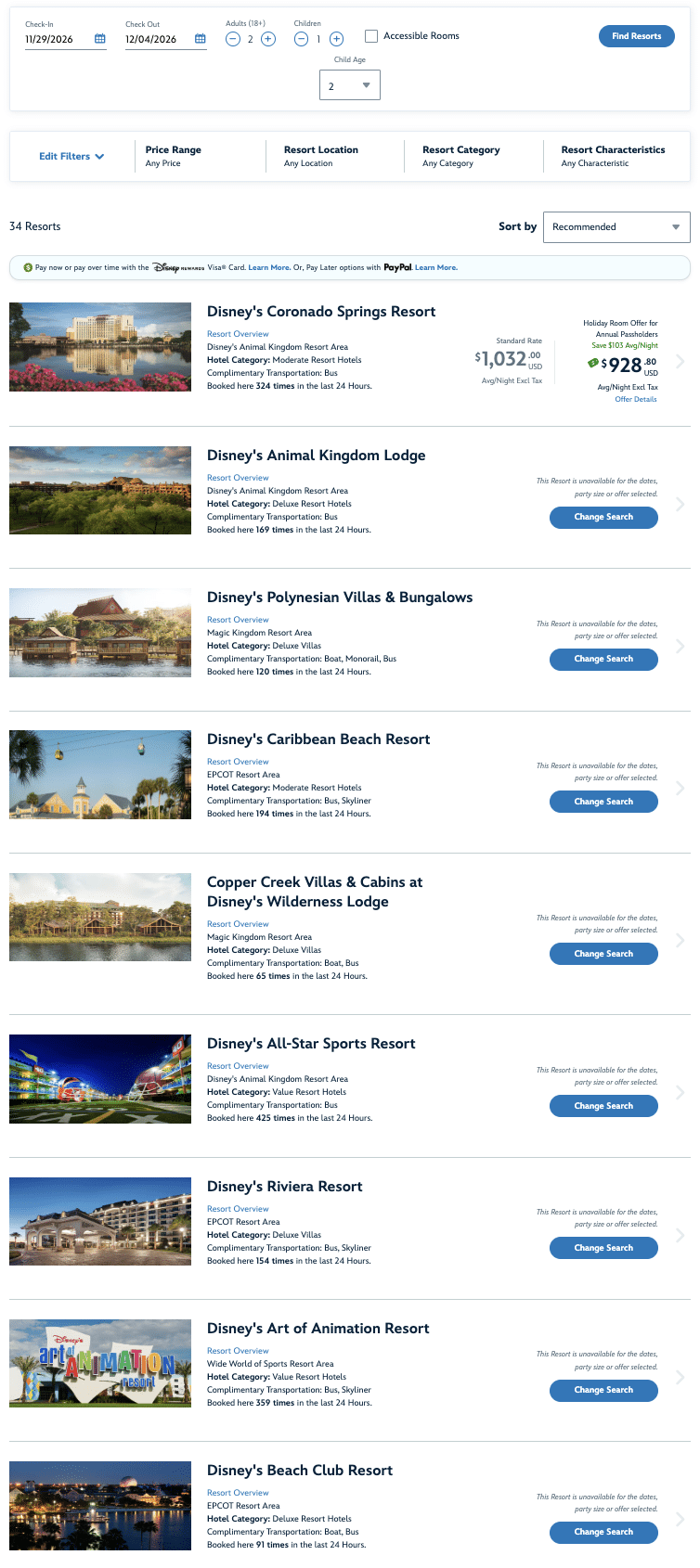
Now you know why I stay at Coronado Springs so often! (Really, this is pretty much the reason. Booking last minute often yields standard rooms at Coronado Springs, along with expensive and obscure room types elsewhere.)
As you might notice, the dates in the search field above are a little over two months from now, during our favorite week of the year at Walt Disney World.
We’ve repeatedly praised this timeframe for low crowds, so there’s the understandable concern among planners who try to make a booking during these dates and find next to nothing.

Accordingly, we’re here for a few reasons. One is to offer a reassurance that the off-peak dates during the upcoming season are still exactly that. Sure, they might be slightly busier than last year or the year before (and certainly busier than a decade ago), but they still won’t be bad. Definitely less busy than the week before or one month later.
The other components are explaining why this is happening more and more, and providing assistance in working around this to find availability. Let’s start with the tips.
First, contrast the above availability with the below–exact same travel dates, searches within 2 minutes:
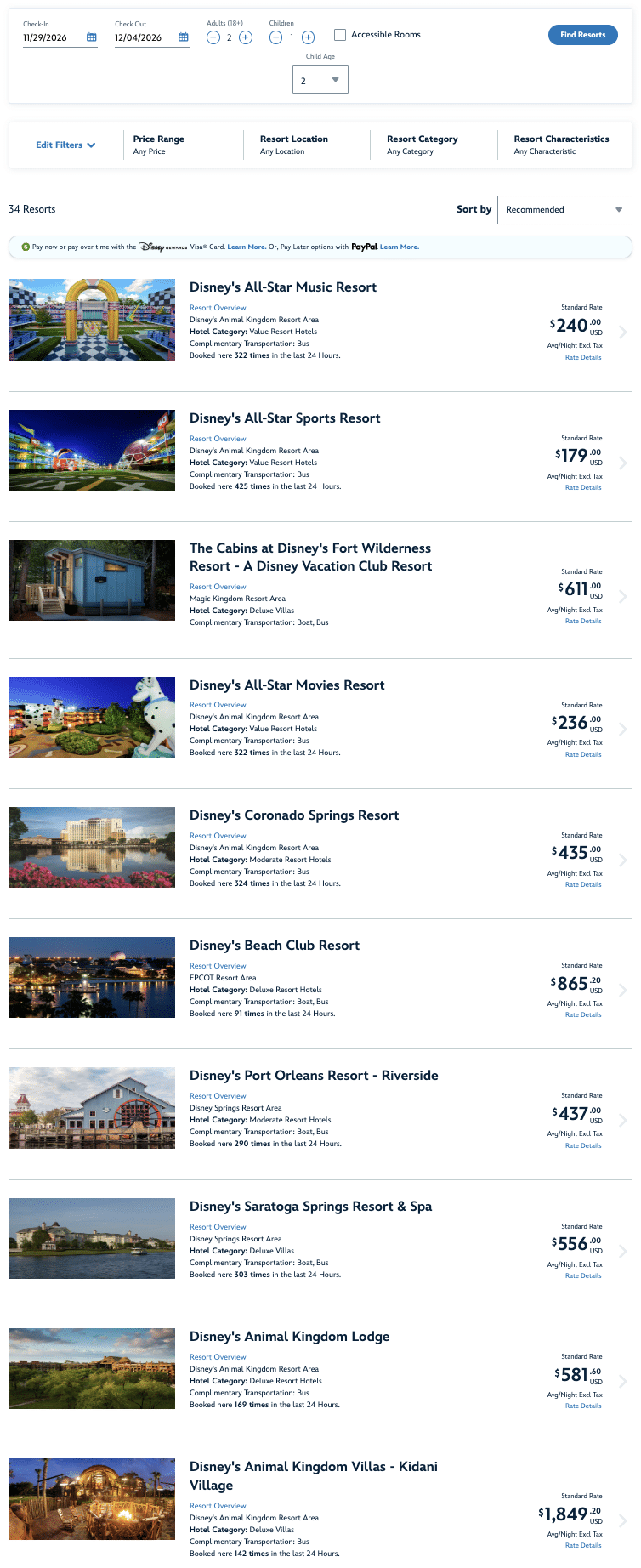
Tips for Finding Availability When WDW Hotels Appear Sold Out
The key difference is that I did this search logged out, so it didn’t default to showing me the Annual Passholder discount. A few resorts are still sold out even at full-priced, but as you can see, inventory isn’t nearly as limited. Even if you’re not an AP or Florida resident, you might need to deselect discounts to see actual, full-priced availability.
There’s understandable confusion about this, and it’s compounded by the odd user interface choice to not have a discount toggle on this page when searching resort availability as a whole. These toggles do exist on individual resort booking pages, but they’re absent on the main search. Meaning there’s no easy way to see availability as a whole unless you either log out or drill down to specific resorts. This quirk is easy to miss!
The reason for this is that special offers pull from different “buckets” of room inventory that are more limited. Walt Disney World doesn’t offer resort discounts out of generosity; they do so to hit occupancy targets. Accordingly, there’s only so many rooms allocated to special offers; it’s a subset of the total. Availability for full priced rooms will always be better than discounts.
Another thing to try is modifying your search to a subset of your actual travel dates or more than what you actually need.
If booking last-minute, I’ll do 1-night searches, make notes of what’s available each day, and then piece that together in multi-day searches. Sometimes this works, and helps me find availability when all resorts are supposedly sold out.
Conversely, if I’m trying to do a shorter stay, I will also search for longer reservations just to confirm Walt Disney World isn’t withholding availability for 1-2 night stays. More often than not, this is the actual issue. Here’s an illustrative example of precisely this problem, which I just dealt with:
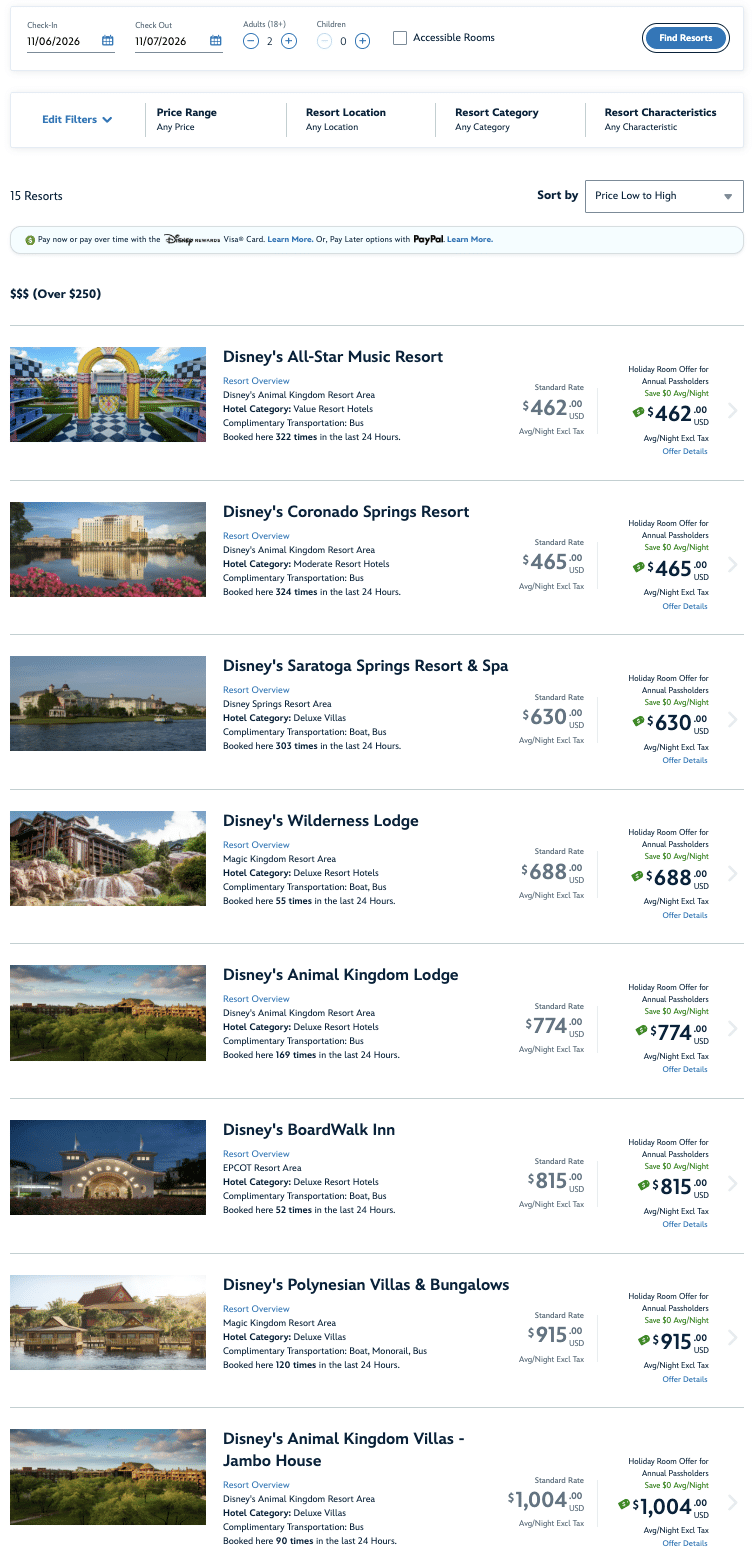
This is a search for rooms over the Christmas kickoff weekend that falls between Jersey Week and Veterans Day. There’s very little availability via special offers, and it isn’t even discounted since weekends are excluded from the promo!
It just shows an AP or FL resident rate that’s exactly the same as rack rates, while still limiting me to the smaller “bucket” of room inventory. On top of that, most of the availability is for higher-end resorts or room categories, making the “cheapest” option an All Star Music Family Suite at $462/night or Coronado Springs Preferred Room at $465/night. All of these discounts offer $0 savings, and there are many more rooms that are over $1,000/night.
Now let’s try this again….
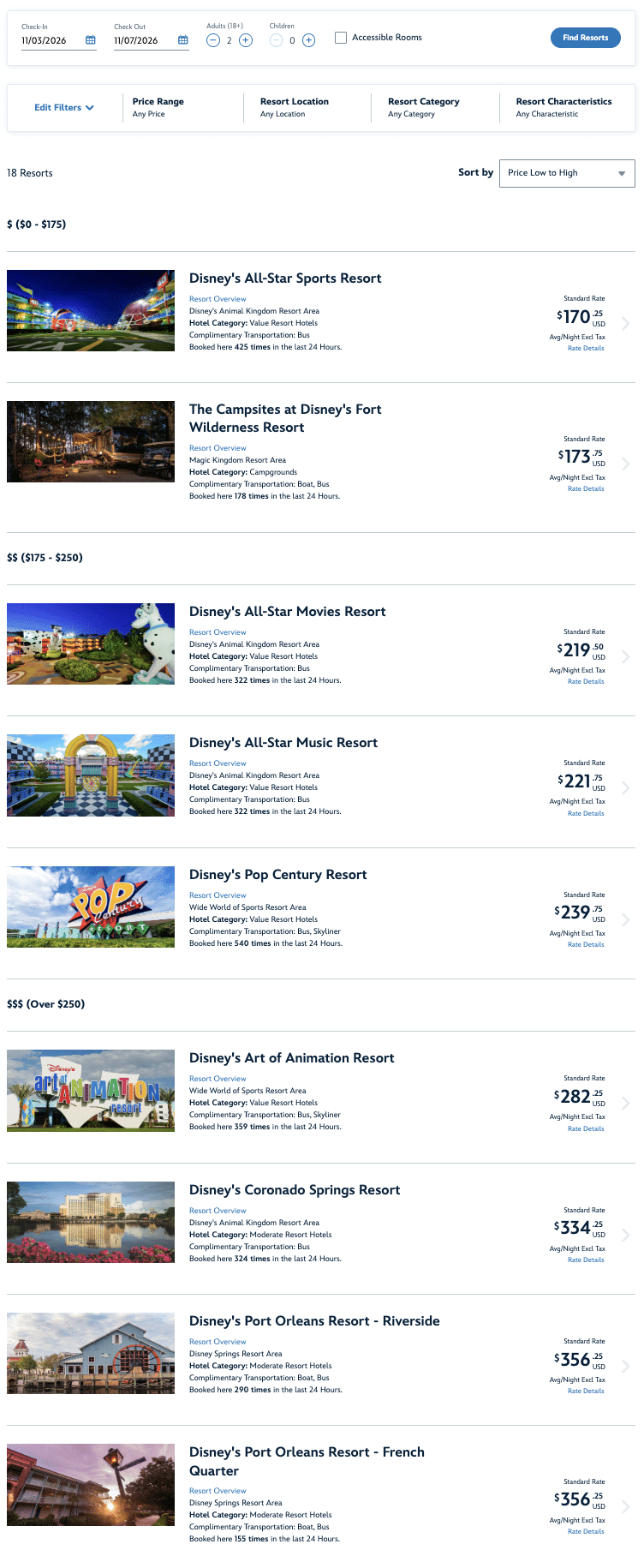
I’ve expanded my parameters from November 6-7, 2026 (one night stay) to November 3-7, 2026 (4-night stay) and also opted out of special offers, since they’re not offering any actual savings, anyway.
The result is that every single resort at Walt Disney World has availability. And almost all of them have options in standard rooms (a few are preferred only, explaining the discrepancy between All Star Sports and Music or Movies). At risk of stating the obvious, this is not how hotel availability should work in a system without artificial constraints. Adding nights should decrease options, not increase them. That’s not how “sold out” works!
This is a tedious game to play, but it’s sometimes necessary to get what you need.
With this approach, it’s easier to identify the actual night(s) that are sold out (if any), and book around those. I can do a split stay at two different resorts, or book a random DVC night at Saratoga or Old Key West or whatever table scraps are available.
I recently did exactly this with a stay at Old Key West in order to “unlock” a great rate at Caribbean Beach Resort. The latter didn’t have any availability for one of the nights during my stay, full-priced or discounted, no matter what I did. So I shortened the stay by a night, booked that at OKW, and scored a great AP rate at CBR for the remainder. And I had this issue during the off-season, after school went back into session!
Additionally, persistence pays off. Just because you see sold out resorts today doesn’t mean you will tomorrow. Walt Disney World availability comes and goes, as holds are released, rooms reenter the system following refurbishment, cancellations occur, etc.

In addition to our favorite week, two other times when we frequently run into this issue are around October 1st and over Jersey Week. The latter is likely one of the highest occupancy times of the entire year. Even months in advance, many/most resorts are often fully booked.
Two years ago, it really came down to the wire and I was able to score Pop Century on the morning of my flight, which was actually one of several resorts that suddenly became available. I’ve found that inventory opening up relatively last minute is a very common occurrence, especially right around the 8 day mark.
That’s when cancellations often occur in order to receive a full refund. If I’m not satisfied with my original booking, I’ll often set a reminder 8 days out, and look again. (I do NOT recommend having no reservation until then. Always book a backup!)
Why Crowds Can Be Low Even With High Occupancy
As for sold out hotels not equaling high crowds, we know this based on past precedent. During the most recent (third) quarter, Disney’s 10-Q showed that domestic resort hotel occupancy was up to an impressive high of 91%, up from 86% for the same quarter last year. Occupancy in the second quarter was “only” 89%, and that encompassed Spring Break and the increasingly busy winter months.
By contrast, the third quarter was mostly after spring break, and included less-busy shoulder season dates. In analyzing wait time data, Walt Disney World crowd levels were higher in the second quarter than in the third quarter, despite the lower occupancy level.

For context, here are the monthly wait time averages for Walt Disney World for those quarters:
- January 2026: 32 minutes
- February 2026: 36 minutes
- March 2026: 36 minutes
- April 2026: 34 minutes
- May 2026: 30 minutes
- June 2026: 27 minutes
The third quarter of 2026 had the lowest average wait times since Q4 of last year, but it had the highest occupancy rate. That should be pretty conclusive that occupancy does not equal crowds.
It’s tough to make sense of that, and the best explanation is that Disney has just gotten really, really adept at pulling the right “levers” to optimize occupancy. More important for our purposes is that occupancy and crowd levels are two different things, and one is not necessarily indicative of the other.
On-site hotels selling out completely can cause planners to freak out that the parks are going to be chaotic and crowded. Which can be true…sometimes. As for higher occupancy not moving the needle on attendance or being divorced from crowd levels, that’s explained simply by off-site stays.
Again, Walt Disney World has ~30,000 hotel rooms, and if you assume 2.5 to 3 guests to a room and a little under 1 park day per night (.75?), on-site guests account for fewer than half of all guests. That’s the back of napkin math of occupancy vs. attendance, but Walt Disney World has also suggested that most guests come from off-site.
With 130,464 hotel rooms in Orlando, there’s a ton of capacity that feeds Walt Disney World that’s not on-site. The fill-rate at those hotels is what’s outcome determinative, especially since Disney’s numbers are fairly strong throughout the year. (Disney Vacation Club, in particular, has little variance across the calendar.)
Beyond the third party hotels around Orlando, there’s also the growing population in Central Florida and beyond within driving distance. Locals might simply come out for the day when the weather is nice, because there’s a ticket deal, or to enjoy the current flavor of EPCOT’s festival. But they are mostly day guests who are not factored into overnight numbers.

Moreover, just because someone is occupying a room at Walt Disney World does not mean they are contributing to crowds. I’ve stayed at Coronado Springs on several occasions when the resort has been slammed, but the buses to the parks have been downright dead. Other times, the resort hasn’t seemed that busy, but the buses have been packed.
As one of the resorts that often hosts conventions, youth sports, and other large group events, this dynamic is most evident at Coronado Springs. It also happens at other hotels, including the All Stars, Contemporary, Grand Floridian, and every Crescent Lake Resort. Beyond conventions and youth sports, there are other smaller scale events like weddings, corporate and social events. Disney has a whole team dedicated to this large line of business via Disney Meetings & Events.
This is why our back of napkin estimate for parks per day is .75 as opposed to 1, and it might be even lower than that. Same goes for the average guest count of 2.5 to 3. That might seem low given Disney’s core demographic of families with kids, but it also accounts for all of the solo conventioneers and growing contingent of Childless Disney Adults. I wouldn’t be surprised if the .75 and 2.5 numbers are both overestimates.

Why Booking Early Is Best
Finally, given the frequency with which some Walt Disney World resorts sell out, we would recommend booking early and applying special offers when they’re released. That is, if there’s inventory for your date, resort and room combo. If not, you can always rebook elsewhere or stay put at your current rate. Absent a time machine, you cannot book something once it’s sold out.
This advice absolutely applies to January through March 2027 travel dates. Special offers for the general public were just released, and are already selling fast. It behooves you to book ASAP. Better yet, book a bounceback if eligible. If you have trouble finding something, keep checking.
It’s worth underscoring that dates in the first 3 months of the year are really popular. It’s a combination of shifting travel trends and lower rate seasons, plus special events. The same issue is bound to arise with dates between January and March 2027. Just something worth being aware of if you have firm travel plans but are in ‘wait and see’ mode for special offers. There’s zero downside risk to booking now, but there is in waiting.
Ultimately, that should help explain what’s going on with unavailable rooms at Walt Disney World. More than anything else, this is simply the “new normal” and one we’ve seen play out predictably and consistently in the post-COVID era.
Even with revenge travel over, there’s a higher baseline level of demand. Americans have reevaluated their spending and will continue to prioritize travel for the foreseeable future. It also helps that Walt Disney World has taken a divergent approach from other high-end hoteliers, which do not attempt to optimize occupancy with discounts. In fact, they do the opposite, tolerating lower occupancy rates to preserve high pricing and brand cachet. (Not an apples to apples comparison, but true!)
On top of that, on-site hotel room inventory has not meaningfully increased in a while, and Walt Disney World is pulling more “levers” to keep occupancy as close to 90% as possible. Given that, it’s downright necessary to book earlier than it used to be if you don’t have flexibility and want the best deals.

The good news is that Central Florida is in the midst of a hotel boom, with countless off-site options opening in the last few years and more under construction. On top of that, Universal has gotten more competitive on the hotel side, and added a ton of inventory.
Best of all, the most meaningful increase to Walt Disney World’s hotel inventory in over a decade will arrive on July 1, 2027, when Disney’s Lakeshore Lodge opens and adds 967 units, some of which are considerably higher capacity than the average hotel room.
Some Walt Disney World fans hate to hear this, but there are only two solutions to addressing the problem of sold out hotels. The first is raising rates and offering fewer discounts. The second is increasing supply. To each their own, but I am staunchly in favor of the latter, and hope Disney’s Lakeshore Lodge is just the start of an on-site hotel boom. That new property should help provide some relief…maybe enough that we aren’t revisiting this question again for Christmas 2027!
Planning a Walt Disney World trip? Learn about hotels on our Walt Disney World Hotels Reviews page. For where to eat, read our Walt Disney World Restaurant Reviews. To save money on tickets or determine which type to buy, read our Tips for Saving Money on Walt Disney World Tickets post. Our What to Pack for Disney Trips post takes a unique look at clever items to take. For what to do and when to do it, our Walt Disney World Ride Guides will help. For comprehensive advice, the best place to start is our Walt Disney World Trip Planning Guide for everything you need to know!
YOUR THOUGHTS
Have you encountered “sold out” (air quotes) resorts at Walt Disney World during a time you didn’t expect to be busy? Did you manage to discover hidden inventory by tweaking searches or checking back? Thoughts on how hotel inventory does or does not impact crowd levels in the parks? Do you agree or disagree with our commentary? Any questions we can help you answer? Hearing your feedback–even when you disagree with us–is both interesting to us and helpful to other readers, so please share your thoughts below in the comments!