
Best Credit Cards for Disney Travel
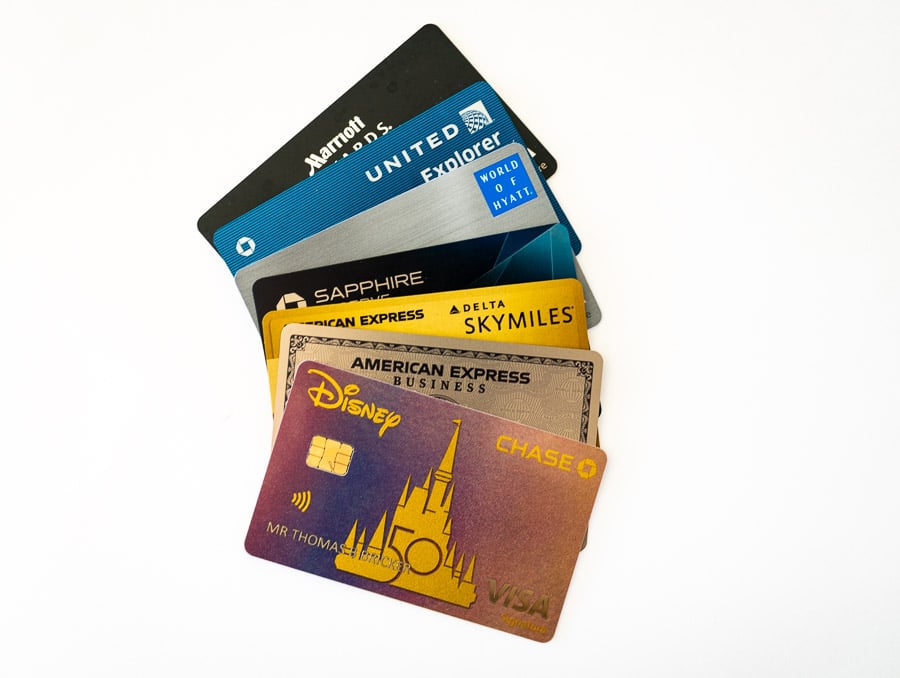
We review the best credit cards for travel rewards that can be redeemed for flights, hotels, or dining at Walt Disney World and Disneyland. These same cards are also good options for any destination in the world–that includes places like Tokyo Disney Resort, DLP, and even Japan or France as a whole. (Updated August 4, 2025.)
We understand and appreciate that credit cards are not for everyone, but that does not make them inherently bad. Between the two of us, Sarah and I have had ~25 credit cards, received tens of thousands of dollars in rewards, seldom pay cash for flights or non-Disney hotels, and never pay any interest on purchases.
Credit card debt is obviously bad. It should go without saying that you aren’t coming out ahead with rewards if you’re paying interest. That does not change the fact that “debt” is not an inherent element of possessing a credit card. Nor does it change the fact that an inherent element of credit cards is rewards and perks. We’ll stop with the preachiness, but felt a little of it was necessary to overcome the terrible stigma associated with having credit cards.
Let’s turn to our methodology for determining which credit cards belong on this list. Factors include annual fees, sign-up bonuses, earning and redemption rates, reward options, redemption difficulty, and ancillary benefits (such as free checked bags).
One factor that is notably omitted is APR. All of the benefits offered by credit cards are outweighed by paying any amount of interest, and that goes for any credit card. While valuable tools if you leverage their benefits and pay off your balance in full each month, credit cards are counterproductive when they carry a balance.
Again, this is because we use credit cards for their rewards and awards. If you have good credit, time to spare, the desire to travel, and some great organizational skills, we recommend that you do the same. This is how we “pay” for many flights, stays in ~$1,000/night hotels, and are able to use airport lounges, among many other things.

Credit cards are an integral component of this. We used to be big on “churning,” which involves simultaneously opening new credit cards based upon which perks are being offered, spending the appropriate amounts to receive those perks, redeeming said perks, and closing or downgrading the card account after the first full year of having it. (If you wondered why we’ve gone through so many credit cards, that’s precisely the reason.)
More recently, we’ve been still been rotating through some credit cards, but aren’t as diligent about it. Although after booking our December 2025 trip to Japan and significantly depleting our points stockpiles on a trio of luxury hotels, we’re planning on getting back in the game again!
Suffice to say, churning can be well worth the effort if you want to get serious about travel hacking. There’s a slight learning curve involved, but once you spend a few hours learning the ins and outs, you’ll overcome that and be rewarded with the knowledge needed for inexpensive or totally free travel.
With that out of the way, here are the travel credit cards we recommend…

Disney Premier Visa Credit Card
Let’s start with the most obvious option, given that this is a Disney blog. Despite that fact, we are not huge fans of the various Disney Visa credit cards. This is a credit card we have, but not one we use with regularity. We cannot stress enough that the Disney Visa is NOT the best credit card for Walt Disney World or Disneyland, counterintuitive as that might seem.
This credit card is really only advantageous to use while at Disney destinations, making it a solid specialized use card for Disney fans, but not among the best cards on this list–even for Disney fans. It’s a good card to have as a 4th or 5th card to hold simply for the perks, but not for the rewards and certainly not everyday use.
Basically, it comes down to rewards. You are better off with a regular cash back credit or a different credit card for travel. The value you’ll derive from those rewards will be much higher than this, and you won’t be locked in to Disney rewards points. We do a more thorough job of explaining why in our Disney Visa Credit Card Pros & Cons post.
The Disney Premier Visa card has a $49 annual fee and offers 2% rewards at gas stations, grocery stores, restaurants, and most Disney locations, and 1% everywhere else. It’s also good for some discounts at Walt Disney World and Disneyland; sometimes Disney Visa holders also receive advantages when it comes to Free Dining.
We know a lot of people who use this for everyday purchases and then use the rewards to pay for portions of their Walt Disney World vacations. Flip the script on that: use this credit card while at Walt Disney World, and not for everyday purchases. (Redeem the rewards for DisneyStore.com purchases.) Currently, there’s receive a sign-up bonus of up to $300 in rewards dollars after spending $1,000 within the first 3 months with our referral link.

Chase Sapphire Reserve Credit Card
This is another one of our primary credit cards for travel purchases. One reason we recommend this card is because of its redemption flexibility, as its rewards are not tied to any single airline or hotel chain. Another is that it earns at a higher rate (across the board) than almost any other card.
The biggest balking point on this card is going to be the annual fee, which just increased from $550 to $795. Honestly, that wasn’t the biggest blow from our perspective–it was that travel purchases now earn only 1 point per dollar, a significant cut from the previous 3X rate that applied to all travel not booked through Chase. There are now 4X rates for flights and hotels booked directly, which is the Sapphire Reserve’s potential saving grace.
Honestly, the annual fee doesn’t bother us nearly as much. Chase Sapphire Reserve cardholders still receive a $300 per year travel credit, as well as TSA PreCheck or Global Entry application fee, plus DoorDash and Lyft credits, StubHub credits, Apple TV+ and Apple Music credits, and Peloton membership credits. There are also credits for Chase’s high-end hotel and dining portals, but we haven’t found much use in those.
The Chase Sapphire Reserve also offers complimentary IHG One Rewards Platinum Elite Status through December 31, 2027. IHG is not one of the loyalty programs we use, so to each their own on that. More significant is that Sapphire Reserve cardholders get access to Chase Sapphire Lounges and Priority Pass lounges for themselves and up to two guests. There are currently eight Sapphire lounges, with three more lounges set to open soon. None in Orlando, but there are Priority Pass lounges at MCO (The Club).
Arguably the biggest benefit is the flexibility of Chase Ultimate Rewards points, which gives them a value that’s well above-average. Currently, you can receive a sign-up bonus of 100,000 points in rewards dollars after spending $5,000 within the first 3 months with our referral link. If valuing these points at around 1.5 to 2 cents each when transferred out and maximized, the value of the sign-up bonus alone is easily double to triple the annual fee. And that’s before accounting for the perks.
Chase Ink Preferred
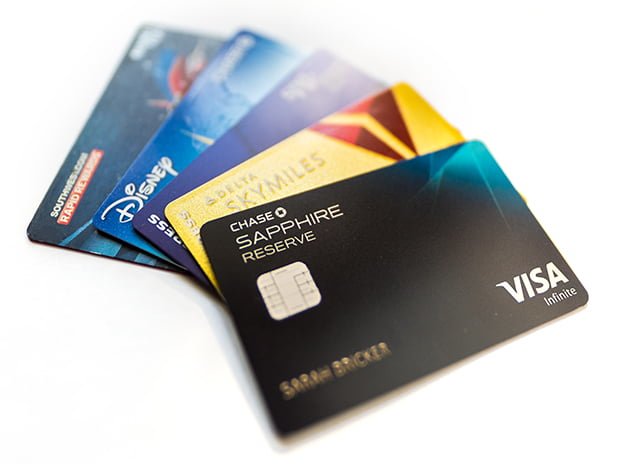
The Ink Business Preferred Credit Card is one of the best travel cards thanks to the card’s rewards and value. For only a $95 annual fee, you earn 3X points on the first $150,000 spent in combined purchases on travel, advertising, shipping, and internet, cable and phone services each account anniversary year. Earn 1 point per dollar on all other purchases.
This is the only Ink card that earns transferrable Chase Ultimate Rewards points as opposed to cash back (remember, points are worth more than 1 cent each if smartly redeemed). It’s also the only Chase Ink credit card that earns bonus points on travel purchases. This is technically a business card, which is why it’s often overlooked in conversations about best travel cards, but the bar for having a “business” is low. We primarily use this card for the travel earn–it not having other perks is a benefit to use since we also hold the AmEx Platinum and CSR. There are already redundancies between those two–don’t need another card offering identical credits.
The other big win here is the sign-up bonus. Currently, you can earn 90,000 bonus points after you spend $8,000 on purchases in the first 3 months using our referral link. That’s not as attractive as the CSR above, but if you’d prefer a lower-fee card or multiple Chase Ultimate Rewards cards (you can combine points across accounts!), this is a good option.

Chase Sapphire Preferred Card
Think of this as the “lite” version of the Chase Sapphire Reserve Credit Card. It has the same upsides in terms of flexibility, but with scaled back earning and redemption rates, and lacks a few of the other perks. It also only has a $95 annual fee. We recommend this credit card if you travel less, don’t need or want the Sapphire Reserve, or are looking for an entry-level travel credit card.
With the Chase Sapphire Preferred Card, you earn 3 points on dining, 2 points on travel per $1 spent and 1 point per $1 spent on everything else. Additionally, Chase Sapphire Preferred cardholders earn an anniversary bonus equal to 10% of their total purchases from the previous year. As with the Chase Sapphire Reserve, this uses the Chase Ultimate Rewards portal and you can also transfer them at a 1:1 rate to several loyalty programs.
The Capital One Venture Rewards Credit Card is a comparable card. For the same $95 annual fee, it offers 5X miles on hotel and rental cars booked via Capital One Travel and 2X miles per dollar on all other purchases. This is another good beginner credit card, and is more straightforward than the Chase Sapphire Reserve or other options.

American Express Platinum
This is another one of our go-to travel credit cards. Thanks to its strong slate of travel benefits and reimbursements, it’s easily worth the $695 annual fee. As steep as that may sound, it includes annual statement credits that can total approximately $1,500 and are relatively easy to use.
The Amex Platinum also offers exceptional travel insurance for delays, interruptions, cancellations, and even emergency evacuation. On top of that, concierge customer service–among many other things–is available with this card. The Amex Platinum also offers 5x points on flights and hotels, plus airline credits and Global Entry or TSA PreCheck. That’s before even getting to the American Express Membership Rewards points, which are among the most valuable–and transferrable!
Another reason we love the Amex Platinum more than any other credit card is the lounge access. We fly between Los Angeles and Orlando, typically on Delta. This card gives us access to American Express Centurion Lounges (there’s one in LAX) plus Delta Sky Clubs (also great ones at LAX, MCO, and ATL, which is a frequent layover for flights out of MCO).
With that said, the AmEx Platinum pretty much requires a high annual spend in order to make sense. Given how much we drop at Walt Disney World, Disneyland and beyond each year, it does make sense for us. YMMV. Currently, you can receive a sign-up bonus of up to 175,000 points in rewards dollars after spending $8,000 within the first 3 months with our referral link.

Marriott Bonvoy Credit Card
There are a ton of hotels where you can earn and redeem Marriott Bonvoy points. At Walt Disney World, your best options are Swan & Dolphin, and Swan Reserve hotels, which are located right next to Disney’s BoardWalk Inn and are within walking distance of both Epcot and Disney’s Hollywood Studios. But there’s also the JW Marriott Orlando Bonnet Creek Resort & Spa, and a couple options at Flamingo Crossings.
At Disneyland, the options are even better. The Westin Anaheim Resort, Courtyard Anaheim Theme Park Entrance, JW Marriott Anaheim Resort, and Fairfield Anaheim Resort all perform well on our Rankings & Reviews of Anaheim Hotels Near Disneyland. Two of those are the only luxury resorts in the city, and the other two are less than a 10 minute walk to the parks.
In addition to the sign-up bonus that’ll earn you multiple free night awards, the Marriott Bonvoy Credit Card offers up to 6 points per $1 spent at Marriott Bonvoy hotels, 2 points per $1 spent on all other purchases, and one free night per year. There are three different credit cards that are Marriott Bonvoy-branded, but we recommend the middle-tier “Boundless” card.
Sign-up bonuses vary, but it’s currently 3 free award nights, which is very good! Sign-up for the Marriott Bonvoy Boundless Credit Card via our referral link!

Hilton Honors American Express Aspire Card
Hilton is quickly becoming one of our favorite hotel chains, and is already where we stay the most. Last year, we logged over 30 nights at the Hilton Tokyo Bay–a monorail loop resort at Tokyo Disneyland, and that alone is enough for us to justify having this card. We also usually redeem our points at the Conrad Tokyo, and are looking forward to a stay at the Roku Kyoto.
At Walt Disney World, there are also three on-site Hiltons that are eligible for Early Entry! At Disneyland, the options for Hilton aren’t as good, quite frankly. We probably wouldn’t get the Aspire Card or make HHonors your program of choice if you’re primarily a Disneyland person.
With a massive sign-up bonus, you can stay several nights at any of these properties. Other perks of this Hilton Honors Amex include large category spend bonuses, Hilton property credits, an airline fee credit, and Diamond Status–which means concierge lounge access, free breakfast, and room upgrades at select hotels. This last part is huge for us, as having access to the Executive Lounge is our favorite way to stay at Tokyo Disney Resort!
Sign-up for the Hilton Honors American Express Aspire Card via our referral link and earn 175,000 HHonors points after you spend $6,000 in purchases on the credit card within your first 6 months of membership. Offer ends 08/13/2025.

United MileagePlus Explorer Credit Card
We bounce back and forth between Delta and United as our preferred carrier depending upon the year (never American Airlines) as we’ve had success with both airlines and need a primary carrier that has actual international routes. (Although now that we have a toddler, we find ourselves flying Southwest again more and more.)
The perks provided by this card (free checked bags, priority boarding, free United Club passes) are also nice. The sign-up bonus is currently 60,000 miles after spending $3,000 in the first 3 months via our referral link, which is good enough for two round-trip flights to Walt Disney World.
Honestly, we are not huge on airline-specific credit cards. We each hold 1-2 for the perks, but we typically do not use airline co-branded credit cards to earn miles. It’s a similar idea to the Disney Visa. Instead, we use the Chase Sapphire and Ink plus the Amex Platinum and transfer those points to partner airline portals. As always, your mileage may vary.

Southwest Rapid Rewards Premier Credit Card
The next few cards are airline and hotel loyalty ones that we think will most benefit Disney travelers. The Southwest card is our airline pick for a few reasons. First, we know Southwest is the most popular airline for Walt Disney World and Disneyland fans (it’s a popular and convenient carrier at both MCO and SNA).
Second, this card makes earning and redeeming points easier than most other airline-specific cards. Third, since Southwest Airlines pulled a page from the Bob Chapek playbook and made several guest-unfriendly changes, the credit cards are the best and easiest way to get a free checked bag, standard seat selection, boarding benefit, and more.
For most Disney travelers, the Southwest card is the best airline-specific option. The $99 annual fee might sting a bit, but you receive a 3,000-mile anniversary bonus each year. Standard point rate is 1 point for every $1 spent, except Southwest purchases, which earn at a 2:1 rate.
There are also no foreign transaction fees, and the ability to earn a Southwest Companion Pass (see our Guide to the Southwest Companion Pass for how to score this for almost 2 full years with a dual credit card hack) with a mileage boost. Currently, you can receive a sign-up bonus of 100,000 points in rewards dollars after spending $4,000 within the first 5 months with our referral link.

World of Hyatt Credit Card
Hyatt is our favorite hotel chain in the world (more so than Hilton, Marriott–or even Disney), and we stay at their various brands whenever and wherever possible. We especially love the Park Hyatt Kyoto and Park Hyatt Tokyo for Japan trips, and those are good uses of Chase Ultimate Rewards point transfers. If you travel internationally, there are incredible Hyatts in the cities near all of the other Disney Parks (Paris, Shanghai, Hong Kong, Tokyo).
There are no Hyatts on-site at Walt Disney World, but the Hyatt Regency Grand Cypress is a wonderful resort that’s only ~5 minutes from Walt Disney World (a cheap Uber ride). At Disneyland, there are actually 3 hotels within walking distance–Hyatt Place Anaheim, Hyatt House Anaheim, and Hyatt Regency Orange County.
With the current sign-up bonus, you earn 2 free nights at any Category 1–4 Hyatt hotel or resort after spending $4,000 in your first 3 months of account opening. Plus, earn 25,000 Bonus Points after spending $12,000 in your first 6 months of account opening. This limited-time offer ends August 28, 2025.

BankAmericard Travel Rewards Credit Card
Okay, let’s say you want to pay no annual fee at all. This is pretty common sentiment, and we can respect not wanting to spend money on credit cards. However, we would caution against being anti-annual fee before doing the math to see if the benefits (based on your spending habits) don’t offset the fee. In any case, if this describes you, this card offers a moderately good reward rate, good redemption options, and a decent sign-up bonus.
The BankAmericard Travel Rewards card earns a flat 1.5 points on every $1 spent. It’s that flat 1.5 rate that makes this card our ultimate recommendation for the “no fee” category. Points can be redeemed as a statement credit for travel purchases. If you have a Bank of America account, you receive a 10% bonus; if you’re a Preferred Rewards client, that bonus is up to 75%.

Okay, that covers it for our summary of the best credit cards for travel (with an emphasis on Disney travel). Note that none of these credit cards are one-size fits all. Our primary travel credit cards are AmEx Platinum and Chase Ink, and we also have airline and hotel-specific cards are for Delta, United, Marriott, Hilton and Hyatt. Those are just what happen to work best for us. You might have different needs or preferences, spend differently than we do, etc.
Also, travel cards are not the same as primary, everyday use credit cards–you should look to different cards for that. That’s a whole other topic, and one that is not relevant to this blog. There are also a couple other credit cards that are tangentially good for Disney travel if you’re taking advantage of the hacks in our Money-Saving Tips for Buying Disney Gift Cards post.
Planning a Walt Disney World trip? Learn about hotels on our Walt Disney World Hotels Reviews page. For where to eat, read our Walt Disney World Restaurant Reviews. To save money on tickets or determine which type to buy, read our Tips for Saving Money on Walt Disney World Tickets post. Our What to Pack for Disney Trips post takes a unique look at clever items to take. For what to do and when to do it, our Walt Disney World Ride Guides will help. For comprehensive advice, the best place to start is our Walt Disney World Trip Planning Guide for everything you need to know!
Your Thoughts
What’s your favorite credit card for Disney? Do you prefer paying a high annual fee and receiving better perks and rewards, or staying fee-free? Do you agree or disagree with our advice? Any questions we can help you answer? Hearing your feedback–even when you disagree with us–is both interesting to us and helpful to other readers, so please share your thoughts below in the comments!






Just a heads up re: the Chase Sapphire Reserve, the signup bonus of 100,000 points for $4000 spend money is no longer available online. Word is it’s still available in-branch until March, but the online signup bonus is now 50,000, same as the Preferred.
My wife and I were just looking at this post at about the same time, unbeknownst to the other, because we had been talking about getting the Disney Visa since we are planning a trip for the end of August/beginning of September (and taking advantage of free dining when it becomes available). We figured with the few in-park perks and the early availability of the free dining sale (historically), we thought we would get the Disney card.
However, we are very intrigued by the Sapphire Reserve but are trying to determine whether it’s worth it in this instance. We currently use Discover for the quarterly 5% offers and Capital One Venture card for everything else (we are even able to pay our massive monthly daycare bill with our card). The 2% towards travel on everything and the ease of redeeming the points toward travel have made it worthwhile. We’re anticipating having about $1000 towards our trip from the points (after clearing them out for our first family Disney trip this past fall).
From a response to an earlier comment, it appears that we can’t take advantage of the portal that would give us the 50% bonus because we can’t book for Disney through it. We’re also planning on flying JetBlue, which I haven’t seen listed as one of the airlines that participates (we can likely fly from DC/Baltimore to Orlando for under $700 roundtrip for the 4 of us).
Even $1,000 statement credit for opening still seems like a pretty good deal. Are there any requirements on using the statement credit that anyone has found (i.e., does it matter how or through whom we book the trip)? We’re just a bit concerned about being able to use the rewards if we’re looking primarily towards spending on Disney – booking and making changes ourselves.
Anyone have any thoughts?
For no-annual-fee cards, the Citi Double Cash (2% back on everything) is pretty good. Also, the no-fee Chase Freedom (5X points on rotating categories) can be a nice performance booster to your Chase Sapphire Reserve or Chase Sapphire Preferred. The Freedom points are only worth 1 cent, but can be transferred to your Reserve or Preferred account, where they become more valuable.
I also use the Citi Double Cash card for most of my puchases. Another card that is easy to use for just gas (almost 5%) and groceries (almost 3%) is the Pen Fed card. Both of the above cards have no fee. I also have the Chase Reserve and Southwest card. I have not paid for a flight to Orlando since my wife and I started using the Southwest and Chase Reserved card. The Chase Reserve card points can be transferred to Southwest also. I had the Chase Preferred and cancelled that when the Reserve came out.
I’m really surprised your experience with Priority Pass has been so poor… I haven’t yet used my Priority Pass, but I have used Lounge Club a few times (lower tier pass from the same company) and I’ve never had any issues. Have you guys been using the Priority Pass app to make sure you’ve got the most up to date info on which lounges participate and any applicable restrictions? You can download all the data to your phone before you leave the country so that it’ll work even if you’re somewhere you don’t have service – that’s helped me a lot.
Man I wish I had the ability to sit down and figure this stuff out, I’m still trying to pay off younger me’s debt . Maybe one of these days I’ll figure out how to play the game, this article was really interesting.
I used the Barclaycard Arrival Plus card this past year to earn enough points to buy our 3 (5 day) WDW tickets through UnderCover Tourist. I think they have a 50,000 mile sign up offer now, plus 2% back in miles. The miles can be redeemed for travel purchases including travel agents. Undercovertourist.com is coded as a travel agent, so it works. I think its a nice treat!
Do the credit card companies make a profit of you or someone like you? I’m assuming they must, or that most people don’t pay of the balance each month so you are something akin to a loss-leader?
Loss leader…unfortunately, most people get credit cards, run up debt, pay lots of interest, and benefit the credit card companies. The other, wiser way is to only use a credit card if you have the cash available to back it up.
Credit card companies use these offers to entice people and many fall in the first category. Others of us, get any good offer available, meet minimum spending requirements, and then move on to a new card.
As Tom mentions, credit cards get a bad rep, but utilizing cards effectively can improve a credit score while offering a multitude of bonuses. My credit score is higher after aggressive credit card opening/usage than before…and that’s with 10 opened recently.
I think it also depends upon how aggressive you are with churning the cards. Credit card companies make money on transaction fees in addition to interest. If you hold one card for several years and use that for all of your purchases–but pay your bill in full each month and never pay interest–they’re still making money off of you.
They’re definitely losing money on savvy churners, though.
You’ve missed the ABSOLUTE BEST card for Disney Resort travel, the Citi Prestige. It’s similar to the CSR, BUT you can use it for the 4th Night Free deal. We’ve booke at Poly Theme Park View and Boardwalk for a couple of successive 4 night stays, which basically saves about two thousand bucks. I’m not going to renew it because I usually don’t do personal travel for more than three nights.
That’s definitely a great way to leverage the Citi Prestige–thanks for mentioning it!
I thought about including that, but Citi has really hacked off a lot of its benefits (taking effect sometime in 2017–I can’t recall when) and it felt like overkill to include two upper echelon cards when otherwise, I only included one from each potential category.
Citi Prestige is a great card, but I cannot fathom someone holding it *and* Sapphire Reserve. I think the perks of the latter, all things considered, give it the edge.
Great Post!
Capital One venture is my favorite. With only a $50 annual feel, you get 2% back on all purchases. I pay many of our household bills on it. Then you can “redeem” vacation purchases you made. So any airline, hotel or travel item can be paid back with your points. I fly to Disney every year for free.
Does it have a good sign-up bonus?
I also have this card and LOVE LOVE LOVE it. The fact that I get 2% back on everything was more then worth it for us.
I do believe there was a sign up bonus, a certain amount of points adding up to what I think I remember being $400 travel credit after spending so much on the card over the course of 3 months. That part was easy for us, and landed us a few free nights at our favorite neighboring Disneyland hotel.
We also use the Capital One Venture – the ease of redeeming the “miles” (aka points) for travel is what keeps this one at the top of the list for us. Also, for a long time it was hard to find an offer as good as the 2% (“double miles”) for any purchase. Generally, I found it to be better than most of the 3 points for certain purchases with 1 points for the rest. With those, unless you do more than half of your spending on whatever that 3x deal is – the 2x for everything is going to be better.
The one thing on this one – keep in mind it’s really a 2x “miles” for every purchase (2 miles for every dollar spent). If you redeem the miles for travel, then it’s $.01 per mile, which is where the 2% comes from. If you redeem it for other things, than the value is decreased.
We are firm believers in the Southwest cards (we have a personal Premier and a personal Plus). Since opening our first cards two years ago, our family has taken a total of 34 one-way flights and paid only a total of $510 in annual fees. Nothing else out-of-pocket, save for the security fee. We also have enough points for our family of five to fly for a good while longer. (We have taken advantage of them allowing individuals to earn the sign-up bonus once every two years.)
I’m so intrigued by the Chase Sapphire Reserve, though. For a family who has been flying Southwest “free” and always stays on property at WDW (traveling virtually nowhere else), I’m wondering how the Sapphire Reserve could possibly win out, though I’d love for it to do so!
I used the sapphire preferred bonus (50 k) to fly 5 people round trip from Indianapolis to mco for just the fees. Chase ultimate rewards transfer at a rate of 1:1 with southwest. I just got the chase reserve and the 100k bonus plus points acquired hitting the 4K spend with be enough for almost 5 round trip flights to Hawaii using chase transfer partners. If you paid for your southwest flights with the reserve vs your southwest card you would be getting 3 points instead of 2 since chase is a transfer partner with southwest
The flexibility of chase ultimate rewards is where they have the most value. Shopping through chase shopping portal gets you bonus miles which aside from the sign up bonus is the easiest way to get miles/points. Delta and southwest also have their own shopping portal.
We use the US Banks FlexPerks Signature Visa. It gets double points on gas, groceries, and cell phone bills. It also gets triple points for charitable contributions. We are able to make donations to our church with the card, which causes the miles to add up quickly.
One of the key features of having a non-airlines card, is that you can accrue frequent flier miles when booking a reward ticket.
Can’t you use the Disney Reward’s dollars you’ve earned to pay towards airfare purchased with the Disney Premier card?
You mentioned that you had tried to use the Chase Sapphire Reserve Credit Card to access 10+ lounges, but have been denied each time. What were the reasons for denial of that benefit?
“We aren’t currently accepting any vouchers.”
“We only accept that between X & Y hours.”
“We no longer accept that card.”
“I’ve never seen that before…Sorry.”
And variants thereof…
The priority pass card does seem to have quite a few limitations, as well as being absent from some major hubs, but I have managed to shoe horn visits within certain confines, and some of the lounges are pretty nice. I’ve found good use with the amex platinum, combining a good sign up bonus, spreading the annual $200 credit across two years, and have really enjoyed the Delta lounges.
While the 40K bonus is public for the SW premier and Plus cards, the 50K bonus does pop up on occasion, or find a friend with a referral link (which is what I did).
The sapphire reserve gives you a priority pass select membership. It’s valid at over 900 lounges around the world but only about 30 in the United States. You have to enroll in it when you receive your card. They then send you a priority pass membership card. It doesn’t work at delta sky clubs, aa admirals lounges, or Amex centurion lounges. You have to show your membership card or digital copy of it. Showing your reserve card won’t get you access.
Yeah, we signed up for (and received) the lounge pass after receiving the Reserve card. We still weren’t able to use it at some “participating” lounges, with the above-cited reasons given.
Perhaps we’ve just had poor luck…
I’m sorry you’be had bad luck with PriorityPass. I’ve successfully used it at the Alaska Lounges at SEA, and at the Air France / KLM lounge at SFO. Supposedly there is ONE “The Club” location at MCO that is eligible.
But the list of locations in the US isn’t great. Its very useful overseas, though.
Not happy at all, hearing about the lounge access. Just received my card last month. And while it wasn’t a deciding factor, it was a nice additional perk that comes with the card. I also, saw some similar comments on another travel blog. I wonder if anyone has been Priority Pass rejected, proceeded to buy their way into the lounge with the Sapphire Reserve Card and then requested a credit back from Chase?
As a Sapphire Reserve cardholder, this perk was not a deciding factor in signing up, but it was interesting. I’m a little annoyed if it is, in fact, worthless. So I’ll echo Chris (and maybe Diondre Cole?) and ask, “What up with that?”
Thanks for this analysis! But I’m curious… Why didn’t you include the Capital One card that has all those commercials touting it as the best card for travel?
The Venture? It’s a good option, but not better than the ones listed.
The venture was awesome in 2012 when they gave you a sign-up bonus of up to 100,000 miles (double what you had earned – up to 50,000 – on any other travel credit card in 2011). Sadly, they ahve never brought that promotion back.
Seriously? I did the homework multiple times when I signed up for the Venture card, and came up with a completely different answer. I have had the Capital One Venture card for 5 years now. We pay everything, literally everything with our card. (Utilities and bills, down to .99 cent drinks at convenient stores. It gives you 2% all the time, every time. It only has a $50 annual fee. (You would have to spend $10,000 with the Chase card just to make up the difference.) It also has the same TSA credit benefits. Reward redemption can be used for literally anything related to travel. Any airline, hotel, rental car, Disney Parks, Cruises… You can even pay your DVC annual dues, and pay for your Disney annual passes with Venture rewards. We earn several thousand per year in rewards, and have not paid for an airline ticket, or an annual pass in years, and we have actually paid our DVC dues with them 3 times. I did the math over and over before making my decision as to which card to go with, and I do not see how the Venture card did not end on your list at all. Mathematically, it is the “Gold Standard.” The only way the Chase card ends up better is if you are Anthony Bourdain or Marco Polo, and the majority of the money you spend each year is actually traveling.
The Capital One Venture is *by no means* a bad card. It’s very good and for people who won’t hold multiple cards and spend a lot on each of them, it makes more sense than some of the choices on this list.
However, there is not a $10,000 spending gap between this and the Chase card; the UR redemption portal, and the bonus on that bridges that gap quite a bit.
With that said, I don’t think it takes an Anthony Bourdain or Marco Polo (ha) travel budget for that. The average family spends above $6,000 on a Walt Disney World vacation. That’s just one trip.
There is no one-size-fits-all credit card.
Great article, I have been trying to weigh out the sapphire reserve card , and have wondered for Disney travel how the chase reserve card works since that is our most frequent destination ? Is it possible to redeem points for a Disney hotel purchase or a dvc rental ? Additionally what about for air travel since from our home airport southwest no longer offers non stop to Orlando, is it redeemable with frontier or spirit. looking fowArd to any insight you may have.
You’re not going to be able to use the rewards directly for anything Disney–they are not one of the partners. When it comes to flights, you’re also not going to be able to redeem directly for Spirit or Frontier.
Participants in the Chase Ultimate Rewards portal include (but are not limited to) United, Southwest, Virgin Atlantic, Delta (through partners), Marriott, Hyatt, IHG, etc.
Of course, you can always just opt for a statement credit and then use that indirectly for whatever travel you want. It’s just not as advantageous given the redemption bonus via the portal.
Thanks to the SPG/Marriott merger, you can in fact use chase points to book a hotel on disney property. As mentioned above, the Swan and Dolphin specifically. Transfer Chase points to Marriott, and from Marriott to SPG. All transfers are free. We pay for nearly all of our disney trips with chase points, all except park tickets and food. If staying off property as we commonly do, we use chase points to cover the full cost of our car rental. The Sapphire card provides primary rental insurance also at no additional cost.
Thanks, John – I haven’t thought of the Chase -> Marriott -> SPG route.
lol, Dave Ramsey would not approve…
First off, I respect Dave Ramsey and those who follow his plan(s) to get out of debt…
With that said, Ramsey is in no way infallible. Moreover, his ‘philosophy’ offers several authoritative principles that make good soundbites, but a few of the things he advocates are overly simplistic or dumbed down for the sake of making the advice easier to follow.
Two such things are his stance on credit cards (“responsible use of a credit card does not exist”) and debt (“all debt is dumb”). While these positions might be true for most Americans, and be sound pillars for those saddled with credit card debt, neither are actually true.
There are countless more nuanced financial and wealth management resources (including blogs) that can help explain how to leverage both to your advantage. Obviously, the topic is beyond the scope of this Disney blog, though.
Dave Ramsey knows his audience. I was one of those that was dumb with money at one time. After hearing Dave, I started investing heavily in my retirement, savings, emergency fund. I’m now four years from being retired and set for life. As you said, “most Americans” the (“pay check to pay checkers” as I say) are the people Dave is trying to reach. Also, TCD from fortfiends made fun of your failure to see the hidden message at Pizzerizzo, in his Thanksgiving trip report.
That’s why I respect Dave Ramsey. I don’t think he makes generalizations or quips for any ulterior motive–I think keeping things as simple as possible for those trying to get out of debt or overwhelmed with financial management is a good way to start. It’s just that once people get beyond that point, Ramsey isn’t the best continuing guidance.
The hidden message at PizzeRizzo…you mean literally? As in the exterior ‘it’s rat pizza’ sign, or the Emmet Otter one on the upstairs board? I believe I posted photos of both in the review.
Great post! It’s amazing how much value you can get out of credit card rewards if you’re sure to ALWAYS pay on time. We just used points to book our flight to Tokyo (including first class on ANA on the return flight), a night at Hilton Tokyo Bay, and a night at the Park Hyatt Tokyo.
@Daniel mentioned earlier, but it is important to note to anyone joining the credit card game to prioritize Chase. The 5/24 rule puts a damper on the churning game so getting the Sapphire card(s) first is vital.
For our first trip to Japan, we used Hyatt rewards to cover a stay at the Park Hyatt Tokyo, too. We’ve also used it for either free stays or significant upgrades at Park Hyatt Seoul, Grand Hyatt Shanghai, Grand Hyatt Hong Kong, Park Hyatt Toronto, and other hotels I’m probably forgetting. It does nothing for WDW visitors, but if you travel to major cities much and prefer Hyatt (as we do) that’s a great card to have–and keep.
Totally agree about prioritizing the Sapphire Reserve due to the 5/24 rule. Probably also makes sense to go for an AMEX everyday card if you’re going to be churning, as that gives you more room to work when churning…
How does the Costco credit card rate? Now that it is a visa, I have been considering it. Thoughts?
As far as store/everyday use cards go, it’s solid. It’s not a good card for Disney travel, unless you’re looking at it from the perspective of gift-card buying (in which case the Target REDCard should also be on this list). More details on Disney gift card hacks here: https://www.disneytouristblog.com/disney-gift-card-discount-tips/
I have no clue as to Costco’s policy on CC rewards with gift card purchases, so caveat emptor there…
We don’t travel enough to really invest in a true “rewards” card, but we have the Costco card for a couple of travel reasons. One, no annual fee (just Costco membership). Two, 3% cash back on travel (not just travel purchased through them). And three, the Citi card has excellent travel insurance without doing anything other than buying the trip. I booked a trip for Thanksgiving with 4 different vendors (flight, car, hotel, tickets). Due to a death in the family we had to cancel. I contacted the credit card company about the situation. We already have all the money credited back to us.
I love the credit card game. I’ve also found the Amex Premier Rewards Gold to be a great card. It’s midway between the Sapphire Reserve and a no-fee card. Travel rewards are great if you pay your balance every month. One thing to note: Chase — the issuer of the Sapphire Reserve, Southwest, and Disney cards — has a pretty strict rule about card applications. They typically don’t approve applications if you’ve established more than 5 lines of credit in the last 24 months. That includes credit cards, student loans, iPhone Upgrade Program, etc. It’s meant to discourage “churning” of cards. That being said, Sapphire Reserve is amazing and if you run the risk of hitting the “5/24 Rule,” prioritize your Chase applications first!
Good call on mentioning Chase’s 5/24 rule. That’s probably better reserved for the comments, anyway, as this post is more credit cards 101, and that’s upper-level. (Most people who will run up against the 5/24 rule already know which cards are best for travel, everyday use, etc.)
Their 5/24 rule definitely has put a damper on credit card churning, particularly as most of the best (IMO) credit cards are issued by Chase.