
Disney World Launching New AI Tools to Find Lowest Price Rooms & Best Discounts
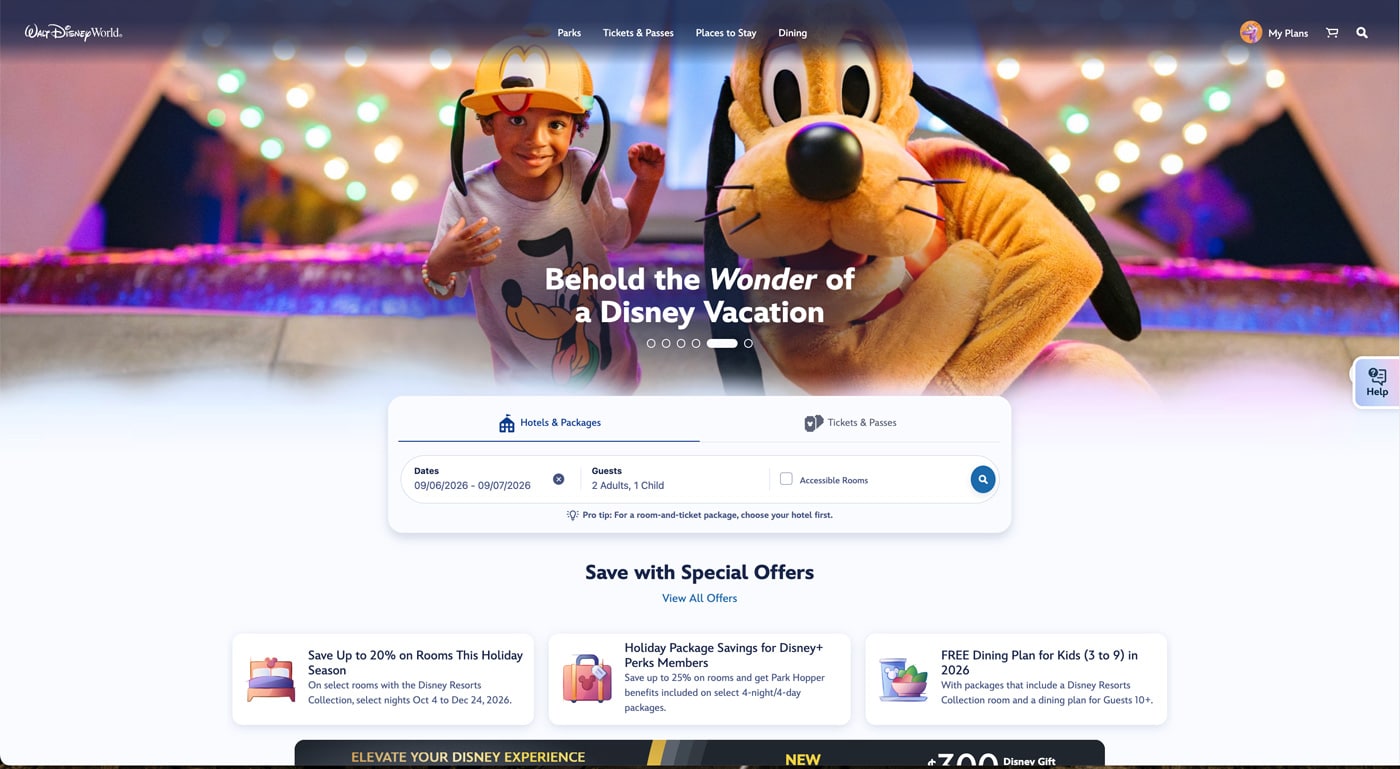
Walt Disney World will soon begin beta testing new artificial intelligence technology on its official website including a flexible search to find the cheapest room rates, a new pricing & availability calendar, resort comparison tools, and AI-powered planning tools. This shares a first look at the changes and what else to expect in the months to come, along with our take after attending a demonstration of the new tech in action on DisneyWorld.com.
As we first reported back at the start of Cool Kids’ Summer, Walt Disney World will be making big changes to its website and the My Disney Experience app. We learned about this during a presentation from WDW Product Management, Guest Experience, and Commercial Strategy departments discussed what to expect from the upcoming changes.
Fast-forward three months, and there was another presentation during the Magic of Disney Animation media event. This time, Walt Disney World demonstrated a beta version of the desktop website that will soon begin testing. According to Walt Disney World, they’re introducing this new technology to make the vacation planning process simpler and help guests book with greater confidence.
This is the latest of several rounds of modernizations to the Walt Disney World websites and app aimed at improving the user experience in the last couple of years. Thus far, the others have all been fantastic. Many of the biggest improvements have revolved around the Advance Dining Reservation (ADR) and Lightning Lane systems, and they’ve been big wins for ease of use. Expect the upcoming website changes to follow that same general ethos.
This site is often critical of Disney IT or skeptical that things will go smoothly, but I can’t think of a single complaint about any of the changes made in the last few years. This is most noticeable with ADRs. We have spent far less time doing the whole dance–searching, refreshing, rechecking, and so forth. The process has been painless and simple.
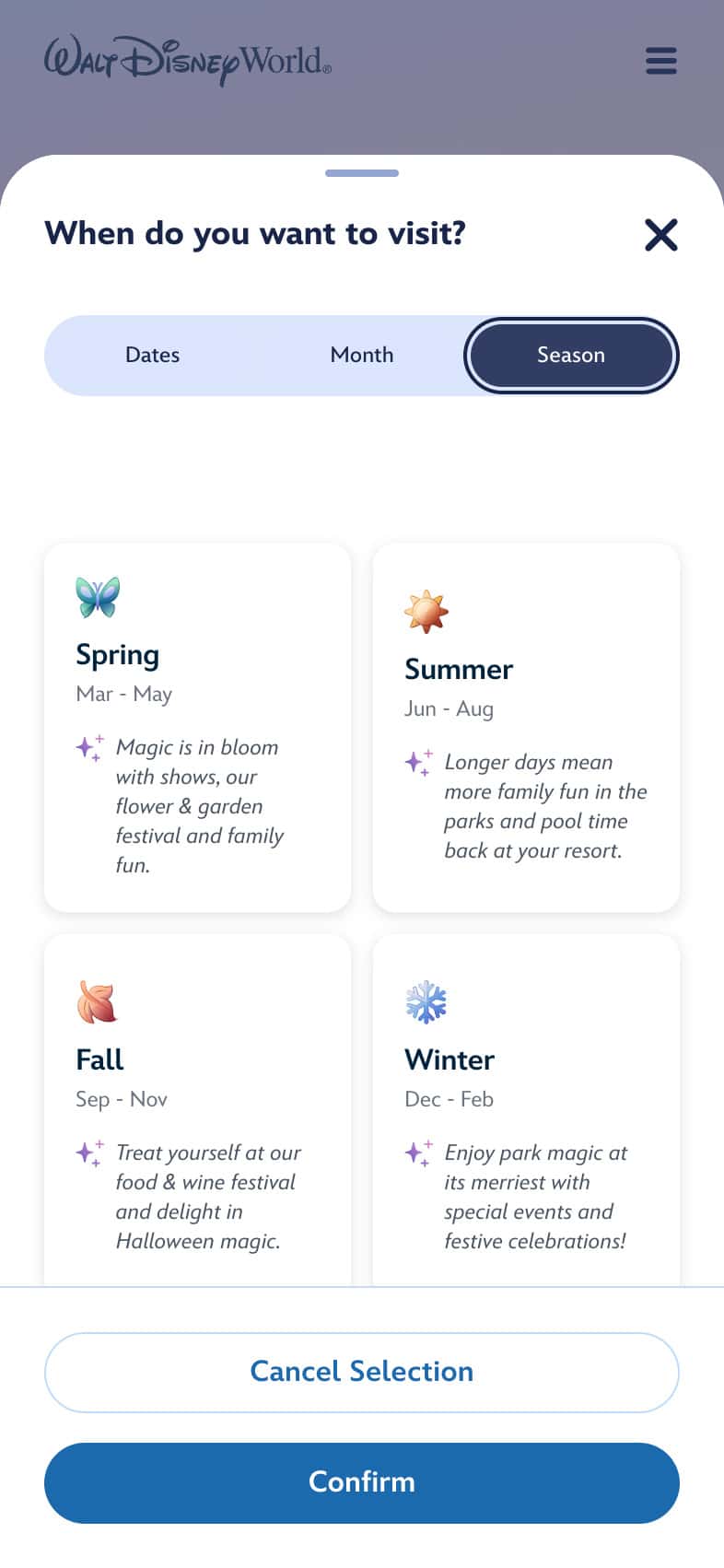
We’ve actually started to already see the fruits of the ongoing overhaul, with Walt Disney World debuting a cleaner new website late last month. The new technology will build on that foundation, introducing a new “Guided Search – BETA” tab for select guests. Here’s how that’ll look when deployed:
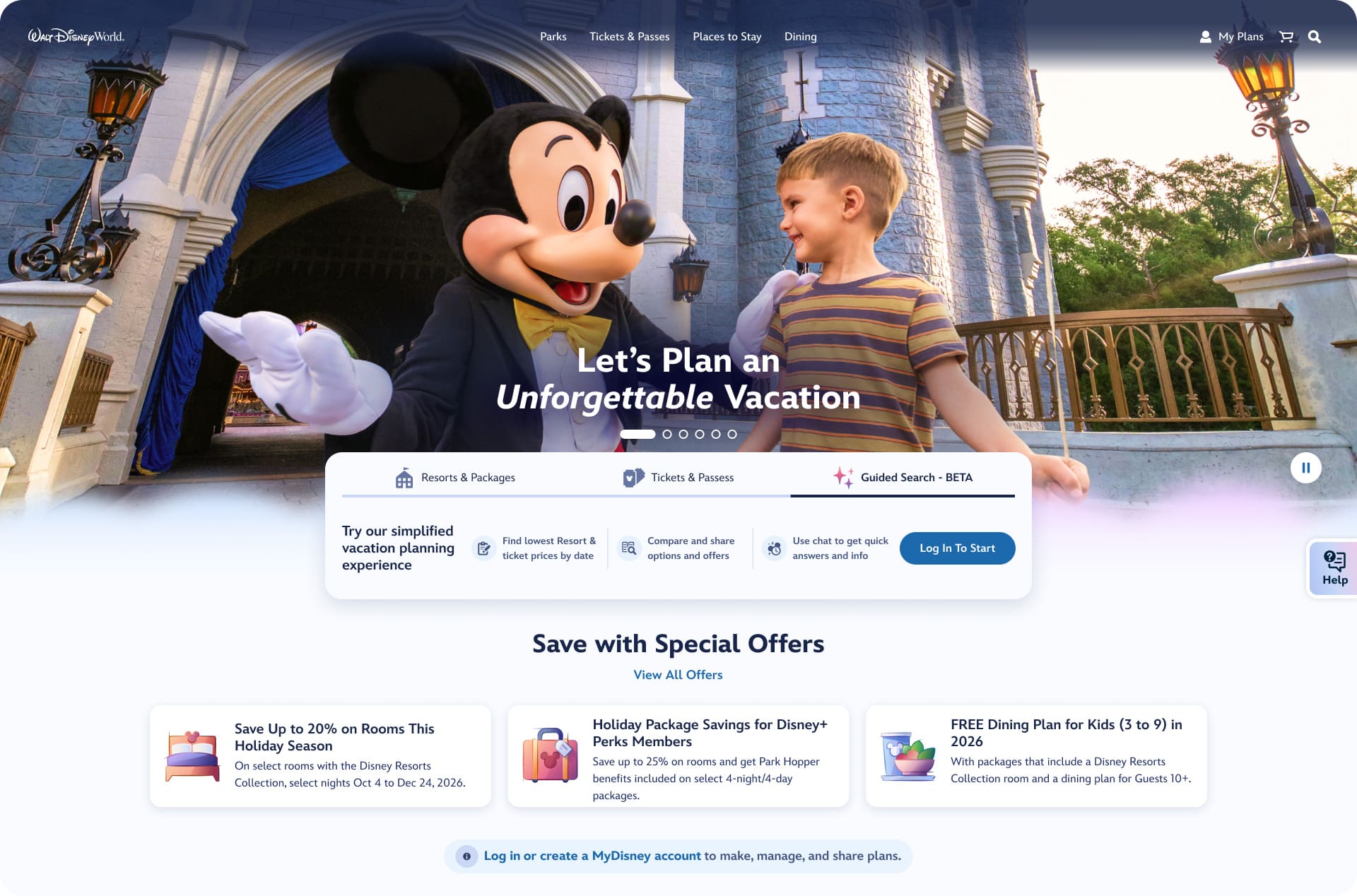
Before digging into the specifics of the new features, let’s start with a few basics.
First, this new technology is being developed by Disney in collaboration with Google Cloud. If you’re a regular Google user, you should notice interface parallels with Google Gemini or Google Travel. As a power user of Google Travel, I’d note that a lot of what Walt Disney World will soon launch strikes me as being strikingly similar to Google’s existing tools for searching airfare, hotels, and more. That’s a very good thing, as Google Travel is a fantastic tool with a lot of powerful, consumer-friendly features.
Second, the “Guided Search – BETA” experience will soon be available to a limited number of randomly selected guests in the United States and Canada. Guest feedback will help shape future updates as Walt Disney World iterates based on the website and expands availability in phases to continue refining the search experience and ‘guest journey’ over time.

Third, nothing is changing with Lightning Lanes or Advance Dining Reservations as part of the beta test at this time. Although Walt Disney World did use the ‘at this time’ wiggle words, there’s honestly no reason to expect ADR or LL changes. Those systems have already been modernized, and there’s minimal room for improvement.
Finally, Walt Disney World recognizes that everyone plans vacations differently. During our demonstration, leadership emphasized repeatedly that AI tools will not be mandatory. Guests can continue to use existing search and booking tools on DisneyWorld.com just as they exist today (albeit with the fresh coat of paint from last month). Independent travel agents, as well as Cast Members at the WDW Call Center will continue to be available to help guests plan their vacations.
Against that backdrop, let’s dig into some of the upcoming changes that’ll soon start beta testing on DisneyWorld.com…
AI Search
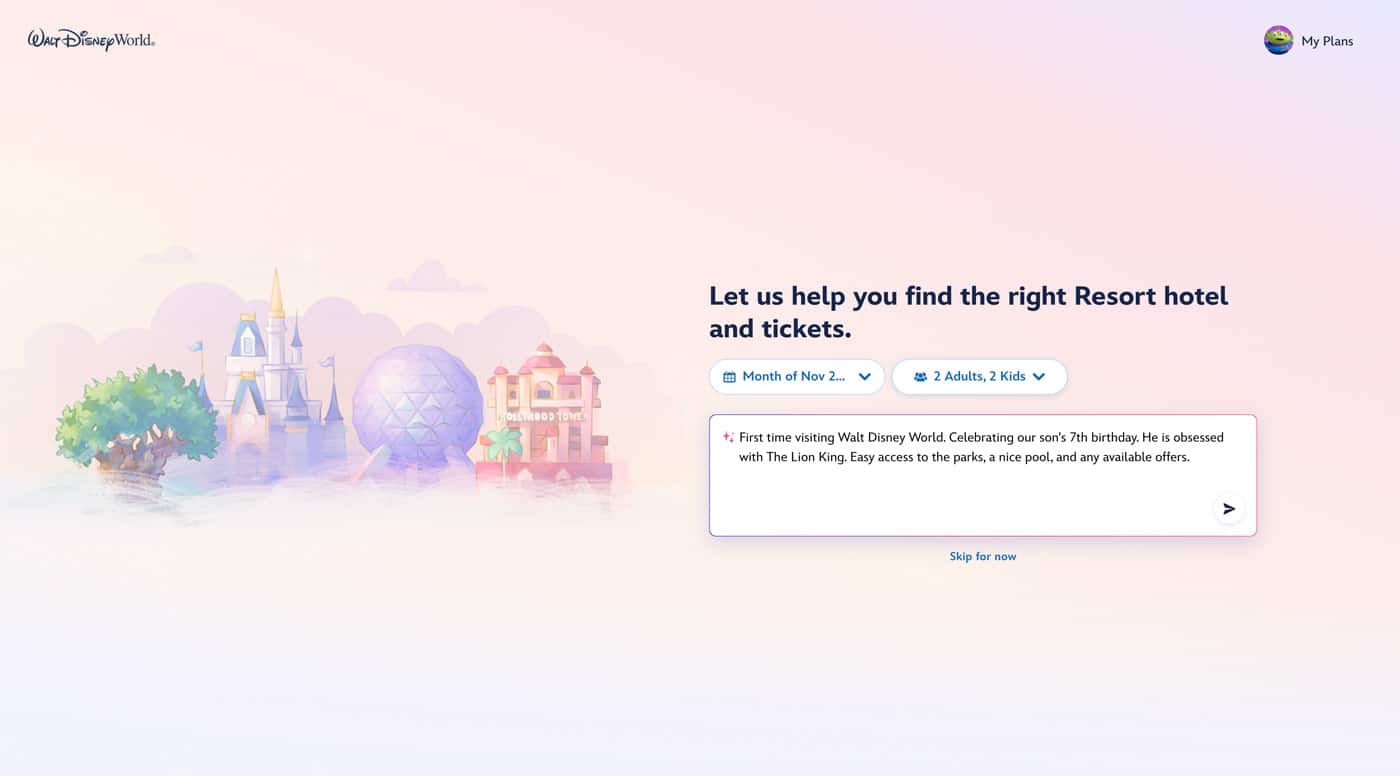
One of the big changes is coming via the “Guided Search” experience. Bluntly, search is broken in the current version of the app. It spits back a long list of results that may or may not be related to your query. As the industry moves towards making it easier to get answers to their questions directly in results, so too is Disney’s approach changing as they try to reduce needless clicks and links.
The new search experience will use AI to answer questions in a simple summary pulled from Walt Disney World’s resources, so guests don’t have to read through multiple FAQs or browse through unrelated results. It’ll offer the ability to dive deeper if guests would like, but the goal is an up-front summary that quickly answers most questions.
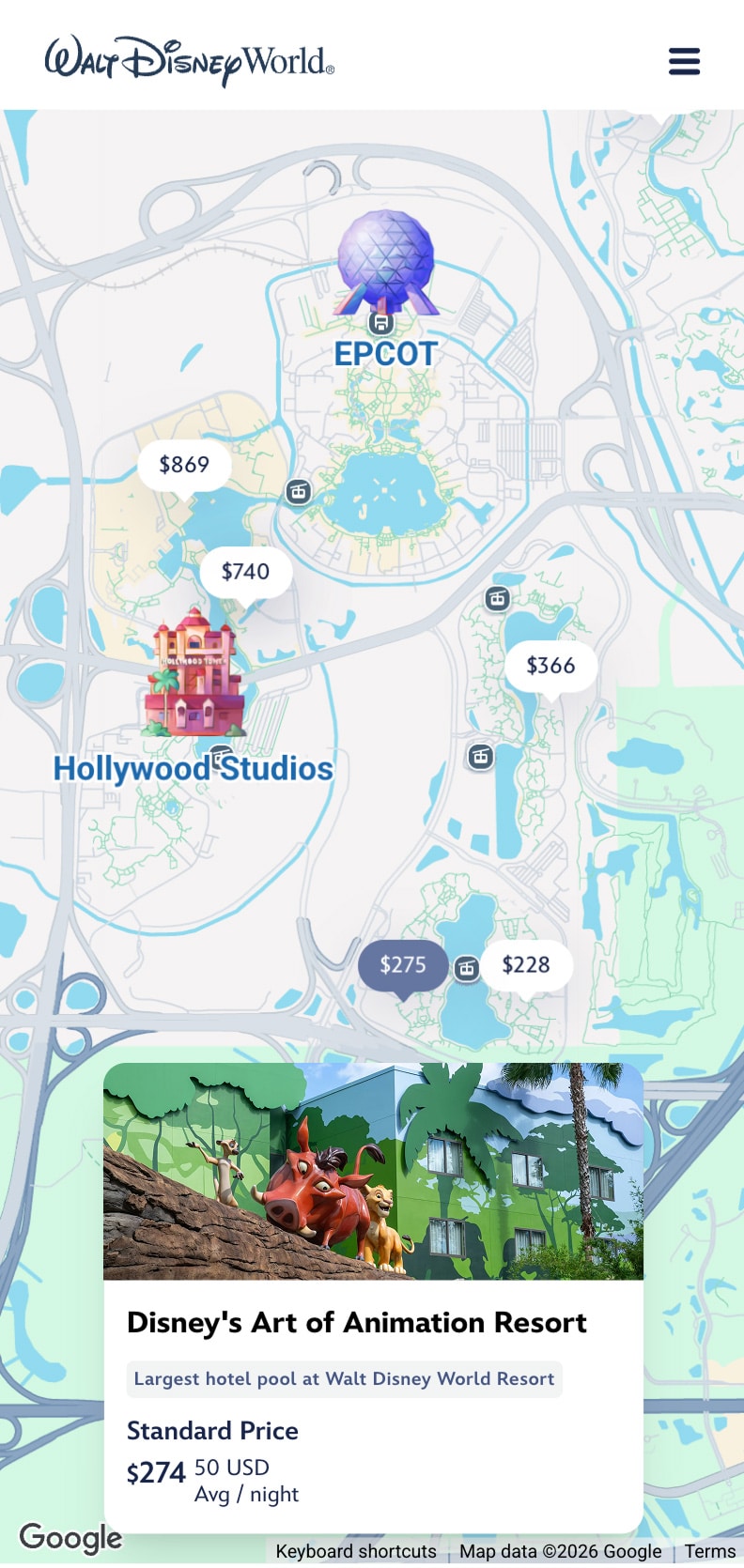
In addition to AI-powered summarties, there will be the option to ask the AI questions and get answers based on your vacation plans. Here’s a look at how that’ll work on the mobile version of the website:
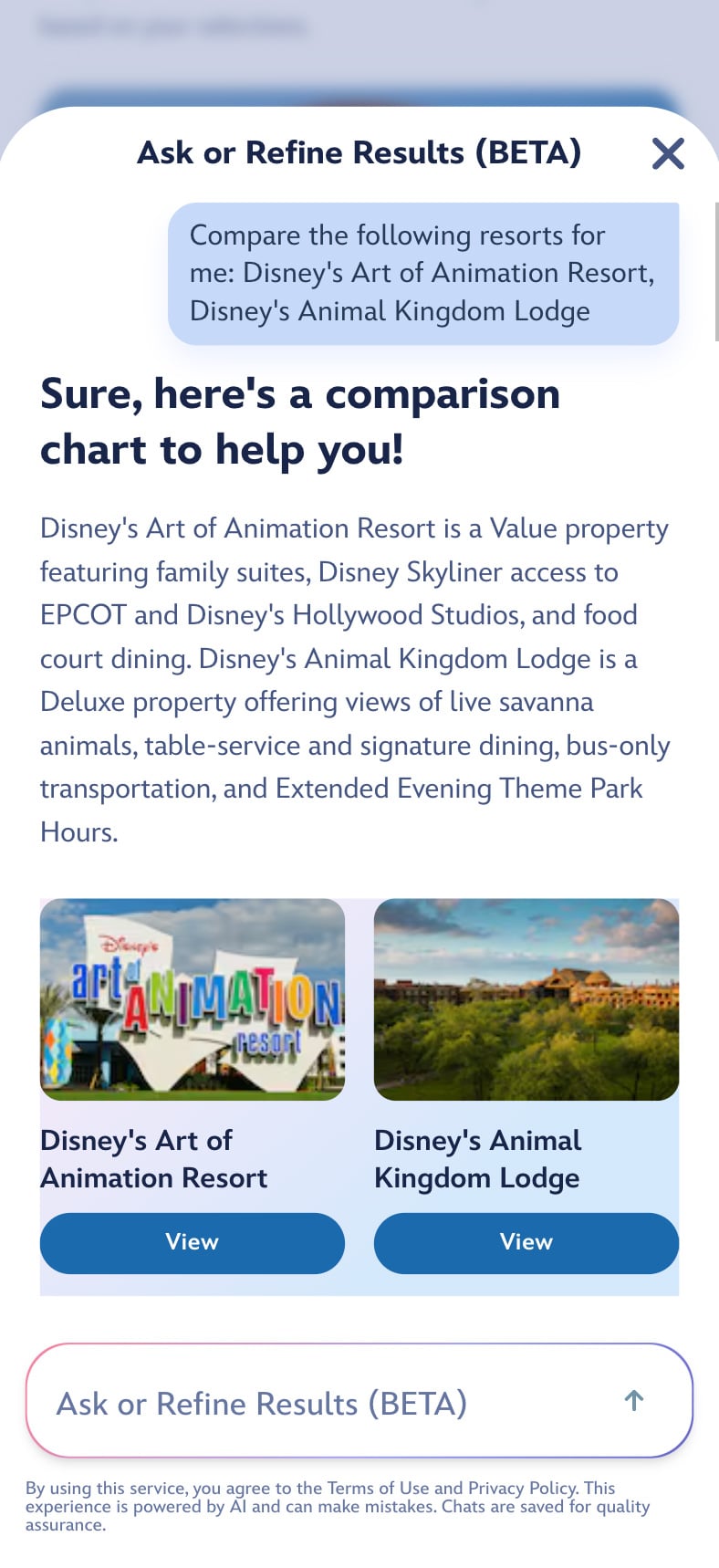
The comparison in the screenshot above began with a family planning their first Walt Disney World trip for their son’s birthday, They told the AI that he loves Lion King and the tool suggested either Disney’s Art of Animation Resort and its Lion King Family Suites or Disney’s Animal Kingdom Lodge.
From that, they went into a comparison of the pools, transportation, and other features. This underscored that guests will be able to search for specific characters, preferred style of room, pool or other amenities, or other interests to receive personalized recommendations. It will also be able to explain that, for example, Art of Animation is not within walking distance of EPCOT, whereas Beach Club is, despite both being Skyliner resorts.
Amusingly, the AI will also be able to ‘redirect’ guests if they ask questions like “where in Disneyworld is home to Harry Potter?” (A question that comes up way more than you might think!) Obviously, Disney isn’t going to link out to the competition, but it will make clear that you won’t find the Wizarding World at Walt Disney World.

Walt Disney World shared that AI was applied very thoughtfully throughout the experience, being used in a measured approach where it can help, as opposed to being heavy-handed and forced on guests. (Again, there’s no requirement to use AI; it’s totally optional.)
Disney also strongly emphasized that the AI results are pulled only information from official Walt Disney World resources. This should, at least in theory, mean the results are accurate as opposed to being confidently wrong. However, I’d note that Disney’s own website is often wrong or outdated. (PlanDisney, in particular, is wrong all the time. And not just with outdated info that has changed since publication. Answers are often incorrect when given!) This should be less of a problem when it comes to more ‘evergreen’ things, or comparing one resort to another.
But the notion that it’ll never produce outdated answers or hallucinate strikes me as unreasonable. The fine folks at Anthropic, OpenAI, and other AI companies predicting that their products have a ~10% chance of killing us all don’t seem to be particularly detail-oriented. This AI search could work well, but we shall see. The demonstration was undeniably impressive, but it was also in a controlled environment.
Flexible Search
Honestly, I don’t really care about all of the AI powered comparison tools, Q&A, etc. When it comes to this stuff, I feel like Ron Swanson walking into Lowe’s, with the AI being the employee asking if he needs any help. And if you’re reading this, so are you. We aren’t exactly the target audience for these more surface-level tools.
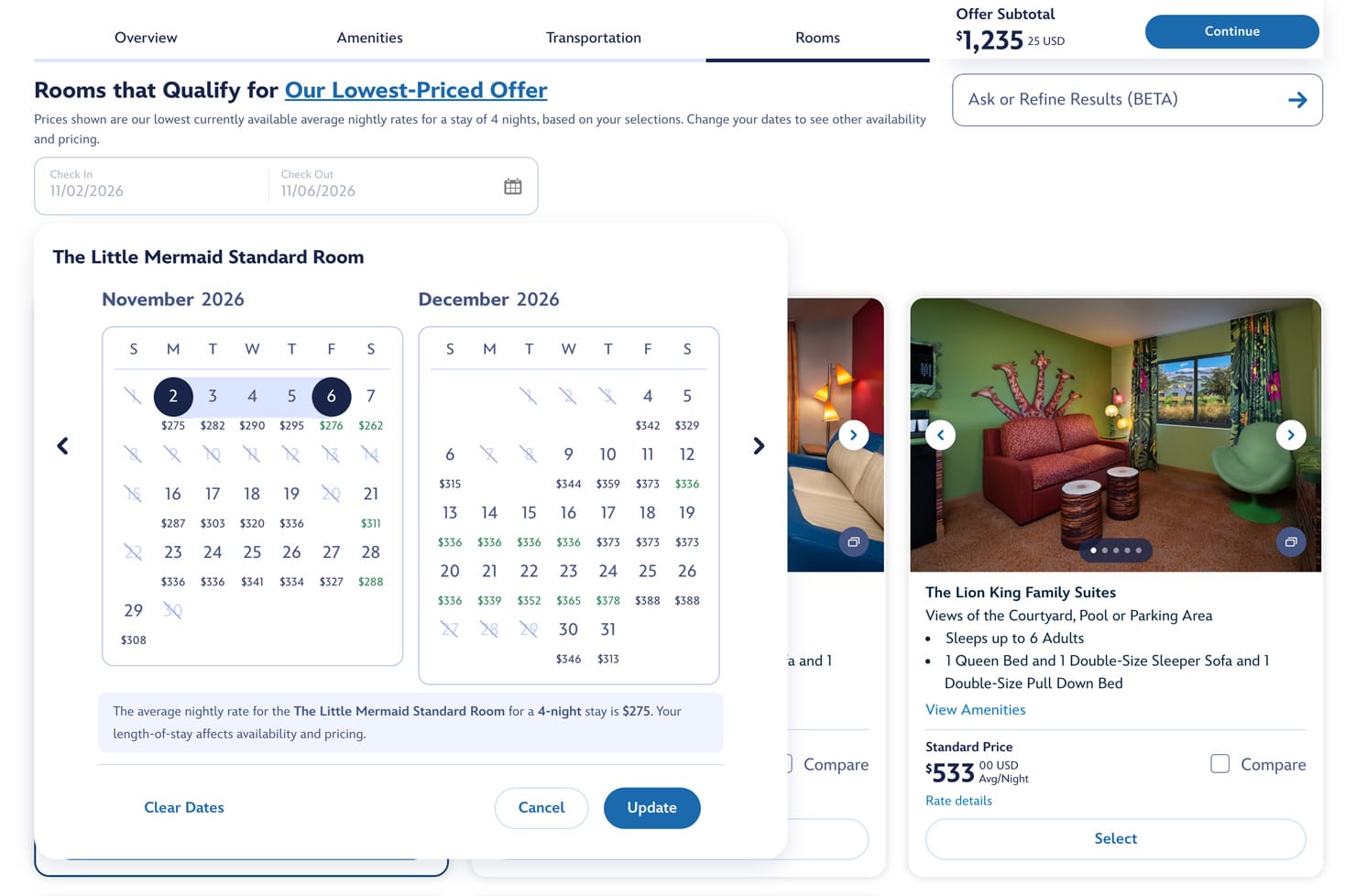
What has the potential to be incredibly helpful to us is flexible search with new pricing and availability calendar, as well as the ability to find the best available rate. Above is how the calendar view for each resort will look in the beta search.
This has the potential to be a game-changer.
This calendar is doing a couple of things at once.
First, it’s showing dates that are and are not available in real time. In theory, this should mean the days of playing around with shorter and longer stays in the search to see whether that uncovers “hidden” availability are over. In theory.
Second, it is not just showing the lowest rack rates, but also automatically applying the best available discounts in displaying those rates. In theory, this also means less searching, combing through the special offers pages, or toggling between discounts to see which yields better rates or uncovers availability. In theory.
You might notice an “in theory” or two above for, ahem, dramatic emphasis.
That’s because the current search for resorts and vacation packages is slightly opaque when it comes to all of this stuff. The argument could be made that it’s simply outdated and archaic, prone to problems, glitches, and other issues. I’m sure there’s some of that at play.
I also fully believe that much of it is deliberate and by design. Walt Disney World used to have a calendar view that displayed resort rack rates, making price comparisons easier. They got rid of it within the last year. One reason availability disappears and reappears based on search parameters is so Walt Disney World can optimize occupancy.

It’s fairly well known that special offers pull from different “buckets” of room inventory for that same reason. We probably sound like a broken record, but Walt Disney World is not offering deals out of generosity. They’re doing it to maximize per guest spending, and only to the extent absolutely necessary.
That is a big reason why availability appears to come and go; Disney is purposefully manipulating inventory to hit their occupancy targets while minimizing discounts to the greatest extent possible. (We’ve seen some fantastic special offers over the last couple of years, but finding availability at standard rooms can often be challenging!)
It is very, very hard for me to believe that Walt Disney World will stop all of this once the new technology debuts. Maybe they will for a period of time as the Disney IT launches a “pure” version of the website and tools, but they are far from the only internal stakeholders.

If this yields lower per guest spending or nightly average room rates, other teams will quickly push back and the tools will be diluted. I would imagine those conversations have already happened internally, and they will actually launch in a throttled fashion.
The bottom line is that these tools have tremendous potential. That’s true even if there are guardrails on them to prevent them from being as useful as something like Google Flights. Just having a view of nightly rates and availability alone will be a massive improvement. I just would not expect an end to having to poke around on the website a bit if you really want to find the best discounts and availability for them.
Remember, the House of the Mouse always wins. They are not spending untold millions of dollars on a website overhaul in order to give guests better deals and make less money. I didn’t graduate from one of Canada’s best business schools with really good grades, but even I know that’s not how this works.

Why is Disney Making These Changes?
Disney’s goal is to reduce friction, streamline the booking process, and make planning easier. That sounds great, and the new-look homepage and navigation bar is a good start. During this presentation, Disney indicated that the new website reduced links by 40%.
The changes were driven by some guests visiting and revisiting the website 20-30 times before booking. The updates are meant to reduce this friction, and make it easier to compare pricing across dates, resorts, discounts, etc.
I do believe that this is the actual justification–as opposed to helping guests find lower prices or anything else–as the abandonment rate on booking a Walt Disney World vacation or resort was probably deemed unacceptably high. (In the past, we’ve noted how Amazon spends a ton of money optimizing the user experience, reducing clicks and load times because all of that moves the needle on conversions.)
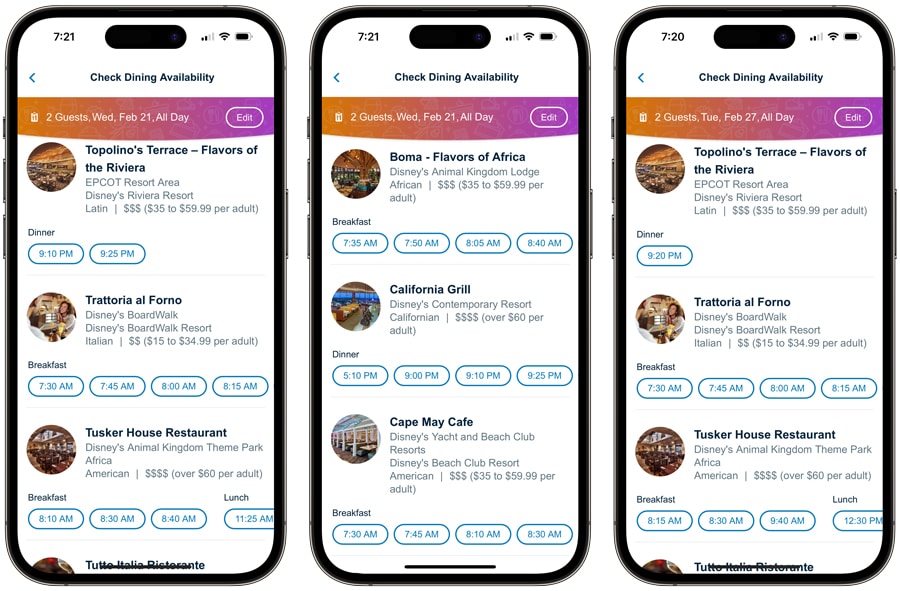
Walt Disney World shared with us that they’ve seen measurable improvements in guest satisfaction as a result of the changes. For example, combining “Today’s Plans” and “Future Plans” into the cohesive “My Plans” flow on MDX improved ease of use by 8%. Streamlining the ADR booking flow and search improved guest satisfaction by 5% and drove record-high website ratings.
Likewise, the switch from Genie+ to Lightning Lanes coupled with the shift from day-of booking to pre-arrival reservations led to double-digit gains in both ease of use and overall experience. I’m not surprised by this in the least. We knew that guest satisfaction scores were a big driver behind the switch from Genie+ to Lightning Lane Multi-Pass and Single Pass, even if a vocal minority of power users (us included!) preferred the same-day system.
Based on what we heard earlier this summer, the website updates are the first of many upcoming changes. The big one will be an overhauled app, which does not yet have a firm rollout for deployment and was not covered at all during the September 2027 presentation. We were previously told they would begin launching in phases at Walt Disney World in the coming months, and then at Disneyland in the months after that.
I wouldn’t be surprised if it takes until late 2026 for the new app rollout at Walt Disney World, and sometime in 2027 at Disneyland. As a refresher, here are the other upcoming digital changes that Disney announced…

Cleaner App Home Screen
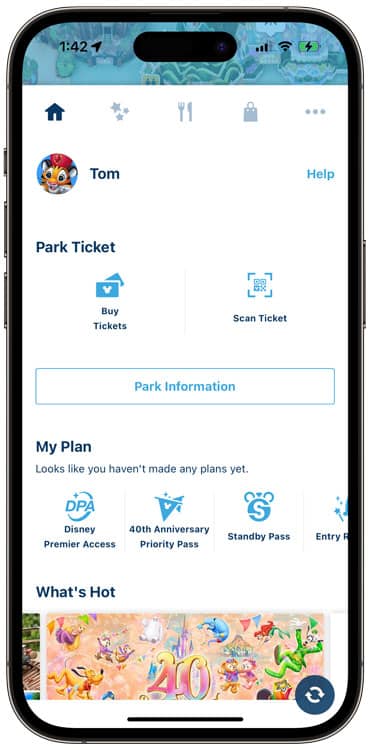
Everything is oriented around the guest’s upcoming trip on the new-look home screen, which ditches the neverending tiles in the current apps in favor of a cleaner and simpler style that pulls in reservations, travel parties, and planning reminders.
Leadership acknowledged that one of the biggest guest complaints is navigating the app and finding information that’s relevant to them. With the redesign, everything that guests need will be front and center, and easily accessible.

Trip Planning Checklist
One of the top additions is a new trip checklist feature. This is intended to reduce the anxiety that guests feel when planning, especially first-timers who may not know the key pre-planning milestones, such as booking ADRs and making Lightning Lane selections. (I will personally appreciate the latter, as I’m constantly forgetting when this window actually opens.)
They mentioned that this will include not just a checklist, but also calls to action, such as to add your park tickets to Apple Wallet so you’re not scrambling at the tapstiles. All of this is separate from the hotel check-in checklist, which includes adding your credit card on file, making room requests, etc.
This version is more akin to what Disney Cruise Line uses, and in fact, leadership referenced DCL as a template of sorts for this new feature. If you’ve never used it, the Disney Cruise Line user experience is pretty good. Definitely more straightforward than MDX, but then again, DCL is a simpler type of trip!
New Trip Party
The current process for sharing plans with family and friends is tedious, to use a charitable term. You have to send an email (hoping that you’ve chosen the correct one), and then wait for acceptance. You have to deal with managed guests and more.
Leaders shared that the new version of sharing travel plans will be as easy as sending a text message. Walt Disney World will use industry-standard native device capabilities to pull in contacts from your phone. From there, you can simply tap the contact and send them a link to the trip. They click that link, accept the invitation, and are added to the trip. It’s as easy as that.
While this wasn’t demonstrated during the September 2027 presentation, new shareable planning links were. This will allow someone to price a Walt Disney World vacation and then send a link to family and friends with their ‘pitch’ on the perfect trip. This seems similar to the trip party feature.
Whereas the checklist feature is inspired by DCL, this trip party feature reminds us of the Tokyo Disney Resort app. WDW leaders did not invoke that by name, but it seems like they’re applying the best lessons learned at other Disney destinations around the globe.

Disney IT has delivered several improvements over the last few years, and although the product still isn’t perfect, it’s headed in the right direction. Everything recent has been thoughtfully done, intuitive, and actually works. The user experience and interface have measurably improved. The app doesn’t crash as much, or send me in a neverending email verification code loop.
If everything works as advertised, these changes will be great for both diehard Disney fans and first-timers. They’ll make every facet of the planning process easier and more intuitive, which is a sharp contrast to today. Sure, it works for power users (presumably you, if you’re reading this), but most people planning WDW trips are not us.
All of this has been incredibly unintuitive for the uninitiated in the past. As advocates for removing as much friction as possible from Walt Disney World vacations, we’re cautiously optimistic about these proposed improvements. Even the AI-powered comparison and chat features, while not for us, have the potential to be useful in removing a layer of friction for first-timers.

Walt Disney World has done a lot to even the playing field and make planning easier for casual guests. While some fans have bemoaned certain changes (like shorter booking windows), these have been largely positive changes on balance for most average visitors over the last few years. To the greatest extent possible, it looks like the upcoming tools will continue that trend.
Disney’s IT team is making a laudable effort, but it’s also worth acknowledging that there’s only so much they can do to reduce complexity since the underlying issue is the complexity of the core guest experience. They can remove or deprioritize a bunch of lower use features and pages, but everything there serves a purpose, and if features are indiscriminately moved, that’s going to impact guests. The truly meaningful path to simplifying the user experience on Disneyworld.com or MDX is…simplifying the guest experience at Walt Disney World.
Planning a Walt Disney World trip? Learn about hotels on our Walt Disney World Hotels Reviews page. For where to eat, read our Walt Disney World Restaurant Reviews. To save money on tickets or determine which type to buy, read our Tips for Saving Money on Walt Disney World Tickets post. Our What to Pack for Disney Trips post takes a unique look at clever items to take. For what to do and when to do it, our Walt Disney World Ride Guides will help. For comprehensive advice, the best place to start is our Walt Disney World Trip Planning Guide for everything you need to know!
YOUR THOUGHTS
What do you think about the new AI-powered guided search? What about the flexible search, price calendar, and best available discount features? Any other features on your ‘wish list’ for the website or apps? Agree or disagree with our assessment? Any questions we can help you answer? Hearing your feedback–even when you disagree with us–is both interesting to us and helpful to other readers, so please share your thoughts below in the comments!





I’m curious how/if it’ll compare room only discounts to package discounts. For example with the discounts just released for early next year, it seems easy to compare the disney visa discount to the general public offer, but would it also be able to compare those to the $250 per night offer?
The problem with the special offers that are not room-only is that you have to fit within their parameters. Comparison is possible if you do, but I’m still skeptical that it’ll be automatically applied or recommended if it’s the superior offer.
My guess is that flexible dates and availability calendar is the highlight of the new launch for people like us, with the discount comparison being more or less a fresh coat of paint on what already exists.
As Controller for 2 full-service hotels, this initiative brings me to two of our top expenses in Hospitality – GDS Commissions and Travel Agent Commissions. A reservation can cost 10%-20% off the top when booked on the Global Distribution System (especially Expedia). Travel Agent commissions typically run 10% (although some larger chains are starting to reduce what they’ll pay – a franchised property has strong-armed their way to 8% or less). Now on top of that are other fees to access and utilize network reservations can add another 5-9% of expense out of gross revenue.
Even with a company with the size and power of Disney to get these types of fees reduced, you’re still looking at many Millions of Dollars saved by pulling people to just book direct.
That’s a fantastic point.
The complexity of Disney makes it unlikely that travel agents will ever be entirely removed from the equation, but if this gets even ~2% (probably a conservative estimate) more people to book direct, that is a massive savings that more than justifies the investment.