
We Don’t Recommend FuelRods
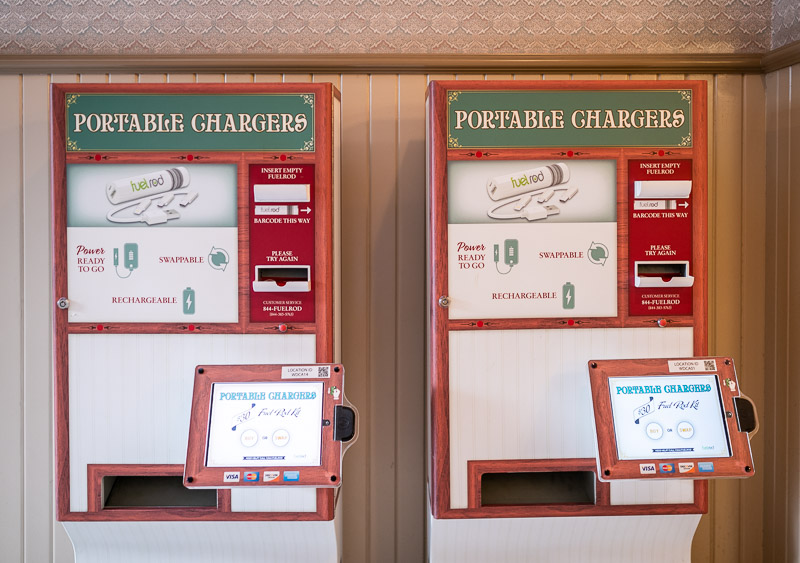
FuelRod kiosks can be found at Walt Disney World, Disneyland, airports, and other locations. The service offers reusable, portable charging to fuel or charge your phone on the go, and then swap for a fresh battery. In this FuelRod review, we’ll cover whether the “unlimited” service is worth the money and effort. (Updated July 28, 2024.)
While the headline is pretty blunt, there is more nuance to the question of whether you should buy a FuelRod while visiting Walt Disney World or Disneyland. As such, we’ll address their cost v. convenience, and weigh the pros and cons. Note that this FuelRoad review is entirely our subjective assessment of how FuelRods work (or don’t) for us. You may disagree entirely, finding a lot of value in FuelRods–and that’s fine.
For those who are unfamiliar with the concept, FuelRods are portable chargers that can be purchased in Walt Disney World parks and used to (partially) recharge your iPhone or other device on the go. You can then swap for a new battery pack at FuelRod kiosks once you’ve exhausted one. In a nutshell, our view is that FuelRods are pretty great…for people who have never heard of the internet..
The general concept of these portable chargers is great for Walt Disney World. Using just the My Disney Experience app alone is a big drain that people underestimate as is browsing brilliant Disney blogs to figure out where you should eat. Suffice to say, it’s easy for your battery to die early in the day. Rechargeable battery packs have existed for some time (so to that end FuelRod is hardly revolutionary), and are one of the recommended staples on our What to Pack for Disney List.
The ‘twist’ with FuelRods is that when you’re done using them, you can trade out your depleted FuelRod for a fully-charged one at the many kiosks throughout Walt Disney World and Disneyland. The appeal is thus the ‘unlimited’ charge the FuelRods offer by virtue of swapping them out. When put that way, it’s easy to see the appeal of FuelRods.
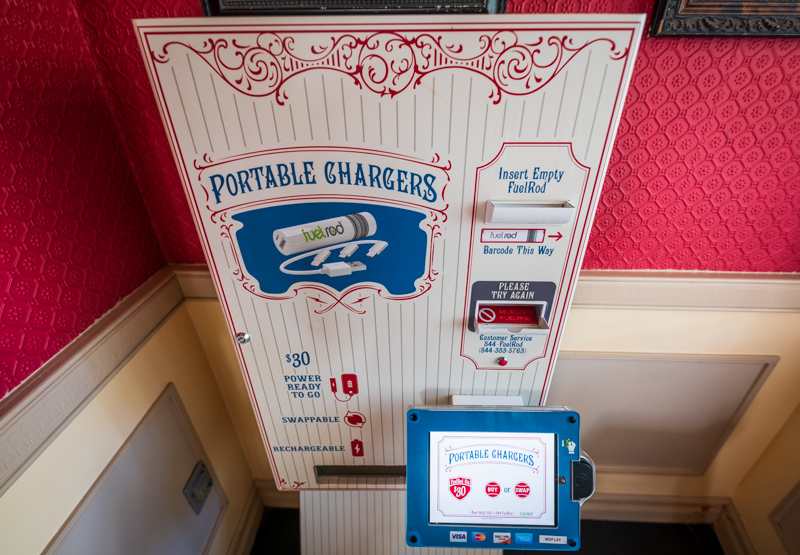
July 28, 2024 Update: FuelRod kiosks have been updated all around Walt Disney World, Disneyland, airports, convention centers, and everywhere else. With this, the price of FuelRods at Disney Parks locations have also increased–the cost of a single FuelRod is up from $30 to $38, two rods are now $76, and three rods are $114 (you can do the math for yourself, but there are no bulk purchase discounts–and weren’t before, either).
The good news is that FuelRods are only $35 for a 2-pack on Amazon. You read that correctly. Two for less than the price of one at Walt Disney World, which is about par for the course with Disney vs. real world pricing of regular products.
Although in the case of FuelRods, the devices are typically more expensive at non-Disney locations like airports or convention centers. (Last I checked, the airport price of a FuelRod at the airport was $40 and the swap was $3.) They’re just much cheaper on Amazon than anywhere else, so if you do opt to buy FuelRods…get them there!

With the higher prices comes improved performance. Here are the highlights of the new FuelRods:
- More Power: The NEW FuelRod boasts an increased capacity of 3,200 mAh (over 23% more power than the original FuelRod), providing longer-lasting power to keep your devices charged throughout the day.
- More Control: With USB-C compatibility, the NEW FuelRod offers versatile charging options for a wide range of modern devices. It also features a power button and four LED battery light indicators, giving users greater control over their charging experience.
- Same Swap: Maintaining the simplicity and convenience that FuelRod is known for, the swap process remains effortless. Just visit any FuelRod kiosk, insert your old FuelRod, and receive a fully charged new one instantly.
As before, swapping remains free at Walt Disney World and Disneyland for now. There was a class action lawsuit a few years back that resulted in FuelRod giving “Founder’s Status” to anyone who bought their devices before late 2019. For a while, this was verified at kiosks at Disney locations, which then provided free swapping.
The verification no longer occurs for whatever reason, meaning swaps are free for everyone. Since I don’t know the why of this, I’m weary that it could change at any time–and that would make the usefulness and convenience of FuelRods much worse.

Here’s how the upgrade process works according to FuelRod:
- Visit Any FuelRod Kiosk Nationwide: Locate a FuelRod kiosk at most major airports, theme parks, convention centers, and other high-traffic areas. All FuelRod locations are being upgraded to support the new program through a phased rollout. Rest assured; we are working as quickly as possible to have all kiosks updated.
- Select “Swap” Button: On the kiosk screen, choose the “swap” option.
- Insert Your Original FuelRod: Place your original FuelRod into the kiosk. (Note: You will have to re-insert your original rod to continue the upgrade process.) Please follow the on-screen instructions for more details.
- Receive the NEW FuelRod Kit: For the cost of a normal swap, you’ll receive the NEW FuelRod Kit, which includes the upgraded fully charged USB-C FuelRod along with new cables and adapters.
We have to give props to FuelRod here for making this update, as slow charging and low capacity were two of our biggest complaints about the devices. As best we can tell, the device had never been updated prior to this, and portable batteries have come a long way in the last decade. FuelRod is still well behind the competition, but still–credit where credit is due, and nice to see the update made. In a pinch, this should be a better option than its predecessor.
As always, we still recommend purchasing one of the Anker devices on our list of the Best Backup Batteries for Disney. There’s a wide range of quick and high-capacity portable chargers on that list, most of which are faster and cheaper than FuelRods. Of course, that doesn’t do you much good if you’ve already arrived at Walt Disney World or Disneyland and are finding that you need more juice–but for those planning ahead, consult that list instead.

For what it’s worth, you probably will need a portable charger in the parks. The new Lightning Lane Multi-Pass at Walt Disney World and Disneyland just launched and these updated line-skipping systems are (still) serious battery drains.
While it’s theoretically possible to go an entire day using Lightning Lanes without recharging, it’s very difficult–especially since you’ll need a strong “refresh game” if you want to score good subsequent selections. Many guests will be unprepared for this, and find themselves needing a spare battery during their days in the park.
On top of that, there are certain features, like the itinerary builder and PhotoPass AR lenses, that really kill a phone’s battery. Just ~30 minutes of playing around with the augmented reality filters took my battery down significantly. Plus, you’ll really want to use other app features like Mobile Order and Walk-Up Waitlist, which can save you a ton of time.
The apps are practically essential to doing Walt Disney World or Disneyland at this point. They aren’t technically required, but they’re hugely convenient. Just something to keep in mind if you don’t have a backup battery packed!
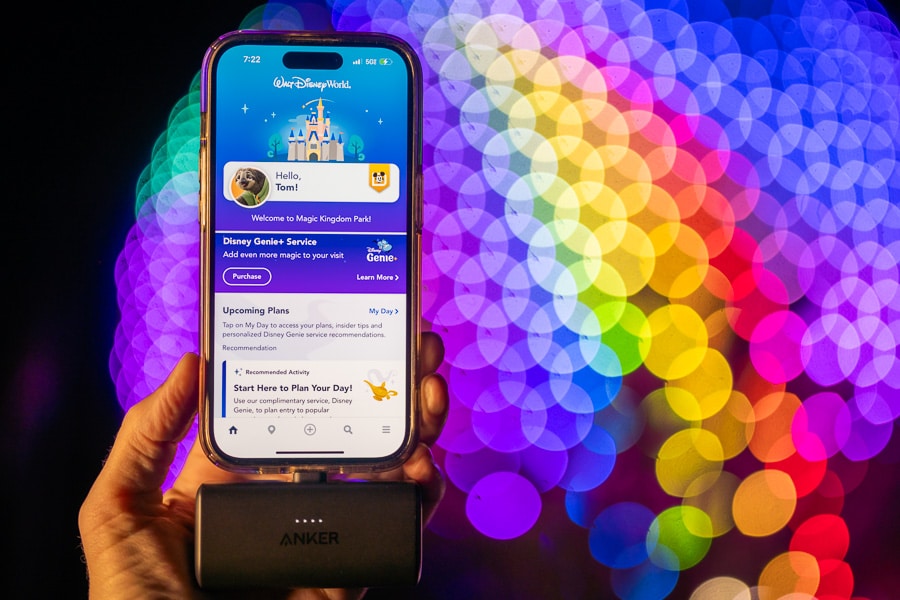
For many guests, the argument in favor of the FuelRod is the same as the Disney Dining Plan: convenience. However, like the argument in favor of the Disney Dining Plan, I’d counter that it’s the illusion of convenience, rather than actual convenience. And, like the Dining Plan, you’re paying extra for that illusion.
The problems with FuelRods are two-fold. First, the price is very high for a battery pack of this capacity and quality. Second, the aforementioned capacity is poor by modern battery pack standards. (Although this has improved in the last couple of years, it’s still nowhere what you’d get from something from Amazon for under $40. Nor is the charging as fast.)
Let’s talk a bit more about FuelRod’s capacity relative to its competitors. Up until the 2024 update, FuelRod did not indicate its charge capacity. (Which alone should set off red flags.) It can charge a current iPhone about halfway with its 3,000 mAh capacity.
Again, the alternatives on our list of the Best Backup Batteries for Disney offer larger capacity, lower cost, and faster charging than FuelRod. Some of these chargers will not only get you through an entire day in the parks–they’ll charge your entire family’s devices for the day. The closest equivalent to the FuelRod is the Anker Nano Portable Charger (here’s the USB-C version that was just released). By modern battery pack standards, FuelRod is antiquated.
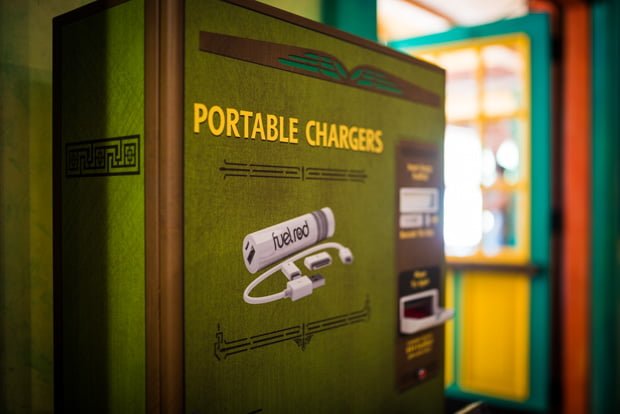
To be fair to FuelRod, the case could be made that there’s a certain convenience in never having to charge a battery pack–just being able to swap out the existing pack ad infinitum. Or that it can be a lifesaver if you forget your charger, cables, etc. True, it does offer appeal in both scenarios. There’s absolutely no arguing about FuelRod being useful if you’ve forgotten your charger/cables.
However, the case for general convenience in everyday scenarios is tougher to make. When I get back to the hotel at the end of a long day, I hate having to plug everything in before getting ready for bed. The thing is, I have to do that regardless with my camera, phone, etc. Plugging in one additional item is (literally) a <30 second commitment that hardly poses an insurmountable obstacle between me and a good night’s sleep.
Moreover, this argument is only even plausible in a world where FuelRod kiosks are ubiquitous. Such a world does not exist, nor will it ever exist. FuelRod’s business model relies upon spontaneous purchases from consumers who either don’t do the research or don’t have a viable alternative. Outside of airports, theme parks, and similar ‘vacuums’, they will lose to competitors. (For the same reason that no one in their right mind would pay $14 for a cheeseburger at Cosmic Ray’s if it were located in their hometown.)

If you’re primarily concerned about using FuelRods at the airport, Walt Disney World, or Disneyland–that’s great. FuelRod probably has you covered. For Disney regulars or Annual Passholders, there is value in FuelRod. Again, we’re not saying this is a totally useless service or product.
Ultimately, the only people for whom I can see FuelRod holding appeal once they get past the initial idea of convenience is those who have never heard of rechargeable batteries before stumbling upon the FuelRod kiosk while in the parks. Yes, these people do exist. We see countless guests sitting in corners charging their phones in random outlets during the course of their vacations.
For those people (or people who simply forget to pack their portable chargers), the FuelRod presents a good spontaneous purchase, as the cost (in time) of sitting in a random corner everyday during a pricey Walt Disney World vacation far outweighs even the $30 cost of a FuelRod. However, if you’re reading this FuelRod review in advance of a trip to the park and have the opportunity to order a higher capacity battery pack from Amazon, that’s your better option.
Planning a Walt Disney World trip? Learn about hotels on our Walt Disney World Hotels Reviews page. For where to eat, read our Walt Disney World Restaurant Reviews. To save money on tickets or determine which type to buy, read our Tips for Saving Money on Walt Disney World Tickets post. Our What to Pack for Disney Trips post takes a unique look at clever items to take. For what to do and when to do it, our Walt Disney World Ride Guides will help. For comprehensive advice, the best place to start is our Walt Disney World Trip Planning Guide for everything you need to know!
Your Thoughts
What do you think of FuelRods? Excited about the 2024 upgrade that offers higher capacity devices and faster charging? Will you continue to use FuelRods at Walt Disney World or Disneyland? Do you agree or disagree with our FuelRod review? Any questions we can help you answer? Hearing your feedback–even when you disagree with us–is both interesting to us and helpful to other readers, so please share your thoughts below in the comments!






Wow! I didn’t even know fuelrods were a thing! Especially considering I bought my first battery pack in WDW for $30 in June ’15 (it is a black lipstick type with a green Disney D on it). They still sell the one I bought and it comes fully charged out of the package and had my phone (in airplane mode) full in an hour. Plus since my phone’s use micro USB, came with a charging cord 🙂
After I got back home I promptly ordered an Anker for $10 (after reading your suggestion list) so I could charge 2 phones at once. I still have both that I take to Disney each trip.
While these fuel rods can be purchased for much cheaper at most any Walmart or Target and yes the concept is really pure convenience. Everytime we have gone to the parks. We’ve also searched out those easy to find outlets that are out there if you just know where to look for them.
Wow, I figured they weren’t super powerful but not that they were so weak, relatively speaking! They sound like a product ultimately destined for those that forgot their battery back up.
They aren’t that weak, it’s misinformation. Weight tells the real story with Li-ion battery packs.
I bought an Anker after reading your blog a couple years ago and I love it! Keeps both my and my husband’s phone charged up for multiple days at the parks as long as the Anker is fully charged before we get to the parks (and I use my phone a LOT while we’re there). Just wanted to add another positive review in case anyone is thinking about buying one!
We went to Disney World twice (September 2015 and January 2016) with a pair of lipstick chargers that we got at Costco. They were OK, but not great. Probably couldn’t charge a phone to full. With the combination of taking pictures and videos, My Disney Experience, and the Touring Plans app (not to mention keeping my Springfield running in Simpsons Tapped Out), our phones would not last all day without a charger.
I’ve since bought a RAVPower 16750mAh charger with 2 ports. It’s a bigger than a deck of cards, but smaller than a paperback book. It’s amazing. It charges phones quickly and never runs out. We’ve both used it all day and never even discharged it below half. Because of the size, you probably don’t want to carry it in your pocket, but if you have a backpack, it’s not too bad.
We, unfortunately, are “those people”. 🙂
We bought one on a whim because my teenager’s phone was dead and also because we are suckers.
We had no intention of ever using the FuelRods, and are big fans of Jackery’s power banks. Until our last spontaneous trip, when my husband killed his charging cable, and we discovered just how crappy my then new phone’s battery truly was. It was $25 to buy just a charging cable for him, and I’d halfway depleted our power bank before lunch. In that VERY specific case, it made sense to us. And I swapped that thing 4 times in our remaining 6 hours in the park. Then I swapped the new phone when we got home!
It made me a little sad to read this article, as this is a great idea and something that really should work. Plenty of people would happily trade battery capacity for a small device, instead of a heavy pack that goes in a bag etc.
In practice, it’s lack of ubiquity means it’ll never catch on. Still, its days were always numbered, as faster charging becomes more ubiquitous the smart money may just be on bringing a charging cable and “docking up” at a charging station for 10 minutes.
I got a Powergen Powerbank on an Amazon lightning deal a year ago. It weighs 6.5 oz, which to me isn’t a lot. It was perfect to have in Disneyland (which has no wifi). We only had to recharge it every other day or so. And it is invaluable for when your plane lands after a 4 hour flight, and your 4 year old’s iPad has just died, and the captain tells you that due to the thunderstorm and the back-up at the gate it will be at least another 2 hours before you can get off the plane.
lol. That sounds like an adventure! 🙂
I’m just hesitant about buying a new one if it’s not going to be a better option
Agree that new technology renders the Fuel Rod obsolete. High capacity chargers are “relatively” small and light. They can provide plenty of charges needed through the day of constant use. I don’t want to track down a kiosk, its easier to just charge them overnight then you can just charge your phone in your bag where ever you are. This isn’t really an argument in my opinion. Fuel rod is for people that forgot their charger or didn’t realize they would need a charger. Otherwise buying on amazon is by far the only option that makes sense.
Just came back from a weekend trip to Disney and thanks to your advice I picked up a portable charger. Thank you so much for that, it definitely came in handy!
What are people doing with their phones that the batteries don’t last a day? I usually have to charge my phone once every 3 days or so, at Disney World or out of it.
It depends a great deal on reception within the parks (which can be bad for some) and how hard the phone needs to hunt for a signal. That alone will sap a battery FAST. And of course taking photos and videos (especially for once-in-a-lifetime visitors), checking wait time apps, etc.
Haha, anybody using a phone (ANY phone) to take pictures on a once-in-a-lifetime trip is a moron who really doesn’t care about photography or good photos. Yes, I know phone cameras keep getting better, even iJunk new ones are decent now. But it’s still not even close to being a real camera.
For our trip this past June, I purchased the Kmashi charger that was on your packing list. Worked great with four teenagers and my wife and I. No one missed a beat on Snap Chat. Never an issue and didn’t notice the weight what with the water bottles in my bag. Always remembered to charge it at night in our preferred resort, the Boardwalk Inn. The following month we had to be in the area again, I forgot the charger and we purchased a fuel rod that could not keep up with our demands. It was convenient. My Kmashi continues to get a workout at home occupying the coffee table for those needing quick charges.
I look at this much like I look at the $10 USB transfer cord that I bought at Disney – a great convenience if you are stuck without options.
Maybe I’m behind the times, but if you’re using your device in the parks enough to require multiple recharges… you wasted your money buying a ticket. I use my phone for photos and to occasionally check wait times. What in green earth are people doing on their phones all day at Disney?
I can see needing one recharge as the battery dies drain quicker at Disney for some reason but multiple? Eesh.
I snap pictures and videos of everything! I love making memory books and videos of our trips. I also am constantly sending pictures and snaps and vids to my mom and sisters because they love keeping up with what we’re doing at the parks when they’re not there with us. It’s really fun for me to use different apps to capture the videos and pictures in different ways. And we use My Disney Experience a lot.
Not a waste of a ticket at all – I have so much fun experiencing everything while I’m there and then I get to go home with lots of things to look back on.
That’s not to say you’re behind the times. Everyone enjoys things in different ways. 🙂
Just a quick update/clarification: I think it’s *great* that Walt Disney World is offering these, and really believe they can be valuable to guests who either haven’t heard of portable chargers or forgot theirs. A lot of guests fall into one of these two categories, making this a viable solution for them.
With how essential the My Disney Experience app is (and how much a day in the parks–even with limited phone use outside of the MDX app–can drain phone batteries), it’s a smart move on Disney’s part, and guest-friendly one as it facilitates a better experience. So kudos where kudos is due there.
This post is written from an informed consumer’s perspective, and for that same audience. For guests at home in the planning process choosing between a FuelRod or some other portable charger, I think it’s a no brainer. 🙂
I disagree with the first commenter. Portable chargers can be very small and very high capacity at the same time, while also being affordable. It’s 2017, the technology has marched forward. Based on guidance from this blog, my partner and I started carrying a high capacity, small profile portable charger on our own Disney World trips. It is the size of my iPhone and the weight of my iPhone and its weight and girth in my park bag is completely unnoticeable. It can charge the kind of phones we use three times, which is more than enough for a day in the parks with heavy Wi-Fi use, and easily recharges overnight in our resort room. It can even give a significant charge to my iPad Pro, if needed. Anyone who thinks portable chargers are “bricks” that are noticeable at all being carried around the parks simply hasn’t purchased a portable charger lately.
My wife and I both have Galaxy S7’s (not the explodable phones) … and if you don’t plan on separating the simple trick is to share the day. When at a park one of us uses their phone in the morning and other switches theirs (fully charged) off. When the first phone hits 30% we switch it off and turn on the other phone. That way if we do have to separate the one phone still has 30% life left.
It works well and with quick charge on the S7 when we sit down somewhere near a plug we simply plug them both in and grab 25% more charge.
Yeah, but the kids these days with the text messaging and the Facebooking and the… (you get the idea) …means that for many people, a portable charger of some sort is a near-necessity when in the park. The question then becomes: FuelRod or something else?
For a frequent park guest this is, frankly, bad advice.
I bought my FuelRod in July of 2016 shortly after they debuted in the parks. I’ve since traded it out dozens of times across multiple trips.
Lower capacity chargers, like battery cases, lipstick & candy bar chargers, trade off size for the amount of charge they can hold. Once you burn through the charge, you’re lugging around a useless hunk of plastic. Higher capacity chargers give you all the power you need but you’re stuck lugging around a literal brick that prevents you from using your phone while charging unless you want to look like your phone is attached to a gas station restroom key. I
The FuelRod is the best of both worlds – a super light & relatively small charger that offers unlimited charge for your phone. For a few bucks more than the high capacity charger in the article, you get something that is guaranteed to never run out of energy while you’re in the parks. Plus you can pass the thing around to your friends and family without ever having to worry that they are using the last of your juice.
If you’re a one-time guest the value proposition changes. Even so, if you’re doing a full day at the parks taking photos, video, looking up stuff, you’ll go through even the beefiest battery pretty quickly. If you’re there for a couple days, then sure, but if you’re there for a week, you will find countless ways to pay way more than a $15 premium for stuff way less useful than a battery charger.
The fact that I paid $30 a year ago and have used this thing at least two dozen times without any additional charges is extremely un-Disney-like. That there’s multiple locations in each park, Disney Springs and they’re expanding to the hotels is, again, crazy for Disney. I got my money’s worth in convenience alone and I can easily see your average Disney nut getting theirs too.
“Lower capacity chargers, like battery cases, lipstick & candy bar chargers, trade off size for the amount of charge they can hold.”
The first Anker charger mentioned in this post is a lipstick charger, the same size as a FuelRod and with 5x the capacity. From my perspective, *that* is the best of both worlds.
Additionally, I think calling the FuelRod an “unlimited charge” is a bit of a mischaracterization. You need to swap it out once its low capacity runs out, which means finding a kiosk. The cheaper Anker charger that’s the same size does not need to be swapped out 5x over the course of a day.
Has the Anker lipstick charger gotten better? Or did I just get a lemon charger? I have one from 3 or 4 years ago and it has never worked well. Every time I plug in my phone I get the message on the phone “slow charge” and that it isn’t charging at the rate I’m using. It’s kept the phone from completely dying but I’ve needed to shut everything down and go to power saving mode and use sparingly.
Hi Anne, what kind of phone are you using? I’ve been seeing that message on several Droid phones (not all) with different chargers I have, but never on iPhones. I find it interesting because something is telling me it’s more phone related than chargers… like back when you had to use a Motorola charger for Motorola flips phones and no other charger would work.
Anne- If you have one that’s 3 or 4 years old, it likely doesn’t have the output to charge newer phones at faster speeds. It likely just outputs at 1 amp, while newer ones can charge at 2 or 3 amps (2-3 times as fast). The newer ones (with marketing terms like PowerIQ or Quick Charge) will charge modern smartphones much faster.
Unfortunately it’s not that simple. The mAh of a battery pack is only one piece of the puzzle, the amps/charge rate is another. Some packs push out a minimal charge rate that does not meet the need of the phone (hence the slow charge message and/or the phone continuing to drain as the input does not outweigh the output). Ideally you’re purchasing a charger that matches your needs, or one that has intelligent charging technology that detects/optimizes to the device. Most of Anker and Aukeys products do this. I am not certain if the FuelRods do. Just an FYI too, on Samsung phones that have adaptive fast charging, they may still be charging at the fatser rate but the phone will not register this if the chip controlling the charge to the phone is not recognized by the phone. You can test this by switching from one charger to another, and if it indicates fast charging take note of the time left, when you switch it may not indicate fast charging but the time remaining may be identical.
I’ve got a samsung 6 I think? So maybe just need a new lipstick charger? It definitely isn’t charging as fast as I’m using power as my % power left goes down even as I charge.
I followed that link and the Anker is NOT the same size, nor 5x capacity. It’s twice as big and so might have double the capacity, 3x at most depending on weight of the cells. I think you’re missing the point, and insulting people with the absurd ‘informed consumer’ BS. The FR is great for WDW (yes, it’s WALT Disney World) trips or Seaworld, as they carry them now too. Bigger battery packs are better for other activities away from power, etc. And many events, such as music festivals and other events now feature charging lockers, eliminating the need to carry anything!
Newer phones suck power to charge quickly. My Droid Moto Force came with a 5 amp charger that really zings it up fast. But I like using a magnetic cable adapter that puts less stress on the phone’s port. Most newer phones use a USB-C connector instead of a micro-USB (which can’t handle the higher current safely for very long), so that’s one clue that your phone wants more juice.