
Pirates of the Caribbean Redhead Auction Scene Changing: the Debate

If you haven’t heard by now, Disney announced that it would be updating Pirates of the Caribbean at Walt Disney World and Disneyland to remove the ‘Redhead Wench Auction Scene’ and replace it with a new auction scene. This was easily the most controversial Disney news since…eh…about 48 hours before. (Last updated February 26, 2018.)
I don’t have anything to add in terms of news beyond what the Disney Parks Blog shared. So, if that’s all you want, go there. Instead, I wanted to offer some commentary on this. I feel this news has not necessarily been a conversation so much as a shouting match guided by underlying political(ish) views.
Update: Pirates of the Caribbean has now returned from refurbishment, and the new scene has debuted. It pretty much is identical to the concept art, and while there are a couple of cheesy lines of dialogue in the new scene, or analysis of the new Auction scene is pretty much the same as it was when we saw the initial concept art…
I know I’m essentially putting my entire head into the hornet’s nest here, but I think this is an interesting topic that pertains to the intersection of art, history, evolving cultural norms, and more. I also believe it’s a conversation capable of being had without ad hominem attacks…
I think the first, and strongest, argument in favor of maintaining Pirates of the Caribbean is artistic integrity. We’ve discussed theme parks as art on the blog before; the unfortunate reality is that most people do not view theme parks, or the attractions therein, as art. I don’t think it’s a snobbish thing, but rather that (like video games) most people have never really given theme parks that type of consideration.
When viewed as art, there are some practical realities that must be considered and concessions that must be made given their functional purpose. Refreshing Carousel of Progress’ final act is not like painting a mustache on the Mona Lisa. Likewise, you cannot expect Future World to be forever unchanged–the very theme dictates otherwise. Extreme examples, to be sure, but the point stands. There’s more fluidity to theme parks than other art; things must be updated.
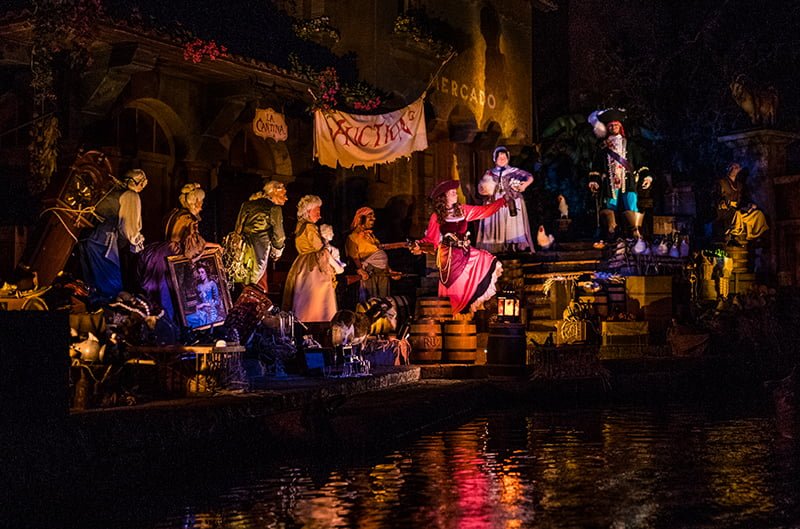
However, there must be a line. Arguably, you approach that line when the conversation involves updating classic attractions–the masterpieces. If the change is change for its own sake or so a new generation of Imagineers can leave their mark–neither of which would actually improve on the attraction–it should not be made. (While I do not think this is change for its own sake, the replacement auction scene does not make a ton of sense in the context of the ride–but that’s another topic for another post.)
The question is: where do updates that fit with evolving cultural norms and values fit into that? Do we reject such changes, acknowledging that the attraction was a product of a different era, when certain gags and jokes would’ve been okay that are cringeworthy today, and appreciate it as art of its generation? Or, do we view Pirates of the Caribbean through a contemporary lens, and expect its content to comport with today’s values?
I’m not sure there’s an easy answer to that, and it certainly doesn’t help that there is not really a body of art theory (or even an ongoing discussion about parks as art) to provide guidance. Usually, art must be confronted on the terms of its day, as it does not change over time. The best example of art being changed decades later that we really have is the revisionism of the E.T. walkie talkies controversy, but that’s different…or is it?
I also think there’s something to be said for being willing to preserve and confront history, even that which makes us uncomfortable. Revisionist history is a problem, and if we don’t face our mistakes, we’re bound to repeat them. There are two components to this: pirate history and American history.
In the case of American history, the case can be made that Pirates of the Caribbean is not just significant as a Disneyland classic and one of the last attractions that Walt Disney himself had personal involvement. You can make a case that, whatever its shortcomings, Pirates of the Caribbean is a ‘time capsule’ of pop culture and views towards entertainment in the 1960s. For this perspective, you have to ignore the 1990s and Johnny Depp changes, but it’s still an arguably-valid point.
With regard to pirate history, I’m not sure a compelling argument can be made that this is a historically accurate take on pirate history to begin with. Is altering the scenes of something that never purported to reflect actual history really revisionist? Moreover, are we actually confronting the bad acts of pirates in the attraction, or are we celebrating them? This leads me into the next point…
The ‘confronting’ side of presenting the dastardly deeds of pirates in Pirates of the Caribbean is that the attraction is acceptable because it is a cautionary tale. This is most clear in the Disneyland version, but even in the other attractions there are signals (“dead men tell no tales”) in the dialogue, visual imagery, and narrative framing.
Despite these, I’d contend that Pirates of the Caribbean does not proceed as an archetypal morality play. The characters who embody specific vices or bad deeds are not confronted with justice. They neither face nor make any difficult decisions, they do not atone for their sins, and they are not directly punished for choosing the wrong path.
Likewise, the audience is not challenged by the negative attributes of the pirates. They are presented at face value, and that’s pretty much that. Due to the narrative structure of Pirates of the Caribbean, each misdeed is presented as a fleeting vignette, not to be revisited. It does not seem to me as if these scenes are asking the guest for contemplation or to make any sort of value judgment.
Pirates of the Caribbean does not have the touchstones of a morality tale, unless you are willing to infer a lot from its narrative framework. While I mentioned above that an argument could be made that it’s a cautionary tale, I think that’s probably only to the extent of the greed of the pirates. Greed is a concept that can be read broadly, but I think it’s a pretty big stretch to say, “these pirates died for their greedy act of selling women.”
This is not to say that Pirates of the Caribbean glamorizes piracy. The foreshadowing and general tone of the narrative frameworks suggests pirate life was grim. I don’t see the attraction as a celebration of pirate life. I don’t really see it as a condemnation of pirate life, either. Instead, it falls in a grey area in between, almost a way of saying: “Hey, you know everything that seems fun in the middle? It’s actually not good…but enjoy it anyway!”
I think it’s easy to see how conflicting interpretations of Pirates of the Caribbean can exist. For my part, I don’t think Pirates of the Caribbean has any message whatsoever. My ‘interpretation’ of Pirates of the Caribbean is pretty straightforward: you begin with varying degrees of foreshadowing and foreboding, which serve to build up to the big reveal of the pirates besieging the fort.
Everything that follows is more about offering clever vignettes of wacky stuff pirates do than about telling a linear story into their fall. I doubt that the actual intent with the narrative arc was to give moral heft to the attraction; it was likely for the sake of pacing and building up to the ‘big reveal.’ From that perspective, the question for me is whether ‘wackiness’ is enough to justify a scene like this?
The strongest argument in favor of modifying the scene to something that does not showcase the subjugation of women is changing social norms. While the scene is explicitly depicting human trafficking and sex slavery, I think casting the auction scene as problematic solely in that light misses the point. Most guests are probably not concerned about these heinous acts being normalized for their kids.
Even as bad as those things are (and likely would not be kosher in an attraction built in 2017), I don’t think their depiction is what bothers people about this scene. Just like other “bad acts” in Pirates of the Caribbean, there’s little danger of the normalization of crime and violence by virtue of exposure to Pirates of the Caribbean–we can all agree those are bad things.
I think it’s a false equivalency to compare the auction scene to, say, the scene with Carlos that could be viewed as waterboarding (a comparison I’ve seen made repeatedly online since this news broke). The controversy surrounding the auction scene is not simply about an act, in isolation, that is bad. It’s about how guests perceive and internalize the act.
In the case of waterboarding, there should be little impact (unless, I guess, you’ve been waterboarded before?) on most guests. I don’t think the same can be said for objectifying women. I’m no good at math, but women are probably like half the world’s population, give or take.
The cumulative effect of casual sexism on women is an issue that is now, rightfully, in the public spotlight. What passed in the 1960s as an innocuous gag we now understand could be viewed to normalize misogyny and the objectification of women. While it’s recently become clear plenty of men yearn for the ‘good ole days’ of the 1960s, I’m not particularly keen on societal regression. Just because something was viewed as “okay” for decades does not mean it was, and will always be, okay. Times change.
As someone who has never experienced the ill effects of misogyny, I feel like this is a scenario where it’s not really my place to offer a value judgment on how the redhead auction scene does or does not impact other guests. I don’t know what that’s like to experience the world as a woman.
Even as I want to be able to justify this current auction scene to myself as being important because of artistic integrity or the history of Disneyland and pop culture (and that is exactly what I did as recently as 5 years ago when addressing the topic), I have come around to the perspective that this is selfish. I picture a hypothetical scenario: I have a young daughter, and after experiencing the attraction, she asks about that scene. What do I say? Even if she doesn’t say anything, do I proactively address it? To be honest, I have no idea.
As much as I value my nostalgia and iconic aspects of classic attractions, it feels “right” to err on the side of not reinforcing sexism. The iconic characters will still be there. The attraction will still focus on the pilfering of pirates.
I’m going to open this topic to reader comments, but I want to reiterate that I expect this to be civil. Besides, as persuasive as inflammatory rhetoric, devoid of reason is…actually, it isn’t persuasive at all. If you have a point to make, articulate it logically, and don’t insult others.





I think something that would be fun is if they kept the “we wants the redhead scene” then added an additional scene of the redhead lady, and the other ladies later tying them up or something to sell them, or getting some other comeuppance of some kind, to keep the original scene, and acknowledge the historical reality, but still have the neat addition of a Lady Pirate!
I would love if the “we wants the redhead” line remained, but another pirate immediately added, “to lead us to the treasure!” (or something of that nature).
Really flip the script on the whole scene, while also retaining a classic line. Win-win?
That’s by far my favourite line and I am a red headed woman!
Win-win for sure. And would be SUCH an easy fix.
I’m personally glad they are changing it. As a woman it is cringeworthy to watch that part. I understand it is from the “good ol’ days” so I take it at face value. But obviously others take it as a justification for their views and for that reason I’m glad it is changing. As a historian I’m sad to see a classic ride change and will be purchasing memorabilia to remember the old ride. However, Walt never wanted his park to be a time capsule and if he knew it was bothering guests he would have changed it.
I think a simple thing people are missing is that the scene is not of something going on today, it is depicting what Pirates did in that era (1700’s ?). 100% of people over 10 years old realize that it is set in a period way back. Those that don’t probably do not even know what is actually going on, and if you had to answer a question from your 8 year old, you easily explain that the Pirates did bad things…..which I think any child over 5 can assume by the overall ride. I went on the POC in Disneyland many times in the 60’s when I was 5,6,7 years old and never once did I spend time deeply contemplating what was really going on in that scene. I’m in the camp that says Disney is worrying way to much about hurting a few feelings. BTW, will the red head be the only woman from the pirate’s ships? If so, now they are going into other deep waters on a woman and her moral character…..just saying.
I agree with a lot of this, but I have a thought about your comment that art doesn’t change. While true with physical and visual arts, like a movie or paining, experiential arts like theater are meant to and often change, which is the form I see theme parks most like. Like a play that was written for one audience to convey one theme would be built upon the original cultural context. But a revival later on would reexamine the presentation choices of the original and alter then to better relate to the current audience so that they also understood the original messaging. That happens extremely often with theater. That’s how I see this situation if the original overall concept is intact after this change.
So I guess it comes down to if you see theme parks as art for their production design and visuals, or for their overall experiential impact. Changing a well known and historical scene would definitely be a problem with the former, but maybe not in my view for the later if it’s in service of better relating to the guest point of view.
Overall, I definitely agree with you about this.
This is a really excellent point, and one I had not considered. For what it’s worth, I do not believe the artistic elements of theme parks should not change. Truthfully, I don’t know what I believe. Part of the reason why is because there has not been much good dialogue on the art theory of theme parks, and how they should be treated. (And even if there were, I doubt the parks’ commercial overlords would adhere to such ‘rules.’)
Interesting food for thought–thanks for sharing!
I love this reply, its a really cool angle on the debate + way to think about it. Thank you!
The Pirates attraction should be about a jolly good time even as depicted with Pirates looting, pillaging, and raping. Can I say the last word? They’re raping the village literally even if they’re auctioning off women, which is the delay in the action. So what flows from the auction was the chase scene. This is what broke the narrative when they changed the chase scene before they changed the auction scene. Auction leads to the chase where the women resist and this was fun to watch. Now, Pirates is less fun because they are adhere to political persuasion of how women are to be treated. Actual Life isn’t so kind. The Yo Ho Ho Ho Pirates life is less lively and less alive.
I recommend they fix the chase scene again to make the new Auction scene work better (Remove the Auction banner.) Have the Pirates chase after the villagers who have valuables as seen in the Pirates movie like a key, the Dead Man’s chest with Davy Jones’ heart, or a supernatural object.
Perhaps in 50 years, let’s see if society becomes more accommodating of Disney art and Disney decides to return the attraction to its complete original scenes.
Or they do a Christmas Frozen overlay and turn the Red Head into White Haired Queen and the skeletons into snowmen. Problem solved.
“Auction leads to the chase where the women resist and this was fun to watch.”
The fun part of the ride was watching the women resist being chased after their auction? REALLY??
I feel Disney exacerbated this problem with all of their “we wants the redhead” merchandise. Hopefully when all is said and done this change will be a good one. As long as they replace this scene with something entertaining I will be happy. This scene represents something that absolutely was happening during that time frame in that part of the world and taking this scene out will not erase that from history. That being said, is the subject matter something that we want our children exposed to at a young age and at Disneyworld? Disneyworld is supposed to be about imagination, magic and happiness (maybe that’s just my opinion) and while there are attractions that steer more toward education and teaching history, I would never place Pirates of the Caribbean into that category. In the politically charged environment we live in today, I understand why so many people see this as just another example of Disney kowtowing to political pressure, and are therefore annoyed by the decision. Hopefully we can all look past that and hope that Disney does a great job on this update so we can enjoy the ride for many years to come.
Thank you for this- when I rode POTC last time at WDW, my issue wasn’t fully with the scene (which is gross, but I never once thought that Disney would change it) but about the merchandise. I always thought THAT was kind of overstepping, people wearing shirts that are about a lady being auctioned off after her town was pillaged. Ick.
As a father of two young boys, I think the entire ride is a “bad influence” on children so to speak. It’s literally men binge drinking (several into stupor and oblivion) and wreaking havoc on a town.
The character of the ride will be changed now that the women are getting involved in the party. Will the red head be partaking now?? Rum or Beer??
What are children more likely to take away after riding the current version? Binge drinking is fun/exciting?, or auctioning women is socially acceptable? I think the former.
Despite all this, I’ll soak up the current form of the ride with my little guys one last time this winter. It’s still a masterpiece.
Having two daughters (16 & 17) that literally grew up going to Disneyland and riding this ride (perhaps 100 plus times), we have had discussions about that scene (and many others in the ride) and they know that much like a movie, it’s not real life or representative of current society. They always took it, like much of the ride, as a lighthearted “tale” of what might have been at one time versus anything they are ever likely to experience in life. Where does Disney draw the line? Should the attic bride be removed given that she decapitated her husbands? Should Carlos stop being tortured in the well in Pirates?
If in reality this is not being done to “plus” the attraction but is truly being motivated by a change in social norms, I wish Disney would just come out and address it head on. In either case, I’m disappointed that they are changing what some folks might agree is one of the most iconic scenes in Disney’s most iconic attraction.
Excellent piece, Tom. This was articulated very well and I hope it makes some people think differently. Most of the commentary I’ve seen so far is explosive, mad and rife with nostalgia (expectedly so), so this was a breath of fresh air to read.
I think you’re a little vague here (probably intentionally), but I agree with the core point.
The issue to me seems not that the scene is there, but that the women look to not really have any problem with it. Since I’ve become an adult, that seen has caused me a lot of tonal whiplash. And I say that as someone who thinks those “90’s changes” were unnecessary.
I do think our society is moving towards a point where merely depicting something bad is treated as endorsing it. But I don’t think this is one of those cases. My personal opinion is that most of the more politically focused criticism of this change is missing the trees for the forest.
This is a very well thought out article and I appreciate how you explained things here. I’ve always been uncomfortable with the auction scene and remember as a kid I didn’t understand the whole “buy a bride” concept (or why the redhead seemed so okay with the whole thing). The fact is, pirate history is not really what’s presented in Pirates. It’s more of pirate folklore, the fun and adventurous version. As such, updates to the scenes make sense to me. Pirates auctioning off the best loot is just as realistic, and even offers a nod to the famous female pirates of the Caribbean (who yes, existed). Suddenly little girls get to see themselves as part of the action, not just chased or sold, and that will make the ride more fun and exciting for everyone. As Walt himself said, “we keep moving forward.” Not backwards.
The thing that ‘troubles’ me about the new scene is why pirates would be auctioning off loot…in the middle of everyone looting a village. There’s “free” loot everywhere.
I like the idea of a badass female pirate, but the rest of the revised scene feels like Disney doing the bare minimum to update the attraction.
I can understand that, but to turn the question around, why would they be pausing to auction off women when they could just take whomever they wanted during a raid? There’s women everywhere for free in this village, too. I think it’s just a chance to revisit the scene while keeping the core of it (pirates auctioning off their “treasure”) intact.
Yeah, that’s exactly what Sarah said. I don’t know. When you actually think about it–in either direction–an auction scene never made sense there, contextually. I never questioned it before though, so perhaps my new reaction is overthinking it.
Thanks for a clear-headed and thoughtful post, Tom! I’m on board with the changes–this scene has always made me uncomfortable in a ride I otherwise love. I do agree, though, that I don’t quite understand the logic behind the new auction scene within the story of the ride. Here’s hoping the actual execution makes more sense!
Disney has in part created this headache for themselves by casting (many of) the pirates as heroes in the movie franchise. This is in direct opposition to their original depiction in the ride as villains. Disturbing as the reference to human trafficking is, you can also say it was originally tempered by the depiction of pirates as clearly-defined ‘bad guys’ and the message that the things they are doing are NOT OK. I suppose the evolution of the ride into near-glorification of the pirates was inevitable once the company realized how much money was to be made selling eye patches, cutlasses and the like – to say nothing of movie tickets and DVDs.
I think the biggest question here is the value of the WHAT ABOUT THE CHILDREN argument. As your blog shows the parks are not only for children but also for adults. However nuances and historical contextualisation do not have the same effect on adults and on children.
I almost did not include that hypothetical towards the end because it feels like, perhaps, an overly-emotional straw man, but that’s really what keeps running through my mind.
Really wonderfully written, Tom. I am so torn on this. As a woman, I’m on board with the idea that the redhead is set to turn the tables–boy, do women need that right now–but on the other hand, there’s something to be said about “whitewashing history.” Your line about being bound to repeat the mistakes we don’t face is indeed just the point. In the end, though, I think making this change will become just another part of history–a reflection of what 2017, and years to come, are/were like. Clearly I haven’t settled on a firm opinion, but your words have really helped to put it all in perspective! If only they could find a way to keep the “we wants the redhead” line–so classic.
p.s. want to thank you for putting together such a thoughtful blog–you have helped us tremendously with our upcoming trip to DLP!
“Your line about being bound to repeat the mistakes we don’t face is indeed just the point.”
To be clear, I’m saying that I don’t believe Pirates of the Caribbean faces or confronts the mistakes of the past. So justifying it on that basis misses the mark, at least for me.
There are some excellent, real world examples of confronting the past by acknowledging the heinousness of what happened. Germany does an excellent job at this. In other cases, I think people want to protect things under the guise of history that, to many, feel more like a celebration of past transgressions than a confrontation of them. There’s a specific example of this currently occurring in America that could be pointed towards.
So true! And fair point–I didn’t intend to take your words out of context. I think that sentiment could be applied to a lot of things going on right now, but Pirates isn’t that place, and I’m projecting! Funny how this small (though not small to us Disney fans), occurrence can stir up a whole mess of stuff!
Hey Tom, great points here. You have to take the high street and be understanding to those who have daughters and would no doubt be extremely impressionable to a scene like this.
I forgot about the auction scene when I rode Pirates for the first time as an adult last year, and it was striking to me to the point where I second-guessed my decision to take my daughter on the ride. We have read stories of historical female pirates like Anne Bonney and others and she is entranced by them and was excited to ride Pirates of the Caribbean. I don’t think that was what she was expecting.
Even octogenarian Imagineer Marty Sklar has supported the Pirates of the Caribbean update. If it was a slave auction, which was absolutely the norm in the West Indies/Caribbean at the time, would the preservation of history argument still hold water? As far as artistic preservation, this is a ride for people’s entertainment, not a one-of-a-kind piece of art in a gallery. You can still record the history of a ride (indeed there are plenty of ride videos on YouTube, etc.) and update it accordingly with an eye towards historical accuracy. That the redheaded woman in the scene is staying and being changed into a pirate is telling … a nod to Jacquotte Delahaye?
At one time, people thought auctioning off women for sale was entertaining, even if they didn’t REALLY support selling women into marriage; and it’s telling that some people still think this way. I’m glad enough people don’t find this entertaining anymore. Forced marriages are still a serious global issue in many parts of the world.
“If it was a slave auction, which was absolutely the norm in the West Indies/Caribbean at the time, would the preservation of history argument still hold water?”
Excellent point! I think it’s a really helpful analogy. Who could argue that a “fun” scene depicting a black family being auctioned off (cheerfully, even!) by white slavers would be fine for Disneyland in 2017? How would such a scene make a black child feel? How welcome and comfortable would that child’s family feel as they exited the ride, knowing that nearly everyone around them (and Disneyland leadership) thought it was all in good fun?
I think most people would agree that Disneyland is no place for a cheerful depiction of a slave auction. So then how could it possibly be okay to show a woman being auctioned off for sex?
For me, it comes down to the fact that while there may be some historical value to leaving this attraction as-is, I don’t need Disneyland prompting “real talk” with my son about sex slavery, or why some people ever thought it would be funny to put such a scene in a Disneyland ride.
I haven’t even talked to him about sex slavery yet. Because he’s FIVE. We’ve had some deep, serious talks about labor slavery and America’s origins in it, but I’m kinda waiting on sex slavery until he’s older, you know?
Great post. We were just at Disney a couple of weeks ago, and I hadn’t been on Pirates in a long time (it was closed for refurbishment the last time we were there, and the time before that my young son was so freaked out by the ride, I wasn’t paying attention). This scene also really struck me as being borderline (or maybe all the way) inappropriate. I support them changing it as it hopefully will only add to the light-hearted nature of the ride.
Got to admit, that is a lot of words about this subject. My reaction when I heard the news was “what took so long”. I would have thought this scene would have been “corrected” when they updated the chasing of the women to be based on food and not carnal pleasures. If anything you can argue the auction scene was more “offensive” as it left no doubt what was happening where as the chase scenes required the viewer (is this right? rider? observer?) to go there in their minds. The auction scene has a sign telling you exactly what is happening.
Just my two cents.
Given the number of people who vehemently disagree with you, I think ‘a lot of words’ were probably necessary here to properly present the debate.
Good point. I was just surprised by the length of the piece. I think the passion for this issue can be summed up by the fact that this was the last attraction Walt Disney worked on so anything that is done to change inflames peoples passions.
Very well thought out and explained! I see this as a classic “Disney Meltdown(TM)” We are going to have people freaking out on twitter and message boards, but once this change is made and they have the red head holding a gun and being in charge I foresee her being the new star of the ride. Expect T-shirts, Pins, Cosplay, etc.
Honestly we should all be happy when the classic rides we love get some TLC and updating here and there. I am excited to see this new female Boss Lady Pirate in action.
Posted to FB as well but cogent enough to repeat 😉
To your credit, your fanbase is mostly sane so this may be a civil discussion. Still…you brave!
I’d also like to point out that there have already been alterations in the name of changing mores specifically regarding pirates and wenches. Specifically, who chases who in the burning town and why. It has gone through multiple revisions to comply with modern sensibilities.
I can easily understand both sides of the issue so I really don’t have a firm position here. I’m just saying; this isn’t the first time we’ve walked this road.
I allude to those by calling them the “1990s changes” but I tried to avoid direct reference to them because I think the idea gets muddied down when you talk about precedent either direction. Just as you point to that precedent, others will point to this as precedent, arguing that everything that is mildly offensive will be made.
I’m not particularly big on slippery slopes; I’d rather just approach each unique situation on its respective merits. 🙂