
Disney World is Worried About Its High Prices.
Disney World is pricing out the middle class. This has become an increasingly “popular” topic among fans. Every few months there’s a big piece in the mainstream media that gains a lot of traction and draws new attention to issues of price increases, nickel & diming, and unpopular decisions made by leadership.
Usually, these articles are supported by quotes from disgruntled fans. They paint a picture of the company suggesting its about to hit its breaking point, and fans in revolt. The thing is, you could use fan anger to “prove” anything. Disney diehards are a passionate bunch, and I could crowdsource an article about the closure of the Fossil Fun Games in Chester & Hester’s Dino-Rama being Walt Disney World’s worst decision ever.
This isn’t to diminish complaints about rising prices. It’s just to say that quotes from random fans aren’t really as conclusive as to consensus as some outside the community might believe them to be. Disney reaching its breaking point has been a much-discussed topic for at least the last decade. However, an excellent new report in the Wall Street Journal actually brings something new (and worthwhile) to the table: internal discussions from Disney about pricing problems and quotes from the company.
Before we get to that, let’s talk about the numbers supporting the assertion that Disney is pricing out the middle class. There’s a lot of financial analysis in the article, which is interesting, but not altogether dissimilar from our own How Much Does It Cost to Go On a Walt Disney World Vacation in 2025?
As with our assessment, the WSJ breaks down different tiers of trips. We have four tiers, mirroring Walt Disney World’s own Value, Moderate, and Deluxe Resort hierarchy–along with the addition of a frugal class for guests staying off-site and trying to do Disney as inexpensively as possible.
By contrast, WSJ has five tiers. That’s not the biggest difference, though. Instead of just taking the cost for each tier of trip at face value, they’re overlaying that with the five U.S. income tiers, and government BLS statistics on average annual travel spending. We question this approach to some extent.
While there is an undeniable nexus between income and travel spending, it’s not definitive.
It’s a fool’s errand to conduct an analysis of Disney pricing out the middle class–or any of the quintiles of consumers–based solely on spending and income data. There are over 125 million households in the United States, and Disney only needs to capture a small percentage of them–we’re talking single digits–each year. And that’s assuming no one visits from overseas, which is obviously inaccurate.
Averages are important but not outcome determine for Disney. What various tiers of average American households “can,” “should,” or “do” spend per year on travel is only part of the equation. Because all it takes is the outliers to skew things completely. Nevermind credit card debt, saving up for expensive vacations, multi-generation trips funded by grandparents, or even the international “whales” (non-derogatory) who make up an increasingly large slice of the tourism pie (not just for Walt Disney World, but for pretty much everywhere).

We’ve previously rebutted the notion that Walt Disney World is now catering only to the wealthy–or even the top 20% of American households, as WSJ suggests. To the contrary, the parks are still reliant on the middle class, and that demographic being willing and able to spend the ever-increasing amount that a Walt Disney World vacation costs.
To be sure, there are wealthy Disney guests. It’s probably fair to say that the top 20% is overrepresented at Walt Disney World as compared to most vacation destinations. However, there are not enough of them to fill the parks and resorts on a daily basis. Bluntly, Disney is dead without the middle class.
The majority of Disney guests–probably the overwhelming majority–are still the middle class, splurging or going into debt. The upper class cannot sustain the parks and resorts. If you visited Walt Disney World today and could Thanos-snap away everyone who wasn’t part of the top 20%, the parks would suddenly look like ghost towns.

To be very clear: we are not saying that this makes the nonstop price increases any better. Nor does it make Walt Disney World’s current approach a savvy long-term business strategy (it makes it worse!). We’ve been sounding the alarms about Disney eroding goodwill for years, and have serious concerns about the company cultivating new generations of fans.
There’s nevertheless a fundamental difference in pricing out the middle class versus attempting to extract more money from them. Disney is squeezing the middle class, not attempting to exclude them. The rich are not booking motel-style rooms with exterior hallways at the Value or Moderate Resorts, let alone the many nearby off-site budget hotels that Disney relies upon to fill the parks. Rite of passage vacations among the affluent are certainly a thing, but not nearly enough to sustain Walt Disney World.
The bottom line is that Walt Disney World is a middle class vacation destination. We’ve made this argument before, often when there’s new data to “prove” that Walt Disney World is dangerously unaffordable. The reality is that the data is important, but it’s only one half of the puzzle. If prices alone were conclusive, Disney would’ve been in serious trouble over a decade ago. And yet, that obviously wasn’t the case.
In reality, the current trajectory doesn’t change until the middle class says “enough is enough.” When that happens is more complicated than simply looking at income and spending. It also concerns guest satisfaction, intent to revisit, and perceptions of value for money. There’s the objective side to this that does matter, but the emotional component is equally critical.
Walt Disney World could increase prices ’til the cows come home, but if they’re also increasing the perceived value at a commensurate clip, many of these conversations about pricing people out wouldn’t be happening. Middle class Americans would save and splurge, viewing their trips to Walt Disney World as “worth it” even if they came with financial strain.
The reason these conversations are happening more and more is because the price increases have been accompanied by cost-cutting, nickel & diming, and other net-negatives that change the calculus for middle class Americans. Not just them, either. No one likes to be ripped off, so that 20% quintile that can safely afford Disney may opt against it, further underscoring the importance of the non-financial factors at play. This is starting to happen and the tide is turning, as evidenced by a year-plus of lower crowds.
According to the WSJ, these conversations are also happening inside the company–not just outside it among fans and critics. This is precisely why all of this matters–because it’s not just the normal financial analysis, but because the WSJ is showing that Disney is starting to lose the middle class on the equally important emotional level.
This brings us to the truly interesting tidbits from the WSJ, which reports that “some inside Disney worry that the company has become addicted to price hikes and has reached the limits of what middle-class Americans can afford.” People with Disney familiar with pricing say that “internal discussions over whether Disney parks may be losing their grip on the hearts and wallets of families with young kids have become more frequent.”
And then there’s this: “Starting in late 2023, the company’s own internal surveys of Walt Disney World and Disneyland guests found that the number of them planning return trips had ticked sharply down.”
This doesn’t come as any surprise to us. If you search this site for “intent to revisit or recommend” or “intent to return” or “guest satisfaction”, you’ll see we’ve been discussing these dropping metrics for a while. It’s our understanding that guest satisfaction took its first big hit with the rollout of Genie+ (late 2021), but improved in 2022-2023.
It’s one thing for us to hear this and another entirely for the Wall Street Journal to be able to credibly source and report it. Although the WSJ doesn’t say as much, our understanding–which we discussed at the time–was that leadership on the ground at Walt Disney World was very concerned with this and wanted to make changes, but then CEO Bob Chapek refused. (That’s precisely how leaks like this start in the first place–concerned employees sounding alarms but being overridden by senior management.)
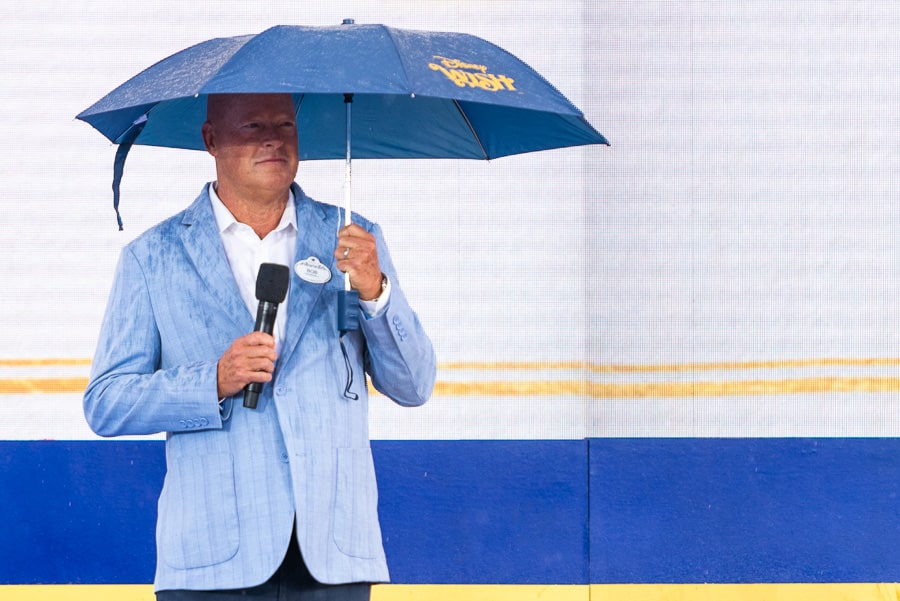
Most fans probably don’t need a reminder of the dark days of the Chapek era, but most of this was set in motion by him. He cut once free-perks, reduced park entertainment and offerings, and set in motion two years of the most precipitous price increases we’ve ever seen at Walt Disney World and Disneyland. Suffice to say, there’s a reason fans hate Chapek.
Upon his return, Bob Iger made it clear that he had been “alarmed” by price increases at Walt Disney World and Disneyland, and was concerned that Chapek was “killing the soul” of Disney. This was widely reported at the time–it’s nothing new.
Shortly after returning, Iger called a meeting with Parks Chairman Josh D’Amaro and asked him to come up with a list of things the company could do to win back the goodwill of fans. According to people familiar with the meeting, D’Amaro offered up discounted parking, more days during the off season with lower-priced tickets, and freezing the regular rounds of price hikes.
Iger chose to bring back free overnight parking at Walt Disney World Resort hotels and ticket promotions, but regular price hikes continued, the WSJ reported. This isn’t entirely accurate.
I don’t know why I even bother since perception is reality and prices spiked massively from 2019 to early 2023–and fans are still reeling from that. But Walt Disney World did not raise ticket prices between December 2022 and last year. That was unprecedented.
At the same time, hotel rack rates barely budged last year (below the rate of inflation, on average). For 2025, there were just as many rack rate decreases as there were increases. Due to greater discounting, the effective rates at resorts largely decreased from 2021-2022 to 2023-2024 (and in 2025, so far).
Ticket prices are up, and fairly significantly for many dates, in 2025. Restaurant and merchandise prices have continued to increase, unabated, since 2022. Same goes for upcharges and add-ons, including the line-skipping service (that once was free). So it’s not like overall prices have held steady.
To be clear, none of this is a defense of Disney–just striving for accuracy. We have also argued that while Iger got off to a strong start in improving guest satisfaction, that progress has stalled and more needs to be done (see Walt Disney World Could Fix the Guest Experience by Improving These Things and Big ‘Little Things’ Disney World Needs to Bring Back).
The bottom line is that prices have gone up sharply since 2019, and even though increases have decelerated dramatically since 2022, it’s no wonder fans are disgruntled. The cumulative impact of the cost-cuts coupled with price increases is still staggering, and much more needs to be done to address it.

WSJ also reports that about a year after Iger’s return, Disney began to have “serious concerns” about the rising cost of visiting the parks, according to former employees involved in the discussions. The results of surveys asking whether Walt Disney World and Disneyland guests intended to return soon showed a drop. This aligns with what we’ve been told, and also extends to the likelihood to recommend metrics (which is equally important).
The issue was reportedly raised with Iger, according to WSJ citing people familiar with the matter, but parks were still booming. The Experiences division, which is primarily Parks & Resorts, had become the company’s primary profit engine in 2022, replacing the declining cable TV business. Experiences represented 70% of Disney’s overall operating income in the 2023 fiscal year, up from 41% in 2019 and 34.5% in 2018.
The Experience unit’s income of $3.1 billion for the final three months of 2024 was flat year-over-year. Attendance declined 2%, and operating income fell 5% year-over-year. As we explained following last week’s earnings call, the results probably would’ve been more positive but for Hurricanes Helene and Milton, both of which had a long tail of cancellations. Nevertheless, this came at the same time that the international parks were up a staggering 28%, fueled not by the smoke and mirrors of cost-cuts and higher guest spending, but by opening new lands and attractions.
Pricing has been a concern for investors and analysts, and was even one of the catalysts for the proxy fights of the last couple years. For the company’s part, CFO Hugh Johnston indicated during the December earnings call that Disney needs to be “smart about pricing,” especially at the lower end of the market where consumers are “feeling stress.” (This is similar sentiment to what fast food chains and retailers have reported during their recent earnings calls.)
Johnston indicated that Disney has tried to hold prices steady for lower-priced offerings at the parks and that most of the price increases were concentrated among premium packages or during high-demand dates. He added that the company wants to “tap in to those families and build the habit of coming to Disneyland or Disney World, not one time, but multiple times.”
“The number-one thing we hear from the millions of guests who visit our parks each year is how much a Disney vacation means to them, and we intentionally offer a wide variety of ticket, hotel and dining options to welcome as many families as possible, whatever their budget,” said Josh D’Amaro in a written statement to WSJ. “We also know that in inflationary times it’s especially important to give families ways to save on their visits.”

One random tidbit from the WSJ article that I found interesting was this: “Five years ago, the skip-the-line feature FastPass was free. Now visitors choose from three different tiers of Lightning Lane passes for the privilege—the most expensive reaching $449 a person a day.”
I’ve mentioned this repeatedly, but one of my recurring fears as a longtime fan is been that Disney is inflicting long-term brand damage for short-term financial gain. This line in the article is a perfect example of that. That $449 cost is eye-popping, and will catch the attention of the general public.
Without added context, they might (understandably!) assume that line-skipping at Disney costs hundreds of dollars, not that it starts at under $20. Insignificant as it might seem, lines like those might turn people off from even considering a Disney trip. They won’t learn the full range of Lightning Lane prices, because they’ll say “I’m out” before it even comes to that.
Obviously, this WSJ article as a whole is damaging to Disney. But so are specific sentences like that, or every single article about the failed Star Wars Galactic Starcruiser. Same goes for the $100,000+ private jet Disney Parks worldwide “adventure” and the Storyliving by Disney communities.
Those have received outsized negative attention for niche offerings–same with Lightning Lane Premier Pass–and I really wonder whether the limited financial gain is worth the brand damage inflicted. It’s not something that shows up on a balance sheet, so of course they look like positives (except Starcruiser, which very obviously was not). But a balance sheet can’t measure long-term ramifications or indirect consequences. I feel like this is a microcosm for this “Disney is pricing out the middle class” conversation, as a whole.
The WSJ report also points to a couple of surveys that indicate an overwhelming majority of Americans feel theme parks, cruises, and other expensive vacations are financially out of reach.
Many are reporting trading down from these to nature-driven experiences, such as state parks or beaches. Visitor data from the National Park Service bears this out, as does the growing discrepancy between Orlando International Airport’s traffic volume and Central Florida theme park (all of them) attendance.
Disney called one of the polls “flawed and misleading” and unfairly cast Disney in a negative light, according to the WSJ. The company’s response strikes me as oddly defensive, but I’m admittedly not as interested in this type of survey. Over the last decade-plus, I’ve received countless ‘story pitches’ about surveys like this for Walt Disney World, Disneyland, and myriad other destinations. (In fact, you can find recent articles similar to this one about tourism in Las Vegas or New York City.)

It’s been true for a while that the majority of Americans feel Disney vacations are financially out of reach.
The percentages have undoubtedly increased, but the results themselves are nothing new. Those of us who can afford to visit are extremely fortunate. As with the income vs. costs data, what matters more is behavior.
Are enough people voting with their wallets, or are they complaining about prices in surveys but continuing to visit and having positive experiences? It’s undeniable that the financial burden is steep; but is the emotional value still worth it? That’s what makes the intent to revisit/recommend and guest satisfaction metrics the biggest key to all of this.

I’d go a step further and say the “intent to recommend” is a very underrated variable in this. We have heard from more and more fans that, even though they’re still going to Walt Disney World for emotional or sentimental reasons, they’ve stopped recommending it to friends.
It used to be the case that current Disney fans were excellent, unpaid brand ambassadors for the company–introducing Walt Disney World to others, making new fans in the process. What we’ve heard is that–due to higher prices, greater complexity of visiting, less value for money, and more–fewer readers of this site are recommending Disney Parks to others. This is really significant, and under-discussed. People trust the word of one person in their own social circles more than that of one-thousand social media influencers.
This is also why it’s worse for Disney to lose fans on an emotional level. If costs were all that mattered, the damage would be easy to undo. Disney could turn its big pricing dial down, or pull that giant discount lever and entice people to return in greater numbers. But when you lose fans emotionally, the likelihood of that damage being undone is far lower.
Ultimately, this WSJ piece is not going to be “breaking news” to anyone reading this. It covers some well-trodden ground, and similar sentiment to what we’ve been hearing and expressing (see our article, Is Disney Eroding Fan Goodwill?, from 2018 and its nearly 400 reader comments) for years–long before the Chapek regime.
One difference here is that we’re starting to see cracks emerge in Disney’s financial results, with growth at Walt Disney World and Disneyland being primarily driven by price increases as attendance “softens” and demand moderates. Another is that the WSJ spoke to people inside the company, with the leaks suggesting that there are significant worries within about pricing (and probably a fierce internal debate if this is bubbling over with people going to the press).
Finally, there’s the practical reality that Disney has a couple of years ahead of it with no new attractions opening, and at a time when it’s biggest competitor is opening a brand-new theme park down the street. My sincere hope is that important people inside the Walt Disney Company recognize the gravity of all this and the long-term ramifications and intend to do something about it. I was optimistic about that in early 2023, and although I’m still optimistic about the long term investments in new attractions and lands, there needs to be a greater sense of urgency about improving the guest experience and satisfaction in the near-term. Otherwise, there won’t be as many fans or as big of a pool of guests from which to draw once all those fancy things open.
Planning a Walt Disney World trip? Learn about hotels on our Walt Disney World Hotels Reviews page. For where to eat, read our Walt Disney World Restaurant Reviews. To save money on tickets or determine which type to buy, read our Tips for Saving Money on Walt Disney World Tickets post. Our What to Pack for Disney Trips post takes a unique look at clever items to take. For what to do and when to do it, our Walt Disney World Ride Guides will help. For comprehensive advice, the best place to start is our Walt Disney World Trip Planning Guide for everything you need to know!
YOUR THOUGHTS
What would you like to see done to improve the guest experience and satisfaction at Walt Disney World? Think that runaway price increases are the big concern, or is the value proposition an equally or more significant matter? Thoughts on the WSJ article? Do you agree or disagree with our assessment? Any questions we can help you answer? Hearing your feedback–even when you disagree with us–is both interesting to us and helpful to other readers, so please share your thoughts below in the comments!




Along the lines of pricing, why is LL multipass $39 for MK March 2?!? Correct me if I’m wrong, but isn’t that the all time high price it reaches between Christmas and New Year’s?
I bet Brooks Barnes of the NYT is annoyed about getting “scooped”. Generally he’s been the one getting the big stories coming out of Mouse House Corporate.
I wouldn’t be the least bit surprised to see similar pieces from Barnes and Alex Sherman over at CNBC within the next two weeks.
Both are well-connected, and this makes it almost certain they’ll go poking around with their sources to see what else they can uncover.
I fully expect to get roasted for this take, because I always do in Disney fan spaces, but these conversations about people getting priced out are always deeply amusing to me because they just prove how deeply insular and out of touch the core Disney fan community is and has always been with the economic reality of the US and their own privilege vis a vis it. MANY American families have been getting priced out of WDW since the 70s, including large swaths of the middle class. Growing up as a kid in the 80s and 90s in NYC I didn’t know anybody who was going to Disney World every year. The overwhelming majority of working and middle class families I grew up with were doing “once in a lifetime” trips, if they could afford even one of those at all. I was an extreme outlier among my peers having done more than one childhood trip, and my family was not going every single year–my mom was a single parent and a military veteran RN who worked for the fed govt and saved up for years between trips. When we did go, we stayed with relatives in Tampa or offsite, and we certainly weren’t doing table service meals–we brown bagged it, and MAYBE got a treat or two from Adventureland Verandah or something. Our big splurge was the Dolphin back when it first opened. I didn’t stay on site in a Disney resort until I was an adult paying for my own trips! Many of my non-Disney friends, including one we’re taking this summer for the first time, never went as kids at all because their families couldn’t afford it. And they were all solidly middle class. These group of fans who grew up going every year and staying on site have never understood how privileged they are relative to other Americans. And slowly losing that privilege is hitting them hard.
Of course Disney has shot prices up and cut benefits and perks, I’m not defending them. But to put it bluntly, I think there is a demographic of middle class Americans with a certain level of entitlement, right or wrong, for whom annual Disney trips on property with all the bells and whistles is a class marker. It’s just part of the lifestyle they’re used to. They may not even realize it, and most of them don’t. But the middle class in this country has been getting squeezed for a very long time by corporate greed and is rapidly shrinking. Them suddenly having to cut back on Disney vacations is perhaps an uncomfortable reality check that they aren’t doing as well anymore as they used to, or as well as their parents did. But I also believe very strongly that there’s an element of FOMO and keeping up with the Joneses fueling this resentment and anger over pricing, which has grown by leaps and bounds due to social media.
Influencer channels on YouTube, IG and TikTok and people on Facebook groups and the big fan message boards are exposing people to vacation styles they can’t necessarily afford and normalizing expensive experiences making them think they HAVE to do Disney that way or they will disappoint their families. I’m thinking of the people on FB groups who need to be talked down from the proverbial ledge because they couldn’t get BBB appointments for their kids because now the whole trip is ruined. Upcharge and deluxe level experiences have been normalized as the only way to have a good trip, and these families with multiple kids don’t want to stay at All Star Sports or the Days Inn on I-4, they want to stay at the Polynesian and eat extravagant table services meals every day like their fav YouTubers (most of whom are single childless adults or DINKs with the attendant disposable income that comes with that, I know because I’m one of those childless millennial Disney DINK couples). What they don’t realize is how deceiving some of that social media shine is. A lot of these folk are overextending themselves, going into crazy debt, but also as an extreme example there was a local couple I used to watch on YouTube all the time until their channel abruptly vanished, because it turned out all those extravagant DVC vacations were being paid for by the husband running Medicare fraud with his dad.
tl;dr I agree with you Tom that part of this is perception, but some of that perception actually has nothing to do with Disney itself or its pricing structures and more about economic realities people have been able to ignore because they personally were never impacted by them until now, and social media driven FOMO. I feel like that needs to get talked about more.
Well, you might get roasted by others, but I very much agree with–and appreciate–your comment.
In past posts, I have similarly mentioned that being able to visit at all makes us all very privileged, as Disney is totally out of reach for the overwhelming majority of the world’s population. When people say the middle class is being priced out, they often mean that they are being priced out–or can’t go as frequently as they once did, do all Deluxe stays anymore, etc. That also wasn’t well received–and this post was already really long–so I edited it to one line here: “Those of us who can afford to visit are extremely fortunate.” (It almost doesn’t even make sense in that paragraph now that I re-read it, which is due to the editing.)
My experience as a kid was similar. Not many people from my small town visited Walt Disney World, and my family could only afford to go because my parents saved and camped at Fort Wilderness (followed by Shades of Green), and my dad got military discounts.
Aurora–your comment makes a lot of truthful observations. People have too high expectations about what they are “entitled” to these days. I certainly go to WDW way more than the average family, and definitely more than average families 30 years ago. It is an absolute privilege to live in a time where that is possible. As a country, we have become much richer. I would take being a middle class citizen today over one 30 years ago with absolutely no hesitation. All that said, this is the new reality, and Disney as a business needs to find a way to make profits. They need convince people of the value proposition. I think appealing more to families and kids is the way to do that.
I agree with you that a Disney vacation, even in the 80’s was expensive for most middle class families. My middle class parents were able to afford a Disney vacation once every other year with careful planning and purposeful saving. It was not an every year thing and when we did go, it was a week at the beach and 3-4 nights at Disney. Most times were offsite and the odd time, they splurged for a wing room at the Contemporary for 2 nights. They could never afford to stay in the main tower building.
Into the late 90’s up to now, Disney tried to sell it as an every year destination. And for years, it was possible utilizing a variety of discounts and hacks. As I mentioned, most of those have dried up. The internet and social media has not helped. The keeping up with Jones is off the charts. And many of the bloggers, (We love you Tom!), only exist by the fact that going to and covering Disney is their financial livlihood.
With all of the tariffs the POTUS is promising, middle class Americans are about to see prices for daily items go through the roof. The least of their worries will be a Disney vacation,
Thank you! This does need to be discussed more often! The number of comments that are some version of “Disney has just gotten so expensive, after we take the two trips we already have booked this year we won’t be back” reveal a frankly shocking lack of self awareness among those making them. Yes, Disney has irrefutably gotten more expensive in the last 10 years, even relative to inflation. But long before that it was expensive or even out of reach to the vast majority of people. As a child I went a grand total of twice, and that was more most people I knew growing up.
And related to expectations needing a reality check, I think far too much is made of crowds/lines. I do not understand how people can go to the most popular theme park in the world and then be upset they have to wait over 20 minutes for some rides. That’s what popular means. I personally think this is a direct result of people going annually or even more frequently; if you’ve done something 10+ times, yeah, you are going to have a lower tolerance for long waits.
My experience is similar to yours. When I was a kid, we went with some extended family to what I thought was a once-in-a-lifetime trip. We carpooled with my grandparents, and stayed offsite. We literally only did Magic Kingdom and spent the rest of the trip going to the free beach.
Imagine my surprise when four years later, we get to return only because my dad had a work conference. Even with his work paying for staying at the Swan (I couldn’t believe we were actually on property), we drove 15 hours straight to not pay for an extra hotel night, and we spent his two conference days riding the monorail and looking at resorts because paying for an extra park day would have been too pricey.
When I took my family in 2022 for the first time, I was shocked at how affordable it was (compared to what I thought it was going to be). I was ready for Six Flags food prices and was surprised to see Counter Service restaurants basically in line with regular fast casual food prices. Our daily rate at Pop Century was cheaper than the Holiday Inn Express we stayed at on the way down to Florida. Now, look. I’m not saying Disney’s not expensive, but it was a bit of a shock after reading so many comments saying Disney has priced the middle class out back then. I quickly learned there are several different ways to “experience” Disney.
Like others here, as a kid (back in the 80s) WDW was basically a ‘once-in-a-lifetime’ trip – I was lucky, I got to go once in 5th grade, and again in 12th grade, both times because my father had a work trip to FL that helped defray part of the cost. I did know people who went every year, but I wasn’t one of them! I’ve been many more times as an adult, but my financial situation is pretty different from my parents’.
This last line really hits home for me:
” there needs to be a greater sense of urgency about improving the guest experience and satisfaction in the near-term. Otherwise, there won’t be as many fans or as big of a pool of guests from which to draw once all those fancy things open.”
ABSOLUTELY!
There are so many memorable things about Walt Disney World that are simply gone, without anything having taken their place. Parades, holiday decorations, and streetmosphere are greatly reduced from 7 -10 years ago. So many things are weaker in general and yet far more expensive. Disney has done some nice things in the last five years, but the glacial pace of construction AND the rapid-fire reduction of secondary entertainment AND the number of price increases have overshadowed most of it.
Disney has been working to “trim the fat” for so long I don’t think they realize that they’re hitting bone at this point. I’ve been giving them the benefit of the doubt for a while now but without some significant improvements to the overall experience (NOT just some new attractions) I just can’t see me visiting as often or recommending it to others.
Matt B., yes, exactly this!!!!
My family is choosing not to vacation to Walt Disney World for the first time since 2013 (my 15 year old has been 15 times and my 9 year old 12 times) because of the pricing increases. We used to be able to travel for around $4k for a family of 4 (including dining, tickets, and a moderate resort). Now it is well over 6k and we need more space than a moderate resort can give. We have stayed offsite the last couple of years to bring the price down. I will say we can still travel to Universal for under $4k (and even include a day at their New Epic Universe theme park).
We are Canadians, long time fans. We don’t recommend Disney to others now or tell them to go. We love it, but get a lot of negativity from friends about the pricing, so we try not to talk about it with others. My teenage daughter gets called “Richie Rich” by her friends if she lets slip that we are going there for a trip, so she has asked us to keep any trips we plan there secret when possible. That is so sad! We feel it is perceived by a lot of Canadians as financially out of reach and they’re bitter about it (Our dollar vs the US dollar makes it much worse). There are Canadian offers on occasion but they don’t seem to publicize them well because anyone we’ve mentioned it to hasn’t even realized that those deals exist. They just see sticker shock once and don’t continue to look for deals past that. The general view here is very negative from what we are seeing.
With continued inflation combined with the imminent phase-out of small U.S. coins like the penny, Disney is just realizing they’re gonna have to make a corporate mindset shift to dime-and-quartering.
“We have heard from more and more fans that, even though they’re still going to Walt Disney World for emotional or sentimental reasons, they’ve stopped recommending it to friends.”
You just described me perfectly. I often joke that I’m a WDW “lifer,” especially since I almost always travel alone, which generally makes it easier to be frugal about what I spend. But I’m no longer trying to convince anyone else to go. It’s hard to make an argument that it’s really worth it anymore. I did recently help my brother and his wife plan a trip, and they were blown away with the sticker shock of planning a trip, even for just two adults.
Even if you can afford to go to WDW, you have to start asking about the value proposition – we went to WDW in January 2023 to catch the tail end of the Magic Kingdom 50th anniversary and for my own 50th birthday. Five days at WDW, all-in, cost about the same amount of money as 16 days in Japan (Kyoto, Nara, Osaka and Hiroshima) later that same year. Needless to say, we’re going back to Japan for the third year in a row (Sapporo, Hakodate, Aomori, Sendai, Ginzan Onsen and Nikko this year) and WDW is nowhere on our plans.
commenting in hopes that someone from Disney might see a regular family perspective. welp after a lot of tears I just cancelled our March trip to DW. The whole trip was giving me so much anxiety and I felt like Disney was up charging to remove that anxiety (premier pass).
I appreciate all of the Disney bloggers like you trying to show us how to do Disney without all of the up charges but I just couldn’t wrap my head around how convoluted it has gotten.
Disney is what the lawyer in Jurassic Park envisioned. Paraphrasing: We can charge whatever we want and people will pay it. For those that can’t afford it, maybe we’ll have a coupon day.
I am spending a night at a Disney Resort after a cruise, and I wish we could spend a day in the parks before we head back home, but a 1 day ticket for 4 people after the exchange rate is over $1200 Canadian, that is outrageous! We will have to enjoy the Disney ambiance at the resort and Disney Springs instead.
Some factors that give me pause for optimism include short-sighted efforts such as nickel and diming, stagnant park offering (yes, we have something to look forward with change there, but not soon enough), dismal rollout of the updated DAS and customer service fallout over the treatment of applicants and climate instability will continue to affect summer, as more hurricanes in number and strength will become an issue and one of which we are already seeing- each year for the past two years have had record breaking heat.
We are DVC owners and used to do 4-5 park visits during our trips. Last year we did 3. This year, only 2. This is directly a result of cost, lack of new offerings and the fact that our child will not be able to endure parks like they could before because they will likely not qualify for DAS like in the past (he is a 12 year old with Autism, and as much as the company stated that the offering was for a child like mine, I am seeing too many denials to trust their word and unwilling to buy unrefundable tickets until we see how it goes without DAS).
Since we have a school-aged child, we cannot go when tickets are lower priced and have also seen the pattern of airfare jump right before summer vacations- by like $200 minimum from CA to FL- and of course we expect a jump but the airfare jumps seem to be higher than the deals we used to be able to find.
I know this blog – and many other people with common sense- have been screaming to offer more attractions for years now! Give us a justification for costs, cost cutting, etc. All of the “blue sky” and “imagine if” statements that were presented on so many D23 just caused me not to believe anything until I see it.
Because of all of these reasons, I am afraid that brand damage has been done, but to an extent that affects the bottom line? I guess we will see.
“I know this blog – and many other people with common sense- have been screaming to offer more attractions for years now!”
It’s so patently obvious from Disney’s own earnings reports that the only approach that works reliably is building new attractions, and yet, they’ve persisted with the smoke and mirrors approaches for years. It’s like they learn the right lessons…only to quickly forget them.
Even so, I’ve also been screaming for years that it’s not just new attractions–all of which are years away–that can help.
Walt Disney World and Disneyland could meaningfully move the needle with new entertainment and other offerings that could be deployed on an accelerated timeline. Starlight Parade is a great example of this, and should be a big win for Magic Kingdom in the second half of 2025. But I swear if Animal Kingdom doesn’t get a drone show and EPCOT does nothing for summer, I’m going to be dumbfounded. What are they even thinking?!
This seems to be all “Much Ado About Nothing.” This handwringing by anonymous “insiders” is meaningless. Disney will continue to enact the plan they’ve outlined to the owners (aka investor calls) – maximize revenue in the short term by making sure the hotels are at the maximum price (while being filled), raising prices as much as possible, and up charging everywhere for everything while simultaneously downgrading the core WDW going experience (shorter park hours, less entertainment). The prices may stagnate a year or two, but once they open new attractions, the prices will quickly rise again (being able to raise prices is the only reason they are building anything in the next five years).
When I planning on going back? When my oldest turns 21 to have a beer in Germany (I promised). She’s 18 now.
While I understand the reasons for your pessimism, the sustainability of this approach has become an increasingly common question from Wall Street on earnings calls. And Disney has signaled on those same calls that they are hitting a wall, especially on the lower end.
This WSJ article reminds me a lot of the ones that came out in late 2022 when Iger returned (also in WSJ–and on CNBC), indicating he was “alarmed” by price increases and the negative changes to the guest experience. Less than 2 months later, they rolled out a number of improvements to start undoing the damage.
The problem was that, aside from a couple of other minor changes, they didn’t really follow through with other improvements. It was a start, but just that. And the D23 announcements don’t do anything, as they won’t be felt until 2027 (at the earliest).
It’ll be interesting to see whether there are more leaks like this via CNBC, NYT, etc–and if Disney does anything in response.
I have a better suggestion for you. Instead of waiting until your daughter is 21 and going to a fake Germany with inflated Disney pricing and rubbish food, take her to the real country of Germany now and experience history, real German cuisine and beer that she can consume now.
Let me be succinct. My wife and I are middle class. We visited WDW at least once every year from the time they were seven and six. They became huge Disney World fans. Now we have grandchildren, and they will never be able to do that because of the prices. Inflation, other priorities, and Disney greed have stolen that from them. We still have DVC points, but I’m not sure how long we will keep them. It costs more for less. It makes me sad to say these things because my grandchildren will not have the same memories nor feel the same joy as their mothers.
It will only get worse from here. Americans are about to experience a total economic collapse.
I dont need to be agreed with. It will just happen and it will be lived experience.
When it does, Disney’s crowd problems will just take care of themselves. Lowering prices now may buy them some timebefore they injured by the economy.
When the economy is strong, Disney doesn’t hesitate to increase prices faster than the inflation rate. I think one point from the article is that strategy is unsustainable, and Disney can’t rely on price increases alone to grow revenue going forward. At some point, a Disney vacation will be out of reach of the middle class. Based purely on the numbers, Disney prices are reaching the pain point for the middle class. Enough people can still afford the trips, but it’s becoming harder to justify when the cost is so much higher than other destinations.
On the other hand, how would Disney react to a recession and a higher unemployment rate? When you’re out of work or feel your job could be on the chopping block at any moment, a 20% discount, which normally would be fantastic, just doesn’t make up for a decade of steep increases well above the inflation rate.
I still can’t believe that, after more than 50 years of Disney trips, I left my beloved Disney vacations behind and have now transferred my loyalty over to Universal Orlando. I did make one last trip in December to say goodbye to holiday Disney. That was for nostalgia.
I will be taking my third trip in May. It has taken a while to get used to the differences, but not the price difference I certainly get more bang for my buck at Universal.
Again, thank you for a great (and to my point) write up.
We are long standing Disney nuts at our house and will vacation at the parks in any event. We do, however, work to figure out ways to reduce our overall costs for doing Disney especially with dining and tour add-ons.
We alternate APs at WDW and DL and get in a minimum of two trips on each at the beginning and end of the AP year. Trips to WDW used to be for two weeks and we are now down to a maximum of 10 days.
We no longer do the tours with our friends when they attend Disney with us.
We try to be very careful with dining so that we do not leave vast amounts of food on the table and seldom go to the buffet restaurants. We almost never eat breakfast on-property and love the ‘normal’ sandwich offerings for lunch and have a nice dinner.
We eat a large number of meals at the Garden Walk in Anaheim and often eat off property at WDW (when we have transportation).
It has turned out to be almost as much fun to look for ways to structure the vacation in ways to beat the Disney system (Love that Turkey and Gravy sandwich at Earl’s).
From my perspective WSJ is pretty accurate. We live in Michigan, but spend about two months a year in Orlando, but have only purchased Disney tickets twice since 2019. As a result Disney is getting less of my spending than they did in the past. We now have preferred annual passes for Universal in place of visiting Disney. The loss of the non expiring tickets and steep price hike of items like not scary Halloween have significantly damaged my opinion of Disney. We would also stay in the parks (Polynesian, Boardwalk, Port Orleans,) but that’s just too costly as well.
A Disney vacation has been out of reach for many middle-class families for over 10 years now. After COVID it went to an all out “How much can we suck out of people?”. At every turn, they are looking for money. We are DVC owners from Canada and watching the yearly fees increase with a decrease in value has been very sad. We think we have had our best years with it and as the kids are now teens and soon adults, we question if it is time to pack it in and use the money to take them to may great places around the world. Given the Canadian dollar is at a 25-year low, imagine Canadians are basically paying an additional 40% of what Americans are for these vacations. Add to this a US President that makes daily outlandish comments about tariffs with its closest trading partner or wanting to make Canada a 51st state. I am going to suggest, Disney will see a sharp decline in Canadian attendance at its US parks. My wife and I are paid fairly well in Canada, but even our salaries do not keep up with the increases Disney continue to roll-out. I am frugal when planning these vacations and over the years Disney has pretty much closed up many previous ways to find some discounts. Perhaps the company should be in line with the POTUS, and go back to the golden age that it put it on the map in the first place.
Ditto, Mike. Our family has been going to Disney annually (or more) for the last twenty-some years. I look back at the Eisner years and yearn for a return to the clean, wholesome reputation I viewed the company with, and the abounding “magical feeling” we experienced every time we set foot in the parks, filled with lots of entertainment, two MK daytime parades, a nighttime parade on Wednesdays, free fast-passes, a dining plan that was priced as a value, and a magical express from the airport that handled your luggage. All that added up to the perception that our annual trips to that magical place were really worth it. Not anymore. Even though we’re DVC members, we’re thinking it’s time to go elsewhere if things don’t change and Disney regains the magic lost.
On behalf of ~49% of us down here in the states, we’re very sorry about the “daily outlandish comments about tariffs with [our] closest trading partner or wanting to make Canada a 51st state.”