
Disney World is Worried About Its High Prices.
Disney World is pricing out the middle class. This has become an increasingly “popular” topic among fans. Every few months there’s a big piece in the mainstream media that gains a lot of traction and draws new attention to issues of price increases, nickel & diming, and unpopular decisions made by leadership.
Usually, these articles are supported by quotes from disgruntled fans. They paint a picture of the company suggesting its about to hit its breaking point, and fans in revolt. The thing is, you could use fan anger to “prove” anything. Disney diehards are a passionate bunch, and I could crowdsource an article about the closure of the Fossil Fun Games in Chester & Hester’s Dino-Rama being Walt Disney World’s worst decision ever.
This isn’t to diminish complaints about rising prices. It’s just to say that quotes from random fans aren’t really as conclusive as to consensus as some outside the community might believe them to be. Disney reaching its breaking point has been a much-discussed topic for at least the last decade. However, an excellent new report in the Wall Street Journal actually brings something new (and worthwhile) to the table: internal discussions from Disney about pricing problems and quotes from the company.
Before we get to that, let’s talk about the numbers supporting the assertion that Disney is pricing out the middle class. There’s a lot of financial analysis in the article, which is interesting, but not altogether dissimilar from our own How Much Does It Cost to Go On a Walt Disney World Vacation in 2025?
As with our assessment, the WSJ breaks down different tiers of trips. We have four tiers, mirroring Walt Disney World’s own Value, Moderate, and Deluxe Resort hierarchy–along with the addition of a frugal class for guests staying off-site and trying to do Disney as inexpensively as possible.
By contrast, WSJ has five tiers. That’s not the biggest difference, though. Instead of just taking the cost for each tier of trip at face value, they’re overlaying that with the five U.S. income tiers, and government BLS statistics on average annual travel spending. We question this approach to some extent.
While there is an undeniable nexus between income and travel spending, it’s not definitive.
It’s a fool’s errand to conduct an analysis of Disney pricing out the middle class–or any of the quintiles of consumers–based solely on spending and income data. There are over 125 million households in the United States, and Disney only needs to capture a small percentage of them–we’re talking single digits–each year. And that’s assuming no one visits from overseas, which is obviously inaccurate.
Averages are important but not outcome determine for Disney. What various tiers of average American households “can,” “should,” or “do” spend per year on travel is only part of the equation. Because all it takes is the outliers to skew things completely. Nevermind credit card debt, saving up for expensive vacations, multi-generation trips funded by grandparents, or even the international “whales” (non-derogatory) who make up an increasingly large slice of the tourism pie (not just for Walt Disney World, but for pretty much everywhere).

We’ve previously rebutted the notion that Walt Disney World is now catering only to the wealthy–or even the top 20% of American households, as WSJ suggests. To the contrary, the parks are still reliant on the middle class, and that demographic being willing and able to spend the ever-increasing amount that a Walt Disney World vacation costs.
To be sure, there are wealthy Disney guests. It’s probably fair to say that the top 20% is overrepresented at Walt Disney World as compared to most vacation destinations. However, there are not enough of them to fill the parks and resorts on a daily basis. Bluntly, Disney is dead without the middle class.
The majority of Disney guests–probably the overwhelming majority–are still the middle class, splurging or going into debt. The upper class cannot sustain the parks and resorts. If you visited Walt Disney World today and could Thanos-snap away everyone who wasn’t part of the top 20%, the parks would suddenly look like ghost towns.

To be very clear: we are not saying that this makes the nonstop price increases any better. Nor does it make Walt Disney World’s current approach a savvy long-term business strategy (it makes it worse!). We’ve been sounding the alarms about Disney eroding goodwill for years, and have serious concerns about the company cultivating new generations of fans.
There’s nevertheless a fundamental difference in pricing out the middle class versus attempting to extract more money from them. Disney is squeezing the middle class, not attempting to exclude them. The rich are not booking motel-style rooms with exterior hallways at the Value or Moderate Resorts, let alone the many nearby off-site budget hotels that Disney relies upon to fill the parks. Rite of passage vacations among the affluent are certainly a thing, but not nearly enough to sustain Walt Disney World.
The bottom line is that Walt Disney World is a middle class vacation destination. We’ve made this argument before, often when there’s new data to “prove” that Walt Disney World is dangerously unaffordable. The reality is that the data is important, but it’s only one half of the puzzle. If prices alone were conclusive, Disney would’ve been in serious trouble over a decade ago. And yet, that obviously wasn’t the case.
In reality, the current trajectory doesn’t change until the middle class says “enough is enough.” When that happens is more complicated than simply looking at income and spending. It also concerns guest satisfaction, intent to revisit, and perceptions of value for money. There’s the objective side to this that does matter, but the emotional component is equally critical.
Walt Disney World could increase prices ’til the cows come home, but if they’re also increasing the perceived value at a commensurate clip, many of these conversations about pricing people out wouldn’t be happening. Middle class Americans would save and splurge, viewing their trips to Walt Disney World as “worth it” even if they came with financial strain.
The reason these conversations are happening more and more is because the price increases have been accompanied by cost-cutting, nickel & diming, and other net-negatives that change the calculus for middle class Americans. Not just them, either. No one likes to be ripped off, so that 20% quintile that can safely afford Disney may opt against it, further underscoring the importance of the non-financial factors at play. This is starting to happen and the tide is turning, as evidenced by a year-plus of lower crowds.
According to the WSJ, these conversations are also happening inside the company–not just outside it among fans and critics. This is precisely why all of this matters–because it’s not just the normal financial analysis, but because the WSJ is showing that Disney is starting to lose the middle class on the equally important emotional level.
This brings us to the truly interesting tidbits from the WSJ, which reports that “some inside Disney worry that the company has become addicted to price hikes and has reached the limits of what middle-class Americans can afford.” People with Disney familiar with pricing say that “internal discussions over whether Disney parks may be losing their grip on the hearts and wallets of families with young kids have become more frequent.”
And then there’s this: “Starting in late 2023, the company’s own internal surveys of Walt Disney World and Disneyland guests found that the number of them planning return trips had ticked sharply down.”
This doesn’t come as any surprise to us. If you search this site for “intent to revisit or recommend” or “intent to return” or “guest satisfaction”, you’ll see we’ve been discussing these dropping metrics for a while. It’s our understanding that guest satisfaction took its first big hit with the rollout of Genie+ (late 2021), but improved in 2022-2023.
It’s one thing for us to hear this and another entirely for the Wall Street Journal to be able to credibly source and report it. Although the WSJ doesn’t say as much, our understanding–which we discussed at the time–was that leadership on the ground at Walt Disney World was very concerned with this and wanted to make changes, but then CEO Bob Chapek refused. (That’s precisely how leaks like this start in the first place–concerned employees sounding alarms but being overridden by senior management.)
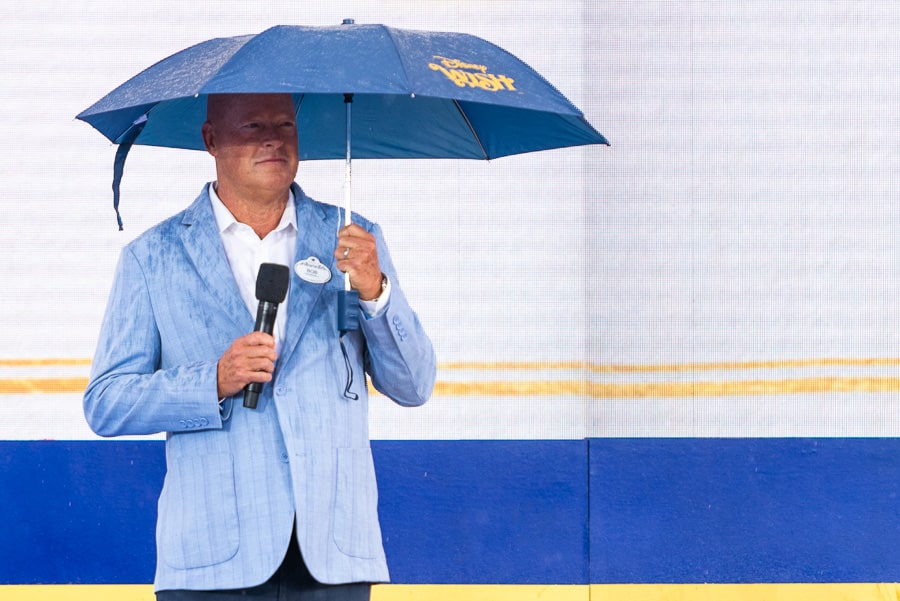
Most fans probably don’t need a reminder of the dark days of the Chapek era, but most of this was set in motion by him. He cut once free-perks, reduced park entertainment and offerings, and set in motion two years of the most precipitous price increases we’ve ever seen at Walt Disney World and Disneyland. Suffice to say, there’s a reason fans hate Chapek.
Upon his return, Bob Iger made it clear that he had been “alarmed” by price increases at Walt Disney World and Disneyland, and was concerned that Chapek was “killing the soul” of Disney. This was widely reported at the time–it’s nothing new.
Shortly after returning, Iger called a meeting with Parks Chairman Josh D’Amaro and asked him to come up with a list of things the company could do to win back the goodwill of fans. According to people familiar with the meeting, D’Amaro offered up discounted parking, more days during the off season with lower-priced tickets, and freezing the regular rounds of price hikes.
Iger chose to bring back free overnight parking at Walt Disney World Resort hotels and ticket promotions, but regular price hikes continued, the WSJ reported. This isn’t entirely accurate.
I don’t know why I even bother since perception is reality and prices spiked massively from 2019 to early 2023–and fans are still reeling from that. But Walt Disney World did not raise ticket prices between December 2022 and last year. That was unprecedented.
At the same time, hotel rack rates barely budged last year (below the rate of inflation, on average). For 2025, there were just as many rack rate decreases as there were increases. Due to greater discounting, the effective rates at resorts largely decreased from 2021-2022 to 2023-2024 (and in 2025, so far).
Ticket prices are up, and fairly significantly for many dates, in 2025. Restaurant and merchandise prices have continued to increase, unabated, since 2022. Same goes for upcharges and add-ons, including the line-skipping service (that once was free). So it’s not like overall prices have held steady.
To be clear, none of this is a defense of Disney–just striving for accuracy. We have also argued that while Iger got off to a strong start in improving guest satisfaction, that progress has stalled and more needs to be done (see Walt Disney World Could Fix the Guest Experience by Improving These Things and Big ‘Little Things’ Disney World Needs to Bring Back).
The bottom line is that prices have gone up sharply since 2019, and even though increases have decelerated dramatically since 2022, it’s no wonder fans are disgruntled. The cumulative impact of the cost-cuts coupled with price increases is still staggering, and much more needs to be done to address it.

WSJ also reports that about a year after Iger’s return, Disney began to have “serious concerns” about the rising cost of visiting the parks, according to former employees involved in the discussions. The results of surveys asking whether Walt Disney World and Disneyland guests intended to return soon showed a drop. This aligns with what we’ve been told, and also extends to the likelihood to recommend metrics (which is equally important).
The issue was reportedly raised with Iger, according to WSJ citing people familiar with the matter, but parks were still booming. The Experiences division, which is primarily Parks & Resorts, had become the company’s primary profit engine in 2022, replacing the declining cable TV business. Experiences represented 70% of Disney’s overall operating income in the 2023 fiscal year, up from 41% in 2019 and 34.5% in 2018.
The Experience unit’s income of $3.1 billion for the final three months of 2024 was flat year-over-year. Attendance declined 2%, and operating income fell 5% year-over-year. As we explained following last week’s earnings call, the results probably would’ve been more positive but for Hurricanes Helene and Milton, both of which had a long tail of cancellations. Nevertheless, this came at the same time that the international parks were up a staggering 28%, fueled not by the smoke and mirrors of cost-cuts and higher guest spending, but by opening new lands and attractions.
Pricing has been a concern for investors and analysts, and was even one of the catalysts for the proxy fights of the last couple years. For the company’s part, CFO Hugh Johnston indicated during the December earnings call that Disney needs to be “smart about pricing,” especially at the lower end of the market where consumers are “feeling stress.” (This is similar sentiment to what fast food chains and retailers have reported during their recent earnings calls.)
Johnston indicated that Disney has tried to hold prices steady for lower-priced offerings at the parks and that most of the price increases were concentrated among premium packages or during high-demand dates. He added that the company wants to “tap in to those families and build the habit of coming to Disneyland or Disney World, not one time, but multiple times.”
“The number-one thing we hear from the millions of guests who visit our parks each year is how much a Disney vacation means to them, and we intentionally offer a wide variety of ticket, hotel and dining options to welcome as many families as possible, whatever their budget,” said Josh D’Amaro in a written statement to WSJ. “We also know that in inflationary times it’s especially important to give families ways to save on their visits.”

One random tidbit from the WSJ article that I found interesting was this: “Five years ago, the skip-the-line feature FastPass was free. Now visitors choose from three different tiers of Lightning Lane passes for the privilege—the most expensive reaching $449 a person a day.”
I’ve mentioned this repeatedly, but one of my recurring fears as a longtime fan is been that Disney is inflicting long-term brand damage for short-term financial gain. This line in the article is a perfect example of that. That $449 cost is eye-popping, and will catch the attention of the general public.
Without added context, they might (understandably!) assume that line-skipping at Disney costs hundreds of dollars, not that it starts at under $20. Insignificant as it might seem, lines like those might turn people off from even considering a Disney trip. They won’t learn the full range of Lightning Lane prices, because they’ll say “I’m out” before it even comes to that.
Obviously, this WSJ article as a whole is damaging to Disney. But so are specific sentences like that, or every single article about the failed Star Wars Galactic Starcruiser. Same goes for the $100,000+ private jet Disney Parks worldwide “adventure” and the Storyliving by Disney communities.
Those have received outsized negative attention for niche offerings–same with Lightning Lane Premier Pass–and I really wonder whether the limited financial gain is worth the brand damage inflicted. It’s not something that shows up on a balance sheet, so of course they look like positives (except Starcruiser, which very obviously was not). But a balance sheet can’t measure long-term ramifications or indirect consequences. I feel like this is a microcosm for this “Disney is pricing out the middle class” conversation, as a whole.
The WSJ report also points to a couple of surveys that indicate an overwhelming majority of Americans feel theme parks, cruises, and other expensive vacations are financially out of reach.
Many are reporting trading down from these to nature-driven experiences, such as state parks or beaches. Visitor data from the National Park Service bears this out, as does the growing discrepancy between Orlando International Airport’s traffic volume and Central Florida theme park (all of them) attendance.
Disney called one of the polls “flawed and misleading” and unfairly cast Disney in a negative light, according to the WSJ. The company’s response strikes me as oddly defensive, but I’m admittedly not as interested in this type of survey. Over the last decade-plus, I’ve received countless ‘story pitches’ about surveys like this for Walt Disney World, Disneyland, and myriad other destinations. (In fact, you can find recent articles similar to this one about tourism in Las Vegas or New York City.)

It’s been true for a while that the majority of Americans feel Disney vacations are financially out of reach.
The percentages have undoubtedly increased, but the results themselves are nothing new. Those of us who can afford to visit are extremely fortunate. As with the income vs. costs data, what matters more is behavior.
Are enough people voting with their wallets, or are they complaining about prices in surveys but continuing to visit and having positive experiences? It’s undeniable that the financial burden is steep; but is the emotional value still worth it? That’s what makes the intent to revisit/recommend and guest satisfaction metrics the biggest key to all of this.

I’d go a step further and say the “intent to recommend” is a very underrated variable in this. We have heard from more and more fans that, even though they’re still going to Walt Disney World for emotional or sentimental reasons, they’ve stopped recommending it to friends.
It used to be the case that current Disney fans were excellent, unpaid brand ambassadors for the company–introducing Walt Disney World to others, making new fans in the process. What we’ve heard is that–due to higher prices, greater complexity of visiting, less value for money, and more–fewer readers of this site are recommending Disney Parks to others. This is really significant, and under-discussed. People trust the word of one person in their own social circles more than that of one-thousand social media influencers.
This is also why it’s worse for Disney to lose fans on an emotional level. If costs were all that mattered, the damage would be easy to undo. Disney could turn its big pricing dial down, or pull that giant discount lever and entice people to return in greater numbers. But when you lose fans emotionally, the likelihood of that damage being undone is far lower.
Ultimately, this WSJ piece is not going to be “breaking news” to anyone reading this. It covers some well-trodden ground, and similar sentiment to what we’ve been hearing and expressing (see our article, Is Disney Eroding Fan Goodwill?, from 2018 and its nearly 400 reader comments) for years–long before the Chapek regime.
One difference here is that we’re starting to see cracks emerge in Disney’s financial results, with growth at Walt Disney World and Disneyland being primarily driven by price increases as attendance “softens” and demand moderates. Another is that the WSJ spoke to people inside the company, with the leaks suggesting that there are significant worries within about pricing (and probably a fierce internal debate if this is bubbling over with people going to the press).
Finally, there’s the practical reality that Disney has a couple of years ahead of it with no new attractions opening, and at a time when it’s biggest competitor is opening a brand-new theme park down the street. My sincere hope is that important people inside the Walt Disney Company recognize the gravity of all this and the long-term ramifications and intend to do something about it. I was optimistic about that in early 2023, and although I’m still optimistic about the long term investments in new attractions and lands, there needs to be a greater sense of urgency about improving the guest experience and satisfaction in the near-term. Otherwise, there won’t be as many fans or as big of a pool of guests from which to draw once all those fancy things open.
Planning a Walt Disney World trip? Learn about hotels on our Walt Disney World Hotels Reviews page. For where to eat, read our Walt Disney World Restaurant Reviews. To save money on tickets or determine which type to buy, read our Tips for Saving Money on Walt Disney World Tickets post. Our What to Pack for Disney Trips post takes a unique look at clever items to take. For what to do and when to do it, our Walt Disney World Ride Guides will help. For comprehensive advice, the best place to start is our Walt Disney World Trip Planning Guide for everything you need to know!
YOUR THOUGHTS
What would you like to see done to improve the guest experience and satisfaction at Walt Disney World? Think that runaway price increases are the big concern, or is the value proposition an equally or more significant matter? Thoughts on the WSJ article? Do you agree or disagree with our assessment? Any questions we can help you answer? Hearing your feedback–even when you disagree with us–is both interesting to us and helpful to other readers, so please share your thoughts below in the comments!




Love this discussion! We are now the Disney enthusiasts who have stopped recommending it to all our friends. The added costs over the past few years are one reason but even more so is the added complexity. Changing the timeline for dining reservations as well as the cancellation policy has definitely been an improvement post-Covid but the LL system is way too complicated. I actually can’t imagine being a first timer trying to learn it all. I keep wishing for a few changes that for me, would really improve the experience-
One- eliminate virtual queues!! Fine for use in the first months of a new attraction but YEARS?!?!
Two- eliminate LL single pass, make multipass a little more expensive if you must and include all the rides
Three- bring back free magic bands
Four- bring back some form of Disney airport transfer, I’ll even pay for it lol
Those are my Disney wishes Always enjoy your content!
Disney’s magical express was ran by Mears. there is now Mears connect…. it’s the same company and is in the same spot at MCO. You go to their website instead of through Disney to book it and you pay for it.
We went 3 years in a row until 2019 and then called it quits. The price increases are drastic to our family of 4. The same trip now compared to 2019 will cost us at least $3k more. And it sounds like parks are even more crowded. Additionally, we have to pay now to not stand in line for 2 hours after paying to get in the park and pay for an onsite hotel. When at least before we could get 3 rides “for free.” I’m sad about it because my kids ask to go again but we really cannot justify the expense when we could take 3 week long trips anywhere else for the price of a 6 night stay at Disney. And with the amount of pre-planning required to take on Disney, I feel frustrated with the high costs. Several friends who have been have complained about having to be on their phones, refreshing for rides. It doesn’t sound enjoyable and magical anymore, unfortunately.
Just when I get a bit put out with Disney I have a fantastic trip with great memories. That is what happened when my adult daughter and I went this past October. I now have 2 trips booked this year. Guess I am hooked.
So sad!! We always looked forward to our Disney vacations!!Those magical days are gone forever, between the prices and the amount of time on a phone it has become ridiculous!! So many better vacations out there now. And I am a true Disney believer!! Three kids and five grandkids,and we make a decent amout of money. But can’t afford trips like we went on all those other years!! Again, so sad!
We are from Oklahoma, and have vacationed at Disney World every two to three years since 1982. We always stayed at the Contemporary Resort or the Polynesian Resort. That is no longer possible because of all the price increases. Now all of the Disney Resorts are out of our price range, A 6 day park hopper ticket is over $800 dollars per person, so for my family of six just the park admission alone will be over $4800.00. Our last trip was three years ago .I was so disappointed to find out that the free fast passes were discontinued, and replaced with extra fees per person. Not only that we had to be on our phones continuesly to make reservation or try to get into queries . Many of the favorite rides were shut down. There was so much that we didn’t get to do because there was no standby line. Forget about the after hours tickets, They are almost $200 per person and now you can’t ride Tiana’s Bayou during after hours. We even have to share meals to help make it affordable. We are planning another trip there in April, but I’m not sure , I’m going to be able to pull it off. I am 76 years old now and I really wanted to see my grand daughter and great grand daughter enjoy WDW as the rest of the family have for the last 40 plus years.
That didn’t stop them from yet another steep increase for 2026 if I look at published prices on the Irish website.
I just compared the same dates from 2025 and it was 20% higher in 2026.
So I am not quite sure who actually is having second thoughts but it didn’t make it to stop the increase process. I was actually even quite baffled to read your article Tom. 20% is far from a small increase.
All I know is that my favorite thing to do after a long day at Magic Kingdom is going to Epcot France and having a glass of grapefruit champagne before we get back into the children’s activities. We went twice last year and earlier on my glass of champagne was $18, then it was one, not even available, and two, the cheapest thing on the menu was $30 for six ounces! I am not a wine or champagne enthusiast, nor does my system tolerate much alcohol, so when I find something that I enjoy the taste of and can also tolerate, I stick with it. I don’t complain about costs at Disney World, I expect them to be higher than normal, however, this was one strike and disappointment too many! This has been a seven-year annual and sometimes bi-annual tradition and now it’s over. So disappointing! Price gouging and removing a staple product all at once, Disney you can do better.
This brings new meaning to the phrase “champagne problems.” 😉
“Starting in late 2023, the company’s own internal surveys of Walt Disney World and Disneyland guests found that the number of them planning return trips had ticked sharply down.” This is what I have found with friends and family. They are planning for the once in a lifetime big trip with no plans on going again. Whereas when I was going over the years with my kids, they always wanted to go again the next year when planning our family trips. But as the prices just kept going up and we felt like we were being nickle and dimed constantly, we started going to Europe. More relaxing and honestly? Not more expensive. We will always be Disney fans but just don’t feel the need to go every year. The happiness we used to feel just isn’t there anymore. Our happiness if more nostalgia driven than actual current trip driven.
Tom, I drafted a thoughtful response expressing my opinion – only to see it disappear into the ether, as the page simply “jumped” back to the top of the article and wiped out my comments before I could hit publish. The ironic hilarity of this? That my now forever lost reply was alerting you to the very fact of such page-jumping due to your incessant Ads! Cannot keep following you here unless that gets fixed. My loss? Yes, because I always enjoy your content.
the solution to that is to compose your letter as a separate standalone document, then paste when it’s done,.. I’ve learned this the hard way,.
I get annoyed by the frequent refreshes, too. I can’t usually finish an article without one or two refreshes and having to scroll back to where I was interrupted. I guess it’s a good idea to keep comments short or write them in another app and copy/paste the text!
I love Disney, but they have done a miserable job. first, the prices are definitely too high. I would co.sider myself as comfortable to.upper middle class. However, even with sales, it’s hard tonjsutify these prices. We don’t go enough in a year to warrant yearly passes. We discussed possibly using the new 4 park pass deal and even then, it still comes out to over $1,000 when you I include taxes. Plus hotel, food and other expenses, We ended up deciding against it. I can’t imagine we’re the only ones.
This also has terrible long term repercussions. You want to build that long term/life long loyalty that Disney was known for. But people have options now and some kids will grow up not going to Disney, or grow up going to a rival park, and building that loyalty somewhere else. Disney definitely needs to look at itself in the mirror and adjust how it handles pricing and how it is delivering experiences. Focusing on the bottom line prices you to the bottom.
Couple of things. First, define “Middle Class”. Then; is that definition Disney’s management’s definition? Then; has the actual “Middle Class” income kept up with Disnry’s price increases? IMO, “Middke Class” is a perception, much like the hackneyed term”Fair Share”. Disney and government definitions asude, everyone has a different idea of what these terms mean, who
they are, and where they fit in these areas. if Disney REALLY wanted to increase attendance they’d go back to the pre-Chapek era: restore what they’ve removed, get rid of most of the high-income-customer-targeted perks, lower prices accordingly and the crowds would come back. People put up with lines, crowds and such back then because they got VALUE for their
expenditures and profit would again be largely volume-based, as it was before. That system worked for all concerned, including Disney. It can again.
I also think it would be helpful to define middle class here,.. the range might be so great that the term is nearly meaningless,..
Value for the Money is the name of the game in our case. We just feel that effort that has to be put into going to WDW is no longer worth it for the value we receive from it. The hotels are quite overpriced and have been generic’d down to being almost ugly, and as more perks from staying on property have been taken away, and the prices increased, we just don’t want to go. Add in the fact that I have to be “on my phone” and planned ahead for every last thing I want to do, from which ride I want to ride a week from now to which restaurant I might be like to go. This is not relaxing! Yes, if it was as fun and wonderful as it was 15 years ago, I would be there. But our last trip was in 2015, to Disneyland, where I waited in line 1 hour for a beignet once, and 45 minutes for a corn dog. Never again!! The magic is definitely not there.
Ann, your assessment is spot on! Disney is a “working” vacation on every level.
We’ve gone to Disney parks every year for the past 15 years- sometimes multiple times per year. Not too long ago we’d find ways to stay at deluxe resorts for a week, go to the parks for six days, and do a decent amount of dining. Fast forward to our upcoming trip- we are staying at all star sports for six nights (we’ve never stayed at a value resort for longer than one night), we will probably only go to two parks and one water park, and we are likely going to do all quick service. My income has increased, but it can’t keep up with the cost of Disney tickets, airfare, etc. I hope something changes to balance things out. I don’t agree that Disney isn’t affordable for the middle class, but many of the resorts, restaurants, and experiences are getting there.
I am optimistic about Disney turning this around and improving the guest experience and value-perception. The Disney difference is all about magic, and the middle class has always splurged if that is what you are going to get. Disney seems to be getting it by focusing their price increases on the deluxe experiences like table service restaurants and line skipping. If they hold back on resorts, tickets, and counter-service (which they seem to be), then the middle class will catch up. I think they are also getting better with targeting discount deals. They need to focus on the family, rather than Disney adults. The ratio of adults to kids has definitely changes since I was a kid. Despite all the hand-wringing about Rivers of America, I think Cars land and Monstropolis will appeal to kids. Even if they miss RoA, parents will be happy if the kids are happy. They recently had that $50 kid ticket deal in Disneyland; hopefully they will roll that out to WDW. Getting kids in is the best path toward long-term profitability.
“They need to focus on the family, rather than Disney adults.”
Sadly, they’re doing this for good reason: childless millennials have a lot more disposable income, on average, than the same cohort with children.
I wish it weren’t the case, but it is. And it should go without saying, but there are long-term consequences to this approach, but they’ve kind of backed themselves into a corner.
I’m not convinced Disney is all that reliant on the middle class, technically. The top two income quintiles roughly include 50 million households making 6 figures annually. This seems to be the core audience, not the middle in the $55k-$95k range. I’d love to see Disney’s internal customer segmentation data on household incomes to confirm.
With that said, if we’re going with the over half of Americans that self-identify as “middle class”, then you’re probably right. lol.
I’ve got a pretty diverse family and network, from a socio-economic perspective, and the only ones I know in that middle income quintile going to Disney World saved for years to go once or have had their trips co-funded.
All of this to say, I think the real risk here is starting to lose some of the upper middle class.
The term “six figure income” used to be meaningful but not so much anymore. Besides the impact of inflation, there are huge variations in cost-of living across the country. On 100k annually a family in San Francisco, NYC, LA, Miami, Boston, etc., is often spending the majority of that on housing and basic essentials (though I know at 100k they’re still better off than many neighbors who have it even tougher). In other areas you can live really well on 100k (though those areas usually don’t have as many higher paying jobs). Echoing some other commenters here, I think many folks really take for granted how privileged they are to have ever gone to WDW for a single day in their lifetime, much less having to cut back from yearly week-long WDW vacations and be forced to go to Universal instead, or abandon the theme park lifestyle for Europe or Japan. It’s unfortunate that fewer and fewer folks will be able to enjoy the parks EVER; I don’t weep for anyone who’s decided seeing the world is more cost-effective than another Deluxe resort week at Disney (honestly, the real world is actually better than the World Showcase version).
We will probably never dessert Disney, but the days of flying down for a quick 3-4 day trip seem to be a thing of the past. Not too long ago, on a whim, we would get a cheap flight out of ACY, take Disney Magical Express to a value Resort for $100 a day or less. We wouldn’t even ride many rides cause of all the street entertainers, especially in HS and Epcot. It was such a a great experience, especially to get away from the cole a gray winters of Jersey.
We just looked the other day to get away for a “quick” trip this week. Flight was cheap ($123 round trip), but without DME anymore, we’d have to rent a car ($309) and value Resort were all over $300 a night for this week. That’s insane. Needless to say, we are stuck in the rain and snow this week.
As always, Tom, you’ve provided a generously fair and insightful assessment.
I haven’t been to WDW since 2019, but I’ve helped countless friends and family plan their trips. It begins with me sitting down with them with two timeline flow charts: 1) things to do before the trip (i.e., ADRs, LL) and 2) things to do during the trip (i.e., VQs, more LL, Mobile Ordering for Dole Whip). I joke with them that it takes an advanced degree to complete a WDW vacation, but I’m only partially joking. Cost is a factor, but good experiences forgive a lot. People are willing to pay up for delightful experiences, but they aren’t willing to pay up for short cuts that make the original experiences only moderately less painful, and if they do pay up, they are bitter about having to do so. Cost is a factor, but UOR isn’t THAT much cheaper than WDW, but the returnees from those trips are generally thrilled with their trips, and I have to think that, with very few pain points baked into the UOR theme park experiences, the experience is just more joyful.
And, btw, I’m with you on the drone show. I saw the DLP drone show in 2023. It had been a long time since I felt that Disney magic, but there it was in a 5 minute show that overshadowed the fireworks/castle projection that followed it.
Disney has it backwards. Instead of annual increases, I would like to see Disney cap the number of people allowed into the parks. Disney needs to concentrate on the quality of time that their guests spend at the parks instead of maxing the parks out every day. I feel like Disney is loosing their magic and they need to get back to their roots before it’s lost forever.
To each their own, but I don’t think Disney is uncomfortably crowded except for 3-4 weeks per year. (Obviously, everyone prefers lower crowds–but if we’re talking lowering caps, that’s a different story.)
The problem with capping attendance much lower than where it’s already at is that it necessitates price increases. If Walt Disney World is already hitting a wall with the middle class, and there’s not enough of a market in that top 20% (or whatever), and they have to fill Value & Moderate Resorts…the math just doesn’t pencil out.
I don’t want to go back to the late 2019 and early 2020 levels of chaotic crowds at Walt Disney World, but I think where they’re at right now is perfectly fine most of the time. It’s other aspects of the guest experience that need to improve. I’m also not comfortable with pricing out even more middle class Americans.
Tom, I used to be with Brook (there are too many people in the parks) but then you said something once about how crowded the parks “feel” that turned me around on it, which was essentially: a lot of the “crowd feel” problem has to do with attractions being closed and the slow death of live entertainment, that the problem isn’t too many people in the parks but not enough places for those people to go. That makes so much sense based on my experiences of the last four years in WDW.
I grew up visiting WDW at least once per year most years, and visited frequently with my wife before we had kids, and continued with our young kids until COVID lockdown . Our first trip post-COVID (2023) felt more stressful than we remembered, restaurants worse and pricier, more crowds, more complicated, etc. We decided that instead of an annual trip to WDW we would travel to different states in the U.S. each year. So far, we are spending less while staying in better hotels, eating better food, never waiting in lines, and much more relaxed. Cost of one week at WDW equals 3-4 weeks of vacation elsewhere in the U.S. with four-star hotels around price of moderate resorts and five-star hotels around price of deluxe resorts. Attraction and dining costs are non-comparable.
I recently had shoulder surgery.
Naturally I researched and found the very best surgeon.
It’s important to understand that he is really good. Not your run of the mill decent surgeon.
For a number of years up until last fall, he was the Man the New York Mets called upon to take care of the expensive multi million dollar arms of their pitching staff.
During one of my visits with him, Disney World came up.
He had been there just a couple of years ago.
To sum it up, his family had had a good time, but he stunned me when he said, “It was really expensive.”
This guy is NOT middle class. He’s a top orthopedic surgeon and sports medicine doctor in the tri-state area (NY, NJ, CT). Late 40’s, could retire and do whatever he wants. And his impression was, “It’s expensive.”
“For a number of years up until last fall, he was the Man the New York Mets called upon to take care of the expensive multi million dollar arms of their pitching staff.”
In this case, are we sure he’s really that good? 😉
Sorry, couldn’t help myself.
Just because the top 20/10/5/1% can afford something, doesn’t mean they have no concept of value for money. I don’t know anyone who actively wants to be ripped off. While some people in the upper echelons probably don’t have any concept of prices (or pay attention), there are plenty of others who might have the means to do Disney comfortably, but are finding it’s “not worth it” “too expensive” etc.
This is another reason why looking at this purely through the lens of income misses the mark.
I knew when I put out that honey you would not resist.
In fact, if you hadn’t replied with your cheap shot I would have been very disappointed in you.
It’s important to understand, when someone who can afford Disney no problem, plays word association and responds to Disney World with, it’s expensive, something is wrong in Mudville.
Maybe, the experience is a bit overpriced!
was that a dig at the Mets? So, mickey1928, post surgery are you be able to play the violin?
I am retired and according to a chart I just consulted, have a net worth in the top 10%,.. the problem is that I remember what I could get with a dollar in the good old days and that is just impossible to shake,.. so someone could be considered wealthy and balk at paying so much for a hotel. I think we paid $89 a night at Port Orleans when it opened,.. we didn’t have much and that seemed a fair price,. I can’t understand how someone could pay for a night at the Grand Floridian when a similar amount could get you a decent large tv,.. or am I just a cheapskate?
It’s not about being a cheapskate. If you happen to be blessed to have enough to pay for either a night at GF or a big tv it’s really about what you as a person or family would rather have. My family has one flatscreen (36”) and another with a tube (yep still works), one of our cars is 15+ years old. Can we buy new stuff? I am blessed to say yes. But we would choose the upgraded hotel instead for a bit of family magic because to us stuff is just stuff but if we can share an amazing experience together sign us up. This is why income alone doesn’t tell the story. A good part of the equation is about choice so what Disney needs to work on is enticing people to want to choose the trip over something else from a family’s finite pool of money.