
Rich Rescued Disney from Theme Park Spending Slump

Over the last several months, there have been several signs that Walt Disney World is increasingly reliant on high income guests to fuel the parks & resorts’ strong performance and growth. This covers consumer spending data, statements from Disney’s CFO, how the rich rescued the theme parks industry from a spending slump & our commentary about this trend.
Let’s start with the latest development, which is that Disney CFO Hugh Johnston has confirmed that Walt Disney World and Disneyland had a strong year thanks to guests at higher income deciles, as those consumers “continue to do well.” He went on to explain attendance and per guest spending trends, and how Disney increased the latter even as the former was down.
Johnston made these comments while speaking at the 2025 Wells Fargo Technology, Media, and Telecom Summit–the same event where he confirmed that Dynamic Pricing is Planned for Walt Disney World and Disneyland. Johnston is one of Disney’s senior executives, and is instrumental in setting and guiding the company’s business strategies. He came over from Pepsi a couple of years ago, and is beloved by Wall Street.
During the Wells Fargo Summit, Johnston was asked questions about the company’s most recent earnings call, during which he previously shared that Walt Disney World Still Isn’t Worried About Epic Universe Amid Attendance Decrease & Record Results. The moderator pointed to the downtrend in attendance, and asked about the health of the American consumer that Walt Disney World and Disneyland are seeing, and the overall story of demand for the parks?
Johnston revealed that the core consumer for Walt Disney World and Disneyland “tends to be at the higher income deciles, and those consumers continue to do well. So we certainly broadly feel good about where the consumer is.”

Johnston went on to explain that the Disney Parks & Resorts had a strong year last year. The company originally issued guidance for 6% to 8% operating income growth, and delivered 8%. The parks hit $10 billion of operating income for the year, which was the first time they’ve ever reached the $10 billion milestone.
Johnston pointed to that number to underscore why the company felt “very, very good” about the Parks & Resorts. As for the domestic parks, he said that those parks (which, as a reminder, includes Disney Cruise Line) grew earnings 8% for the year and 9% in the fourth quarter.
He reiterated that, attendance for the domestic parks was down 1% last year. Again, this is something we’ve already discussed at length in the commentary to last week’s earnings report. (We also discussed the overperformance on the hotel side, which is arguably the bigger story that Johnston did not touch on at the Wells Fargo Summit.)

Johnston pointed out that there was “a lot of concern going into the year” for Epic Universe, and that he felt Disney had managed it well. He said the parks’ performance post-Epic Universe came in within our expectations. He also added that the attendance decline could be explained almost entirely by the hurricane scares in the first quarter of Disney’s fiscal year.
This is also something we’ve covered previously. Those storms were so impactful that the company directly addressed them on multiple earnings calls over the last year, warning that Walt Disney World operating income would be adversely impacted by approximately $130 million due to storms. Hurricane Milton caused the parks to close and had a long tail of lower crowds due to cancellations in the days and weeks afterwards.
And in fact, based on the wait times data we saw, October 2025 was up fairly considerably year-over-year, suggesting that most (if not all) of the negative attendance could be attributed to Hurricanes Helene and Milton. Both of those happened long before Epic Universe; meaning that Universal’s new theme park has, thus far, had no impact on attendance at Walt Disney World.

Johnston explained, essentially, that essentially flat attendance was normal in a year without any major new additions. That in years when Walt Disney World or Disneyland add new attractions, you’ll see “attendance jumps.” But when they’re not, attendance is basically about level.
He added that, over the long run, Disney balances attendance growth with pricing growth. Although in any given year, growth “could be more geared towards one versus the other.”
Despite flat attendance, Johnston explained that per guest spending (or per caps) were “actually quite good” last year, with domestic growth of 5%. He said that Disney “felt very, very good about that.” At the risk of (re)stating the obvious, this is precisely how Disney achieved record revenue despite lower attendance (and why this topic is such a hot one). It’s a simple math problem–a smaller pool of people spending more money.

Johnston also dropped a statistic that I hadn’t heard in a while but certainly will be using in future posts: “It’s important to realize is only about 40% of the people who attend our parks actually stay on one of our properties.”
The last I had heard, it was about 50/50 on-site versus off-site. It’s nice to have an updated number for future use when making my point that, actually, Walt Disney World needs to build more hotels–that room inventory is not the problem when it comes to crowds.
This is something we covered recently in the aptly-titled Why Walt Disney World Resort Hotels Still Sell Out Despite Lower Crowds. It was also one of the points in What Walt Disney World Fans Get Wrong About Crowds. More on-site room inventory would be a net positive for guests, especially when it comes to pricing. But I digress.

The moderator then circled back to the question about higher-income consumers being the core constituency for Walt Disney World and Disneyland, asking about the infamous yield management approach to improving margins.
Johnston explained that the company “very much” focuses on how to generate incremental revenue, via ticket prices, as well as on food & beverage, merchandise, and upcharge offerings, such as Lightning Lanes and VIP tours.
He added that the team has gotten increasingly better at getting that yield up, particularly in years where we’re not adding capacity in a particular park that’s going to be the primary growth driver is all of that yield focus.
This was where the conversation segued into dynamic pricing, as a way to increase yield in the future. (As we pointed out, that is the goal with dynamic pricing–they’re not investing a ton of money in new infrastructure to make prices cheaper, on average. But all of you already knew that. I’m preaching to the choir.)

Honestly, Johnston’s comments at the Wells Fargo Summit on their own wouldn’t be all that interesting or worthy of a standalone article. Not like Walt Disney World’s core audience being higher income is breaking news–just price out a vacation package for the Moderate or Deluxe Resorts!
However, they follow up a couple of interesting tidbits from last week’s earnings calls, as well as articles over the last several months about how theme parks are increasingly reliant on the rich. When pieced together, all of this does paint a fascinating story.
For one, this is an ongoing ‘conversation’ (and cause for concern). Last August, Johnston conceded that there there was “softness in the domestic parks.” At that time, he added that the lower income consumer is “feeling stress,” while higher income consumers are traveling internationally more.
This is similar sentiment to what fast food chains and retailers have reported during their earnings calls for the last year-plus. There’s a reason why McDonald’s brought back Extra Value Meals and other restaurants are aggressively courting their downmarket customers. If McDonald’s and other fast food chains are losing lower-income consumers, it stands to reason that premium-priced theme parks are facing the same issue.

During some of these same earnings calls, Johnston has indicated that Disney has tried to hold prices steady for lower-priced offerings at the parks and that most of the price increases have been concentrated among premium packages or during high-demand dates. He added that the company wants to “tap in to those families and build the habit of coming to Disneyland or Disney World, not one time, but multiple times.”
On the most recent earnings call, in November 2025, Johnston reiterated that Epic Universe has been in-line with expectations for Walt Disney World. He added this: “If anything, it seems to be impacting the rest of the competition down in Florida more than it’s impacting us. From a consumer perspective, we certainly feel good about it.”
This suggests that the “rising tides” thesis might be correct, at least for the two big players in Central Florida. The true casualties might be the downmarket offerings, which are already feeling the squeeze in Orlando and beyond, especially as more price-sensitive consumers scale back on spending.
We’ve wondered whether this might actually be the case for a while. That it wouldn’t be Universal or Disney that take a hit, but rather, the smaller players that exist and subsist (more or less) by picking up the table scraps. It’s entirely possible that both Universal and Disney grow stronger, while also moving further upmarket.
As that happens, the market for other Central Florida attractions might dry up. Affluent guests have fewer days to spare given the compelling reasons to spend more time at Universal and Disney. And lower income guests aren’t drawn to Central Florida in the first place, since Universal and Disney priced them out.

There was also an illuminating piece in Forbes titled Don’t Blame the Rich for Theme Parks’ ‘Lackluster’ Summer.
That shared new data illustrating how lower and middle-income Americans spent less at regional theme parks this summer, while affluent travelers spent more than before at pricier Disney and Universal destinations. This divergence revealed a premium product fault line that has come to define the travel industry.
Overall spending at U.S. theme parks was down 5% this summer compared to the same season last year, according to Consumer Edge, which analyzed year-over-year credit card spending data from May through August for Forbes. That demonstrated that weakness was attributable to guests earning under $100,000 per year.
However, that overall trend did not apply to the Disney and Universal theme parks. Visitor spending over roughly the same timeframe increased 8% at Disney parks and a whopping 22% per month this summer at Universal, driven by Epic Universe park in Orlando, according to data from Bloomberg Second Measure. (Worth pointing out that Universal “traded” pricier packages for higher attendance–which turned out to be the correct move–thus explaining that 22% leap.)

It was a very different summer for parks that target guests at the lower end of the income spectrum. United Parks & Resorts, whose portfolio includes SeaWorld, Busch Gardens and Sesame Place properties, saw a 4% year-over-year decline in visitor spending, according to that same data from Bloomberg Second Measure.
Six Flags Entertainment Group, which owns a portfolio of 27 regional amusement parks, 15 water parks, and 9 hotels across 17 states, saw an 8% year-over-year decline in spending this summer, per Bloomberg data.
All of this data paints a picture of spending that is bifurcated among income levels, with low to middle income consumers spending less than last year and affluent Americans spending more than ever before. This is hardly unique to theme & amusement parks.
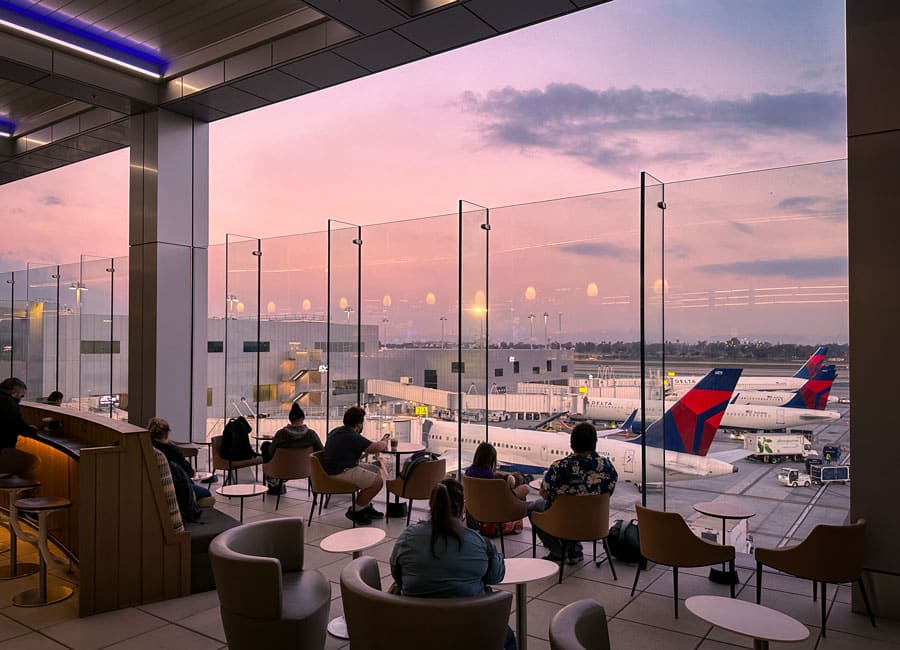
This pattern echoes the rest of the travel industry, where major airlines and hotel companies downgraded their financial outlooks for 2025 in the spring. In their quarterly earnings reports, major U.S. airlines repeatedly noted softening demand for main cabin seats with continued robust demand for premium seats.
The hospitality industry has seen the same split in demand, with budget and mid-range hotel brands faring worse than luxury brands in this economy.
On Marriott’s recent earnings call, its CFO noted pointedly that despite “ongoing economic uncertainty,” the company was “extremely well positioned” in the luxury segment, which accounted for the majority of Marriott’s rooms and were “expected to continue to nicely outperform lower-end chain scales globally.”

As a result of this split, the travel industry has adjusted its strategy to chase higher-spending customers. Airlines are reducing their inventory of economy seats and replacing them with fewer premium cabins, while hotels are replacing standard rooms with suites.
Walt Disney World has been less aggressive in doing this, often instead converting hotel rooms to Disney Vacation Club villas. Similar animating idea, different means to that end. In fact, despite all of the new hotel construction, Walt Disney World’s hotel inventory is actually lower today than it was a decade ago.
Without having any supporting data, it’s probably safe to assume that new DVC buyers are largely from the top 20%. There’s a reason that Disney Lakeside Lodge is full steam ahead on construction despite several other properties in active sales, and direct DVC sales continue to show strong growth. Meanwhile, Disneyland has been expanding its inventory of premium suites and is adding more Club Level inventory to its resorts.

In terms of commentary, I don’t really know what to say that hasn’t already been said. We covered this topic at length back in the spring in Walt Disney World is Worried About Its High Prices and its progeny of posts.
We took that a step further in Is Walt Disney World Too Expensive for Middle Class Americans? by digging into data. That covered the average costs of a Disney vacation, typical consumer spending on travel at different income brackets, and more.
That also covered data indicating that the top 10% of Americans account for 50% of all consumer spending in the United States. This is a record going back to 1989, according to U.S. Federal Reserve data. Three decades ago, the top 10% accounted for about 36% of consumer spending. Households making about $250,000 a year or more are spending freely on everything from luxury goods to extravagant vacations, whereas lower income households are not.

Based on all of that–everything from McDonald’s customers being priced out and the chain needing to bring back the Extra Value Meal to Walt Disney World’s comments and actions–it seems clear that this is more of a bigger-picture problem and not a distinctly Disney issue. When the CEOs and CFOs of countless companies are saying more or less the same thing and altering their strategies accordingly, that suggests something systemic.
Of course, our focus here is Disney, so it makes sense that we’d analyze this through a Disney lens. There are also the public comments of the company’s founder, and his original intentions for his theme parks. I don’t think J. Willard Marriott has any recorded comments about wanting his hotels to be places where families could have fun jumping on beds and enjoying complimentary Wi-Fi together.
Disney is arguably among the most distinctly American companies, and it’s something of a bellwether for middle class Americans as a result. And for mainstream media like the New York Times or Wall Street Journal, using Disney parks as a proxy for economic anxiety (etc.) plays well with its affluent audience for a number of reasons.

Ultimately, if you want more thoughtful analysis about this, we’d again refer you to Is Walt Disney World Too Expensive for Middle Class Americans? This is an interesting trend, but it’s definitely not a new one!
We’d also once again reiterate that it’s likely that Walt Disney World and the travel industry as a whole will continue to aim upmarket. All of the data and earnings calls and everything else since we last tackled this topic in the spring suggests this is the most viable business strategy in the near-term, especially with rising economic uncertainty and declining consumer confidence. If there is a recession or downturn, Disney and other companies seem to believe that the best way to weather it is seeking out affluent consumers.
For our part, we continue to believe that Walt Disney World’s bread and butter is the middle class (realistically, probably the upper middle class). That even though wealthy guests are not the company’s core clientele in the long term, Disney will nevertheless continue targeting that segment with new and differentiated product offerings because, that’s clearly where the money and growth potential lie. For now.

This upmarket strategy will work…until it doesn’t. There are countless reasons as to why that could happen (that AI bubble in the stock market seems poised to burst!), but it could pose problems for the company. The potential for these issues increases in the long-run as consumer perceptions increasingly view Walt Disney World as a destination for the wealthy. (Something also discussed relatively recently in Disney’s Reputation Falls to Only “Fair.”)
Once that middle class reputational damage is done, it’s hard to undo. This is precisely why we’ve repeatedly emphasized the importance of improving the guest experience and satisfaction, as well as the hugely negative long-term ramifications to pricing out families and alienating longtime fans. Rich Americans have more money to spend on fancy one-off rite-of-passage vacations, but it’s still middle class families that are the lifeblood of Walt Disney World.
Planning a Walt Disney World trip? Learn about hotels on our Walt Disney World Hotels Reviews page. For where to eat, read our Walt Disney World Restaurant Reviews. To save money on tickets or determine which type to buy, read our Tips for Saving Money on Walt Disney World Tickets post. Our What to Pack for Disney Trips post takes a unique look at clever items to take. For what to do and when to do it, our Walt Disney World Ride Guides will help. For comprehensive advice, the best place to start is our Walt Disney World Trip Planning Guide for everything you need to know!
YOUR THOUGHTS
Surprised Disney is publicly admitting that its key demo is higher income guests? What do you think about Walt Disney World and Universal seeing their results over the last several months buoyed by wealthy consumers? Can Walt Disney World sustain itself with these big-spenders? Or do you agree with our assessment that Walt Disney World is inherently a middle class destination, and it needs this bread & butter demo? Any questions we can help you answer? Hearing your feedback–even when you disagree with us–is both interesting to us and helpful to other readers, so please share your thoughts below in the comments!




The part of this that I’m not seeing focused on as much, probably because it’s more applicable to Disneyland than to WDW, is how chasing the higher income demographics shuts out locals. Anaheim is the lowest income city in Orange County and complaints that they have been priced out in favor of chasing the wealthier denizens from surrounding areas have been going on for most of my lifetime. (I’m in my mid-40s) We talk about Disneyland being a “locals” park, but that’s only if the term “local” applies to most of Southern California. I know they have recently restarted a program for cheaper tickets for Anaheim residents, but abandoning that program back in (I believe) the Pressler days, which coincided with cutbacks and deferred maintenance, made the company look cheap and miserly and engendered a lot of hyper local hostility that helped make things more difficult for the DLR politically over the last decade. In other words; these choices have much longer term repercussions than just who is and isn’t able to afford to go to the parks.
That last sentence is a fantastic point, and 100% correct. The Eastern Gateway and a luxury hotel at the entrance to Downtown Disney would already exist by now, and they wouldn’t have had to spend untold millions of dollars on DisneylandForward or political campaigns had they been a better neighbor to actual Anaheim residents.
This brings to mind Galatic Starcruiser. I did not participate in this activity, but from all reviews, it was a fun experience, but one that came with a high price tag. This is an example of something working, until it didn’t. It was disappointing to me that the experience wasn’t reimagined into something more affordable, like a restaurant experience. Ultimately, it shows this strategy of creating travel experiences that are largely not affordable, to the point of discontinuing those experiences (and taking revenue loss) rather than creating options that are more within reach of middle-class consumers.
As wealthier patrons increase it is possible they will likely expect a greater experience from WDW.
As much as my personal experience resonates with the with the perspective that Disney needs to engage families with small children to ensure a “rinse and repeat” cycle, I have doubts that any competitor is poised to break into the imaginations of middle and lower income demographics. It would stand to reason that an alternative product at a lower cost should be able to swoop in and take advantage of of the vacuum Disney’s luxury focus is creating, but land is only getting more expensive, airport growth is limited to booming markets, and political dynamics make it nearly impossible to imagine infrastructure investment similar to that which WDW thrives on. National parks vacations have exploded in popularity, for this exact reason, but they don’t have the narrative appeal or dynamism of WDW. I would venture a guess that if and when macroeconomic dynamics shift Disney will still be well poised to recapture lower-income spending.
I agree Disney is playing with fire by pricing out middle class families. I brought my family 10 years ago when we were finally able to afford a trip and we had an amazing week with 6 people for around $3500 total staying offsite, that turned us into regular guests as our finances improved. And we live close enough to drive in. We would have to pay double that for the same trip now.
Now that we are higher income earners we are part of the top 10% that has been propping up the entire US economy for the last year…it’s not just Disney. I don’t mind spending 10k on a 6 night trip for 3 or 4 of us as long as I feel like I’m getting what I’m paying for. Fireworks cruise with our own boat captain that I can ask endless questions to? Absolutely. Dessert party with “seats” but most of the fireworks show is blocked…horrible. Character meals where we never got to see a promised character and the food is literally inedible and cost almost $100 per person…never again. Not everything is worth it and I do feel like Disney is walking on a razor’s edge with it, and eventually will have to do more for middle class families.
I don’t consider ourselves high income but glad to know we are helping to keep Disney “afloat”. We are out of state and visit every December and on our trips we always stay at deluxe resort, buy the Disney Dining Plan, after hour event tickets, and purchase the premier LL pass because it makes our trips less stressful. Is it a good financial decision to go to Disney even though we can afford it, probably not. If cost keeps going up we will probably decide at some point to pull the plug on going to Disney.
yeet the rich
Nailed it. Perfect description of the K-shaped economy. It’s like Jenga. Only so many businesses can file for Chapter 7 or close shop with associated job cuts before there’s an economic consequence that is felt by the upper deciles and upper percentile. And once those upper income brackets cut discretionary spending it won’t be pretty for the travel industry. The stock price did not spike in after hours trading yesterday but actually went down before recovering about half of the decline today. Investors may not be convinced that TWDC’s outlook is as rosy as the CFO said it is. I did appreciate that the CFO says he wants repeat visitors. How refreshing after Bob Chapek said the company was chasing one-and-done families.
I keep coming back to Johnston’s comments about the rich “continue to do well” and it shakes me to my core thinking about the middle class in this country. Seems the gap keeps on widening and it’s about more than Disney vacations. I consider myself lucky in that we can afford the APs, can afford the DVC, are at WDW all the time as locals and DL sometimes. But something about Johnston just plainly stating that just makes it all too uncomfortable to think about. I agree this is not a good longterm plan, especially if we go over the 50% spending by the top 10%.
After having vacationed at Disney World at least 10 times or more, we’ll be going the first week of December for the last time. We saved about $5000 in “Disney Dollars” from Visa purchases ( which we had to spend half a million to do!). That’s the only reason we’re going. It’s gotten ridiculously expensive and far too complicated. It angers me that Isner and his ilk are reaping the rewards from something that none of them would have the imagination to conceive in the first place. It’s disgusting.
Full disclosure, we’re part of the described groups. And from a selfish perspective, I’ll be honest and say I’d trade an (even more) expensive trip for less crowds and more pampering. But I also think the company is playing with fire with this trajectory. There is no way that Disney parks can ever rely solely on these upper spenders. There just aren’t enough in numbers and the required, unlimited spending upside. (If current trends hold, the numbers will get smaller, with more wealth concentration.) More and more companies will be chasing a shrinkingly small pool of clientele. With higher spend come higher expectations and demands, which will further accelerate with competition for these customers. Then there are systemic issues Disney has: As mentioned, the big spenders are typically not roaming FL parks in the summer. And what is currently upcharged and Disney-luxury, is not going to cut it when going after more upmarket customers.
In the end, I don’t think it’s particularly the middle-class that is crucial. It’s more a broad appeal and fandom that has been built over decades, that is propping up price premiums, brand loyalty and ultimately market leader positions. All demographics may not be consuming Disney products in significant ways / directly, but they contribute to the appeal and demand that is fueling the active consumption. Which undoubtedly requires large numbers, far beyond any individual guest spend can ever compensate for.
The real risk here (as is with other industries banking on the “richer” customers to drive revenue through moving further left on the supply-demand curve) is the following:
* By focusing on higher end consumers (and I’d argue that’s what we’re seeing with some of the choices made in the movie / TV side as well the last 5 years or so), you are cutting off your “seed” corn of a lot of lower end consumers who build up the interest in the lower priced but accessible product.
* Within a generation or two, your fanbase you depend on gets less numerous and if you don’t have the “entry level” product, then the more numerous lower end customers don’t generate the emotional loyalty that causes them to aspire to spend money on your product later in life. The same problem is hitting college football and pro sports– as they get more expensive for in stadium experience, less fans are generated in subsequent generation, especially if the competition for the sporting experience is then restricted to home viewing only (more competition for your eyes and hearts on a screen than in a stadium).
When your metric you’re judged on is quarterly reporting as opposed to longer term metrics, and the management team continues to be groomed from outside the home industry, then it’s harder to do the things to build up the critical mass of consumers you need to sustain future business through sheer numbers. The problem for Disney is as prices rise, and the “seed products” (movies, tv shows, etc) become more exclusionary than inclusionary at the mass populace levels, eventually you hit tipping point where the theme park product is seen as a premium only product, you become more dependent on intricate pricing models to squeeze more revenue out of a shrinking customer base. And that has a huge potential to decrease guest satisfaction quickly since the higher priced customer tends to expect a higher quality product / experience.
I’d argue the great success story of the Disney enterprise was that the focus was on “making it up in volume” with introductory products like mass appeal TV & movies that then generate the customer demand for the theme parks which operated on a quality-based metric at a variety of price points.
I actually made that exact argument in an earlier post that was similar to this. From that:
For anyone who enjoyed this post but missed this spring’s earlier controversies, here’s more recommended reading:
https://www.disneytouristblog.com/disney-responds-to-rising-costs-criticism/
https://www.disneytouristblog.com/disney-world-too-expensive-middle-class-americans/
https://www.disneytouristblog.com/disney-world-is-worried-about-its-high-prices/
Honestly, any of those three are better than this one (IMO). Not that this post is bad or anything, but I was trying to weave several subjects together so it didn’t feel like I was just rehashing the same story. I could’ve written a lot more, and don’t feel I did this topic full justice here, but that’s in large part because I’ve already covered it.
How are the seed products of movies and tv shows becoming more exclusionary? They’ve never been more inclusive then now
We were every other year for quite some time, last couple of years we went with two other families. Our last visit was the end of 2021. It was not up to par as far as what we were used to. Granted it was the tail end of covid but the whole vibe was off, and we were really disappointed in the 50th merchandise. We did Universal for the first time in 2024. While its clearly not Disney, and my motion sickness prevented me from getting on most of the rides, it seemed a lot smoother. We stayed at the Royal Pacific and enjoyed the Express Passes and being able to walk to the parks if the boats were crowded. City walk has a couple of nice places but is no Disney Springs. Will we go back? maybe after things slow down with Epic.
We are not rich, probably be considered upper middle class. We live in the midwest and drive to Florida. We normally stay in a Deluxe resort and for the last trip rented points which cut some of the costs down. But having to pay that kind of money for lodging, park tickets, meals etc, we cant justify having to spend even more money to be able to ride certain attractions. Vacation is supposed to be relaxing, from what I hear and see, Disney trips these days are anything but. We miss it terribly but when we can do 2 trips elsewhere, for a longer time and be more relaxed for the same price a week at Disney costs, its a no brainer. Hopefully at some point, Disney will realize this and return to the level of service that got them to this point.
My take (from a purely business, not personal) perspective is that Disney has to: 1. Target a large enough customer base and 2. Not alienate that customer base.
There has been speculation that the base they are targeting right now is not large enough. My thought – and I’m not saying I like this, but just an observation – is that this isn’t necessarily the case. The parks are full, and as international travel becomes easier and easier, they’ll be pulling more from a global audience. The parks are big but in a global sense they’re tiny – without significant competition it’s more akin to selling concert tickets at wild prices. When the venue is small, relatively speaking, you can do that. And a perception of Disney as an upscale experience (strange as that phrase sounds, lol!) could alienate some but make it aspirational for others.
Again, this is not an endorsement of this happening, just saying I don’t know that it will hurt Disney financially, in the short or long term.
What I think will be the more difficult needle for Disney to thread is not alienating their customers, across price ranges. There’s an entire culture around Disney that could not be quickly rebuilt if lost. Fan sites, Youtube channels, and so on – and there’s the shared experience that comes from other people going to the same place, knowing the spots you’re talking about, wishing they could be there because they have memories at that same restaurant, etc. (I actually think the “kids need to build nostalgia for Disney” is overdone – I have nostalgia for Kings Island and I would be perfectly cool with never going there again. But a shared social experience with the people you currently know is different, and takes time for a company to build.)
I think upcharges risk irritating both the upcharged and the bystanders. I’ve gotten super annoyed at plaids a couple of times – in part because in my limited experience they’re often pushy, but made worse by the fact that there’s that “Oh, you think you and your group can push me aside because you’re soooo special?” thing. There’s a definite psychology to it and I think Disney has to be careful with that kind of thing. Not to mention, when the plan becomes constant nickel and diming without giving anything extra, the people paying those upcharges start to feel like they’re being played for fools (I think this definitely happened a bit in the Chapek era).
Last but not least, this is clearly a very finite strategy, because no matter where the threshold is (where Disney starts to lose customers en masse), there IS a threshold somewhere. To my admittedly untrained eye, it seems that price increases should always be a very modest part of the business plan, because again, for any product, if your strategy is not to sell to more people, offer new features, and so on, but simply to charge more each year, you’re going to hit a ceiling on that plan relatively quickly.
If companies want to make more money and keep their product affordable, they can start by cutting the insane salaries that their CEOs get paid.
This was excellent analysis. It reminds me how much the income gap is widening in America (and elsewhere), which is an objective fact and not a political statement. And that income gap isn’t just about fairness or inequality, but impacts all sorts of industries and experiences (like theme parks and WDW specifically).
It’s interesting that, as much as people from all political persuasions can FEEL this being true and and an overwhelming percentage are impacted by it in some form or another (as noted in the analysis above and in Hugh Johnston’s comments), AND all political parties give lip service to this truth in one form or another, there’s not much actually being done about it practically. The modern income inequality trend really began in the mid-1990s, around the same time the world began shifting to a digital economy, and both US parties have had many years of power during those past ~30 years (while movements like Occupy/1% and the “Bernie Bros” have come and gone.). Ironically it may end up being massive corporations like Disney sounding the alarm bell that ultimately gets something done, vs. populist or grassroots movements. If the middle class becomes a hollowed-out shell, that’s a big problem for the markets so many companies have built their businesses upon.
Super interesting article. Thank you.
It’s sad to watch Disney make so many mistakes.
“This upmarket strategy will work…until it doesn’t”
So astute, great article. I wonder exactly how wealthy this core demographic is. Disney risks pricing themselves up to a point where their product does not compare favorably with travel experiences currently upmarket from their resorts.
Probably explains why they don’t care that the new Lakeside Lodge is such an eyesore for Fort Wilderness campers; the lodge visitors probably spend more.
Been to WDW about 10 times (kids and grandkids) but it’s not a good value for money anymore. And planning a trip requires a spreadsheet. Then the crowds and lines.
I’m really sad about it! We had great times with our family.
But we’re retired and not rich, so will probably go to Europe instead. Better value, less stress.