
Disability Access Service (DAS) Changes at Disney World FAQ

We’ve received over 200 questions about the overhaul of Disability Access Service (DAS) at Walt Disney World and Disneyland. This FAQ answers common inquiries about eligibility changes, mechanics of how DAS works (and doesn’t), reasons for new policies, how they should cut down on Lightning Lane misuse, and much more.
This comes as a follow-up to the news that Disney has once again redone DAS at Walt Disney World and Disneyland due in large part to abuse and proliferation of the program’s use. That article covers a lot of ground about the specifics of the new-look Disability Access Service, plus our commentary about winners & losers, as well as collateral damage and more.
In the year-plus since the new-look DAS launched, we’ve received a ton of reader questions and Disney has likewise made multiple changes to the service. The motivation for some of these tweaks might’ve been the Disability Access Service Class Action Lawsuit Filed Against Disney Parks. It seems like some changes might’ve been made in response to that complaint and a demand letter that preceded the lawsuit. It’s possible the outcome of that litigation will result in future changes, but we wouldn’t count on it.
This FAQ combines public information that Walt Disney World has released, questions we’ve been able to get answered during discussions with Disney’s team working on the DAS overhaul, informed speculation based on reading between the lines of the policies, practical realities of ADA compliance, and more.
This is still going to be a long one, so let’s dig right into the FAQ…
How do you register for DAS?
Registration is available via live video chat.
The Guest for whom DAS is being requested must be present during the video chat. The recording of this video chat is strictly prohibited. (These are both new rules as of late 2025.)
When can guests register for DAS?
As of 2025, both Walt Disney World and Disneyland Resort have extended the DAS registration window to 60 days prior to their park visit. Previously, the process could begin no sooner than 30 days prior to your visit.
With the extension of DAS applications to 60 days, guests should be able to make an informed decision about their status and cancel if they’re denied and feel visiting Walt Disney World will not be feasible or desirable without the DAS accommodation. Guests who booked vacation packages who apply for DAS sufficiently early will be able to receive full refunds as a matter of policy.

Is in-person same-day registration available at Walt Disney World?
No and yes. Same day registration is still available by visiting Guest Relations, but it will not be in-person in the sense that you’ll be speaking face-to-face with a Cast Member inside the park. You’ll be directed to a location and given a device to conduct the live video chat. It’ll work exactly like it would from outside the park, except you’ll be wasting precious vacation time to do so.
Given that alone–and the possibility of this taking extra time based on demand–we highly recommend going the pre-arrival route at Walt Disney World. Nothing is going to change, outcome-wise, with getting or not getting DAS. It’s just where you take the time to go through the process.
What’s the maximum DAS party size?
DAS registration maximum party size is the registered DAS guest and all members of their immediate family (parents and siblings), but otherwise up to 3 additional party members, for a total of 4 people.
This means that if the DAS guest brings both of their parents, three sisters, and two brothers (total party size of 8)–that’s fine. But if a DAS guest brings both parents and one sibling (total party size of 4), they would NOT also be able to bring their two grandparents who footed the bill for the trip.
Once outside the nuclear family, the party size cap is 4 people, and that includes the DAS guest. (This is not speculative–I confirmed with Disney since it was a question we were getting a lot.)
How long is DAS valid?
In 2025, both Walt Disney World and Disneyland extended the validity period for Disability Access Service upon a guest being accepted into the program to one year or the length of the ticket (whichever is shorter). Prior to this up to 365 day window, DAS was valid for up to 240 days before re-registration.
The big beneficiary of that change was Annual Passholders, and meant that they would not have to re-register for DAS two-thirds of the way through their AP validity window. That made DAS more convenient for locals and other regulars, while also adding a layer of predictability, and it came right as the first wave of DAS Annual Passholders would’ve been up for renewal.
For which disabilities is DAS intended?
According to Walt Disney World, “DAS is intended to accommodate those Guests who, due to a developmental disability like autism or similar, are unable to wait in a conventional queue for an extended period of time.”
This line (or a variation thereof) can be found repeatedly throughout Walt Disney World’s new DAS resources. From that, it is clear that they’re trying to recalibrate expectations about the intended recipients of DAS.
On its DAS page, the company also warns that “waiting in line is a regular part of the Walt Disney World Resort experience.” It goes on to advise that guests prepare to visit by practicing waiting at home or in lines at places they might already frequent.

Does that mean that DAS has been narrowed in scope to only guests with developmental disabilities?
Not entirely. During the video chat, Inspire Health Alliance’s health professionals will work with Disney Cast Members to determine eligibility for appropriate accommodations and ensure that these accommodations are provided only for the guests for whom they are intended.
This will mean having a personalized conversation about each guest’s unique needs and the services they might require to determine whether DAS is appropriate or whether the guest should be directed to other types of services available, including but not limited to a line-return option for guests who may need to visit the restroom with greater frequency, ASL interpreting services, and wheelchair or other mobility device access.
This may sound vague and unclear, and that’s partly by (Disney’s) design. Just keep in mind that the ADA requires businesses that are open to the public to make reasonable modifications to policies, practices, and procedures where needed. If your individual circumstances are such that a different accommodation is not suitable and only DAS will work for you, for whatever reason, it is likely to be the accommodation you’re granted, developmental disability or not.
The basis of my conclusion is not necessarily anything Walt Disney World has said, although there are several wiggle words (personalized conversations, each guests unique needs, etc.) that suggest requests will be evaluated on a case-by-case basis. Moreover, there’s the matter of federal law, which Disney obviously has the good sense (and legal team!) to know not to violate.

So DAS won’t be issued to fewer guests with actual disabilities?
This is where things get tricky. It is a near-certainty that fewer actually disabled guests will be deemed eligible for DAS. While Disney won’t outright say as much, that is clearly one goal of these changes. This is something we’ve covered separately since the rollout of the overhaul in Changes & DAS Denials at Disney.
However, this has less to do with a changing of who qualifies for accommodations and more to do with the process for evaluating DAS requests. In the past, it was not very rigorous and was more or less a rubber stamping once certain words were said.
This also was by design, especially in-park where Guest Relations Cast Members were given the unenviable task of evaluating DAS requests. It was better for them to err on the side of asking too little and issuing DAS too often, both as a matter of law and the Four Keys.
As a result, DAS was issued to legitimately disabled guests in many scenarios where other accommodations were available. These guests were not abusers (we dubbed them “unwitting misusers” in our previous post about DAS) as their requests were genuine, and they were simply following established procedure. If reevaluated once the new policies take effect, many of them would not receive DAS. So in short, the outcome is reducing the frequency with which DAS is issued.

Will these changes totally eliminate abuse?
Definitely not. There’s no perfect DAS system, and reform cannot be narrowly tailored in such a way that it only hurts the abusers. That just isn’t realistic. The sad reality is that some scammers are incredibly clever and will always find a way to exploit a loophole and outfox a system. The more Disney clamps down to try to stop them, the more disabled guests become unintended casualties, and the more likely it is that the system runs afoul of the ADA.
There’s no flawless means of eliminating abuse. The best I can think of is actually stigmatizing the losers who abuse DAS so they’re not as loud and proud of their awful actions. But in a world where reality television and social media fame seemingly reward the worst of society, that too seems unrealistic.
Why isn’t Disney using IBCCES?
Walt Disney World is not using the International Board of Credentialing and Continuing Education Standards (IBCCES) that has become somewhat of an industry standard. Many other parks have switched to this, including Universal Orlando.
With IBCCES, guests must sign up before their visit and upload documentation for review. Upon qualifying via IBCCES for the Individual Accessibility Card (IAC) prior to their visit, the theme park operators then contact them about accommodations they may need. From there, Universal Team Members may approve them for the Attractions Assistance Pass.
This is a more rigorous system that decreases the likelihood of abuse while also minimizing the number of legitimately disabled guests who are erroneously denied accommodations. In our view, this is the better approach on balance if the goal is to weed out the abusers while still granting the Attractions Assistance Pass to disabled guests. There’s less collateral damage, so to speak, with this approach.
IBCCES is also more controversial. There has already been litigation in California involving IBCCES, with one lawsuit focusing on the pre-planning requirement at Six Flags Magic Mountain. There are also concerns about the use of an intermediary with regard to medical privacy and more. I would not be the least bit surprised if there’s more litigation involving IBCCES. I won’t pretend to know how that will all be decided.
Not wanting to be on the losing side of ADA cases, my strong suspicion is that Disney Legal performed litigation risk assessments on IBCCES and steered DAS in a different direction as a result. I also wouldn’t be the least bit surprised if the next DAS overhaul does involve IBCCES, should they prevail in pending and future litigation. All of this is purely speculative on my part.
In an update, Universal is no longer requiring the controversial IBCCES to qualify for the Attractions Assistance Pass. This is undoubtedly due to the Six Flags litigation, and the company’s concern about potential legal exposure. Guests still may use IBCCES to streamline the process, but it’s not mandatory at Universal.

Why isn’t Disney requiring medical paperwork?
Many disabled guests have welcomed Walt Disney World requiring medical paperwork or proof of a disability as a means of reducing abuse. Some say this is hardly burdensome, as they need this for many aspects of their day-to-day lives. A few indicated they have even brought this to Guest Relations in the past, and Cast Members actually refused to look at it.
This is also all by design. Just as Walt Disney World doesn’t want to run afoul of the ADA, they don’t want to violate the Health Insurance Portability and Accountability Act (HIPAA, not HIPPA). Based on my admittedly limited understanding of public health and administrative law, I think concerns about HIPAA and its limiting factor are probably overblown. It’s not a blanket prohibition on disclosures (especially voluntary ones) or requests to provide documentation for substantiation or to provide the bases for a request for accommodations.
Nevertheless, much like public perceptions (and misconceptions) of the First Amendment, HIPAA acts as a powerful incentive for businesses to treat medical information with care and act in the spirit of that act to comport with public perceptions and expectations.
It’s also important to remember that Disney policies have to be implemented by Cast Members, presenting the opportunity for human error or oversight. On top of that, Disney is conservative and risk-averse with its policies, which is probably fair–the company has a bullseye on its back when it comes to litigation.

How does Attraction Queue Re-Entry work for guests who need to exit the standby line and re-enter?
Guests with specific needs that may arise while waiting in an attraction queue may exit the queue while the rest of their party waits in the queue. The guest may then re-enter the queue prior to boarding the ride. A guest may also wait outside the queue and meet up with their party before boarding the ride if needed based on the nature or condition of the queue at a particular attraction and the Guest’s specific needs. Every attraction has a defined process to support these options.
At the entrance of the attraction, talk with a Cast Member to learn about exit options should you need to leave the queue. In the event your specific need requires you to leave the queue, simply exit while the remainder of your party stays in the queue.
When you are ready to return, go to the front of the attraction and let a Cast Member know that you are using the Attraction Queue Re-Entry accommodation and need to regroup with your party in the queue, and they will help you meet your group to ride together. You do not need to discuss your reason for needing to leave the queue with Cast Members or other guests.
How will video calls work for international visitors?
International visitors have reported having issues connecting with the video chats necessary to complete the pre-arrival DAS process. There are workarounds for this (VPN, etc.) that could and should still work, although that’s not Walt Disney World’s official advice.
Disney’s recommendation is to complete the process via video chat upon arriving in the United States but before coming to the parks. Failing that, there will be an in-park option as discussed above (iPads at Guest Relations). So really, you want to figure out a way to do this before getting to Walt Disney World and there’s no guarantee that the video chat will work abroad without employing a workaround.

Is DAS issued at Walt Disney World valid at Disneyland, or vice-versa?
DAS is valid only on the coast where it was issued. DAS issued at Walt Disney World is not valid at the Disneyland Resort, and vice versa.
What happens if statements made by guests during the DAS registration process are found to be false?
If it is determined that any of the statements a Guest made in the process of obtaining DAS are not true, the Guest will be permanently barred from entering Walt Disney World Resort and the Disneyland Resort, and any previously purchased Annual Passes, Magic Key passes, tickets and other park products and services will be forfeited and not refunded.
Note that this is not a new policy, and has been in place since (at least) the changes introduced alongside Lightning Lanes. It’s probably unenforceable (absent a guest outright stating that they lied to a Cast Member), but I nevertheless wish that Disney were publicizing this more.
Where do guests receive DAS return times?
Guests utilizing DAS (and their party members) can make return time selections right from the My Disney Experience app during the day of their park visit. Registered guests using DAS and members of their party will be able to book, redeem, change or cancel DAS return times using the My Disney Experience app via a smart phone or other smart device.
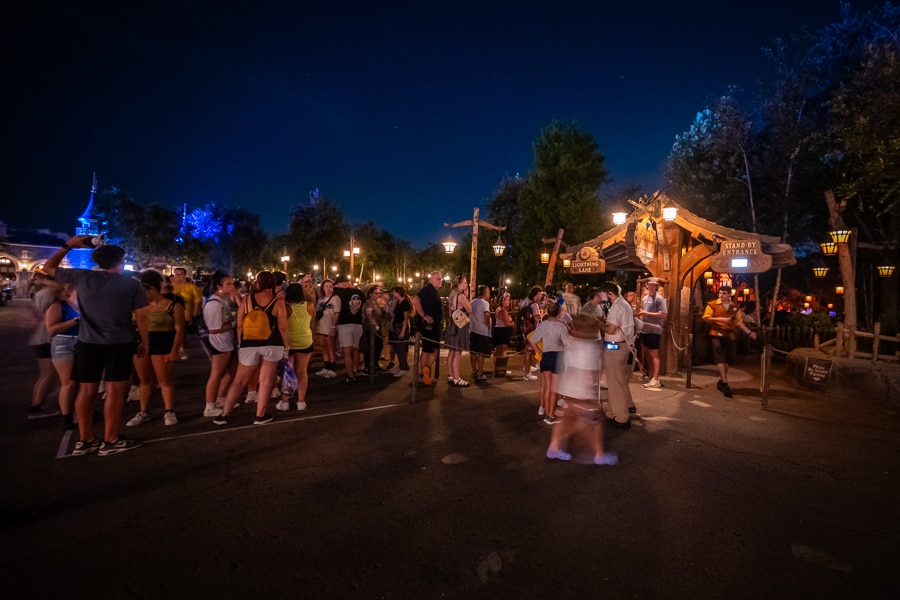
If additional assistance is required, guests can also obtain return times directly from a Cast Member at any Guest Relations or Guest Experience Team location (the blue umbrella stands, pictured above).
Can guests still pre-register for ride return times prior to their visit?
No. Only after you’ve registered and entered the theme park, can you request your first return time.
What can guests do during their virtual wait?
Guests utilizing DAS can enjoy many other experiences throughout Walt Disney World Resort during a DAS virtual wait, such as other rides, shows, entertainment, parades and character meet & greets. They can also take a rest in a break area, get something to eat or go shopping.

Does the Guest utilizing DAS have to be present to obtain a return time at a Guest Relations or Guest Experience Team location?
No. Any member of the DAS-eligible guest’s travel party may obtain a return time, but the guest registered for DAS must be present and experience the attraction with their party.
Does a Guest utilizing DAS have to ride the attraction at the exact return time listed?
No. DAS return times are not limited to a specific window and are valid until the park closes or an attraction closes for the day.
Can a Guest have more than one active DAS return time at one time?
No. A guest may only have one DAS return time at a time. Guests may obtain another return time for the same or a different attraction 10 minutes after they redeem their previous DAS selection.

Are these changes being made to sell more Lightning Lanes?
One goal is undoubtedly to push DAS abusers into purchasing Lightning Lanes, rather than scamming a way of getting them for free. Similar to how Disney+ has started a crackdown on password sharing. (I’d argue they’re not equivalent offenses on an ethical level, but both are breaking rules.)
However, the assumption that this will free up inventory to sell more Lightning Lanes is mostly wrong. Lightning Lane Multi-Pass selling out is fairly rare, so the ‘more inventory’ angle for selling more Lightning Lanes only applies to those dates.
For most days, the limiting factor on Lightning Lanes is demand–not supply. Lightning Lane Single Pass are a somewhat different story in that they’re more frequently supply-constrained, so this could have a bigger impact on sales of those.
Moreover, Lightning Lane utilization, both paid and via Disability Access Service, has decreased year over year. We’ve written a lot about the impact of the DAS changes on wait times at Walt Disney World. Most recently in Is Lightning Lane Multi Pass Still “Worth It” at Disney World?
So why did these changes actually happen?
The short answer is misuse and abuse.
Walt Disney World has publicly stated that DAS usage has tripled since 2019. Independent of that and prior to it, we received credible reports that the majority of Lightning Lane usage is actually DAS. Just to put that into perspective for people who might be inclined to believe that DAS is still a low number in the grand scheme of things or relative to Lightning Lanes as a whole. It’s not.
Does DAS give guests an advantage?
Yes. There’s been a lot of debate about this, but the answer is yes, statistically speaking.
This has come out during past litigation about the system, during which Walt Disney World indicated that guests using DAS experience 45% more attractions than those without DAS. On one of the days, the non-DAS testers waited in queues on average a total of 255 minutes, whereas the DAS testers only waited in line on average total of 107 minutes, or just under two hours.
Notably, this was during the FastPass+ era, back when even the non-DAS group would’ve had access to a version of line-skipping. If that test were redone today, the gap between standby guests and DAS guests would almost certainly be greater.
Some Walt Disney World fans assume this is not the case because DAS involves a virtual wait in line. But a virtual line allows guests to be in two places at once, whereas someone standing in a standby line is only in that line. Obviously, actual results are going to differ from person to person and many disabled guests will accomplish far less for a variety of reasons.
This is likely why some disabled guests justifiably believe DAS is simply leveling the playing field, rather than offering an advantage. The problem, again, likely lies with the abusers who are using DAS to maximize their efficiency and aren’t disabled in the first place.
Is there a way to prevent DAS guests from doing other attractions during their virtual wait?
Of course not. Walt Disney World is not going to scan park tickets at the standby entrances of attractions, restaurant and retail entrances (etc), to stop DAS guests from (effectively) being in two places at one time. That’s an unworkable (proposed) solution.
Why has DAS usage exploded?
This is the more complicated question and the reasons are undoubtedly multifaceted. For one thing, the prevalence of diagnosed developmental disabilities in children have increased significantly in the U.S. population as a whole since 2019. That would account for an increase, but not a tripling. Other contributing factors would include pent-up demand and reputational awareness, as Disney has a historically sterling track record in treating guests with disabilities well.
All of that pales in comparison to the main culprit, which is free FastPass+ going away and being replaced by paid Lightning Lanes. This new system and each subsequent price increase thereof created a perverse incentive for cheating the system. At the same time, it also expanded the audience for social media “hacks” about how to skip the lines for free. This, in turn, created its own vicious cycle. As this DAS abuse content proliferated, it also became normalized by virtue of its ubiquity.
Abuse has always existed with DAS. The difference is that in the past, it was kept quiet as people recognized what they were doing was immoral and they’d be judged for it. Now, that stigma is largely gone. Instead of feeling (rightfully) ashamed of abusing a system intended for disabled guests, people openly boasted about it.
I’m not typically one to get preachy or virtue signal, but I’ll put this in no uncertain terms: people should be ashamed of abusing DAS, as what they’re doing is disgusting–it makes me hope karma is a thing. While this is a problem of Disney’s own doing and predictable consequence of moving to paid Lightning Lanes (making them hardly blameless in the whole affair), that does not make abusing DAS okay.
As we’ve said countless times before, queueing is a zero-sum game. Abusing DAS is not a victimless crime or “sticking it to the man” or whatever dumb justification the abusers might use. There’s literally no good excuse for the abhorrent behavior. Not only is it unethical, but it also comes at the expense of fellow guests, most notably those in legitimate need of DAS who have to wait longer in the Lightning Lane or now might be caught in the crossfire of this crackdown.
Planning a Walt Disney World trip? Learn about hotels on our Walt Disney World Hotels Reviews page. For where to eat, read our Walt Disney World Restaurant Reviews. To save money on tickets or determine which type to buy, read our Tips for Saving Money on Walt Disney World Tickets post. Our What to Pack for Disney Trips post takes a unique look at clever items to take. For what to do and when to do it, our Walt Disney World Ride Guides will help. For comprehensive advice, the best place to start is our Walt Disney World Trip Planning Guide for everything you need to know!
YOUR THOUGHTS
Thoughts on Walt Disney World overhauling Disability Access Service to reduce abuse and misuse? Do you think the new partnership with Inspire Health Alliance and other changes will better ensure DAS is only going to those who truly need it? If you’ve used Disability Access Service at Walt Disney World, what do you think of the experience? Any questions not answered by this FAQ?





You mentioned in your article ..” In an update as of Late 2024, Universal is no longer requiring the controversial IBCCES to qualify for the Attractions Assistance Pass. This is undoubtedly due to the Six Flags litigation, and the company’s concern about potential legal exposure.”
However, on Universal Website it states on their Accessibility Page: “Guests requesting an attraction queue accommodation may obtain the IBCCES Individual Accessibility Card (IAC) by registering at accessibilitycard.org within 30 days of their visit to the park and at least 48 hours before their visit. The IAC registration consists of an online application that includes uploading necessary documentation. IBCCES does not require or ask Guests to disclose their medical or psychological diagnosis or condition.” This implies it is still required. It doesn’t state you can still apply or even elude that you can still apply without IBCCES. Am I missing something?
As discussed further in Tom’s other post linked above, Universal added a same day component that doesn’t require pre-registration with IBCCES, but kept IBCCES as an option. From Universal’s Accessibility Information website:
“Guests who are unable to register in advance may contact Universal Orlando’s Guest Services team at (407) 224-4233 or visit any Guest Services location at the theme parks for additional information.”
As the mom of a teen with autism who has used DAS in the past, greatly appreciate this updated set of FAQs! We’re heading down to WDW next month, and while we’ll still pre-register, I’m not sure how helpful this version will be for our family. Our DAS user avoids most attractions but occasionally wants to visit Toy Story Land at DHS or meet a character. We’ll probably purchase Lightning Lanes in advance to create a few of those opportunities.
As a health data privacy attorney, also can’t help but comment on the HIPAA piece! Your commentary rings true. I’d add that, while HIPAA definitely doesn’t constrain whether/how individuals choose to share their health information, there are so many new state consumer health privacy laws coming online, that it is still likely prudent for Disney to avoid receiving this kind of information from guests.
All this is meant to accomplish is to have more people “PAY” for lightening lane or whatever new maneuver they try next. I never “cut” ahead of anyone. I received a return or time to get in line. That doesn’t constitute cutting or getting ahead of anyone. So the result was on our last trip I was so stressed that I got Into arguments with anyone around me. It could have easily escalated and someone could have gotten hurt, but let’s keep this idiotic new stringent restrictions in place because it makes such sense to those being denied what they need to experience the happiest place on earth.
Sorry lol. I am a nut shell but I meant to say in a nut shell.!!! Also off topic Tom, we went to Topolinos for the character breakfast and it was awesome!!!! 100 percent worth it . Excellent dining area, excellent food and excellent character interaction . Thank you for all your advice !
We are currently in disneyworld utilizing the DAS. Keep in mind there are no longer 3 advance DAS selections when you get approved for your DAS. You have to be in the park first to start using DAS. I strongly recommend purchasing the multi pass in advance and selecting 3 attractions in advance especially if you’re staying at a Disney resort. If time constraints are a part of your loved ones disability , just using DAS is really not too helpful in MK anyway. You will get minimal ability to use the attractions. Also keep in mind after a certain time the multi pass also has limited ability to be used as many attractions are unavailable. So I’m a nut shell if you can’t tolerate long park days and have DAS, you should also get the multi pass
Tom, we appreciate your insight on this subject. We will be attending WDW next month for the first time under the new DAS rules. Our adult daughter has qualified for DAS due to ID and Autism, etc. We visit twice a year from the Midwest. Her park time is usually limited to only a few hours during the day to include meals and a few rides and character greetings. We purchase lighting lane access for rides that she does not desire to ride, so we are not “line skippers.” Our only concern is Disney’s removal of lighting lanes for the meet and greets. She loves hugging the characters, and we’re concerned that she may not have much interaction with them as in the past. Is there any hope of Disney accommodating the DAS for characters? Thank you.
Mike…. We are currently at Disneyworld. We have DAS for our adult daughter. We also purchased the multi pass to try to get as much in as possible. Our daughter like what you are describing your daughter is like only can tolerate a few hours as well. We did use the lightening lane to go to the town square and have a meet and greet with Mickey. I hope this helps. Just remember too that you have to wait 10 minutes after you swipe your DAS to use another one. We are here at a quieter time so it all worked out well. Good luck and have a splendid trip.
Tom, thank you for the pull-no-punches condemnation of DAs abusers. I agree wholeheartedly, and I appreciate reading that view articulated so clearly and unequivocally.
I am glad they revamped it. It was being abused and I would see folks holding the line while others came up as some would say cut the line so they could go from one attraction to another. Others would lie as I heard one say they can’t ask you because it is a HIPPA violation. When our daughter was first diagnosed with Autism in 2006 we were able to obtain a GAC card. We even had our diagnosis with us but they were not allowed to look at it. We did that to show proof and that we were not trying to game the system. Just looking for a better way for our family to enjoy Disney. Fast forward from 2004 to 2024 and we now have DAS. It is a due process but was needed as again so many abused it and that made it difficult for those who truly needed it. As of this day I still do not have a issue if needed to provide medical documentation. No different than when I apply for services I have to show medical proof that my daughter is disabled.
@sherri – you are very close-minded many people make specific modifications to what they do. We go early for 2-3 hours then leave and IF we can get everyone out the door again we go back. We know the places in the park to avoid crowds so its EXTREMELY unfair that you think someone cant do it. I’d wager you have no disabled relative as no one who actually has a child with a disability would ever say something like that. Shame on you.
I see several pieces of misinformation in your column i would recheck your information.
1. While Genie itself selling out is rare, it is fairly common to purchase it and not be able to select lightning lanes.
2. Because you were denied and offered genie does not make you a scammer.
3. Genie is not equivalent for some people especially autistic kids who prefer to ride the same rides over and over.
4. HIPPA applies only to health care organizations specifically – Disney is not a healthcare organization.
5. Disney steered away from using universals system so that they could sell more genies, and its actually easier if you are legitimately disabled to get medical documentation. They also did not want an outside more qualified organization making them take people they dont want. They are at greater liability for diagnosing patients themselves.
6. IBCCES is very simple to use and simple to set up. It uses actual doctors who see the patients and not psychology professionals that may or may not have the knowledge needed to work with these conditions.
7. If karma is a thing, then it should go after disney. Plenty of people are getting denied with the very conditions that disney claims the pass is for.
Sorry, your comment did not age well and highlights the complexity of this topic. There is not a simple solution out there and until the ADA is updated to specify how lines for flight boarding or theme parks should be handled, companies are left trying to balance of interests of all customers.
Your final note-
7. If karma is a thing, then it should go after disney. Plenty of people are getting denied with the very conditions that disney claims the pass is for.
This totally dismisses Disney’s track record of trying to do the right thing and be inclusive. WDW and DL’s generosity with DAS was mostly by choice from the start – not by any mandate. You’re wishing ill on a company for what exactly? Even in its most generous state shut certain disabilities out, like mobility. And the reason is because alternatives existed, just as existed/exists for deaf or blind folks at the parks as well. Having every issue covered under a line shortening accessibility service became unsustainable. The amount of people and their parties it covered became dysfunctional. The current strategy is trying to alleviate some of the strain high DAS usage had on park operations by addressing certain common needs with alternative accommodations *where feasible*. Are they having growing pains? Sure but to depict this issue like there’s some simple ‘right answer’ is disingenuous.
I realize some people have extra struggles in life but DAS was never intended to compensate for those disparities. It wasn’t based on severity of overall needs it was based on who could be helped with issues on line that other accommodations did not yet cover. Through the years Disney has continued expanding those ‘other’ accommodations, putting ramps in, elevators, offering sensory cool down areas, having deaf/blind devices available on deposit, etc. And more recently began adding back park seating, more shade, allowing use of cane chairs in parks, etc. They were all added to help people and common issues.
There’s a long list of things that prevents people from efficiently navigating the parks. Things like babies, elderly, slipped discs, bum knees, migraines, funds, sensory issues, executive functioning, on and on… because if a line is drawn where all these people are invited to DAS then there will be very few without it. At some point a system like that breaks and that already started. The more people and their parties that used DAS, the more people with needs struggled, making them more inclined to request DAS as well. It mushroomed. Sure Disney want’s to sell LL. They also need to protect guest experience across the board because they sell that too.
@Nichole… Wow! I would never imagine a person who has anxiety flying and has a prescription for meds would even get DAS. Not only that , how in the world would a DAS legit user run all over the park and do all these rides like you’re describing?
Sherri- these aren’t users for which, I believe, DAS is intended. As I said, in my made up examples, these are people who are intentionally or unintentionally abusing the system (people who qualify under the old rules due to actual medical issues, but don’t really need DAS to visit the parks or people who know the correct things to say during the virtual interview (it’s pretty well known there is guidance out there on the various social media outlets, in particular regarding IBS and anxiety, about what to say during the interview to be able to secure DAS). I read somewhere, maybe on here, 60% of LL is DAS. It’s pretty obvious, to me, if that many people are using the service, there is significant abuse going on. I will say, I personally know a group of people who have gotten DAS in the past using anxiety as the reason (who don’t actually have anxiety issues that arise at DW, but do have anxiety in other areas of life) who are visiting this summer, who will not be apply for DAS with the new changes. So I do think, for those that want to follow the rules, these new changes are going to make a difference. For those that could care less about rules or don’t care about their actions hurting others…the true cheaters, they will still find a way. Unless Disney actually starts weeding the true abusers out and punishing them, ie banning them from the parks, which I doubt will ever happen.
@nichole…yes I’m completely agreeing with you. A truly disabled person would never be able to run around the park as in your examples. I am surprised Disney would even give DAS to someone like you described. My husband and I bring our 37 yr old multiply handicapped daughter to Disney every year. We would be lucky to get 2-3 rides in. We also don’t stay at the parks long at all. We mostly enjoy the ambiance of the parks. It’s pathetic anyone would take advantage of this. Even with DAS our waits are long and therefore we don’t do too much of them. It’s sad that people work the system like you describe. Previously when they had the 3 free fast passes for everyone that was all we needed as we don’t do much in a given day.
the petitions have already started circulating, claiming disney is discriminating against the disabled. couldn’t be further from the truth- they are trying to help those who need it most by removing those scamming the system. i maintain, those screaming the loudest over this are those who have found a way to scam and are going to lose their cheating ways. anyone who legitimately needs this will have little to no problem following new rules. they may have questions certainly, but that isn’t the same as complaining.
You are so wrong. Many people with significant conditions such as autism are being denied by people not qualified to decide if they are disabled or not. Its very sad. Current trends are super young children regardless of diagnosis are approved 3 to 1 with others. They are simply giving it to those THEY think will be most disruptive. They literally are telling people they think people grow out of autism – you dont you just become better able to deal. I have several truly autistic kids with significant behaviors that will affect everyone in a mile plus radius enjoyment of the trip. If we are denied, I fully intend to make sure that we share that wealthy with as many people as possible to prove a point.
I know of 2 families who both instructed my niece to say she has anxiety to use DAS because they didn’t require proof. It’s those people who do ruin it. However, reading all of the comments on social media these last few weeks, there a lot of people who used a diagnosis as a reason not to wait in line. Many of those were potential problems that may occur. While they are valid, they could occur regardless, whether you are in line for popcorn, sitting at a restaurant, etc. So I think allowing specific accommodations makes the most sense, as opposed to simply handing these out. If you have a genuine medical condition, they are still willing to help you out.
It isn’t my intent to sound heartless, but the comments saying “I can’t do crowds” sounds so silly since theme parks are some of the most crowded places to be.
Amy, perhaps this will help you understand. It’s not necessarily a crowd that is a problem, but a crowd that you can’t get out of when the need arises, such as a long standby line, especially when Cast Members say “fill in all available space” and you’re packed in like a can of sardines. I don’t do roller coasters, but there are plenty of other rides that have very long twisted lines. Been there, done that, in a wheelchair, with other (documented) medical needs that also flared up. I was ready to give up going to Disney until a Cast Member suggested that I would benefit from DAS. But unless someone truly needs DAS, and has benefited from it in the past, I’m sure it’s hard to understand why we are upset over the changes.
They show go to universals system honestly – then only the truly disabled will make it through. Now plenty of fakers have already cheated this system and many more legitimately disabled people with the conditions that disney claims this pass is for have been denied.
My family member has MS. They have qualified for DAS in the past. They do not need a wheelchair or scooter unless they are experiencing numbness in their extremities. The issue for them is a rise in body temperature – even small can bring on MS symptoms very quickly that could require iv steroids to reverse that must be administered as soon as possible and that we dont have quick access to. We try to go in colder months like our recent trip in January and head back to the resort for the hot part of the day or take breaks in air conditioning. Still DAS has helped them be able to do rides with long outdoor queues that they wouldn’t otherwise like Slinky Dog etc. with the changes it sounds like they will not qualify. Is that correct? I know no one knows for sure so please be kind. I’m just worried what our trips will look like in the future if they have to sit out and miss so much. Florida weather is unpredictable and you can expect a cool trip in January and then it is quite warm.
I could be wrong here, but my *guess* would be that Disney would still accommodate those needs but not with DAS specifically. In your example, there is someone who can’t wait in the heat. However, they should still be able to stand in the air conditioned queues of rides like Soarin’ and Test Track and such. So, they still need some accommodations but not necessarily DAS. My guess would be that Disney would allow them to pre-book a couple LLs each day to be able to skip the queues for some of the attractions that involve waiting out in the sun, like Slinky Dog Dash. Again, that’s just a guess, but I would think they’d be accommodated with something like that–prebooking some LLs–instead of getting DAS.
They will make your relative wait in a place of their choosing and have them bring someone with to stand in the line for them. You will be required to have a phone and be in contact with your person waiting. Then they are to call their person and they will have to find a cm and they will bring them to their party.
Hi Tom,
I haven’t noticed you mention this, but what is the difference between abusing DAS and buying Genie+/LL? Either way, you are cutting the line ahead of others even though you are able bodied enough to wait. Why is that Genie+ user allowed to get ahead of you? Because they can afford to bribe Disney, not because they have a disability. Even if all the DAS abusers turn from their evil ways and pay for Genie+ instead, the wait time will be just as long, wouldn’t it? The only difference is, Disney will get paid. Therefore, it is just as unethical to purchase Genie+/LL as to fake DAS. I am speaking as someone who purchases Genie+ but feels guilty about it. Just because I paid for it doesn’t mean it isn’t cheating. The fastpass was different, where everybody gets ahead sometimes and wait other times.
So what this means to me is, when cutting DAS down to developmental disabilities doesn’t work (people can just fake that), Disney will get rid of DAS altogether.
Alex
My husband has had 2 heart attacks. Although cleared by his cardiologists to go, he is limited on which rides he can do. He is unable to stand in long lines without getting extremely tired and also is on heavy diuretics. Needless to say bathrooms are needed very quickly when urges hit. Would he qualify for the DAS pass. We have 2 trips but the response may change our plans.
I was just at Disney this past August. I use a scooter and have a doctor’s note saying I can’t stand for longer than 10 min. The cast member I spoke with told me they do not provide DAS for mobility issues. They were not very nice about it and did not want to hear any other excuses.
Hi Tom, My question is related to the part where it’s noted that DAS use through LL is higher then paid LL as well as standby lines wait longer then DAS lines . When the DAS person gets a return time based in the standby time is it different then the people in the standby line? Not only do DAS users have to wait the standby time they then go through the LL as well. It seems that DAs overall would be longer. Also I know that with our daughter we don’t go on a lot of the more popular rides as she is unable to tolerate them. So is it possible that DAS appear to get more rides in then standby due to utilizing less popular rides with shorter wait times? Curious as to your thoughts. I will also be impressed if you understand what I’m even trying to say lol!
Sherri, I think for the savy DAS user, the intentional and/or unwitting abusers, they are not requesting return times and then sitting out the wait in some air conditioned venue, as many believe. An example, a person has a prescription for anxiety meds due to extreme anxiety when flying, therefore, the thought process being “I have anxiety, I have a doctors note/prescription, I can get DAS.” Said person gets approved and then uses the system to their advantage. So say they request a return time for Minetrain, which is 40 min, they see Pooh has a wait time of 20 min, they hop on that….walk off that ride and see small world has a 15 min wait time, they go get in line for that as well. After that they tap into Mine Train and while in line they request a DAS for Jungle Cruise with a 50min return time, on their way over to that they see Pirates has a 30 minute stand by, they get in that line as well. The difference in this park goer is with Genie+ while you are waiting out these wait times for requested LL rides. The clock is continuing to move on other rides. There is no endless supply of “relative immediate” return times. They may tap into Minetrain, like the guest above, and go to request Jungle Cruise via genie+ LL and Jungle Cruise LL’s are sold out for the day, or the LL is for 5 hours into the future. These are all examples, that I’m envisioning, from what I’ve read and also from what I’ve experience going to the parks with a relative who has a mild disability. Again, these are examples of people who are intentional or accidental abusers who probably shouldn’t have been given the pass in the first place. You can see how a DAS user, who is savy, can keep hopping from ride to ride, as the return times are always available with DAS and usually immediate (relative to Genie+ in which the clock keeps moving forward based on how many people request LL). You can also see how these same users are clogging up lines all over the park, and probably making it hard for Disney to plan for the day and anticipate where they will be. This is all just my speculating, obviously.
I understand what you’re trying to say, and I think you’re looking at this from the perspective of a legitimate user of DAS who actually uses the system as it’s intended for disabled guests. It’s no surprise to me that you’d do fewer rides per day given everything.
But the abusers can use DAS to effectively be in two places at once (waiting in the virtual DAS queue while being in a real physical queue). That’s largely why Disney’s actual data shows DAS users doing more attractions per day.
The problem, as always, comes from the abusers and not the legitimate users of the system. The latter are not putting too much stress on it, at least not for the most part.
One thing to also remember is that Disney has guest files on everyone. They have a decent idea of the extent to which abuse is occurring.
Tom, thanks for this information. We wouldn’t be as productive with our Disney trips if it weren’t for your hard work keeping everyone posted . We appreciate all your efforts. Hoping your time at Disney is even more fun filled with baby Megatron!!!
I would just like to humbly point out that not everyone who ‘stacks’ rides using both systems is necessarily *abusing* DAS. Not all autistic kiddos suffer from sensory overwhelm, many are sensory SEEKERS, and to keep them moving through the parks at the pace you mentioned IS what makes it doable for them. It is also common that the centrifugal movement of many of the rides provides sensory regulation to an overwhelmed nervous system (as in when autistic kiddos spin or swing to regulate) and so getting them onto another ride as quickly as possible is what helps to prevent meltdown. For my son, who has an alphabet soup of diagnoses, our worst nightmare was having to support his regulation when waiting/standing in one place – so waiting in a quiet, air-conditioned room would not be accommodation for him. I agree that there is an advantage as to how many rides a person can get onto in a day using both systems, and that the advantage most definitely leads to rampant abuse of the system… but again, I just wanted to gently highlight that as a spectrum disorder, severe autism presents in a variety of ways and so the way people use the DAS system will vary as well. Thanks for reading.
@jenivere…. Absolutely everyone has different needs. What works for some may not for others. Hope your Disney adventures are fun filled
The saddest thing I have read here are the ableist commenters who basically told every person with a disability,whether mental, physical or developmental, that if they are even mildly inconveniencing someone ablebodied, they should stay home and do nothing because theme parks, etc. are only for the physically perfect.
Wake the blazes up. That disabled person can be you if you are unkucky. You could develop diabetes and need to.hydrate more than a normal person, which means more bathroom breaks. You could end up.Parkinson’s or MS and need a,wheelchair. You could be old like me and limited by congenital duplicating ankles which can turn easily especially if I have to.a,lot of walking and standing–oh and born with a scoliosis, so chronic pain. I am doing g PT, but these issues are congenital so even with PT, they will act up as they did last night.
Or you could just follow the Golden Rule and do unto others as you would have them do to.you. Because one of these days, UT will be YOU inconveniencing a,stranger.
I am in fb disney das groups and people are already changing their personal issues and looking to get around the changes coming. I will give you a few examples of posts I have personally seen: I have seen people post that they have gotten das in the past not for their mobility need (wheelchair user) but because of their additional ibs diagnosis but now say they also have autism but never applied under that diagnosis before because they just applied under their IBS. You can see how the abuse has manifested throughout time: legit wheelchair user used to get front of line access but when they made queues accessible and mobility issues no longer qualified for das they developed “ibs” too, now that bathroom issues will not qualify for das they casually mention they have autism too. Another person posted how they have always used das for their son with autism and had party of 6 on their das, but now that the limit will be 4 their 82 year old grandpa will apply and should qualify because he has a developmental disability (her exact words) of adhd/anxiety and if he doesn’t qualify they have another kid who they could apply for… Seriously, 82 year old grandpa has adhd which she says qualifies him as having a developmental disability. People are justifying having more people apply to skirt the new das party limits. I truly hope Disney has cm’s in these groups to be the eye and ears. The changes haven’t even gone into effect and already people are scamming the system.
@kari, I don’t use social media so what your saying is stuff I don’t see. That’s all wild that people go to such great lengths to be disabled. DAS isn’t even that great of a thing to have. You still have longer times waiting. I don’t understand why people think it’s so great
I have been to the parks with my nephew who has mild ADHD. DAS is a game changer in terms of being able to accomplish more in less time. Now, I’m speaking of a groups whose DAS holder has a MILD disability. There was no need for our group to wake up at 7am to do the mad dash to secure genie+ and start booking LL. There is no need to pay for ILL as those rides are included with DAS. There is no limitations on how many times you can ride a ride (genie+ allows only 1 LL request per ride), and yes, you can actually ride other rides via standby while waiting on DAS return time and also DAS doesn’t run out of ride requests (where as Genie+ can run out of LL). So, to those, who think DAS users are not accomplishing more than Genie+ users or don’t have a different experience, it’s just not true. Again, my experience was when visiting with a DAS holder who had a mild disability. I’m not saying ALL DAS users have this same experience. I’ve been to the parks using both. Genie+ is a stressful way to plan and enjoy a vacation (and people are paying for this service), DAS, as a way to request rides, etc, is the opposite. My hunch, again, MY hunch, if 60% of the LL taps are DAS holders, is that a lot of those ppl are ppl with disabilities that qualify (ie anxiety, etc) yet don’t necessarily NEED DAS to actually be able to do the parks. However, they are saying, I qualify, therefore I’ll get it, I’m not breaking any rules, and so on. Unfortunately, the parks have gotten more convoluted for everyone since Genie+ was introduced and it takes a lot of planning and researching to “get your moneys” worth. However, there are still ways to do the parks without needing DAS and enjoying walk on rides, it just takes more work and yes, more money (this is Disney) (some examples: arriving late to a park and spending the morning requesting LL so your afternoon/evening is “stacked”, staying deluxe and taking advantage of extended evening hours and forgoing a day ticket and doing after hours instead). It seems the new return to line feature is long over due (let’s remember people peeing in line when FOP opened as they were afraid to get out of the 4 hours wait) and will definitely help cut down on DAS passes given to those individuals that “may” have a situation while in line (IBS, anxiety, etc).